Short Communication - (2025) Volume 16, Issue 3
Received: 02-Jun-2025, Manuscript No. jfr-26-184107;
Editor assigned: 04-Jun-2025, Pre QC No. P-184107;
Reviewed: 18-Jun-2025, QC No. Q-184107;
Revised: 23-Jun-2025, Manuscript No. R-184107;
Published:
30-Jun-2025
, DOI: 10.37421/2157-7145.2025.16.668
Citation: Nguyen, Thomas. ”Spectroscopy: Forensic Science’s
Essential Analytical Tool.” J Forensic Res 16 (2025):668.
Copyright: © 2025 Nguyen T. This is an open-access article distributed under the terms of the Creative Commons Attribution License, which permits unrestricted use,
distribution and reproduction in any medium, provided the original author and source are credited.
Spectroscopy, a versatile analytical technique, plays a pivotal role in forensic investigations by enabling the identification and characterization of a wide array of evidence. Techniques like infrared (IR) spectroscopy, Raman spectroscopy, and mass spectrometry are crucial for analyzing trace evidence such as fibers, paints, drugs, and explosives. UV-Vis spectroscopy finds application in the analysis of inks and biological fluids, while atomic absorption and emission spectroscopy are used for elemental analysis in gunshot residue and metal fragments. The ability of these methods to provide specific molecular and elemental fingerprints makes them indispensable for linking suspects to crime scenes and establishing the nature of seized substances. [1]
Infrared (IR) spectroscopy, particularly Fourier Transform Infrared (FTIR) spectroscopy, is a cornerstone in forensic analysis for identifying polymers, inks, and fibers. Its ability to provide a unique molecular fingerprint allows for the direct comparison of unknown samples with known standards. Advancements in portable FTIR instruments are expanding its utility for on-site analysis, reducing the need to transport sensitive evidence to the laboratory and accelerating preliminary investigations. This technique is fundamental for differentiating between visually similar materials that have distinct chemical compositions. [2] Raman spectroscopy offers a complementary approach to IR, excelling in the analysis of inorganic materials, pigments, and crystalline substances. Its non-destructive nature and high spatial resolution make it ideal for examining small or precious samples. SERS (Surface-Enhanced Raman Spectroscopy) significantly enhances sensitivity, allowing for the detection of trace amounts of analytes. In forensics, Raman spectroscopy is frequently employed for identifying explosives, narcotics, and counterfeit goods, providing rapid and reliable identification with minimal sample preparation. [3] Mass spectrometry (MS), often coupled with chromatographic separation techniques like GC-MS and LC-MS, provides powerful capabilities for identifying and quantifying volatile and non-volatile organic compounds. In forensics, it is essential for drug analysis, toxicology, arson investigation (identifying accelerants), and explosive residue analysis. The high sensitivity and specificity of MS allow for the detection of minute quantities of substances, aiding in the establishment of crucial links in criminal cases. Tandem MS (MS/MS) further enhances specificity for complex sample matrices. [4] UV-Visible (UV-Vis) spectroscopy is a fundamental tool in forensic laboratories for the analysis of colored substances, including inks, dyes, and biological fluids. Its application in ink analysis for document examination helps to differentiate between various types of pens and paper. In the analysis of biological stains, UV-Vis spectroscopy can aid in preliminary identification. While less specific than IR or MS, it provides rapid, cost-effective screening and supports further confirmatory testing. [5] Atomic Spectroscopy, encompassing techniques like Atomic Absorption Spectroscopy (AAS) and Inductively Coupled Plasma Atomic Emission Spectrometry (ICP-AES), is vital for elemental analysis. Its primary forensic application is the examination of gunshot residue (GSR), where the characteristic elements (lead, barium, antimony) can link a suspect to a firearm. It's also used for analyzing metallic fragments, paint, and glass, providing elemental profiles that can be compared to known sources. The sensitivity and ability to detect trace elements are key to its forensic value. [6] Nuclear Magnetic Resonance (NMR) spectroscopy, while less common in routine forensic casework due to sample requirements and complexity, offers unparalleled structural elucidation capabilities. It is particularly valuable for complex organic molecules where other techniques may be insufficient. Applications include confirming the identity of new psychoactive substances (NPS) and characterizing complex mixtures. Advancements in micro-NMR and solid-state NMR are increasing its potential for forensic applications with limited sample sizes. [7] Hyperspectral imaging (HSI), a fusion of spectroscopy and imaging, provides spatial and spectral information simultaneously. This allows for the identification and mapping of various materials within a scene or on an object. In forensics, HSI can be used for the detection of latent fingerprints, analysis of inks and dyes on documents, and identification of trace evidence such as fibers and soils. Its ability to cover large areas quickly and non-destructively makes it a powerful investigative tool. [8] The application of LIBS (Laser-Induced Breakdown Spectroscopy) in forensics is gaining traction due to its rapid, elemental analysis capabilities with minimal sample preparation. LIBS can be used to analyze a variety of materials, including glass fragments, paint chips, and soils, by ablating them with a laser and analyzing the emitted light. Its portability and potential for remote sensing also make it suitable for field investigations, such as the analysis of gunshot residue and the identification of inorganic materials at a crime scene. [9] Portable and field-deployable spectroscopic instruments are revolutionizing forensic investigations by enabling rapid, on-site analysis. Techniques such as handheld Raman and FTIR spectrometers allow first responders and investigators to quickly screen evidence like narcotics, explosives, and chemicals at a crime scene. This immediate feedback can guide further investigation, prioritize evidence collection, and enhance officer safety. The development of miniaturized, user-friendly devices is critical for their widespread adoption in the field. [10]Spectroscopy encompasses a diverse range of analytical techniques that are fundamental to modern forensic science, providing the ability to identify and characterize an extensive variety of evidence. These methods are indispensable for linking suspects to crime scenes and determining the precise nature of seized substances by offering unique molecular and elemental fingerprints. The broad applicability of spectroscopy ensures its continued importance in achieving justice. [1]
Fourier Transform Infrared (FTIR) spectroscopy stands as a critical tool in forensic analysis, particularly for the identification of polymers, inks, and fibers. Its capacity to generate a distinct molecular fingerprint enables direct comparisons between unknown evidence and established standards. Emerging portable FTIR devices are enhancing its utility for immediate on-site assessments, thereby reducing the necessity of transporting delicate evidence and expediting initial investigations. This technique is paramount for distinguishing between materials that may appear similar visually but possess different chemical compositions. [2] Raman spectroscopy functions as a valuable complement to IR spectroscopy, demonstrating particular proficiency in the analysis of inorganic substances, pigments, and crystalline materials. Its non-destructive characteristic and high spatial resolution make it exceptionally well-suited for the examination of minute or valuable samples. Furthermore, Surface-Enhanced Raman Spectroscopy (SERS) substantially amplifies sensitivity, facilitating the detection of even trace quantities of analytes. In forensic contexts, Raman spectroscopy is routinely employed for the identification of explosives, narcotics, and counterfeit items, delivering swift and reliable results with minimal sample preparation. [3] Mass spectrometry (MS), frequently integrated with chromatographic separation methods such as GC-MS and LC-MS, offers potent capabilities for the identification and quantification of both volatile and non-volatile organic compounds. Within forensic science, MS is essential for drug analysis, toxicology, arson investigations through the identification of accelerants, and the analysis of explosive residues. The high sensitivity and specificity of MS allow for the detection of minuscule amounts of substances, which is critical for establishing vital connections in criminal cases. The use of tandem MS (MS/MS) further refines specificity when dealing with complex sample matrices. [4] UV-Visible (UV-Vis) spectroscopy serves as a foundational technique in forensic laboratories for the analysis of colored materials, including inks, dyes, and biological fluids. Its application in ink analysis is particularly relevant for document examination, where it aids in distinguishing between different types of pens and papers. In the preliminary identification of biological stains, UV-Vis spectroscopy can be beneficial. While it may not possess the same level of specificity as IR or MS, it provides a rapid and cost-effective screening method that supports subsequent confirmatory testing. [5] Atomic spectroscopy, which includes techniques such as Atomic Absorption Spectroscopy (AAS) and Inductively Coupled Plasma Atomic Emission Spectrometry (ICP-AES), plays a crucial role in elemental analysis. A primary forensic application involves the examination of gunshot residue (GSR), where the presence of characteristic elements like lead, barium, and antimony can directly link a suspect to a firearm. This technique is also utilized for the analysis of metallic fragments, paint, and glass, yielding elemental profiles that can be matched against known sources. The inherent sensitivity and ability to detect trace elements are key contributors to its forensic value. [6] While Nuclear Magnetic Resonance (NMR) spectroscopy is not as commonly employed in routine forensic casework due to its specific sample requirements and inherent complexity, it offers unparalleled capabilities for structural elucidation. It proves exceptionally valuable for complex organic molecules that may not be adequately characterized by other methods. Its applications extend to confirming the identity of novel psychoactive substances (NPS) and detailing the composition of complex mixtures. Ongoing advancements in micro-NMR and solid-state NMR technologies are progressively enhancing its potential for forensic analyses involving limited sample volumes. [7] Hyperspectral imaging (HSI) represents a convergence of spectroscopy and imaging, furnishing simultaneous spatial and spectral data. This integrated approach enables the identification and mapping of diverse materials present within a scene or on an object. In forensic contexts, HSI is applicable to the detection of latent fingerprints, the analysis of inks and dyes on documents, and the identification of trace evidence such as fibers and soils. Its capacity to swiftly survey extensive areas non-destructively positions it as a potent investigative instrument. [8] Laser-Induced Breakdown Spectroscopy (LIBS) is increasingly recognized for its utility in forensic science, owing to its rapid elemental analysis capabilities that necessitate minimal sample preparation. LIBS can be applied to a broad spectrum of materials, including glass fragments, paint chips, and soils, by ablating them with a laser and analyzing the resulting emitted light. Its portability and potential for remote sensing also make it suitable for field investigations, such as the analysis of gunshot residue and the identification of inorganic materials at a crime scene. [9] The integration of portable and field-deployable spectroscopic instruments is significantly transforming forensic investigations by facilitating rapid, on-site analyses. Handheld Raman and FTIR spectrometers, for instance, empower first responders and investigators to promptly screen evidence such as narcotics, explosives, and chemicals directly at a crime scene. This immediate feedback loop can effectively guide subsequent investigative steps, aid in prioritizing evidence collection, and enhance the safety of personnel. The continuous development of miniaturized and user-friendly devices is crucial for their broader integration into field operations. [10]Spectroscopy is a vital analytical technique in forensic science, used for identifying and characterizing various types of evidence including fibers, paints, drugs, and explosives. Techniques like FTIR, Raman, and Mass Spectrometry are crucial for detailed analysis. UV-Vis spectroscopy is applied to inks and biological fluids, while atomic spectroscopy focuses on elemental analysis, particularly for gunshot residue and metal fragments. NMR spectroscopy offers advanced structural elucidation for complex molecules, and hyperspectral imaging combines spatial and spectral data for material mapping. Laser-Induced Breakdown Spectroscopy (LIBS) provides rapid elemental analysis. The increasing availability of portable spectroscopic instruments allows for on-site analysis, improving efficiency and officer safety in forensic investigations.
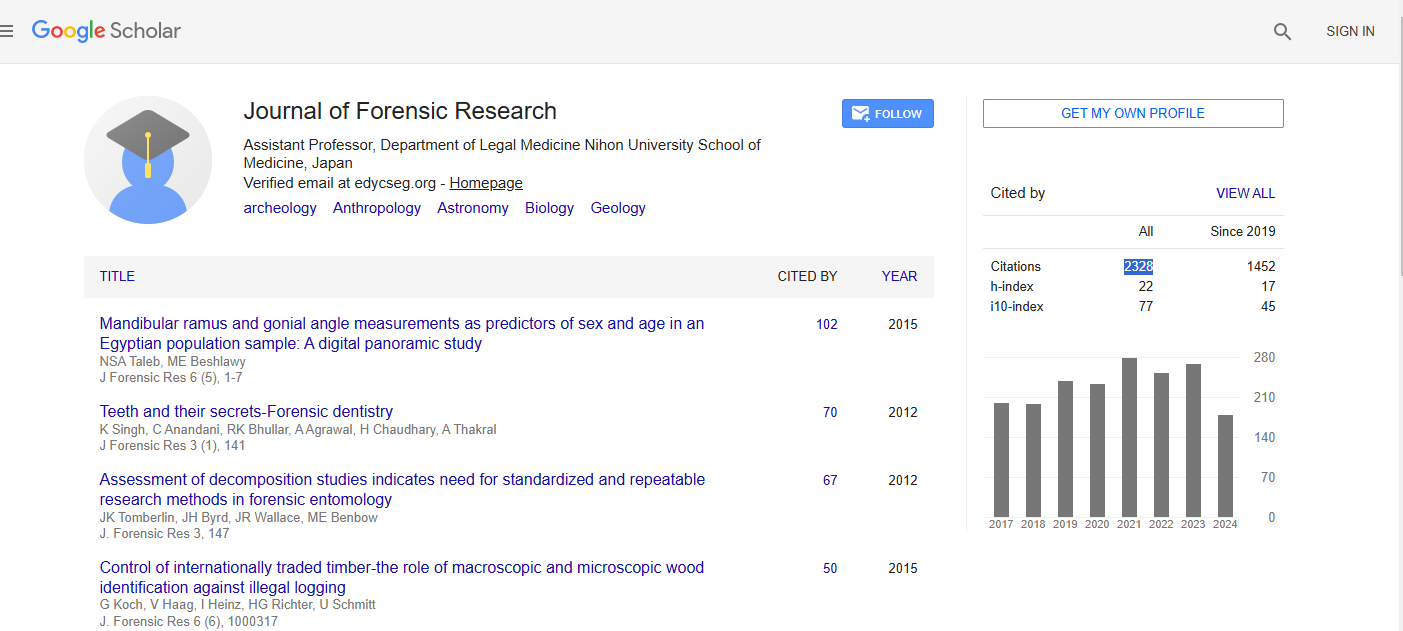
Journal of Forensic Research received 2328 citations as per Google Scholar report