Short Communication - (2025) Volume 9, Issue 6
Received: 01-Nov-2025, Manuscript No. fsb-26-189978;
Editor assigned: 03-Nov-2025, Pre QC No. P-189978;
Reviewed: 17-Nov-2025, QC No. Q-189978;
Revised: 24-Nov-2025, Manuscript No. R-189978;
Published:
29-Nov-2025
, DOI: 10.37421/2577-0543.2025.9.264
Citation: Kim, Daniel. ”Smart Hydrogels for Targeted Drug Delivery.” J. Formul. Sci. Bioavailability 09 (2025):264.
Copyright: © 2025 Kim D. This is an open-access article distributed under the terms of the Creative Commons Attribution License, which permits unrestricted use, distribution and reproduction in any medium, provided the original author and source are credited.
Smart hydrogels represent a significant advancement in the field of controlled and targeted drug delivery, offering sophisticated mechanisms to respond to specific internal or external stimuli. These innovative materials are engineered to release therapeutic agents with remarkable precision, both in terms of location and rate, thereby maximizing therapeutic efficacy while minimizing undesirable side effects [1].
Recent research has focused on the development of stimuli-responsive hydrogels that react to a variety of triggers. These include changes in pH, temperature, and the presence of specific enzymes, as well as externally manipulated systems such as those responsive to magnetic fields or ultrasound, facilitating highly localized drug delivery [1].
The design principles and synthesis strategies for creating these smart hydrogels are central to their functional performance. A key objective is to engineer hydrogel systems capable of releasing drugs specifically in response to biological cues, such as variations in pH or enzyme activity, which are often indicative of disease states [2].
This precise control over drug release is paramount for delivering therapeutics to specific sites of action. Examples include tumor microenvironments or areas of inflamed tissue, where localized drug concentrations can significantly improve therapeutic outcomes and reduce systemic toxicity [2].
Furthermore, the integration of targeting moieties onto smart hydrogel platforms has emerged as a crucial strategy to enhance drug delivery specificity. This involves functionalizing hydrogels with molecules like antibodies, peptides, or aptamers to achieve active targeting of diseased cells [3].
Such active targeting mechanisms are designed to reduce off-target effects, a common challenge in drug therapy, and to concentrate therapeutic agents at the desired site, thereby increasing their local concentration and effectiveness [3].
Thermosensitive hydrogels are a notable class of smart materials extensively studied for controlled drug release applications. These hydrogels leverage the sol-gel transition of specific polymers, such as PNIPAM, allowing them to encapsulate drugs and release them in response to minor temperature fluctuations, making them suitable for localized therapeutic interventions [4].
Enzyme-responsive hydrogels present another promising avenue for targeted drug delivery, particularly in the context of diseases characterized by the overexpression of specific enzymes. The controlled degradation of the hydrogel network by these enzymes can trigger the release of encapsulated therapeutics in a site-specific manner [5].
External triggers, such as magnetic fields, offer a means to precisely control drug release from hydrogel matrices. Magnetically responsive hydrogels can be engineered to alter their swelling or permeability properties when subjected to an external magnetic field, enabling controlled drug elution at a targeted location [6].
In parallel, ultrasound-triggered drug release from hydrogels provides a non-invasive and externally controllable method for drug delivery. These ultrasound-responsive hydrogels achieve precise drug release upon exposure to specific ultrasound frequencies and intensities, demonstrating considerable potential for localized treatments [9].
Smart hydrogels are also being developed with biodegradability in mind, which is essential for in vivo applications. These biodegradable systems allow for drug delivery followed by subsequent elimination from the body without causing permanent implantation, facilitating sustained and controlled drug release [10].
The concept of combining multiple stimuli-responsive mechanisms within a single hydrogel system allows for advanced control over drug release kinetics and targeting. Dual-responsive hydrogels, for instance, can respond to both pH and temperature changes, enabling more sophisticated drug delivery profiles to address complex therapeutic needs [7].
pH-sensitive hydrogels are widely investigated for applications ranging from oral drug delivery, owing to the distinct pH environments of the gastrointestinal tract, to cancer therapy, where tumor tissues often exhibit altered pH levels. These hydrogels can effectively encapsulate and release drugs under specific pH conditions [8].
The ability of smart hydrogels to respond to a variety of stimuli, coupled with their potential for biodegradability and targeted delivery, underscores their transformative role in the future of medicine, offering personalized and highly effective therapeutic strategies. Collectively, these advancements highlight the versatility and increasing sophistication of smart hydrogel technology in addressing critical challenges in drug delivery, paving the way for more effective and patient-friendly treatments across a spectrum of diseases.
Smart hydrogels are sophisticated materials designed for controlled and targeted drug delivery. They possess the unique ability to respond to specific internal or external stimuli, such as changes in pH, temperature, or the presence of enzymes, as well as external triggers like magnetic fields or ultrasound [1].
This responsiveness allows for the precise release of therapeutic agents at predetermined locations and rates, significantly enhancing treatment efficacy and minimizing adverse side effects [1].
Recent reviews have detailed the design principles and synthesis strategies essential for creating smart hydrogels that can release drugs in response to biological cues. The precise control over drug release mechanisms is crucial for delivering therapeutics to specific disease sites, such as the microenvironment of tumors or inflamed tissues, thereby improving patient outcomes [2].
One of the key advancements in smart hydrogel technology is the integration of targeting moieties. By functionalizing hydrogels with molecules like antibodies, peptides, or aptamers, researchers can achieve active targeting of diseased cells. This approach is vital for reducing off-target effects and concentrating therapeutic drugs at the desired site of action [3].
Thermosensitive hydrogels are a significant subclass of smart hydrogels extensively studied for their controlled drug release capabilities. These hydrogels utilize the temperature-dependent sol-gel transition of polymers, such as poly(N-isopropylacrylamide) (PNIPAM), to encapsulate and release drugs upon slight temperature increases. This mechanism is particularly suitable for localized therapeutic applications [4].
Enzyme-responsive hydrogels offer another promising strategy for targeted drug delivery, especially in conditions where specific enzymes are overexpressed. The degradation of the hydrogel network by these targeted enzymes triggers the release of encapsulated drugs, providing a highly site-specific delivery mechanism that is advantageous in therapies like cancer treatment [5].
External stimuli, such as magnetic fields, provide an effective means of precisely controlling drug release from hydrogels. Magnetically responsive hydrogels can be designed to undergo changes in their swelling or permeability characteristics when exposed to an external magnetic field, facilitating controlled drug elution to a specific target area [6].
Multi-responsive hydrogels, which incorporate multiple stimuli-responsive mechanisms within a single system, represent a more advanced approach to drug delivery. For instance, hydrogels that respond to both pH and temperature variations can offer more sophisticated drug release profiles, catering to complex therapeutic requirements and enhancing treatment precision [7].
pH-sensitive hydrogels are widely explored for various applications, including oral drug delivery and cancer therapy. This is due to the distinct pH environments encountered in the gastrointestinal tract and within tumor tissues. These hydrogels are synthesized and evaluated for their ability to effectively encapsulate and release drugs under specific pH conditions [8].
Ultrasound-triggered drug release from hydrogels presents a non-invasive and externally controllable method for drug administration. Ultrasound-responsive hydrogels are developed to achieve precise drug release upon exposure to specific ultrasound frequencies and intensities, showing considerable promise for targeted and localized therapeutic interventions [9].
Biodegradable smart hydrogels are crucial for in vivo applications, as they enable drug delivery followed by natural degradation and elimination from the body. These hydrogels are designed to degrade over time or in response to physiological conditions, facilitating sustained and controlled release of therapeutic agents without the need for surgical removal [10].
Collectively, these smart hydrogel systems offer a versatile platform for addressing numerous challenges in drug delivery, enabling personalized medicine through precise control over drug release and targeting, thereby enhancing therapeutic outcomes and patient quality of life.
Smart hydrogels are advanced materials for controlled and targeted drug delivery, responding to stimuli like pH, temperature, enzymes, magnetic fields, and ultrasound. They enhance therapeutic efficacy and minimize side effects by releasing drugs precisely at desired locations and rates. Key developments include stimuli-responsive mechanisms, integration of targeting moieties for specificity, and the design of thermosensitive, enzyme-responsive, and magnetically responsive hydrogels. Ultrasound-triggered and pH-sensitive hydrogels are also crucial for localized and oral drug delivery, respectively. Biodegradable smart hydrogels are essential for in vivo applications, while multi-responsive hydrogels offer enhanced control. These technologies collectively promise more effective and personalized therapeutic strategies.
None
None
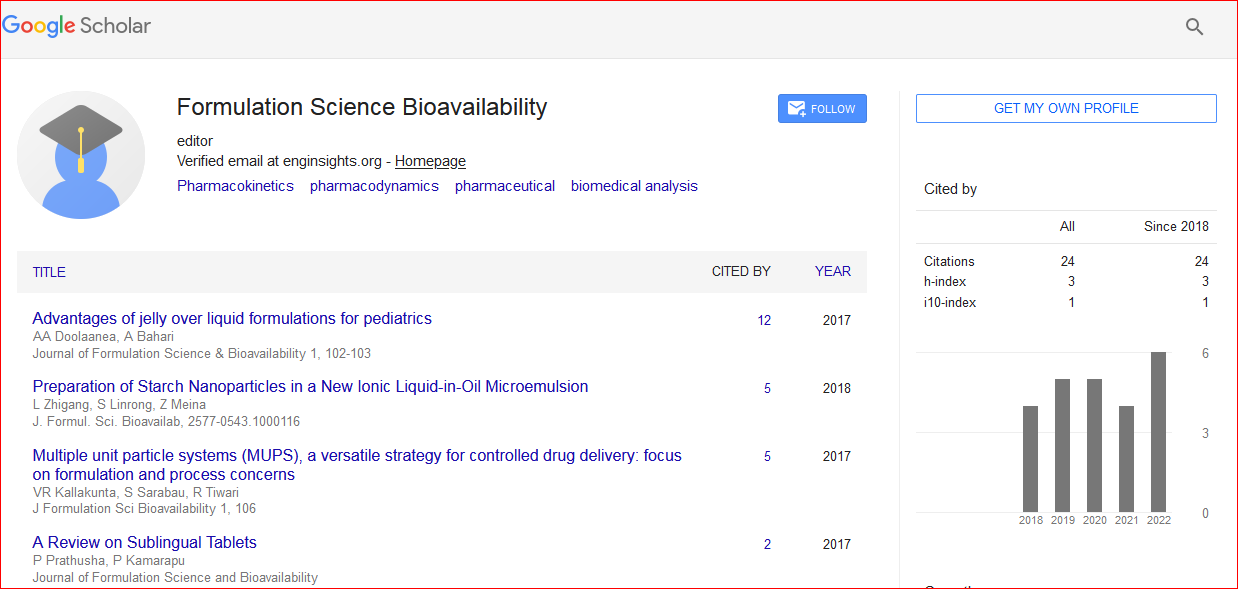
Journal of Formulation Science & Bioavailability received 23 citations as per Google Scholar report