Short Communication - (2025) Volume 15, Issue 4
Received: 02-Jul-2025, Manuscript No. jbpbt-25-178517;
Editor assigned: 04-Jul-2025, Pre QC No. P-178517;
Reviewed: 18-Jul-2025, QC No. Q-178517;
Revised: 23-Jul-2025, Manuscript No. R-178517;
Published:
30-Jul-2025
, DOI: 10.37421/2155-9821.2025.15.693
Citation: Ivanova, Elena S.. ”Smart Bioreactors, Digital Twins Revolutionize Bioprocessing.” J Bioprocess Biotech 15 (2025):693.
Copyright: © 2025 Ivanova S. Elena This is an open-access article distributed under the terms of the Creative Commons Attribution License, which permits unrestricted use,
distribution and reproduction in any medium, provided the original author and source are credited.
The integration of smart bioreactors and digital twins represents a paradigm shift in bioprocess design and optimization. This synergistic approach leverages real-time data from advanced sensors within bioreactors, coupled with the powerful modeling and simulation capabilities of digital twins. This allows for predictive control, enhanced optimization, and rapid troubleshooting, ultimately facilitating faster development cycles, improved product yield and quality, and reduced operational costs in biomanufacturing [1].
The application of digital twin technology extends to the real-time monitoring and control of complex microbial fermentation processes. By developing dynamic digital twin models that integrate sensor data from pilot-scale bioreactors, researchers can accurately predict key process parameters. This enables proactive adjustments to maintain optimal conditions, thereby increasing biomass yield and improving process robustness [2].
A critical component of this advancement is the development of smart bioreactors equipped with advanced sensor networks for continuous process monitoring. These systems address challenges associated with data integration and analysis, providing high-fidelity data streams necessary for the accuracy and efficacy of digital twin models in biopharmaceutical manufacturing [3].
The fusion of digital twins with smart bioreactors is instrumental in predicting and mitigating process deviations, particularly in sensitive mammalian cell cultures. Machine learning algorithms integrated within digital twin frameworks can identify subtle changes indicative of contamination or nutrient depletion before they significantly impact the culture, allowing for timely intervention and process stability [4].
Furthermore, the integration of computational fluid dynamics (CFD) with digital twins and smart bioreactors is optimizing mixing and mass transfer in stirred-tank bioreactors. Digital twins, informed by in-situ measurements from smart sensors, validate and refine CFD models, leading to improved reactor designs and operating strategies for enhanced bioprocess performance [5].
A robust framework for building dynamic digital twins of bioprocesses has been developed, leveraging data from smart bioreactors. This framework emphasizes data quality, standardization, and cybersecurity, facilitating scenario analysis, process validation, and scale-up simulations, all contributing to more efficient bioprocess design [6].
The capability of digital twins, powered by data from advanced biosensors in smart bioreactors, extends to in-situ monitoring and control of recombinant protein production. This approach accurately predicts product titer and quality attributes, enabling adaptive control strategies that maximize productivity and ensure batch-to-batch consistency [7].
The integration of advanced process analytical technology (PAT) tools with digital twins and smart bioreactors is revolutionizing real-time quality control in biopharmaceutical manufacturing. This combined approach enables continuous monitoring of critical quality attributes (CQAs) and facilitates proactive process adjustments to ensure product quality and regulatory compliance [8].
The potential of digital twins and smart bioreactors in accelerating the scale-up of bioprocesses is significant. By creating virtual replicas, designers can simulate different scales and operating conditions using data from smart bioreactors, reducing the need for extensive experimental campaigns and identifying potential bottlenecks early in the development phase [9].
Finally, the development and validation of multi-scale digital twins for continuous bioprocessing platforms, integrating data from smart bioreactors at different stages, is crucial. This digital twin optimizes process parameters, predicts product quality, and improves overall process efficiency and robustness by bridging the gap between lab-scale development and industrial production [10].
The synergistic integration of smart bioreactors and digital twins offers a transformative approach to bioprocess design. This methodology capitalizes on the continuous stream of real-time data acquired from sophisticated sensors embedded within bioreactors. This data is then fed into advanced digital twin models, which possess formidable modeling and simulation capabilities. The resulting synergy enables precise predictive control, sophisticated optimization strategies, and efficient, rapid troubleshooting. Consequently, biomanufacturing benefits from accelerated development cycles, enhanced product yield and quality, and a notable reduction in operational expenditures [1].
Digital twin technology has demonstrated significant efficacy in the real-time monitoring and control of microbial fermentation processes. The creation of dynamic digital twin models, informed by sensor data from pilot-scale bioreactors, allows for accurate predictions of key process parameters. This predictive capability empowers operators to implement proactive adjustments, thereby maintaining optimal conditions, maximizing biomass yield, and bolstering process robustness [2].
The cornerstone of effective digital twin implementation lies in the sophisticated design of smart bioreactors. These systems are equipped with advanced sensor networks designed for continuous, high-fidelity process monitoring. Overcoming challenges in data integration and analysis, smart bioreactors provide the essential data streams that underpin the accuracy and operational effectiveness of digital twin models crucial for biopharmaceutical production [3].
Within the realm of bioprocessing, particularly for delicate mammalian cell cultures, digital twins integrated with smart bioreactors are proving invaluable for predicting and mitigating process deviations. The incorporation of machine learning algorithms into these digital twin frameworks enables the early detection of subtle anomalies, such as contamination or nutrient depletion, which might otherwise go unnoticed until significant impacts occur, thus facilitating timely and effective interventions [4].
Computational fluid dynamics (CFD) plays a vital role when coupled with digital twins and smart bioreactors, specifically in optimizing critical aspects like mixing and mass transfer in stirred-tank bioreactors. The digital twin, continuously updated with in-situ measurements from smart sensors, serves to validate and refine CFD models. This iterative process leads to the development of superior reactor designs and more effective operating strategies, ultimately enhancing overall bioprocess performance [5].
A structured framework has been articulated for the construction of dynamic digital twins tailored for bioprocesses, with a particular emphasis on utilizing data sourced from smart bioreactors. This framework underscores the paramount importance of data integrity, standardization protocols, and robust cybersecurity measures to ensure the reliability of these virtual process representations. It also streamlines scenario analysis, process validation, and simulations for scale-up, contributing to more streamlined bioprocess design endeavors [6].
Digital twins, continuously nourished by data from advanced biosensors integrated into smart bioreactors, are demonstrating remarkable utility in the in-situ monitoring and control of recombinant protein production. This technology has shown a clear ability to predict critical metrics such as product titer and quality attributes, which in turn enables the implementation of adaptive control strategies designed to maximize productivity and guarantee consistency across different production batches [7].
The convergence of advanced process analytical technology (PAT) tools, digital twins, and smart bioreactors is revolutionizing real-time quality control within the biopharmaceutical manufacturing sector. This integrated approach facilitates the continuous surveillance of critical quality attributes (CQAs) and empowers proactive adjustments to manufacturing processes, ensuring that the final product meets stringent quality standards and complies with regulatory requirements [8].
The role of digital twins and smart bioreactors in accelerating the scale-up of bioprocesses is a key area of development. By establishing a virtual counterpart of the bioprocess, researchers and engineers can conduct simulations across various scales and operating conditions, utilizing data acquired from smart bioreactors. This simulation-driven approach significantly reduces the reliance on extensive and costly experimental trials, allowing for the early identification of potential bottlenecks and operational challenges [9].
Finally, the development and subsequent validation of multi-scale digital twins specifically designed for continuous bioprocessing platforms represent a significant advancement. These sophisticated models integrate data gathered from smart bioreactors operating at different stages of the continuous process. The validated digital twin can then be employed to optimize process parameters, accurately predict product quality, and substantially enhance the overall efficiency and robustness of the bioprocess, effectively bridging the gap between laboratory-scale development and full-scale industrial production [10].
This collection of research highlights the transformative impact of integrating smart bioreactors with digital twin technology in bioprocessing. These advanced systems enable real-time data acquisition and sophisticated modeling for predictive control, optimization, and troubleshooting. Benefits include accelerated development, improved product quality and yield, and reduced operational costs. Applications span microbial fermentation, mammalian cell culture, recombinant protein production, and continuous bioprocessing. The integration of advanced sensor networks, machine learning, and CFD further enhances process monitoring, control, and scale-up. Overall, these technologies are revolutionizing biopharmaceutical manufacturing by enabling more efficient, robust, and quality-driven bioprocesses.
None
None
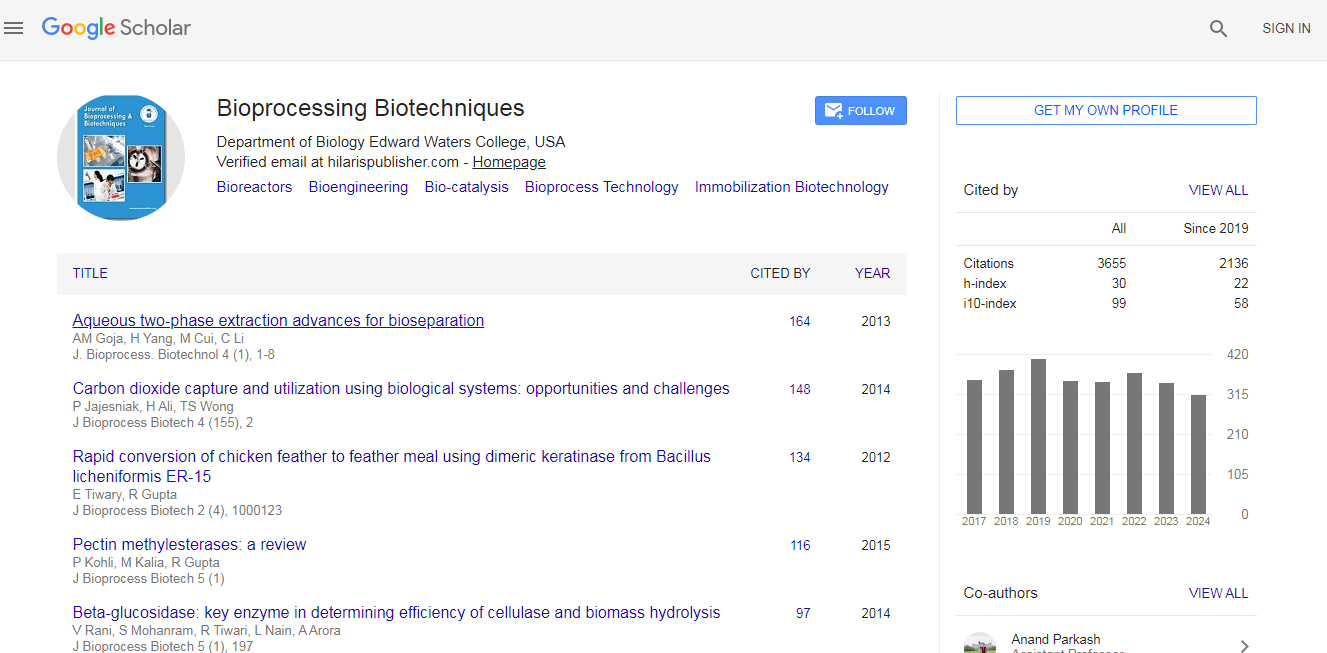
Journal of Bioprocessing & Biotechniques received 3351 citations as per Google Scholar report