Perspective - (2025) Volume 18, Issue 6
Received: 28-Oct-2025, Manuscript No. jcsb-25-176473;
Editor assigned: 03-Nov-2025, Pre QC No. P-176473;
Reviewed: 11-Nov-2025, QC No. Q-176473;
Revised: 18-Nov-2025, Manuscript No. R-176473;
Published:
25-Nov-2025
, DOI: 10.37421/0974-7230.2025.18.616
Citation: Moretti, Liam. âSingle-cell Multiomics: Unlocking Cellular Insights for Medicine.â J Comput Sci Syst Biol 18 (2025):616.
Copyright: © 2025 Moretti L. This is an open-access article distributed under the terms of the Creative Commons Attribution License, which permits unrestricted use, distribution and reproduction in any medium, provided the original author and source are credited.
The realm of biomedical research has seen a transformative shift with the emergence of single-cell multiomics, a suite of technologies designed to simultaneously quantify multiple molecular layers from individual cells. This revolutionary approach offers an unprecedented ability to dissect the intricate complexities of cellular heterogeneity and unravel underlying disease mechanisms, providing a more comprehensive understanding of cellular states than ever before. It emphasizes how these integrated methodologies are pushing the boundaries of scientific inquiry, paving the way for significant advancements in health and disease[1].
A fundamental aspect of single-cell multiomics lies in its computational demands, as effectively integrating such diverse datasets—spanning genomics, transcriptomics, and proteomics—from single cells presents considerable challenges. Researchers are actively developing and refining various computational strategies, from sophisticated dimensionality reduction techniques to network analysis, which are absolutely essential for extracting meaningful biological insights from the wealth of complex multiomic measurements. These computational tools form the backbone of data interpretation, translating raw data into actionable knowledge[2].
These innovative approaches, which combine different omic layers at the single-cell level, are proving invaluable for uncovering the nuances of cellular heterogeneity and understanding intricate interactions within tissues. The continuous technological advancements in this domain allow for the simultaneous profiling of multiple molecular features, ultimately yielding a richer, more detailed understanding of complex biological systems and various disease states. It is increasingly clear that these integrated methods are not merely incremental improvements, but rather critical enablers for the progression of precision medicine, tailoring treatments to individual biological profiles[3].
One particularly impactful area where single-cell multiomics is making significant strides is in cancer research. By simultaneously profiling genomic, transcriptomic, and epigenetic information from individual cancer cells, these techniques are proving instrumental in unraveling the notorious heterogeneity of tumors, meticulously characterizing the surrounding tumor microenvironment, and precisely identifying mechanisms that drive drug resistance. These insights are not just academic; they represent a tangible potential to develop more personalized and ultimately more effective cancer therapies, moving beyond generalized treatments[4].
The investigation into epigenetic modifications is another frontier being redefined by single-cell multiomics. Specialized tools are under development that facilitate the simultaneous measurement of critical epigenetic markers such as DNA methylation, histone modifications, and chromatin accessibility, all alongside gene expression within individual cells. This integrated view is critically important for comprehensively understanding how epigenetic regulation fundamentally influences cell identity and function, both in healthy states and across the spectrum of various diseases, offering a deeper mechanistic understanding[5].
The field is witnessing rapid breakthroughs, with single-cell multiomics technologies being applied across an expanding array of disciplines, from foundational biological discovery to advanced clinical diagnostics. These methods deliver an improved resolution that significantly enhances our ability to comprehend complex biological processes, decipher intricate disease mechanisms, and predict therapeutic responses. Ultimately, these advancements are pivotal in accelerating the journey towards precision medicine and truly personalized healthcare, moving from broad strokes to fine detail in patient care[6].
In immunology, the application of single-cell multiomics has become a powerful tool, providing unprecedented detail into the inherent heterogeneity and diverse functional states of immune cells. By concurrently analyzing multiple molecular layers, researchers can gain a much clearer understanding of immune responses, accurately identify specific cell subtypes previously indistinguishable, and deeply explore disease mechanisms implicated in autoimmune disorders, infections, and the complex landscape of cancer immunity. This depth of insight is reshaping immunological understanding[7].
A recent and highly impactful development is the powerful combination of single-cell and spatial multiomics technologies, a dual approach that is rapidly gaining traction in biomedical research. These cutting-edge methods allow for the simultaneous profiling of multiple molecular layers while critically preserving the vital spatial context within tissues. This revolutionary capability is profoundly changing our understanding of cellular interactions, tissue organization, and the progression of diseases, providing unparalleled detail on how cells function within their native microenvironment, which is crucial for biological relevance[8].
Furthermore, the application of single-cell multiomics sequencing is proving to be a game-changer in understanding neurological diseases. These advanced techniques enable researchers to meticulously dissect the cellular heterogeneity present within the brain and spinal cord, identify unique disease-specific cell states, and uncover the precise molecular mechanisms that drive neurodegeneration or other complex neurological disorders. The potential for these profound insights to translate into novel diagnostic markers and effective therapeutic targets for debilitating conditions is immense[9].
The current landscape of single-cell multiomics, while brimming with significant opportunities, also presents a unique set of challenges. The promise of integrated omics data for unraveling complex biological systems and diseases is undeniable, yet the field grapples with substantial computational hurdles, intricate data integration complexities, and an urgent need for standardized analytical pipelines to ensure reproducibility and broad utility. Nevertheless, researchers are actively projecting future directions for the field, emphasizing continuous technological advancements and the exploration of even broader biological applications, hinting at a dynamic and evolving future[10].
Single-cell multiomics represents a groundbreaking frontier in biomedical research, offering unparalleled insights into the intricate workings of individual cells. This suite of advanced technologies enables the concurrent measurement of various molecular layers, such as genomics, transcriptomics, and epigenomics, within a single cell. This integrated perspective is crucial for understanding cellular heterogeneity, the diverse nature of cells even within seemingly homogeneous populations, and for deciphering the complex mechanisms underpinning various diseases [1]. Such detailed profiling pushes the boundaries of traditional biological investigations, moving towards a holistic view of cellular states.
The integration of these diverse datasets is not without its computational demands. Handling and interpreting the vast amount of information generated by single-cell multiomics requires sophisticated computational strategies. This includes methods like dimensionality reduction, which helps simplify complex data into understandable patterns, and network analysis, which identifies interactions between molecular components. These computational tools are absolutely essential for translating raw, multiomic measurements into meaningful biological insights, allowing researchers to build a comprehensive picture of cellular function and dysfunction [2]. Continuous innovation in these computational methods is key to unlocking the full potential of multiomics data.
The applications of single-cell multiomics span a wide spectrum of biological and clinical fields. In the realm of cancer research, these techniques are proving invaluable. By simultaneously examining genomic, transcriptomic, and epigenetic profiles of individual cancer cells, scientists can gain a deeper understanding of tumor heterogeneity, the varied cell types within a tumor, and how these interact with the tumor microenvironment. This detailed insight is critical for identifying mechanisms of drug resistance and for developing more targeted, personalized cancer therapies that are tailored to the unique characteristics of each patient's tumor [4]. Beyond cancer, the methods are also transforming our understanding of epigenetic modifications. Tools are being developed to measure DNA methylation, histone modifications, and chromatin accessibility alongside gene expression in single cells, which is vital for understanding how these epigenetic factors regulate cell identity and function in both health and disease contexts [5].
Furthermore, single-cell multiomics is making profound contributions to immunology. By analyzing multiple molecular layers from individual immune cells, researchers can uncover unprecedented details about their heterogeneity and functional states. This capability is instrumental in understanding complex immune responses, identifying specific immune cell subtypes that play critical roles in disease, and exploring the mechanisms driving autoimmune disorders, infectious diseases, and the body's response to cancer [7]. This deeper understanding of immune cell dynamics opens new avenues for therapeutic intervention. The field is also expanding through the integration of spatial context. The powerful combination of single-cell and spatial multiomics technologies allows researchers to not only profile multiple molecular layers but also to preserve their critical spatial arrangements within tissues. This dual approach is revolutionizing our understanding of how cells interact, how tissues are organized, and how diseases progress in their native microenvironment, providing a truly contextual view of biological processes [8].
The utility of these advanced multiomics techniques extends significantly into neurological diseases. By dissecting the cellular heterogeneity within the brain and spinal cord at a single-cell resolution, researchers can identify disease-specific cell states and uncover the precise molecular mechanisms that contribute to neurodegeneration and other neurological disorders. The insights gained from such studies hold immense promise for the development of new diagnostic markers and more effective therapeutic targets, offering hope for conditions that are currently difficult to treat [9]. These technologies, while presenting numerous opportunities, also come with challenges. These include complex computational hurdles for data integration and the need for standardized analytical pipelines to ensure reproducibility and broad applicability. Nevertheless, the field is continuously evolving, with ongoing technological advancements promising even broader biological applications in the future, ultimately pushing the boundaries of precision medicine and personalized healthcare [6, 10].
Single-cell multiomics represents a pivotal advancement in biomedical research, enabling the simultaneous measurement of diverse molecular layers within individual cells. This capability offers an unparalleled view into cellular heterogeneity and disease mechanisms [1]. Researchers leverage these technologies to integrate complex datasets, such as genomics, transcriptomics, and proteomics, which necessitates sophisticated computational strategies like dimensionality reduction and network analysis to extract meaningful biological insights [2]. These integrated approaches are crucial for deciphering cellular interactions within tissues and driving progress in precision medicine [3]. The applications of single-cell multiomics are broad and impactful. In cancer research, these techniques help unravel tumor heterogeneity, characterize the microenvironment, and identify drug resistance mechanisms, paving the way for personalized therapies [4]. The field also employs multiomics to investigate epigenetic modifications by simultaneously measuring DNA methylation, histone modifications, and chromatin accessibility, alongside gene expression, vital for understanding cell identity and function [5]. Recent advancements highlight the widespread utility of these methods from basic biological discovery to clinical diagnostics, enhancing resolution in understanding disease and therapeutic responses [6]. Beyond general applications, single-cell multiomics provides unprecedented detail in immunology, clarifying immune cell heterogeneity and function to explore mechanisms in autoimmune disorders, infections, and cancer immunity [7]. The powerful combination with spatial multiomics further revolutionizes understanding by preserving critical tissue context, offering insights into cellular interactions and disease progression in native microenvironments [8]. Furthermore, single-cell multiomics sequencing is applied to neurological diseases, dissecting cellular heterogeneity in the brain and spinal cord to uncover molecular mechanisms and potential diagnostic or therapeutic targets [9]. Despite these opportunities, challenges remain, including computational hurdles, data integration complexities, and the need for standardized analytical pipelines, yet the field continues to advance towards broader biological applications [10].
None
None
Zhirong L, Cong NH, Andrew JW. "Single-cell multiomics: technologies and applications".Signal Transduct Target Ther 6 (2021):239.
Indexed at, Google Scholar, Crossref
Wuming S, Junbo W, Sihan Z. "A Survey of Computational Methods for Single-Cell Multiomics Data Integration".Genomics Proteomics Bioinformatics 19 (2021):900-915.
Indexed at, Google Scholar, Crossref
Tingjun L, Yanli Y, Wenzhong Z. "Integrated single-cell multiomics analyses for deciphering cellular heterogeneity and interactions".Quant Biol 11 (2023):172-192.
Indexed at, Google Scholar, Crossref
Jianmeng T, Mujun G, Jiahui L. "Single-cell multi-omics in cancer research".Exp Hematol Oncol 12 (2023):43.
Indexed at, Google Scholar, Crossref
Junxia F, Binghui D, Dandan C. "Single-cell multiomics technologies for studying epigenetic modifications".Clin Epigenetics 15 (2023):177.
Indexed at, Google Scholar, Crossref
Pengfei M, Yan L, Yuting L. "Recent advances and applications of single-cell multiomics in health and disease".Cell Biosci 14 (2024):7.
Indexed at, Google Scholar, Crossref
K. CZ, Jie X, Yang Y. "Single-cell multiomics for revealing immune cell heterogeneity and function".Cell Biosci 14 (2024):23.
Indexed at, Google Scholar, Crossref
Cuijiao H, Wenjie S, Kui H. "Single-cell and spatial multi-omics in biomedical research".Cell Biosci 14 (2024):38.
Indexed at, Google Scholar, Crossref
Yiyuan L, Runhang P, Zhimin W. "Single-cell multi-omics sequencing for neurological diseases".Brain Res Bull 208 (2024):110900.
Indexed at, Google Scholar, Crossref
Chengyun L, Dezhi W, Mingkai C. "Single-cell multi-omics: Opportunities, challenges and future directions".Comput Struct Biotechnol J 22 (2024):60-68.
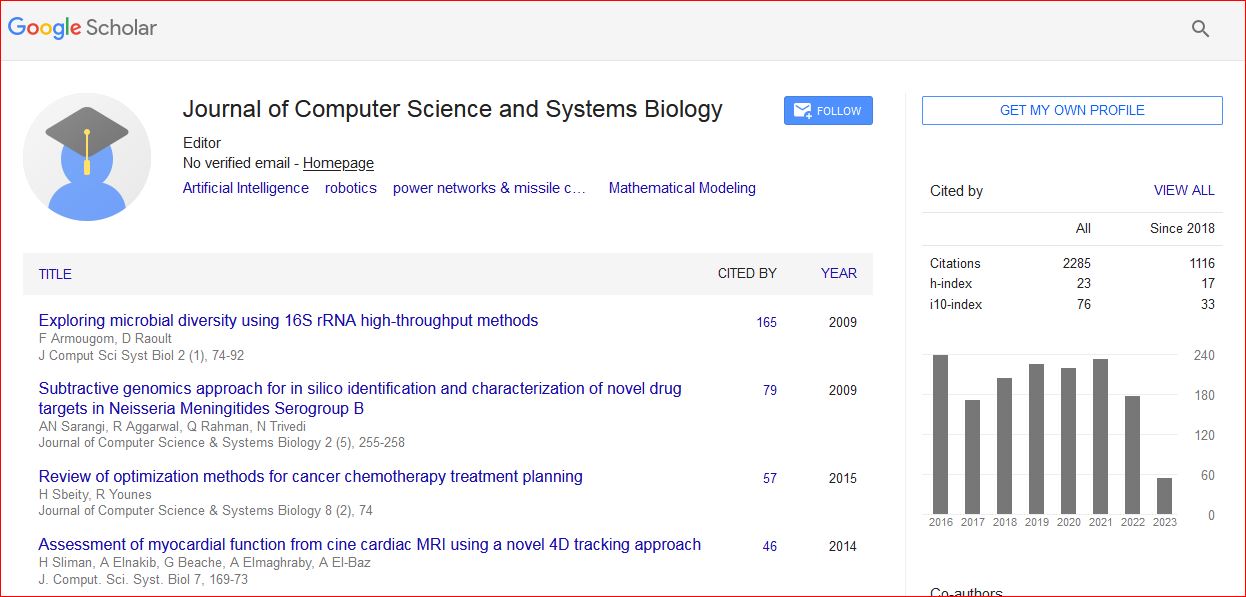
Journal of Computer Science & Systems Biology received 2279 citations as per Google Scholar report