Short Communication - (2025) Volume 15, Issue 5
Received: 01-Oct-2025, Manuscript No. mccr-25-173810;
Editor assigned: 03-Oct-2025, Pre QC No. P-173810;
Reviewed: 17-Oct-2025, QC No. Q-173810;
Revised: 22-Oct-2025, Manuscript No. R-173810;
Published:
29-Oct-2025
, DOI: 10.37421/2161-0444.2025.15.807
Citation: Harper, William. ”Signal Transduction: Universal Regulators
of Life.” Med Chem 15 (2025):807.
Copyright: © 2025 Harper W. This is an open-access article distributed under the terms of the Creative Commons Attribution License, which permits unrestricted use, distribution and reproduction in any medium, provided the original author and source are credited.
Signal transduction pathways are central to cellular life, orchestrating responses to internal and external stimuli across a vast array of biological contexts. This intricate communication network is vital for maintaining homeostasis, but its dysregulation often underlies various pathologies and crucial biological processes. For instance, ubiquitin-specific proteases (USPs) are critical in modulating cell signaling pathways and metabolic processes involved in cancer progression[1].
Delving into the intricate crosstalk of JAK/STAT signaling and other crucial pathways in innate immune cells fine-tunes immune responses, impacting inflammation and pathogen recognition[2].
Beyond immunity, mitochondrial dysfunction, oxidative stress, and aberrant signal transduction show a complex interplay in Parkinson's disease[3].
Similarly, crucial signal transduction pathways govern pancreatic β-cell function, controlling insulin secretion and glucose homeostasis[4].
In plants, the ubiquitin-proteasome system (UPS) precisely tunes signal transduction pathways during stress responses[5].
Dysregulated signal transduction pathways are also critical in the development of drug resistance in cancer, necessitating targeted interventions[6].
Moreover, signal transduction pathways fundamentally dictate stem cell fate, influencing self-renewal and differentiation crucial for regenerative medicine[7].
The dysregulation of these pathways, like JAK/STAT, NF-κB, and MAPK, also contributes to autoimmune diseases, making them key therapeutic targets[8].
Furthermore, non-coding RNAs (ncRNAs) play increasingly recognized roles in modulating signal transduction pathways relevant to cardiovascular diseases[9].
Lastly, these essential pathways influence the aging process and the development of age-related diseases[10].
Signal transduction pathways are indispensable cellular mechanisms, translating external and internal cues into appropriate cellular responses. Their precise regulation is critical for maintaining cellular health, and conversely, their dysregulation is often implicated in various disease states and fundamental biological processes. This intricate network governs everything from gene expression to cellular metabolism, ensuring cells adapt and respond effectively to their ever-changing environments.
Many studies highlight the profound impact of these pathways in the context of cancer. For instance, ubiquitin-specific proteases (USPs) are key modulators of cell signaling and metabolic pathways implicated in cancer development and progression, by regulating protein stability and activity in crucial pathways like NF-κB, PI3K/Akt, and MAPK. This offers vital insights into potential therapeutic targets for various cancers [1]. On a related but distinct note, the dysregulation of signal transduction pathways directly contributes to the insidious problem of drug resistance in cancer, underscoring the necessity for targeted strategies. Researchers are actively focusing on specific components within pathways such as PI3K/Akt/mTOR, MAPK, and JAK/STAT to overcome this resistance and pave the way for more effective therapeutic interventions [6].
Beyond oncology, these pathways play crucial roles in immunity and neurodegeneration. In the immune system, the JAK/STAT signaling pathway intricately crosstalks with other crucial pathways in innate immune cells, thereby finely tuning immune responses that impact inflammation, pathogen recognition, and overall immune homeostasis [2]. Similarly, aberrant signal transduction pathways are major contributors to immune pathology observed in autoimmune diseases, with dysregulation of JAK/STAT, NF-κB, and MAPK pathways being identified as key molecular targets for developing more effective and personalized treatments [8]. Shifting to neurological health, the complex interplay between mitochondrial dysfunction, oxidative stress, and aberrant signal transduction is central to Parkinsonâ??s disease. Pinpointing key dysregulated pathways involving reactive oxygen species and inflammatory mediators provides a clearer picture of the cellular damage mechanisms leading to neurodegeneration [3].
Metabolic regulation, plant adaptation, and developmental biology also depend on precise signal transduction. Crucial pathways govern pancreatic β-cell function, particularly in insulin secretion and glucose homeostasis. Diverse extracellular signals are translated into intracellular responses through pathways like GPCRs, tyrosine kinase receptors, and calcium signaling, all intricately regulating insulin release [4]. Furthermore, in plants, the ubiquitin-proteasome system (UPS) plays a vital role in fine-tuning signal transduction pathways during stress responses. Ubiquitination, as a post-translational modification, precisely regulates the activity and stability of key signaling components, enabling plants to adapt and survive various environmental challenges [5]. The fundamental involvement of various signal transduction pathways also dictates the fate of stem cells, influencing their self-renewal, proliferation, and differentiation. Pathways like Wnt, Notch, Hedgehog, and TGF-β integrate environmental cues to precisely control stem cell behavior, offering significant insights for regenerative medicine [7].
Lastly, the impact extends to cardiovascular health and the fundamental process of aging. Non-coding RNAs (ncRNAs), including microRNAs and long non-coding RNAs, are increasingly recognized for their significant roles in modulating signal transduction pathways relevant to cardiovascular diseases. They intricately regulate gene expression and protein activity within these pathways, impacting cardiac remodeling and vascular function [9]. Simultaneously, key signal transduction pathways profoundly influence the aging process and the development of age-related diseases. This involves pathways like mTOR, AMPK, sirtuins, and insulin/IGF-1 signaling in regulating cellular senescence, metabolism, and stress responses, identifying them as potential targets for healthy aging interventions [10].
Signal transduction pathways are pivotal in diverse biological processes, governing everything from cell fate to disease progression. In cancer, these pathways are central, with ubiquitin-specific proteases modulating key signaling in development and progression [1]. Dysregulated pathways, including PI3K/Akt/mTOR, MAPK, and JAK/STAT, are also crucial drivers of drug resistance, highlighting therapeutic targets [6]. The immune system relies heavily on intricate signaling, where JAK/STAT crosstalks fine-tune responses to inflammation and pathogens [2]. Similarly, aberrant pathways like JAK/STAT, NF-κB, and MAPK are targets for treating autoimmune diseases [8]. Beyond human health, these pathways extend to plant biology, where the ubiquitin-proteasome system regulates stress responses, enabling adaptation [5]. They are fundamental in controlling stem cell fate, influencing self-renewal and differentiation through pathways like Wnt and Notch, offering promise for regenerative medicine [7]. In neurodegenerative conditions like Parkinson's, mitochondrial dysfunction and oxidative stress interact with dysregulated signal transduction, revealing mechanisms of cellular damage [3]. Metabolic regulation, specifically pancreatic β-cell function and insulin secretion, is also precisely controlled by various signaling pathways [4]. Furthermore, non-coding RNAs are emerging as critical modulators of these pathways in cardiovascular diseases [9]. Ultimately, understanding these pathways, including mTOR, AMPK, and sirtuins, is key to addressing aging and age-related diseases [10], demonstrating their universal importance in biological function and disease.
None
None
1. Ting C, Xiao S, Zhaochun Z. "Regulation of Cell Signaling and Metabolism in Cancer by Ubiquitin-Specific Proteases".Front Cell Dev Biol 9 (2021):747535.
Indexed at, Google Scholar, Crossref
2. Qiqi Y, Zhipeng L, Deyu Y. "Crosstalk of JAK/STAT signaling with other signal transduction pathways in innate immune cells".Cytokine Growth Factor Rev 63 (2022):44-59.
Indexed at, Google Scholar, Crossref
3. Yuting S, Zhiming M, Shaodong Y. "Mitochondrial dysfunction, oxidative stress, and signal transduction pathways in Parkinson's disease".Neurochem Int 164 (2023):105501.
Indexed at, Google Scholar, Crossref
4. Huan C, Zhong Z, Jun C. "Signal transduction pathways involved in the regulation of pancreatic β-cell function".Int J Mol Med 45 (2020):3-18.
Indexed at, Google Scholar, Crossref
5. Shalini S, Shikha S, Amarbir S. "Deciphering the Ubiquitin-Proteasome System in Regulating Signal Transduction Pathways in Plant Stress Responses".Int J Mol Sci 24 (2023):2478.
Indexed at, Google Scholar, Crossref
6. Shicheng Y, Siyu M, Bo L. "Targeting Signal Transduction Pathways for Overcoming Drug Resistance in Cancer".Cancers (Basel) 14 (2022):4073.
Indexed at, Google Scholar, Crossref
7. Xin L, Yang W, Bo Z. "Critical Roles of Signal Transduction Pathways in Regulating Stem Cell Fate".Stem Cells Int 2021 (2021):6690492.
Indexed at, Google Scholar, Crossref
8. Yuting F, Meifen L, Kun M. "Targeting Signal Transduction Pathways in Autoimmune Diseases".Front Immunol 12 (2021):785213.
Indexed at, Google Scholar, Crossref
9. Yan Z, Yuqing L, Hao W. "Emerging Roles of Non-Coding RNAs in Regulating Signal Transduction Pathways in Cardiovascular Diseases".Int J Mol Sci 23 (2022):3481.
Indexed at, Google Scholar, Crossref
10. Wei L, Chuanling Z, Dayong L. "The Role of Signal Transduction Pathways in Aging and Age-Related Diseases".Front Cell Dev Biol 9 (2021):691230.
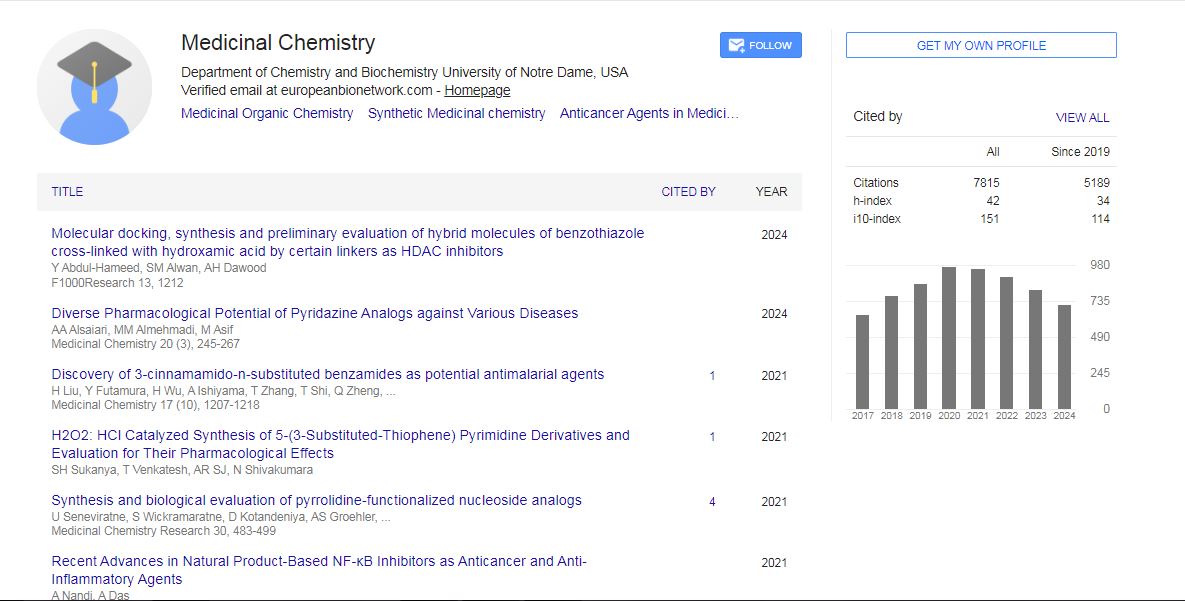
Medicinal Chemistry received 6627 citations as per Google Scholar report