Research Article - (2025) Volume 15, Issue 5
Received: 02-Sep-2025, Manuscript No. jprm-25-170638;
Editor assigned: 04-Sep-2025, Pre QC No. P-170638;
Reviewed: 19-Sep-2025, QC No. Q-170638;
Revised: 25-Sep-2025, Manuscript No. R-170638;
Published:
03-Oct-2025
, DOI: 10.37421/2161-105X.2025.15.757
Citation: Thiam, Khady, Bouchra Elberhichi, Fatimata Binetou Rassoule Mbaye and Souleymane Diatta, et al. "Scoring System to Detect Complications for Thoracic Empyema in Dakar: A Cohort Study." J Pulm Respir Med 15 (2025): 757.
Copyright: © 2025 Thiam K, et al. This is an open-access article distributed under the terms of the Creative Commons Attribution License, which permits unrestricted use, distribution and reproduction in any medium, provided the original author and sources are credited.
Introduction: Thoracic empyema, the presence of pus in the pleural cavity, is a severe disease that can be life-threatening.
Objective: To assess a newly defined severity scoring system of thoracic empyema in adults based on several predictive factors.
Methods: A retrospective chart review of consecutive adult patients presenting thoracic empyema was conducted from January 2021 to July 2024. Patients were categorized into a cohort depending on non-isolated germ (G), use of Indian hemp (I), diabetes mellitus (D), no respiratory physiotherapy (P), no pleural washing (L), single-dose antibiotic (S) and age >60 years. Multivariate analysis was performed using binary logistic regression. Adjusted Odds Ratios (ORs) with their 95% Confidence Intervals (CI) were calculated for each variable included in the final model.
Results: A severity score labeled 'GIDPLS-60 was built with each item assigned from a cohort of 388 consecutive patients according to criteria previously mentioned. The enrolled patients were predominantly male (n=252, 65.2%) with a mean age of 40.7 ±1 4.6 years. According to the "GIDPLS-60" score, the risk of complications was 3-5% for a score ≤ 1, 29-42% for a score of 2 or 3 and at least 99% for a score ≥ 4. The higher scores were correlated to co-morbidities, smoking behavior and use of Indian hemp, mono antibiotic therapy, no isolated germ, no pleural drainage and physiotherapy.
Conclusion: The management of empyema which must be timely and appropriate, can be guided by the initial assessment with a scoring system based on clinical and therapeutic factors adapted to the local context.
Purulent pleurisy • Empyema • Scoring system • Complicated pleural infection • Mortality
Purulent pleurisy or empyema denotes the presence of purulent fluid in the pleural space and represents the late stage of pleural infection before the organizing stage [1]. It is a diagnostic and therapeutic emergency that can compromise vital and functional prognosis. Its non-specific clinical presentation [2,3] results in delayed diagnosis and management. Despite advances in care, empyema carries high rates of mortality, prolonged hospital stays and significant healthcare costs [2,4]. The occurrence of frequent complications contributes to an increase economic burden and mortality leading to the need for surgical management that is not always available in all countries [2,5,6]. Therefore, recent statements and recommendations regarding the management of pleural infections are difficult to transfer into developing countries. Consequently, a score predicting complications of pleural infection and empyema is needed aiming the accurate choice of initial management modalities for in a tuberculosis endemic area. The specific objective of this study was to describe the profile of enrolled patients, to determine the factors associated with complications and to establish a predictive score, the first in Africa, for patients suffering complicated pleural infection.
This study was conducted from January 1, 2021 to July 31, 2024 at the Pulmonology clinic of the CHNU of FANN, Dakar (Senegal). All consecutive patients admitted during the study period who presented purulent pleurisy, defined by the purulent macroscopic appearance of the pleural fluid and the presence of more than 50% of PNA in the pleural fluid were recruited. The data were collected anonymously from the department's consultation records, the medical file and a direct interview of the patient. Written patients' informed consent was obtained before data collection. The data were processed and archived in such a way as to safeguard the confidentiality of each patient. Data collection complied with the principles of the World Medical Association Declaration of Helsinki and was done after agreement from the Hospital Director and the Head of the Pulmonology Department according to local policies.
Data entry and analysis were performed using Sphinx 2.0 and Excel 2016 software.
Quantitative variables were expressed according to their position and dispersion parameters and compared with Student's Z or t tests according to their conditions of applicability. Qualitative variables were expressed as a proportion and compared using Pearson's or Fisher's chi-square (chi2) test as appropriate. Any difference was considered statistically significant for a p-value less than 0.05. When the difference was significant, the Relative Risk (RR) was calculated. Multivariate analysis was performed using the binary logistic regression method. All variables with a p-value ≤0.25 were retained to model the occurrence of complications and deaths. Then, ascending modeling was performed. The adjusted ORs with their confidence interval [95% CI] were determined for each variable retained in the final model. The quality of the model adjustment was verified with the Hosmer and Lemeshow test. This made it possible to establish predictive scores for complications named "GIDPLS-60", including the following seven parameters: Non-isolated germ (G), use of Indian hemp (I), diabetes (D), absence of respiratory physiotherapy (P), absence of pleural washing (L), single-dose antibiotic therapy (S), age>60 years. To miss each item, we proceeded as follows:
• Identify the lowest coefficient B of each score, assign 1 point to the lowest coefficient,
• Proportionally adjust the other coefficients by dividing each coefficient by the lowest,
• Then round the results to the nearest absolute value.
Patient profile
388 patients were enrolled. The mean age was 40.74 ± 14.67 years. More than two-thirds of the patients, or 75.26% (n=292), were aged between 20 and 50 years (Table 1). The sex ratio was 2.88. Among the 388 patients, 78.35% (n=304) were employed, including 70.06% (n=213) whose work involved regular human contact. Half of the patients, or 50% (n=194), had a medical history, predominantly tuberculosis in 22.16% of cases (n=43) and diabetes in 14.43% (n=28). Addictive behaviors were recorded in 180 patients. More than one-third, or 36.08% (n=140), of patients were smokers, of whom 74.29% (n=104) were active smokers, with 80.77% (n=84) having not ceased smoking. The consumption of cannabis (Indian hemp) or alcohol was reported by 10.31% and 7.22% of patients respectively (Table 1).
| Group | Biological Samples | Comments | Species | n (%) |
|---|---|---|---|---|
| Age group (years) | 20–30 | 12 (3.09%) | ||
| 30–40 | 92 (23.71%) | |||
| 40–50 | 68 (17.53%) | |||
| 50–60 | 132 (34.02%) | |||
| ≥ 60 | 48 (12.37%) | |||
| Sex | Men | 288 (74,2%) | ||
| Women | 100 (25,8%) | |||
| Cmorbidities (n=153) | Diabetes kind 2 | 26 (17%) | ||
| Malnutrition | 10 (6,5%) | |||
| HIV | 8 (5,2%) | |||
| Cancer scalable | 12 (7,8%) | |||
| Chronic respiratory diseases | 72 (47,1%) | |||
| Others | 25 (16,4%) | |||
| Addictive behavior | Active/passive smoking | 65 (36.08%) | ||
| Indian hemp | 18 (10.31%) | |||
| Alcohol | 13 (7.22%) | |||
| Bacteriology | Pleural liquid | Gram-positive cocci | Staphylococcus aureus | 30 |
| Streptococcus pneumoniae | 12 | |||
| Kocuria kristinae | 2 | |||
| Gram-positive bacilli | Erysipelothrix rhusiopathiae | 1 | ||
| Klebsiella pneumoniae | 28 | |||
| Burkholderia cepacia | 6 | |||
| Escherichia coli | 6 | |||
| Enterobacter cloacae | 6 | |||
| Pseudomonas aeruginosa | 5 | |||
| Serratia marcescens | 5 | |||
| Sputum | Gram-negative bacilli | Salmonella spp. | 2 | |
| Gram-negative bacilli | Pseudomonas aeruginosa | 3 | ||
| Klebsiella oxytoca | 1 | |||
| Serratia marcescens | 1 | |||
| Bronchial aspirate/BAL | Gram-positive cocci | Staphylococcus aureus | 1 | |
| Gram-negative bacilli | Klebsiella pneumoniae | 1 | ||
| Burkholderia cepacia | 2 | |||
| Pseudomonas aeruginosa | 1 | |||
| Enterobacter cloacae | 1 | |||
| Antibiotic Regimen | A | Amoxicillin +Clavulanic Acid 1 g × 3/day | 181 (46.65 %) | |
| (Label) | B | Amoxicillin +Clavulanic Acid 2 g × 3/day | 108 (27.84 %) | |
| C | Third-generation cephalosporin (2 g/day) +Metronidazole 500 mg × 3/day | 47 (12.11 %) | ||
| D | C3G 2 g/day +Metronidazole 500 mg × 3/day +Gentamicin 160 mg/day | 35 (9.02 %) | ||
| E | Amoxicillin +Clavulanic Acid 1 g × 3/day | 17 (4.38 %) |
Table 1. Patients characteristics and antibiotic treatment.
Bacteriology and microbiological examinations
Pleural fluid bacteriology, performed in all patients, was positive in 103 cases (26.55%) and allowed the isolation of 11 types of pathogenic organisms. These were mainly Gram-Negative Bacilli (GNB), predominantly Klebsiella pneumoniae (Table 1).
Cytobacteriological examination of sputum was conducted in 6.2% (n=24) of patients and yielded a pathogen in 29.2% of cases. Blood cultures were performed in 10 patients and were positive in 2 cases, isolating Pseudomonas aeruginosa and Staphylococcus aureus (Table 1).
Bacteriology of Bronchial Aspiration (BA) and Bronchoalveolar Lavage (BAL) was performed in 3.9% (n=15) of patients and resulted in pathogen isolation in 53.33% (n=8) of cases, mainly GNB, predominantly Burkholderia cepacia (Table 1).
Antibiotic therapy and treatment duration
Empirical antibiotic therapy was initiated in all patients, based on amoxicillin-clavulanic acid in 74.45% of cases (n=289). The mean treatment duration was 20.49 ± 10.26 days. Double-dose antibiotic regimens (schedules B and E in Table 1) were administered for 2 to 3 weeks, while single-dose antibiotic therapy (schedules A, C and D in Table 1) was administered mainly for 4 to 6 weeks.
Pleural drainage and additional interventions
Pleural evacuation was performed in 96.9% of patients (n=376). More than half of the patients, or 57.5% (n=223), underwent thoracic drainage, which was passive in 66.4% of cases (n=148). Passive drainage followed by lavage with isotonic saline at room temperature was performed in 43.7% of patients (n=21) until the pleural fluid was clear, with a mean drainage duration of 26.13 ± 14.08 days.
Respiratory physiotherapy was provided to 71.13% of patients (n=276) and in 92% of these cases (n=254) it was performed passively in an improvised manner.
Surgical treatment was carried out in 2.83% of patients (n=11), predominantly involving decortications and debridement in 36.6% (n=4) and 18.18% (n=2) of cases respectively. Two patients underwent thoracotomy. Pneumonectomy was performed in one patient and lung abscess debulking in two cases.
Complications occurred in 66.5% of cases (n=258). Short-term complications were chiefly represented by death in 5% of cases (n=13). Fibrothorax (pachypleuritis) and loculation (encystment) were the predominant medium- and long-term complications, observed in 93.8% (n=242) and 22.5% (n=58) of cases respectively. Among the patients, 3.35% (n=13) had died, representing 2.1% of all deaths recorded during the study period and in the department (Table 2).
| Complications | Staff (n=) | ||
|---|---|---|---|
| Short term | Death (n=13) | Shock septic | 11 |
| Shock has vacuum | 1 | ||
| SAT | 1 | ||
| Fall of drain | 13 | ||
| Emphysema below cutaneous | 7 | ||
| Extension of infection (n=4) | Below cutaneous | 2 | |
| Mediastinitis | 1 | ||
| Effusion pericardial |
1 | ||
| Superinfection | 3 | ||
| Decompensation of diabetes | 2 | ||
| Average and Long term |
Pachypleuritis | 242 | |
| Encystment | 58 | ||
| Destruction parenchymatous | 8 | ||
| Disorder ventilatory restrictive | 5 | ||
| Fistulization In their skin | 2 | ||
| Chronic Respiratory Failure | 1 | ||
Table 2. Complications for 258 patients.
Factors associated with complications
Patients with a medical history, comorbidities, or predispositions had an increased risk of complications (p=0.00114); such factors increased the risk of complications by a factor of 1.2.
Complications were more frequent in patients with active cancer, those living with HIV and diabetes, with complication rates ranging from 92.86% to 100%. Patients living with HIV, those with active cancer and diabetes had a 1.4- to 1.5-fold higher risk of complications.
The complication rate was 73.57% (103/140) in smokers, 71.43% (20/28) in alcohol consumers and 95% in cannabis (Indian hemp) users (38/40) (p=0.01). The risk of complications was 2.5 times higher in cannabis users, 1.8 times higher in alcohol consumers and 3.1 times higher in smokers. In patients with no isolated pathogen, the complication rate was 80.4% (160/199) compared with 51.9% (98/189) in those with an isolated pathogen (p=0.0001).
Complications were less frequent in patients who received double-dose antibiotic therapy, with a rate of 33.60% (42/125) vs. 82.13% (216/263) in those who received other regimens (p=0.0001). Double-dose therapy reduced the risk of complications by 60%. The double-dose regimen based on amoxicillin-clavulanic acid (2 g × 3/day) was associated with 36.10% complications, whereas the regimen based on ceftriaxone (2 g × 2/day) plus metronidazole (500 mg × 3/day) was associated with 17.60% complications (p=0.0001). Antibiotic therapy with double-dose ceftriaxone (2 g × 2/day) plus metronidazole (500 mg × 3/day) reduced the risk by 70% and the regimen with amoxicillin-clavulanic acid (2 g × 3/day) by 50%.
Patients managed with suction pleural drainage experienced fewer complications, with a rate of 30.67% (23/75) (p=0.0001); suction drainage reduced the risk by 60%. Among patients who received instrumental treatment without pleural washing, 73.14% (226/309) developed complications (p=0.0001), while the combination of pleural washing with instrumental treatment reduced the risk by 60%.
Patients who did not receive respiratory physiotherapy had a complication rate of 90.18% (p=0.0001). Respiratory physiotherapy acted as a protective factor against complications in 40% of cases (Table 3).
| Studied Factors | Exposure | Complications Yes (n) |
Complications Yes (%) | Complications No (n) | Complications No (%) | Total (n) | P value | RR |
|---|---|---|---|---|---|---|---|---|
| Progressive cancer | Yes | 12 | 100.0% | 0 | 0.0% | 12 | 0.0104 | 1.5 |
| No | 246 | 65.43% | 130 | 34.57% | 376 | - | - | |
| Type 2 diabetes | Yes | 26 | 92.86% | 2 | 7.14% | 28 | 0.0014 | 1.4 |
| No | 232 | 64.44% | 128 | 35.56% | 360 | - | - | |
| Malnutrition | Yes | 10 | 100.0% | 0 | 0.0% | 10 | 0.0348 | 1.5 |
| No | 248 | 65.61% | 130 | 34.39% | 378 | - | - | |
| HIV | Yes | 8 | 100.0% | 0 | 0.0% | 8 | 0.056 | 1.5 |
| No | 250 | 65.79% | 130 | 34.21% | 380 | - | - | |
| Asthma | Yes | 72 | 83.72% | 14 | 16.28% | 86 | 0.0001 | 1.3 |
| No | 186 | 61.59% | 116 | 38.41% | 302 | - | - | |
| Other conditions | Yes | 25 | 44.64% | 31 | 55.36% | 56 | 0.0004 | 0.6 |
| No | 233 | 70.18% | 99 | 29.82% | 332 | - | - | |
| Smoking | Yes | 103 | 73.57% | 37 | 26.43% | 140 | 0.0001 | 3.1 |
| No | 58 | 23.39% | 190 | 76.61% | 248 | - | - | |
| Alcohol | Yes | 20 | 71.43% | 8 | 28.57% | 28 | 0.0012 | 1.8 |
| No | 141 | 39.17% | 219 | 60.83% | 360 | - | - | |
| Indian hemp | Yes | 38 | 95.00% | 2 | 5.00% | 40 | 0.0001 | 2.7 |
| No | 123 | 35.34% | 225 | 64.66% | 348 | - | - | |
| Isolated germ | Yes | 98 | 51.9% | 91 | 48.1% | 189 | 0.0001 | 0.6 |
| No | 160 | 80.4% | 39 | 19.6% | 199 | - | - | |
| Amox +Clavulanic acid 1g x3/j | Yes | 150 | 82.90% | 31 | 17.10% | 181 | 0.0001 | 1.6 |
| No | 108 | 52.17% | 99 | 47.83% | 207 | - | - | |
| Amox +Clavulanic acid 2g x3/j | Yes | 39 | 36.10% | 69 | 63.90% | 108 | 0.0001 | 0.5 |
| No | 219 | 78.21% | 61 | 21.79% | 280 | - | - | |
| 3GC +Metronidazole | Yes | 38 | 80.90% | 9 | 19.10% | 47 | 0.0314 | 1.3 |
| No | 220 | 64.52% | 121 | 35.48% | 341 | - | - | |
| 3GC +Metro +Gentamicin | Yes | 28 | 80.00% | 7 | 20.00% | 35 | 0.0913 | 1.2 |
| No | 230 | 65.16% | 123 | 34.84% | 353 | - | - | |
| 3GC: 2g x2/j +Metronidazole | Yes | 3 | 17.60% | 14 | 82.40% | 17 | 0.0001 | 0.3 |
| No | 255 | 68.73% | 116 | 31.27% | 371 | - | - | |
| Pleural lavage | Yes | 22 | 32.84% | 45 | 67.16% | 67 | 0.0001 | 0.4 |
| No | 226 | 73.14% | 83 | 26.86% | 309 | - | - | |
| Respiratory physiotherapy | Yes | 157 | 56.88% | 119 | 43.12% | 276 | 0.0001 | 0.6 |
| No | 101 | 90.18% | 11 | 9.82% | 112 | - | - |
Table 3. Complications related to empyema according to the patient’s past history, the comorbidities, the addictive behaviors, the germ(s) isolated and the treatment.
Predictive scores of complications
A multivariate logistic regression identified seven factors statistically associated with the occurrence of complications, including death (Table 4). These factors were rated using the described methodology (pages 1-2) to develop a predictive score for complications during treatment, named "GIDPLS-60", which includes the following seven parameters: (Table 4)
| Model | Factor | B | p-value | OR | 95% CI |
|---|---|---|---|---|---|
| Global model | Constant | -3.45 | <0.001 | 0.03 | [0.01–0.08] |
| No isolated germ(s) | 2.06 | <0.001 | 7.86 | [4.43–13.95] | |
| Indian hemp use (Yes) | 2.97 | 0.001 | 19.40 | [3.16–119.01] | |
| Antibiotic monotherapy (Yes) | 0.60 | 0.046 | 1.82 | [1.01–3.27] | |
| No pleural lavage | 2.38 | <0.001 | 10.81 | [5.06–23.09] | |
| No respiratory physiotherapy | 1.27 | <0.001 | 3.55 | [1.93–6.53] | |
| Diabetes mellitus (Yes) | 2.37 | 0.006 | 10.75 | [2.01–57.56] | |
| Age ≥ 60 years | 22.86 | 0.998 | 8.5×10⁹ | [0–∞] | |
| Clinical model | Constant | -0.55 | 0.002 | 0.58 | [0.41–0.81] |
| No isolated germ(s) | 1.76 | <0.001 | 5.83 | [3.57–9.52] | |
| Indian hemp use (Yes) | 2.10 | 0.006 | 8.20 | [1.85–36.30] | |
| Diabetes mellitus (Yes) | 2.33 | 0.003 | 10.27 | [2.26–46.73] | |
| Age ≥ 60 years | 22.75 | 0.998 | 7.6×10⁹ | [0–∞] | |
| Therapeutic model | Constant | -1.63 | 0.36 | 4.55 | <0.001 |
| Antibiotic monotherapy (Yes) | 0.55 | 0.046 | 1.82 | 1.01–3.27 | |
| No pleural lavage | 2.00 | <0.001 | 10.81 | 5.06–23.09 | |
| No respiratory physiotherapy | 1.05 | <0.001 | 3.55 | 1.93–6.53 |
Table 4. Predictive factors for complications during treatment (n=388).
• Non-isolated pathogen (G)
• Use of cannabis (I)
• Diabetes mellitus (D)
• Absence of respiratory physiotherapy (P)
• Absence of pleural lavage (L)
• Single-dose antibiotic therapy (S)
• Age>60 years
The sensitivity of the "GIDPLS-60" score was 21% and its specificity 86%. The area under the ROC curve for "GIDPLS-60" was 0.87, indicating very good performance (Figure 1). According to this score, the risk of complications was 3-5% for a score ≤ 1, 29-42% for a score of 2 or 3 and at least 99% for a score ≥ 4 (Table 5).
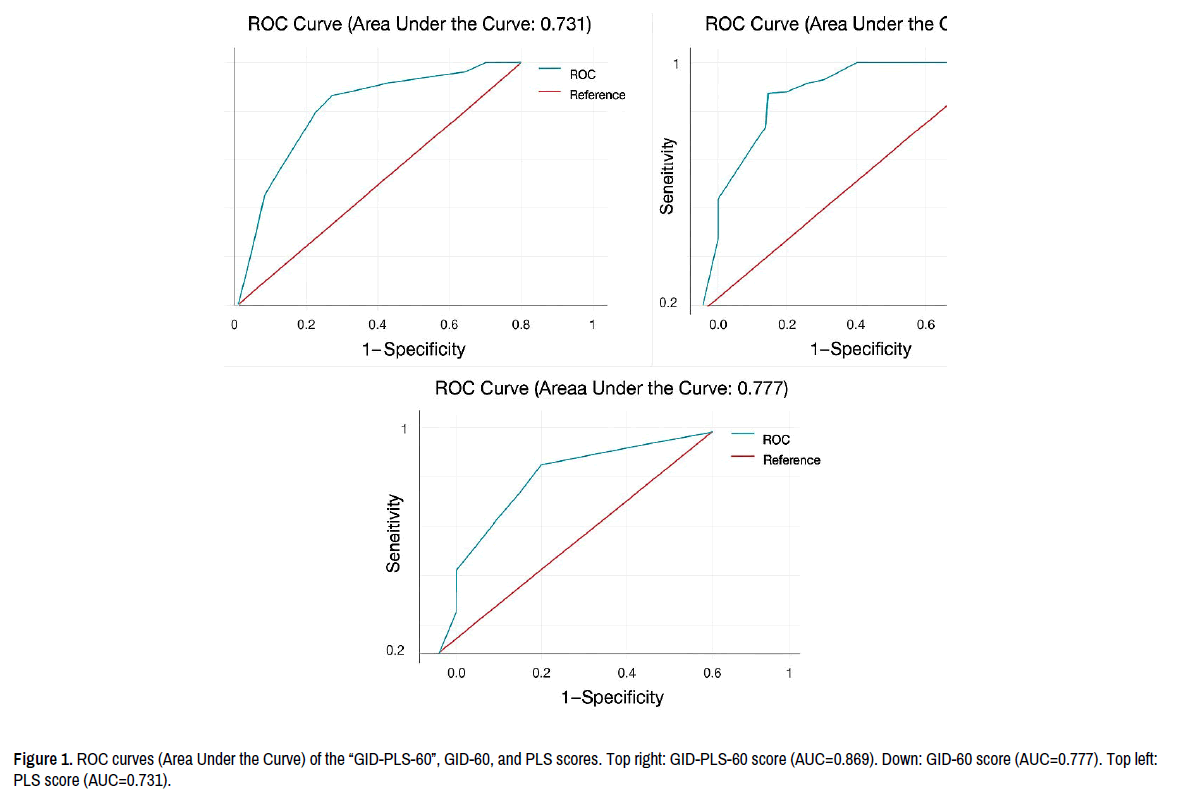
Figure 1. ROC curves (Area Under the Curve) of the “GID-PLS-60”, GID-60, and PLS scores. Top right: GID-PLS-60 score (AUC=0.869). Down: GID-60 score (AUC=0.777). Top left: PLS score (AUC=0.731).
| Items | Scores |
|---|---|
| Score " GIDPLS-60 » | |
| Lack of physiotherapy Respiratory (P) | +2 points |
| Absence washing pleural (L) | +4 points |
| Single-dose antibiotic therapy (S) | +1 points |
| Germ No isolated (G) | +4 points |
| Use of hemp Indian (I) | +5 points |
| Ground of diabetes (D) | +4 points |
| AGE> 60 years | +38 points |
| SCORE | Risk of complications |
| ≤ 1: risk Low (3-5% of complications) 2-3: risk moderate (29%-42% of complications) > 4 severe: (99%-100% of complications) |
|
| Score clinical "GID-60 » | |
| Germ No isolated (G) | +1 point |
| Use of hemp Indian (I) | +1 point |
| Ground of diabetes (D) | +1 point |
| AGE > 60 years | +13 points |
| Score | Risk of complications |
| 0: risk weak (37 % of complications) 1: risk moderate (77%-86% complications) 2: risk severe: (96%-98% of complications) 3: risk very severe: (100% of complications) |
|
| Lack of Physiotherapy Respiratory (P) | +2 points |
| Lack of pleural lavage (L) | +4 points |
| Single-dose antibiotic therapy(S) | +1 points |
| SCORE | Risk of complications |
| ≤1 point: risk weak (16-31% of complications) 2 has 3 points: risk Moderate (62-74% of complications) >4 points: risk Pupil (99-100% of complications) |
|
Table 5. Predictive scores for complications of purulent pleurisy (n=388).
These predictive factors were divided into clinical and therapeutic factors.
The clinical factors (age>60 years, cannabis use, diabetes mellitus and non-isolated pathogen) were used to develop a pre-treatment predictive score, named "GID-60", which includes:
• Non-isolated pathogen (G)
• Use of cannabis (I)
• Diabetes mellitus (D)
• Age>60 years
The sensitivity of the "GID-60" score was 33% and its specificity 80%, with an ROC area of 0.77, indicating good performance (Figure 1). According to "GID-60", the risk of complications was 37% for a score of 0. 77-86% for a score of 1, 96-98% for a score of 2 and 100% for a score of 3 (Table 5).
Therapeutic factors (single-dose antibiotic therapy, absence of respiratory physiotherapy and absence of pleural washing) were rated to create a score predicting complications related to treatment type, named "PLS", which includes:
Absence of respiratory physiotherapy (P)
Absence of pleural lavage (L)
Single-dose antibiotic therapy (S)
The "PLS" score had a sensitivity of 41% and a specificity of 83%, with an ROC area of 0.73, indicating good performance (Figure 1). According to "PLS", the risk of complications was 16-31% for a score ≤ 1, 62-74% for a score of 2 or 3 and at least 99% for a score ≥ 4 (Table 5).
Patient profile
The mean age in our study was 40.74 ± 14.67 years, significantly lower than that reported by Bobbio A, et al. [7] in France (62.4 ± 15.6 years), Arnold DT, et al. [8] in the United Kingdom (64 years), Gupta I, et al. [9] in the USA (58.3 ± 0.1 years) and Mouddene AN, et al. [10] in Casablanca (55 ± 16 years). Conversely, Diallo OH, et al. [11] in Guinea reported a mean age of 35 years. This difference between African and European/American populations likely reflects the generally demographic youngers in West Africa, particularly in Senegal.
In our study, males predominated (74.2%, sex ratio 2.88), corroborating findings by Bobbio A, et al. [7] in France (71.7% males; sex ratio 2.53), Arnold DT, et al. [8] in the United Kingdom (sex ratio 2.17), Gupta I, et al. [9] in the USA (sex ratio 2.11) and Mouddene AN, et al. [10] in Casablanca (sex ratio 3.5). This male predominance may be due to men seeking care later and leading less cautious lifestyles.
Among the 388 patients, 78.35% (n=304) were employed, with 70.06% (n=213) having occupations that involved public contact. These findings suggest that purulent pleuritis affects young men in active socio-economic roles, potentially contributing to both direct and indirect economic losses and an predominantly increased poverty index [12].
In our study, 51.5% of patients had a significant medical history and/or comorbidities, predominantly tuberculosis (21.5%) followed by diabetes (14%). These Figure are lower than those reported by Mouddene AN, et al. [10] in Casablanca (diabètes: 17%, neoplasia: 5%), Bobbio A, et al. [7] in France (71.7%, malnutrition: 33%), Cargill TN, et al. [13] in the United Kingdom (72%), Mummadi et SR, al. [14] in the USA (68%) and Chan KP, [15] in China (13.7%), thereby reflecting the endemic nature of tuberculosis in West Africa.
Diabetes remains a common risk factor for infections, particularly respiratory infections, across populations. In our study, 36.08% of patients were smokers, 10.31% used cannabis (Indian hemp) and 7.22% consumed alcohol. These rates are higher than those reported by Bobbio A, et al. [7] in France (18.6% smokers) and Mummadi SR, et al. [14] in the USA (16% smokers). Although alcohol consumption is recognized as a risk factor, precise data are not always available. Tobacco smoke, with its harmful constituents, damages the mucociliary clearance - a vital component of mechanical defense - while alcohol can impair the swallowing reflex, increasing the risk of inhaling oropharyngeal secretions laden with microorganisms.
In our study, pleural fluid cultures were positive in 26.55% of cases (n=103), yielding 11 types of pathogenic organisms, predominantly GNB (n=58), mainly K. pneumoniae (n=28) and Gram-positive cocci (n=44), mainly S. aureus (n=30).
These results are similar to those of Mouddene AN, et al. [10] in Casablanca (26.4% positive cultures, predominantly Pneumococcus) and lower than those reported by Bobbio A, et al. [7] in France (65% positive cultures, with S. aureus predominating in 33% of cases) and Mummadi SR, et al. [14] in the USA (56% positive cultures, with the Streptococcus milleri group predominating in 20.7% of cases). Additionally, endobronchial brushings, blood cultures and endoscopic sample bacteriology isolated a pathogen in 7, 2 and 8 patients respectively. These lower yields, compared with Pang Chan [15] in China (88.7%, predominantly Streptococcus and anaerobes such as P. aeruginosa, B. cepacia and S. aureus), underscore the need to improve our sampling techniques. This could be achieved by integrating cytobacteriological sputum examinations due to the pulmonary entry point of pleural infection [12], systematic blood cultures and inoculation of pleural fluid into blood culture bottles [12]; alternatively, bronchial endoscopy may be considered if the initial bacteriology is non-contributory, potentially increasing the yield by 20% [15].
Empirical antibiotic therapy was initiated in all patients, based on amoxicillin-clavulanic acid in 74.45% of cases, corroborating Letheulle J, et al. [16] in France (60% usage) and Porcel JM, et al. [17] in Spain (universal use).
In the study by Maskell NA, et al. [18] in 2015 from the UK, all 454 patients received a combination of cefuroxime and metronidazole. The preference for amoxicillin-clavulanic acid is justified by its broad spectrum and effective pleural penetration, even when administered orally, whereas cephalosporins demonstrate poor oral pleural diffusion. The duration of treatment conforms to international recommendations [12].
Pleural evacuation was performed in 96.9% of patients. More than half (57.5%) underwent chest drainage, while needle pleural evacuation was performed in 40.7% of cases. Empyema represents the fibrinopurulent stage of purulent pleuritis, justifying the high rate of drainage [4]. These findings are similar to those reported by Hindi M, et al. [19] in Marrakech (73.7% drainage, 13% iterative evacuation puncture) and Ayari A, et al. [20] in Tunisia (77.8% drainage, 22.2% evacuation puncture), with Letheulle J, et al. [16] in France reporting 100% evacuation puncture.
Passive drainage with washing was performed in 43.7% of patients (n=21), with a mean duration of 26.13 ± 14.08 days; these results are lower than those reported by Hooper CE, et al. [21] in the UK (2015).
Differences between studies may be attributed to varying research objectives, whether comparing methods or assessing the impact of adjunct treatments with pleural evacuation-lavage. Additionally, our study was conducted during the COVID-19 pandemic, necessitating cautious pleural procedures to protect both healthcare staff and patients. The unavailability of thoracic ultrasound further limited pleural interventions in these predominantly septate cases. Respiratory physiotherapy, performed in 71.13% of our patients (mostly passively, either improvised or via incentive spirometry), may have been suboptimal, potentially contributing to sequelae such as fibrothorax. Surgical treatment, carried out in 2.83% of patients (n=11), predominantly involving decortication and debridement (36.6% and 18.18% respectively), contrasts with the high rates of medium- and long-term complications- fibrothorax (93.8%; n=242) and loculation (22.5%; n=58)-indicating that surgery is not always performed when indicated, thus increasing morbidity and mortality. The lethality of purulent pleuritis was 3.35% (n=13), with a proportional mortality of 2.1%, similar to the 4.6% reported by Mouddene AN, et al. [10] in 2023.
Factors associated with complications
Mortality was higher in patients aged 50 years and over, or those with a history, comorbidity, or predisposition-particularly in diabetics, individuals living with HIV and patients with progressive cancer. Mortality was also more frequent in alcohol consumers, cannabis users and smokers [21].
Mortality was higher when a pathogen was isolated, particularly a GNB. Indeed, the profitability of bacteriology of samples taken after antibiotic therapy could reflect the resistance of the organism to first-line antibiotics and its virulence. This mortality was lower in patients treated with double-dose β-lactam therapy, particularly with ceftriaxone. Pleural evacuation (especially via needle) and respiratory physiotherapy (notably passive as an adjunct) were associated with reduced mortality. These results align with Bobbio A, et al. [7] in France (where advanced age, diabetes and immunocompromised conditions increased complications by 72%, including death from purulent pleuritis) and with findings from Cargill T. et al. [13] in the UK and Soegaard M, et al. [22] in Denmark, which both reported that comorbidities, immunocompromise, tobacco and alcohol use increased complications and mortality. Rahman NM, et al. [23] further noted that delayed consultation increased complication rates and mortality.
Regarding GNB, the mortality and complication rates were very high-especially in studies by Mummadi SR, et al. [14] in the USA and Cargill T, et al. [13] in the UK-corroborating our findings. Cargill TN, et al. [13] demonstrated that β-lactams, particularly ceftriaxone, achieve better pleural penetration, explaining their efficacy, while Porcel JM, et al. [17] in Spain supported that higher doses of β-lactams reduce complications. Our results indicate that suction drainage reduces the risk of complications by 60%. Aspiration, not available in all settings and requiring hospitalization, increases management costs. In our study, combining pleural washing with instrumental treatment reduced the risk by 60%. Hooper CE, et al. [21] in the UK reported that pleural evacuation combined with isotonic saline (0.9%) wash reduced complications by 15%, whereas Letheulle J, et al. [24] in France found that iterative evacuating pleural puncture was associated with a 4% complication rate. Recent studies support the effectiveness of optimized drainage protocols. For instance, Smith J, et al. [25] demonstrated in 2023 that enhanced drainage protocols, combined with close monitoring, significantly reduced complications in patients with thoracic empyema.
Respiratory physiotherapy is a protective factor, reducing complications by 40%, particularly as it can start early at the patient's bedside and is relatively accessible. Furthermore, Garcia M, et al. [26] reported that early integration of respiratory physiotherapy resulted in lower morbidity associated with pleural infections, confirming our findings regarding the protective role of this practice. Finally, recent guidelines from the World Health Organization (WHO) [27] emphasize the need to adapt management strategies according to the epidemiological context and available resources, thus reinforcing the interest in having a predictive score such as "GIDPLS-60".
These recent contributions consolidate the value of a combined approach that takes into account both clinical and therapeutic factors in predicting complications. Validating this score in other hospital centers could further refine its precision and applicability in varied clinical settings.
Predictive scores of complications
We defined three scores: the combined clinical and therapeutic "GIDPLS-60" score, which can be simplified into the clinical "GID-60" score or the therapeutic "PLS" score. The "PLS" score had a sensitivity of 41%, which is higher than that of the "GID-60" and "GIDPLS-60" scores; however, the "GIDPLS-60" score exhibited superior specificity at 86%. Although the "GIDPLS-60" score is less sensitive, it is more specific and overall, more efficient than both the "GID-60" and "PLS" scores. The "GID-60" score was the least specific and sensitive, while the "PLS" score, despite its better sensitivity, remained the least efficient. Hence, the "GIDPLS-60" score appears to be the best predictor. These results should be validated by applying the score in other departments managing purulent pleuritis, followed by further evaluation. The presence of a support tool or measurement instrument (such as the PP score) can reduce inter-evaluator variability and improve the reproducibility of clinical decisions [26]. However, despite its theoretical usefulness, the integration of a clinical score into daily practice depends on its simplicity, external validity and actual impact on patient management [27,28]. In our study, the PP score showed good discriminative potential, suggesting that it could serve as an effective decision support tool in routine practice [29]. The relevance of this score must nevertheless be assessed within the clinical context. For instance, previous studies have shown that the performance of predictive scores may vary according to the characteristics of the studied population or local care practices [30,31]. Furthermore, the use of predictive scores in emergency departments or primary care remains a logistical and organizational challenge [32]. The methodological robustness of our study is one of its strengths, particularly due to multivariate analysis and model validation on an independent sample. However, certain limitations should be highlighted, such as potential selection bias and the need to validate the PP score in other populations [33,34]. Finally, the acceptability of the score by clinicians and its integration into hospital information systems are crucial factors for its widespread adoption [35,36]. Future studies should assess the impact of the PP score on clinical outcomes, patient satisfaction and healthcare efficiency [37].
Purulent pleurisy can progress to death. Their lethality was 3.35% (n=13) and the proportional mortality was 2.1%. These complications are pachypleuritis (93.8%; n=242) and encystment (22.5%; n=58). The predictive score of complications "GIDPLS-60" determined in this work could be applied in other departments and evaluated later. Its validity would allow its use in Africa where patients with purulent pleurisy have a particular profile.
(I) Conception and design: K Thiam, B Elberhichi; (II) Administrative support: NO Touré; (III) Provision of study materials or patients: K Thiam, B Elberhichi, FBR Mbaye, S Diatta, PM Soumaré, Mbaye Fall, M Sangharé, NO Touré, P Astoul; (IV) Collection and assembly of data: K Thiam, B Elberhichi; (V) Data analysis and interpretation: All authors; (VI) Manuscript writing: All authors; (VII) Final approval of manuscript: All authors.
None.
There is no conflict of interest in this study.
Google Scholar, Cross Ref, Indexed at
Google Scholar, Cross Ref, Indexed at
Google Scholar, Cross Ref, Indexed at
Google Scholar, Cross Ref, Indexed at
Google Scholar, Cross Ref, Indexed at
Google Scholar, Cross Ref, Indexed at
Google Scholar, Cross Ref, Indexed at
Google Scholar, Cross Ref, Indexed at
Google Scholar, Cross Ref, Indexed at
Google Scholar, Cross Ref, Indexed at
Google Scholar, Cross Ref, Indexed at
Google Scholar, Cross Ref, Indexed at
Google Scholar, Cross Ref, Indexed at
Google Scholar, Cross Ref, Indexed at
Google Scholar, Cross Ref, Indexed at
Google Scholar, Cross Ref, Indexed at
Google Scholar, Cross Ref, Indexed at
Google Scholar, Cross Ref, Indexed at
Google Scholar, Cross Ref, Indexed at
Google Scholar, Cross Ref, Indexed at
Pulmonary & Respiratory Medicine received 1690 citations as per Google Scholar report