Perspective - (2025) Volume 16, Issue 4
Received: 01-Jul-2025, Manuscript No. jpm-26-179434;
Editor assigned: 03-Jul-2025, Pre QC No. P-179434;
Reviewed: 17-Jul-2025, QC No. Q-179434;
Revised: 22-Jul-2025, Manuscript No. R-179434;
Published:
29-Jul-2025
, DOI: 10.37421/2090-0902.2025.16.545
Citation: Brooks, Lillian. ”Scientific Frontiers: Advancements in Physics and Beyond.” J Phys Math 16 (2025):545.
Copyright: © 2025 Brooks L. This is an open-access article distributed under the terms of the Creative Commons Attribution License, which permits unrestricted use, distribution and reproduction in any medium, provided the original author and source are credited.
The field of computational physics continues to advance, driven by the need to simulate increasingly complex phenomena. One area of significant progress is the development and application of advanced numerical methods for solving challenging partial differential equations that govern fluid dynamics. These methods are crucial for achieving greater accuracy and efficiency in simulations, particularly when dealing with fine-scale structures. For instance, adaptive mesh refinement techniques have demonstrated their effectiveness in this regard, providing improved resolution where it is most needed. This foundational work ensures the stability and convergence of the numerical schemes employed, paving the way for more robust and reliable simulations of fluid behavior. The study of quantum entanglement in many-body systems presents another frontier in theoretical physics. Researchers are actively developing novel approaches to quantify and understand this fundamental property of quantum mechanics. A key development is the introduction of new entanglement entropy measures that are computationally tractable, even for large systems. These measures offer deeper insights into the intricate correlations that exist between particles, proving invaluable for characterizing phase transitions and topological orders in quantum materials. The exploration of novel materials with unique electronic properties remains a vital area of research. The development of new classes of topological insulators, for example, promises to revolutionize electronic devices. These materials exhibit tunable electronic characteristics, making them highly attractive for applications in low-power electronics and spintronics. Experimental synthesis and characterization, supported by theoretical calculations, are essential for understanding and harnessing their full potential. Understanding emergent phenomena in complex networks is crucial for deciphering the behavior of many natural and artificial systems. Theoretical frameworks are being developed to analyze these intricate structures. Novel statistical approaches are emerging that can identify critical nodes and map the flow of information within networks. The practical applicability of these frameworks is being validated through simulations of diverse systems, including social and biological networks, highlighting their broad relevance. Non-linear optical phenomena in photonic crystals are of considerable interest for the development of advanced optical devices. Research in this area focuses on tailoring these materials to enhance specific optical responses. The observation of enhanced second-harmonic generation through nanostructure engineering is a significant achievement. This work opens up avenues for creating more efficient optical devices for telecommunications and sensing applications. The quantum mechanical behavior of systems under extreme conditions, such as trapped ions in intense electromagnetic fields, is a subject of ongoing investigation. Advanced spectroscopic techniques are employed to probe these systems. Elucidating the energy level structures and transition probabilities is fundamental for advancing quantum computing and precision measurement technologies. These studies are critical for harnessing quantum phenomena for technological applications. The simulation of granular materials and their behavior under stress is essential for fields like geotechnical engineering. The development of computational models that incorporate realistic physical parameters is a key objective. Such models can provide more accurate predictions of material failure and flow, which are critical for safety and design in relevant industries. The incorporation of friction and cohesion parameters is vital for this accuracy. The discovery of new superconducting materials is a major goal in condensed matter physics. Machine learning algorithms are emerging as powerful tools in this quest. By analyzing vast datasets of material structures and experimental results, predictive models can be developed to accelerate the identification of novel superconductors with desired properties. This data-driven approach significantly speeds up the discovery process. Soft biological tissues exhibit complex viscoelastic behavior that is not fully understood. The development of theoretical frameworks based on statistical mechanics is crucial for their study. Such frameworks can capture the intricate relationship between a tissue's microstructure and its macroscopic mechanical properties. Validation against experimental data from actual biological tissues is essential for confirming the model's accuracy. Anomalous diffusion processes, where transport deviates from classical Fickian diffusion, are prevalent in many natural systems. Fractional calculus offers a powerful mathematical tool for modeling these phenomena. The introduction of novel fractional diffusion equations accurately describes transport in heterogeneous media. This approach has significant potential applications in areas like porous media flow and polymer dynamics, providing a more nuanced understanding of transport mechanisms.
The practical application of advanced numerical methods in fluid dynamics is a testament to the ongoing progress in computational physics. The use of adaptive mesh refinement techniques, as highlighted in recent studies, is pivotal for enhancing the accuracy and computational efficiency of simulations involving complex partial differential equations. These techniques are indispensable for capturing the intricate details of phenomena characterized by fine-scale structures, ensuring that simulations provide a faithful representation of reality. Furthermore, the research emphasizes the importance of understanding the theoretical underpinnings that guarantee the stability and convergence of these advanced numerical methods, which is crucial for building reliable simulation tools. In the realm of quantum physics, the analysis of quantum entanglement in many-body systems has seen significant methodological advancements. The development of new entanglement entropy measures that are computationally efficient represents a breakthrough, enabling the study of larger and more complex quantum systems. These novel measures provide unprecedented insights into the correlations between particles, proving to be exceptionally useful for the characterization of critical phenomena such as phase transitions and the identification of topological orders. Such advancements are key to understanding the fundamental nature of quantum matter. The materials science community is actively pursuing the creation of novel materials with tailored electronic properties. The synthesis and characterization of a new class of topological insulators exemplify this effort. These materials hold immense promise for next-generation electronic devices, particularly in the domains of low-power electronics and spintronics, due to their unique electronic behavior. The synergy between experimental findings and theoretical calculations is vital for achieving a comprehensive understanding of these materials and unlocking their technological potential. The study of emergent phenomena in complex networks is an interdisciplinary endeavor that draws upon various fields of science. The introduction of a new theoretical framework, employing a novel statistical approach, is a significant step towards understanding how collective behavior arises in these systems. This framework allows for the identification of critical nodes and the analysis of information flow, offering valuable insights that can be applied to diverse networks, from social interactions to biological systems. The field of optics is witnessing exciting developments in the engineering of photonic crystals for enhanced non-linear optical responses. The reported observation of amplified second-harmonic generation through meticulous nanostructure engineering is a notable achievement. This advancement provides a clear pathway for the development of more efficient and effective optical devices, which are crucial for the advancement of telecommunications and sensing technologies, areas that rely heavily on sophisticated light-matter interactions. The quantum behavior of systems under extreme electromagnetic conditions, such as trapped ions, continues to be a subject of intense research. The application of advanced spectroscopic techniques allows for a detailed investigation of their energy level structures and transition probabilities. The insights gained from such studies are of paramount importance for the advancement of quantum computing technologies and the development of highly precise measurement instruments, areas that are at the forefront of scientific innovation. The accurate simulation of granular materials is a challenging but critical task for various engineering disciplines. The development of a new computational model that incorporates realistic parameters for friction and cohesion marks a significant improvement in this area. This enhanced model leads to more precise predictions of material failure and flow dynamics, which are of direct relevance to geotechnical engineering and materials science, ensuring greater reliability in critical infrastructure design. The application of machine learning to materials discovery is revolutionizing the field of condensed matter physics. The use of machine learning algorithms to predict the properties of novel superconducting materials, by analyzing extensive datasets, represents a powerful new paradigm. This approach has the potential to dramatically accelerate the discovery of new superconductors with specific desirable characteristics, leading to breakthroughs in energy technologies. The statistical mechanics of soft biological tissues presents a complex but important area of study. The development of a thermodynamic framework that accurately models the viscoelastic behavior of these tissues, taking into account their intricate microstructure, is a significant contribution. The validation of such models against experimental data, such as that from muscle tissue, is crucial for ensuring their applicability and reliability in biological and medical research. Anomalous diffusion, a phenomenon observed in many complex systems, is now being effectively modeled using the principles of fractional calculus. The introduction of a novel fractional diffusion equation provides a more accurate description of transport processes in heterogeneous media. This theoretical advancement has broad implications for various scientific and engineering fields, including the study of porous media flow and the dynamics of polymers, offering a more refined understanding of transport phenomena.
This compilation of research highlights advancements across several scientific disciplines. In computational physics, improved numerical methods and adaptive mesh refinement are enhancing simulations in fluid dynamics. Quantum physics sees progress in efficiently computing entanglement entropy for many-body systems, offering deeper insights into particle correlations. Materials science is advancing with the development of tunable topological insulators for electronics and spintronics. Complex network analysis benefits from new statistical frameworks for understanding emergent behavior. Non-linear optics research focuses on tailoring photonic crystals for better optical devices. Quantum dynamics of trapped ions are being explored for quantum computing and precision measurements. Computational models for granular materials are becoming more accurate. Machine learning is accelerating the discovery of superconducting materials. Statistical mechanics is providing frameworks for understanding the viscoelasticity of biological tissues. Finally, fractional calculus is offering new ways to model anomalous diffusion in complex media.
None
None
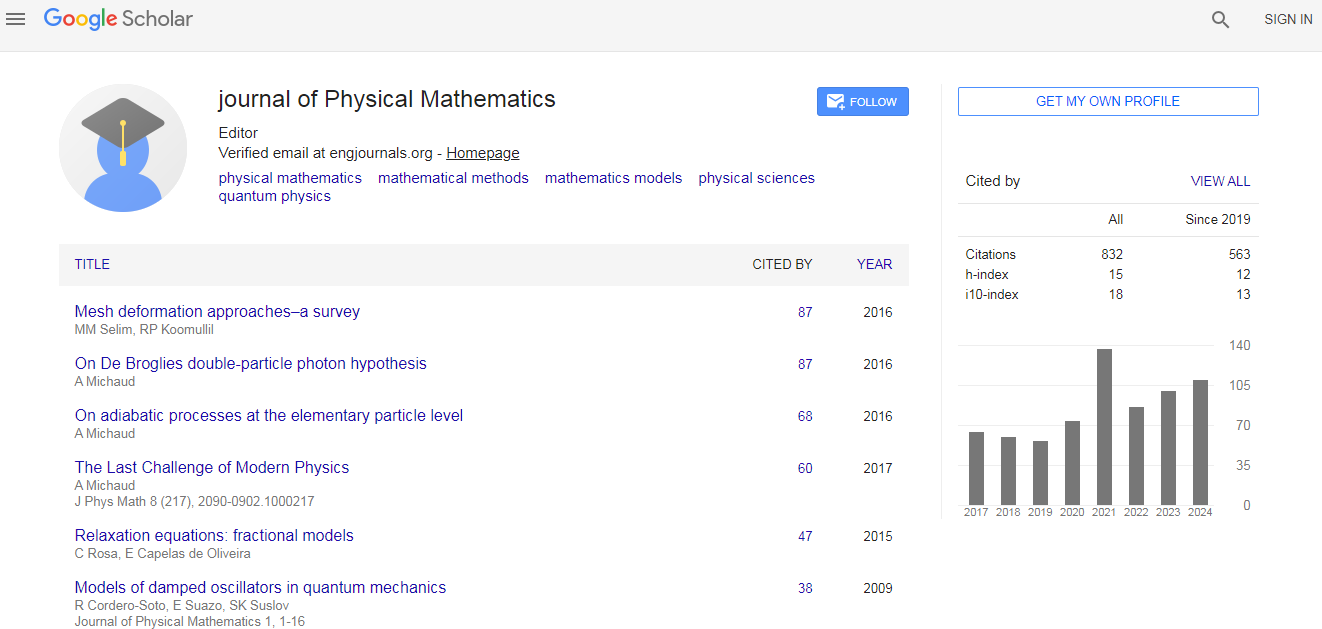
Physical Mathematics received 686 citations as per Google Scholar report