Opinion - (2025) Volume 11, Issue 3
Received: 02-Jun-2025, Manuscript No. jctt-26-188406;
Editor assigned: 04-Jun-2025, Pre QC No. P-188406;
Reviewed: 18-Jun-2025, QC No. Q-188406;
Revised: 23-Jun-2025, Manuscript No. R-188406;
Published:
30-Jun-2025
, DOI: 10.37421/2471-9323.2024.10.324
Citation: OConnor, Daniel. ”Science of Hair Shine: Structure, Care, and Appeal.” J Cosmo Tricho 11 (2025):324.
Copyright: © 2025 OConnor D. This is an open-access article distributed under the terms of the Creative Commons Attribution License, which permits unrestricted use, distribution and reproduction in any medium, provided the original author and source are credited.
The aesthetic appeal of hair is intrinsically linked to its visual luster, a quality that cosmetic science continuously endeavors to enhance through innovative formulations and advanced ingredients [1].
The inherent shine of hair is a complex phenomenon, influenced by structural integrity and the way light interacts with the hair surface, prompting extensive research into its underlying mechanisms [2].
Understanding the optical properties of hair fibers is crucial for developing effective shine-enhancing products, as treatments can manipulate light reflection to create a perception of gloss and health [3].
Environmental factors and styling practices can significantly degrade hair's natural shine by damaging the cuticle, necessitating cosmetic interventions for protection and restoration [4].
Specific ingredients, such as polymers and lipids, play a pivotal role in cosmetic formulations aimed at imparting shine by creating a smooth, reflective surface on the hair shaft [5].
The perception of hair shine is a key factor in consumer assessment of hair health and beauty, driving the development of products that optimize this visual attribute [6].
Formulating hair care products for long-lasting shine presents unique challenges, requiring careful selection of ingredients like emulsifiers and emollients to maintain and improve the hair's reflective properties [7].
Conditioning treatments are vital for repairing damaged hair's surface morphology, restoring cuticle smoothness, and consequently increasing light reflectance for enhanced visual appeal [8].
Advanced cosmetic developments have led to the creation of products that focus on light-refracting properties and cuticle smoothing, aiming to achieve a captivating and dynamic hair shine often described as 'aurora strands' [9].
Ultimately, the interplay between trichological understanding and cosmetic science is essential for achieving optimal hair health and beauty, with shine being a prominent indicator of vitality [10].
The multifaceted nature of hair's aesthetic appeal, particularly its shine, is being continually explored through cosmetic advancements that aim to amplify light reflection and create a visually striking, healthy appearance [1].
Research into novel ingredients and technologies for hair care focuses on enhancing shine and visual radiance, with developments in conditioning agents, optical brighteners, and silicone derivatives playing a significant role [2].
The optical properties of hair fibers are being meticulously examined to understand how surface treatments can manipulate light reflection and enhance gloss, linking physical hair characteristics to aesthetic outcomes [3].
The impact of environmental stressors and styling practices on hair shine, such as UV exposure and heat styling, is well-documented, leading to the development of protective and restorative cosmetic solutions [4].
Specific polymers and lipids are integral to hair care formulations designed to impart shine by creating a smooth, reflective surface through their interaction with the hair shaft [5].
The perception of hair shine, often associated with hair health and beauty, is a key consideration in trichological and cosmetic science, driving product development to optimize this attribute [6].
Formulation science addresses the challenges in creating hair care products that deliver lasting shine, utilizing ingredients like emulsifiers and emollients to enhance and maintain the hair's reflective properties under various conditions [7].
Conditioning treatments are specifically investigated for their ability to improve the surface morphology of damaged hair, restoring smoothness and increasing light reflectance to enhance visual appeal [8].
The concept of achieving exceptionally lustrous hair, termed 'aurora strands,' is directly linked to advancements in cosmetic product development that focus on light-refracting properties and cuticle smoothing [9].
The sensory attributes of hair, with shine being a primary focus, are crucial in consumer perception, guiding the selection and formulation of cosmetic ingredients to enhance perceived hair quality and beauty [10].
This collection of research explores the multifaceted aspects of hair shine, from its structural and optical properties to the impact of cosmetic advancements. Studies investigate innovative ingredients like polymers, lipids, and conditioning agents that enhance light reflection and smooth the hair cuticle. Environmental factors and styling practices are examined for their detrimental effects on shine, leading to the development of protective formulations. The perception of hair shine is linked to consumer appeal and hair health, driving the creation of products that optimize gloss and radiance. Ultimately, the research highlights the critical interplay between trichology and cosmetic science in achieving desirable and lasting hair shine.
None
None
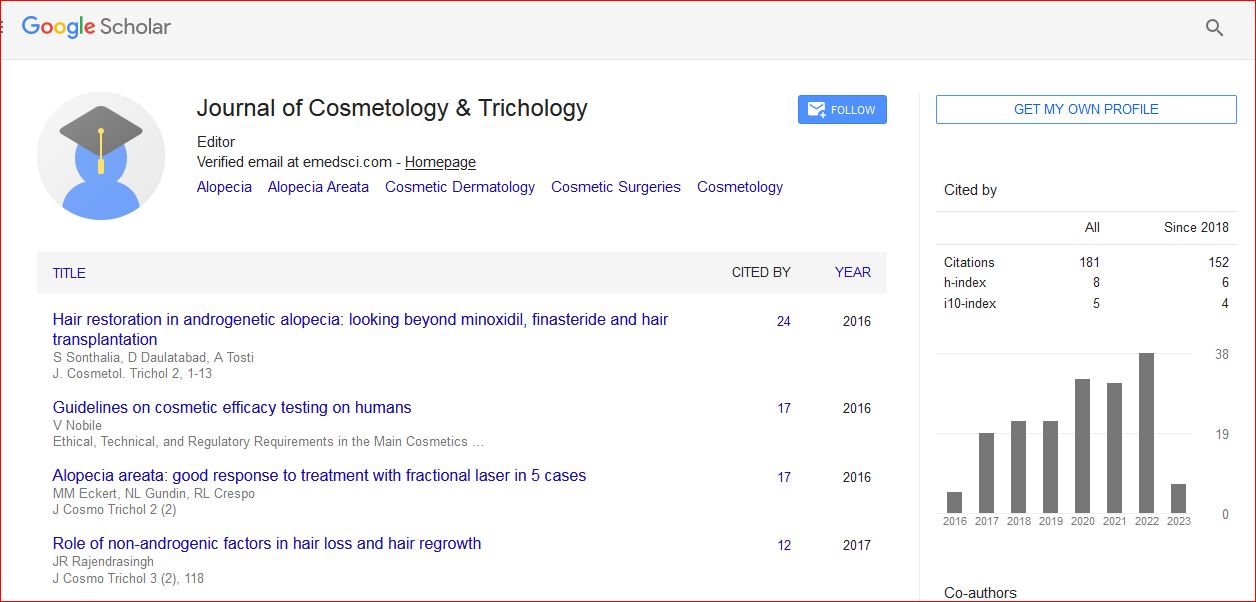
Journal of Cosmetology & Trichology received 180 citations as per Google Scholar report