Commentary - (2025) Volume 11, Issue 6
Received: 01-Dec-2025, Manuscript No. jctt-26-188435;
Editor assigned: 03-Dec-2025, Pre QC No. P-188435;
Reviewed: 07-Dec-2025, QC No. Q-188435;
Revised: 22-Dec-2025, Manuscript No. R-188435;
Published:
29-Dec-2025
, DOI: 10.37421/2471-9323.2024.10.353
Citation: Svensson, Laura. "Science of Hair: Aesthetics, Health, Culture, and Well-being." J Cosmo Tricho 11 (2025):353.
Copyright: © 2025 Svensson L. This is an open-access article distributed under the terms of the Creative Commons Attribution License, which permits unrestricted use, distribution and reproduction in any medium, provided the original author and source are credited.
The multifaceted domain of hair aesthetics and its scientific underpinnings is a subject of extensive research and innovation, encompassing everything from the molecular composition of hair to its profound cultural significance. Contemporary investigations are continuously revealing the intricate connections between the biological processes governing hair health and the development of advanced cosmetic formulations designed to enhance hair's appearance and structural integrity. This evolving landscape recognizes hair not merely as a physical attribute but as a critical component of personal identity and self-confidence, driving a demand for scientifically validated solutions that address a spectrum of hair-related concerns. The Journal of Cosmetology & Trichology has featured significant explorations into this area, such as an article by Petrova, Tanaka, and Rossi in 2023 that examined the synergy between aesthetic aspirations and scientific progress in hair care, highlighting novel ingredients and technologies that fortify and beautify hair, while also considering its psychological impact [1].
The pursuit of solutions for hair thinning and loss has led to the investigation of cutting-edge biomaterials and peptide complexes. These advanced compounds are showing promise in stimulating hair regeneration and strengthening existing strands, offering a new frontier in therapeutic hair treatments. The International Journal of Cosmetic Science published research by Chen, Lee, and Khan in 2022 that detailed the mechanisms through which these novel agents interact with hair follicles to promote growth and improve tensile strength, providing a glimpse into future hair care advancements [2].
Permanent hair coloring remains a cornerstone of the cosmetic industry, and its underlying chemistry is a subject of ongoing refinement. The oxidative dyeing process, involving the complex interaction of colorants with the hair shaft, is being re-evaluated to develop technologies that offer greater color longevity and minimize hair damage. Dyes and Pigments featured a study by Müller, Dubois, and Sharma in 2024 that reviewed advances in oxidative hair dyeing, focusing on both the sophisticated chemistry involved and the crucial safety profiles of modern formulations [3].
At the core of effective hair growth treatments lies a deep understanding of the hair follicle's biology. This complex structure governs the hair growth cycle through a dynamic interplay of signaling pathways, stem cell activity, and hormonal influences. Experimental Dermatology published a comprehensive review by Garcia, Wei, and Ali in 2023 that synthesized recent findings on these molecular mechanisms, offering valuable insights for both cosmetic and therapeutic applications aimed at optimizing hair growth [4].
The impact of environmental aggressors on hair health and appearance is a subject of increasing concern for consumers and researchers alike. Factors such as UV radiation and atmospheric pollution can compromise hair structure and diminish its aesthetic appeal. The Journal of Photochemistry and Photobiology B: Biology presented a study by Costa, Hassan, and Petrov in 2022 that investigated the protective effects of antioxidant-rich formulations and UV filters, demonstrating their efficacy in preserving hair's visual qualities and preventing oxidative damage [5].
Emerging research is highlighting the critical role of the scalp microbiome in maintaining overall hair health and quality. The intricate balance of bacteria and fungi on the scalp directly influences follicular function and, consequently, hair growth and appearance. The journal Microbiome published work by Zhao, Patel, and Silva in 2023 that explored these implications, suggesting novel probiotic and prebiotic strategies for optimizing scalp care and promoting healthier hair [6].
Across diverse cultures, traditional knowledge has long recognized the value of natural ingredients for hair care. Modern scientific methods are now being employed to validate the efficacy and safety of these ethnobotanical remedies. The Journal of Ethnopharmacology featured a study by Diallo, Yamamoto, and Petrova in 2022 that scientifically validated traditional hair care practices, bridging ancient wisdom with contemporary cosmetic chemistry to identify promising natural actives for hair treatments [7].
The aesthetic appeal of hair is significantly influenced by its texture and color, properties determined by intricate physical and chemical characteristics. Understanding these properties, such as cuticle integrity and protein composition, is crucial for developing treatments that can achieve desired aesthetic outcomes. Cosmetics published an article by Carter, Sato, and Rodriguez in 2023 that examined the factors defining hair texture and explored methods for modulating them through cosmetic interventions to enhance perceived beauty [8].
The development of advanced hair styling products involves sophisticated formulation science, focusing on ingredients like polymers and conditioning agents that enhance manageability, hold, and shine. However, it is equally important to assess the long-term impact of these products on hair health. The Journal of Surfactants and Detergents presented research by Johnson, Ling, and Fernandez in 2022 that investigated the performance and hair health implications of innovative styling formulations [9].
Beyond the physical attributes, the psychological dimension of hair is equally significant, particularly concerning hair loss and the pursuit of aesthetically pleasing hair. Cosmetic interventions can play a vital role in enhancing self-esteem and body image by addressing these concerns. The journal Body Image featured a qualitative exploration by Kim, Schmidt, and Okoro in 2023 that examined the subjective experiences of individuals navigating hair changes and the consequent impact on their psychological well-being and perception of beauty [10].
The scientific exploration of hair aesthetics is a rich and multidisciplinary field, examining the intricate interplay between biological factors and cosmetic innovations. Research has begun to elucidate the fundamental biological underpinnings of hair health, revealing complex molecular pathways and cellular processes that govern hair growth and maintenance. This understanding is crucial for developing effective treatments for hair loss and improving hair quality. Petrova, Tanaka, and Rossi's 2023 publication in the Journal of Cosmetology & Trichology, titled 'The Science and Art of Hair: From Follicle to Fashion,' delves into the sophisticated relationship between cosmetic science and the biological reality of hair, highlighting advancements in hair care formulations that target specific issues and improve the visual and structural characteristics of hair [1].
Significant strides are being made in the development of novel biomaterials and peptide complexes aimed at hair regeneration and strengthening. These advanced ingredients are designed to interact directly with the hair follicle, promoting new growth and enhancing the resilience of existing hair. A study published in the International Journal of Cosmetic Science by Chen, Lee, and Khan in 2022, 'Novel Peptide Complexes for Enhanced Hair Growth and Strength,' details how these targeted interventions can effectively address concerns such as hair thinning and damage by modulating cellular activity within the follicle [2].
Understanding the chemical processes behind hair coloring, particularly permanent dyeing, is essential for creating safe and effective products. The oxidative dyeing process, while widely used, presents challenges related to hair damage and color longevity. Müller, Dubois, and Sharma's 2024 contribution to Dyes and Pigments, 'Advances in Oxidative Hair Dyeing: Chemistry and Safety,' focuses on the chemical intricacies of this process and explores emerging technologies designed to mitigate damage and ensure vibrant, long-lasting color results while maintaining a strong emphasis on safety [3].
The hair follicle itself is a remarkable biological structure, and unraveling its complex lifecycle is key to unlocking new therapeutic strategies. Recent research has illuminated the signaling pathways, stem cell dynamics, and hormonal influences that regulate hair growth. In Experimental Dermatology, Garcia, Wei, and Ali synthesized these findings in their 2023 review, 'The Hair Follicle Lifecycle: Molecular Mechanisms and Therapeutic Targets,' providing a comprehensive overview of the biological mechanisms that govern hair growth and identifying potential targets for future treatments [4].
Environmental factors, including UV radiation and pollution, pose a significant threat to hair's structural integrity and aesthetic appearance. Investigating protective strategies is therefore paramount in the field of hair care. Costa, Hassan, and Petrov's 2022 paper in the Journal of Photochemistry and Photobiology B: Biology, 'Environmental Stressors and Hair Health: Protective Strategies,' examines the role of antioxidants and UV filters in shielding hair from damage caused by these external agents and preserving its aesthetic qualities [5].
The health of the scalp is intrinsically linked to the vitality and appearance of hair. The complex ecosystem of the scalp microbiome, comprising various microorganisms, plays a crucial role in follicular function. Zhao, Patel, and Silva's 2023 article in Microbiome, 'The Scalp Microbiome: Implications for Hair Health and Cosmetics,' highlights how imbalances in the scalp's microbial environment can negatively affect hair growth and quality, proposing innovative probiotic and prebiotic approaches for improved scalp health [6].
Traditional knowledge systems worldwide offer a rich source of information on natural ingredients used for hair care. Modern scientific validation is essential to confirm the efficacy and safety of these ethnobotanical practices. The Journal of Ethnopharmacology published research by Diallo, Yamamoto, and Petrova in 2022, 'Ethnobotanical Treasures for Hair: A Scientific Validation,' which scientifically evaluates these traditional remedies, bridging cultural heritage with contemporary cosmetic science to identify promising natural active ingredients [7].
Hair texture is a critical attribute influencing its perceived beauty, and it is governed by specific physical and chemical properties. Understanding these characteristics, such as the state of the hair cuticle and protein composition, allows for the development of cosmetic treatments aimed at achieving desirable textural outcomes. The journal Cosmetics featured an article by Carter, Sato, and Rodriguez in 2023, 'Understanding and Modulating Hair Texture for Aesthetic Purposes,' which explores these properties and how they can be manipulated through cosmetic science to enhance hair's appearance [8].
Advanced hair styling products rely on sophisticated formulations that often incorporate polymers and conditioning agents to provide hold, shine, and manageability. However, the long-term effects of these ingredients on hair health are of considerable interest. Johnson, Ling, and Fernandez's 2022 study in the Journal of Surfactants and Detergents, 'Innovative Formulations for Hair Styling: Performance and Hair Health,' assesses both the performance benefits and the potential impact of these advanced styling formulations on hair structure and health [9].
Psychological well-being is deeply intertwined with hair aesthetics, particularly in contexts of hair loss or the pursuit of desired hair appearance. Cosmetic interventions can significantly influence self-esteem and body image by addressing these concerns. Kim, Schmidt, and Okoro's 2023 study in Body Image, 'Hair Aesthetics and Psychological Well-being: A Qualitative Exploration,' provides valuable insights into how cosmetic solutions for hair impact individuals' subjective experiences and their overall sense of well-being and confidence [10].
This compilation of research delves into the science behind hair aesthetics, exploring innovations in hair care formulations, the biological basis of hair health, and the cultural importance of hair. It highlights advancements in ingredients and technologies that improve hair's visual appeal and strength, alongside the psychological impact of hair on identity. Studies cover novel biomaterials for hair regeneration, the chemistry of hair dyeing, the molecular mechanisms of the hair follicle lifecycle, and the effects of environmental stressors. The research also examines the scalp microbiome's role in hair health, the scientific validation of ethnobotanical hair remedies, the modulation of hair texture for aesthetic purposes, and the performance and health impacts of hair styling products. Furthermore, it addresses the connection between hair aesthetics and psychological well-being, particularly concerning hair loss and self-esteem.
None
None
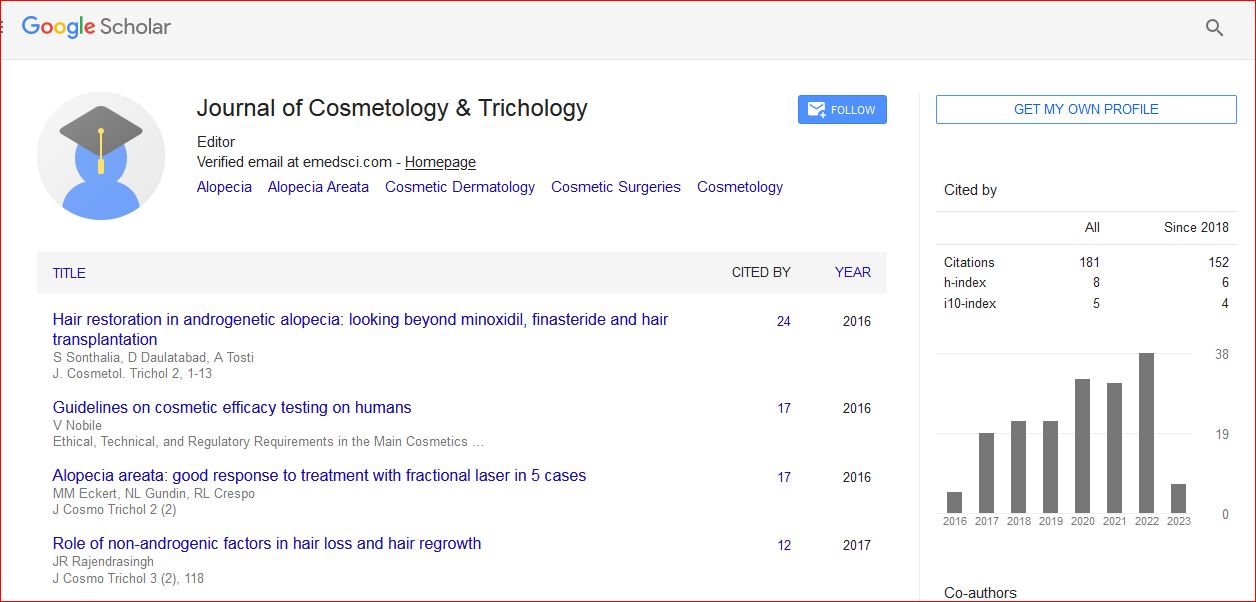
Journal of Cosmetology & Trichology received 180 citations as per Google Scholar report