Short Communication - (2025) Volume 16, Issue 4
Received: 01-Jul-2025, Manuscript No. hycr-25-174946;
Editor assigned: 03-Jul-2025, Pre QC No. P-174946;
Reviewed: 17-Jul-2025, QC No. Q-174946;
Revised: 22-Jul-2025, Manuscript No. R-174946;
Published:
29-Jul-2025
, DOI: 10.37421/2157-7587.2025.16.612
Citation: Park, Jun-seo. ”River Flow Management: Challenges and Advanced Approaches.” Hydrol Current Res 16 (2025):612.
Copyright: © 2025 Park J. This is an open-access article distributed under the terms of the Creative Commons Attribution License, which permits unrestricted use, distribution
and reproduction in any medium, provided the original author and source are credited.
The interconnected challenges facing global water resources are increasingly complex, driven by climate change, land use transformations, and growing human demands. A foundational area of research involves understanding how climate change impacts flood and low flow events in rivers. Global assessments, utilizing diverse hydrological models and observed data, have pinpointed significant shifts in both the intensity and timing of extreme flow conditions across varied geographical regions. This critical insight reinforces the urgent need for adaptive water resource management strategies to mitigate future risks [1].
In parallel with environmental changes, advancements in predictive modeling are transforming how we manage these systems. The application of machine learning and deep learning techniques for global-scale river flow modeling has demonstrated remarkable efficacy. These cutting-edge computational methods have been shown to considerably enhance prediction accuracy when compared to conventional hydrological models, thereby providing robust tools essential for modern water resource management and effective flood forecasting [2].
Such innovation is particularly crucial given the dynamic nature of global hydrological cycles. Beyond climatic influences, direct human activities profoundly reshape local hydrology. Research indicates that significant alterations in land use and land cover, such as urbanization and deforestation within subtropical watersheds, lead to substantial modifications in streamflow and sediment yield. The consequences manifest as increased flood risks and discernible changes in water quality, compelling a reevaluation of sustainable land management practices [3].
These findings underscore the direct link between human development and environmental outcomes in river systems. Furthermore, a significant challenge in water resource management lies in regions with limited data availability. Comprehensive environmental flow assessments, particularly in data-scarce areas, are being addressed through integrated approaches that combine hydrological modeling with expert knowledge. This method empowers water resource managers to make informed decisions aimed at preserving river ecosystem health while simultaneously balancing the competing demands of human water consumption [4].
Such holistic strategies are vital for equitable resource allocation. Urban development, a pervasive force in many parts of the world, exerts distinct pressures on aquatic environments. Studies reveal that rapid urban expansion profoundly alters the spatial and temporal variability of streamflow within urbanized river basins. This often results in increased runoff and heightened flash flood risks, emphasizing the critical necessity for urban planning frameworks that deeply integrate water management principles to ensure long-term sustainability [5].
Large-scale engineering projects, specifically dam construction, introduce another layer of complexity. Investigations, such as a case study focusing on the Jinsha River in China, demonstrate that dams drastically modify natural hydrological regimes and sediment delivery patterns. These alterations lead to significant geomorphological changes and adverse ecological consequences, thereby stressing the importance of adopting integrated river basin management strategies that consider both human and environmental needs [6].
An often-overlooked yet fundamental aspect of hydrological understanding is the interaction between groundwater and surface water. Detailed modeling of these intricate connections and their collective impact on river flow within complex watersheds proves indispensable for achieving accurate hydrological predictions. This understanding is paramount for effectively managing water resources, particularly in regions that are already experiencing significant water stress [7].
Looking towards the future, climate change projections necessitate foresight in water planning. Research forecasting future changes in seasonal streamflow characteristics across the contiguous United States under various climate change scenarios indicates substantial shifts in the timing and magnitude of seasonal flows. These projected changes carry profound implications for critical areas such as water availability, agricultural practices, and the overall integrity of ecosystems [8].
Proactive planning is therefore essential. Addressing persistent data gaps, especially in remote or ungauged areas, is a key focus for global water assessment. Satellite-based methodologies for estimating river discharge, which ingeniously combine machine learning with hydraulic modeling in data-scarce basins, offer a promising and viable solution. This innovative approach significantly enhances our global water resource assessment capabilities, enabling better monitoring and management worldwide [9].
Finally, the ecological ramifications of hydropower operations, specifically hydropeakingâ??the rapid fluctuation of river flowâ??demand careful consideration. A comprehensive review synthesizes the significant negative impacts of hydropeaking on aquatic biota and proposes a range of mitigation strategies. These strategies aim to harmonize energy production with the essential objective of maintaining river ecosystem health, thereby offering crucial insights for developing sustainable hydropower management practices [10].
This collective body of research underscores the multifaceted challenges and innovative solutions emerging in the field of hydrology and water resource management.
Global river systems face a confluence of pressures, ranging from the pervasive impacts of climate change to localized human interventions. A central theme across recent hydrological research is the observed shifts in extreme flow conditions. For instance, a global assessment has highlighted how climate change significantly alters the magnitude and timing of flood and low flow events, necessitating adaptive management strategies for water resources [1]. These climatic changes are often exacerbated by regional alterations, such as those caused by land use and land cover transformations. Urbanization and deforestation in subtropical watersheds, for example, have been shown to directly modify streamflow and sediment yield, leading to increased flood risks and degraded water quality, which calls for sustainable land management practices [3]. Furthermore, urbanization in specific river basins can lead to heightened runoff and flash flood risks, emphasizing the need for urban planning to integrate water management principles effectively [5].
Addressing these complex challenges requires sophisticated analytical tools. The field of hydrological modeling has seen significant advancements, particularly with the integration of machine learning and deep learning techniques. These advanced computational methods have demonstrated their capability to substantially improve prediction accuracy in global-scale river flow modeling, offering powerful tools for both water resource management and flood forecasting [2]. Such innovations are particularly valuable when dealing with data scarcity, a common issue in many regions. In this context, comprehensive approaches that integrate hydrological modeling with expert knowledge have proven effective for environmental flow assessment in data-scarce regions, aiding water managers in decisions that balance ecosystem health with human water demands [4]. Complementing this, satellite-based methodologies, combining machine learning with hydraulic modeling, are providing viable solutions for estimating river discharge in remote or ungauged basins, thereby enhancing global water resource assessment capabilities [9].
Beyond these broad drivers, specific human-engineered interventions significantly alter river dynamics. Dam construction, for example, has been meticulously studied for its profound effects on downstream river flow and sediment transport. A case study of the Jinsha River in China revealed that large dams lead to considerable modifications of natural hydrological regimes and sediment delivery, resulting in geomorphological changes and significant ecological consequences [6]. This underscores the critical importance of integrated river basin management that considers the full spectrum of impacts from infrastructure projects.
Another crucial aspect of river system understanding involves the subterranean connections. The intricate interactions between groundwater and surface water have a collective impact on river flow within complex watersheds. Modeling these interactions is fundamental for accurate hydrological predictions and for the effective management of water resources, especially in areas experiencing significant water stress [7]. A holistic view that encompasses both surface and subsurface hydrology is thus essential for robust water management strategies.
Looking forward, projections of future hydrological conditions under various climate change scenarios reveal impending shifts that require proactive planning. For the contiguous United States, future changes in seasonal streamflow characteristics are expected to show significant alterations in timing and magnitude. These shifts will have profound implications for water availability, agricultural practices, and the overall integrity of ecosystems, making long-term strategic planning indispensable [8]. Concurrently, the ecological impacts of operational practices like hydropeakingâ??the rapid fluctuations in river flow due to hydropower generationâ??are being critically examined. Research synthesizes the negative effects on aquatic biota and proposes mitigation strategies, offering valuable insights for sustainable hydropower management that balances energy production with river ecosystem health [10]. Collectively, these studies highlight the multi-faceted nature of river system management, demanding integrated approaches that leverage advanced modeling, account for human impacts, and adapt to climate change realities.
This collection of studies provides a comprehensive look at factors influencing river flow and water resource management across various scales. It highlights how climate change profoundly alters flood and low flow characteristics globally, necessitating adaptive management strategies [1]. Human-induced changes, particularly urbanization and deforestation, significantly modify streamflow and sediment yield, increasing flood risks and impacting water quality [3, 5]. Large-scale infrastructure like dams also disrupt natural hydrological regimes and sediment transport, with serious ecological consequences [6]. Addressing these challenges involves advanced methodologies. Machine learning and deep learning are proving highly effective for global-scale river flow modeling, significantly improving prediction accuracy for water resource management and flood forecasting [2]. For data-scarce regions, integrated approaches combining hydrological modeling with expert knowledge, alongside satellite-based estimation techniques, are vital for environmental flow assessment and discharge monitoring [4, 9]. Understanding intricate groundwater-surface water interactions is also crucial for accurate hydrological predictions and managing water-stressed regions [7]. Future projections indicate significant shifts in seasonal streamflow due to climate change, impacting water availability and ecosystems [8]. Furthermore, specific operational practices, such as hydropeaking from hydropower generation, have negative ecological impacts, leading to a focus on mitigation strategies for sustainable river ecosystem health [10]. The overarching message is the urgent need for integrated, technologically advanced, and ecologically conscious approaches to manage global water resources amidst complex environmental and anthropogenic pressures.
None
None
Indexed at, Google Scholar, Crossref
Indexed at, Google Scholar, Crossref
Indexed at, Google Scholar, Crossref
Indexed at, Google Scholar, Crossref
Indexed at, Google Scholar, Crossref
Indexed at, Google Scholar, Crossref
Indexed at, Google Scholar, Crossref
Indexed at, Google Scholar, Crossref
Indexed at, Google Scholar, Crossref
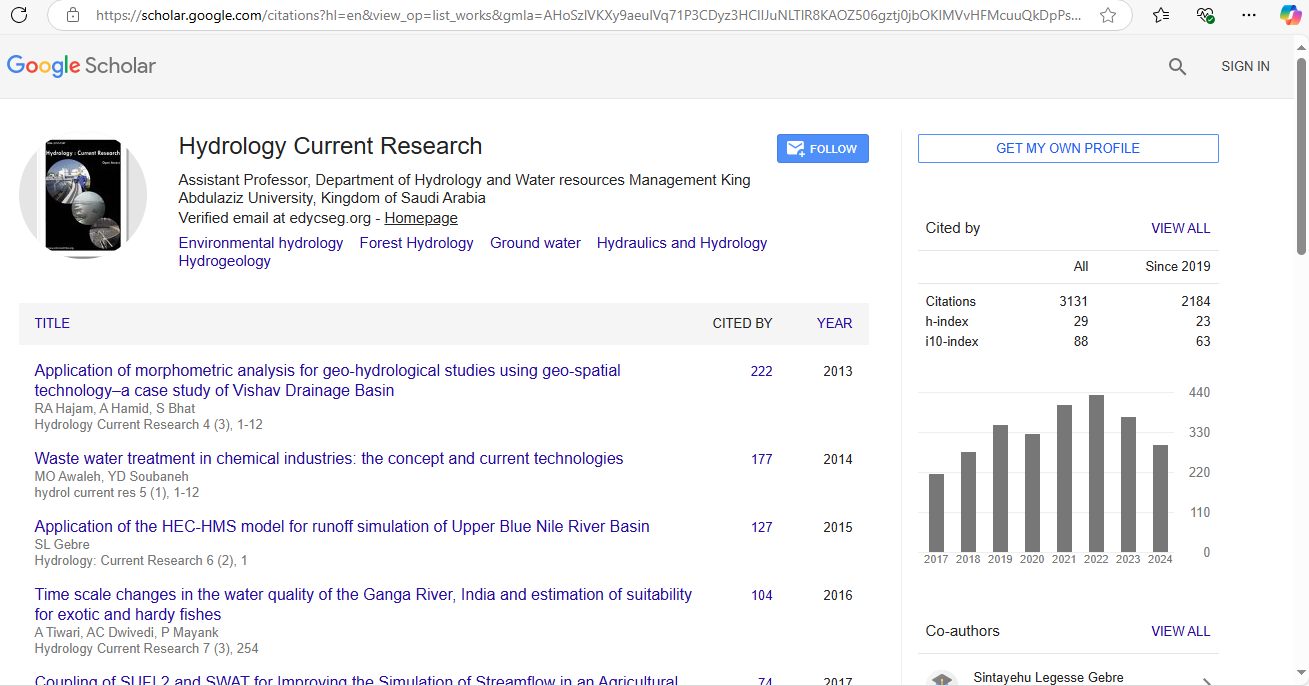
Hydrology: Current Research received 2843 citations as per Google Scholar report