Commentary - (2025) Volume 16, Issue 2
Received: 01-Apr-2025, Manuscript No. jar-25-176261;
Editor assigned: 03-Apr-2025, Pre QC No. P-176261;
Reviewed: 17-Apr-2025, QC No. Q-176261;
Revised: 22-Apr-2025, Manuscript No. R-176261;
Published:
29-Apr-2025
, DOI: 10.37421/2155-6113.2025.16.1053
Citation: Kumar, Rajeev. "Revolutionizing HIV Prevention, Treatment,
Cure." J AIDS Clin Res 16 (2025):1053.
Copyright: © 2025 Kumar R. This is an open-access article distributed under the terms of the Creative Commons Attribution License, which permits unrestricted use, distribution
and reproduction in any medium, provided the original author and source are credited.
The landscape of HIV prevention is undergoing a transformation with significant advancements in long-acting injectable cabotegravir for HIV pre-exposure prophylaxis (PrEP). It highlights its high efficacy in preventing HIV acquisition, favorable safety profile, and the ongoing efforts to address implementation challenges and improve access globally [1].
This review provides an in-depth look at the current landscape of HIV cure research, detailing strategies like 'shock and kill,' gene therapy, and immune-based interventions aimed at eradicating the viral reservoir. It also addresses the significant challenges in translating these promising approaches from preclinical studies to successful clinical trials [2].
This critical review summarizes recent progress in HIV vaccine development, highlighting key clinical trials that have tested various vaccine platforms, including viral vectors and broadly neutralizing antibodies. It discusses the challenges encountered in achieving durable immune responses and broad protection [3].
This systematic review and meta-analysis evaluates the clinical efficacy and safety of recently approved antiretroviral drugs for HIV-1 infected individuals who have experienced treatment failure or developed resistance. It synthesizes data from multiple clinical trials, demonstrating the sustained virological suppression and improved immunological outcomes [4].
This article focuses on the increasing burden of non-AIDS comorbidities, such as cardiovascular disease, renal dysfunction, and bone disorders, in the aging HIV-positive population. It reviews current clinical trials investigating interventions to prevent and manage these conditions [5].
This review explores the significant advancements in the development and clinical testing of broadly neutralizing antibodies (bNAbs) for both HIV prevention and treatment. It summarizes findings from recent clinical trials demonstrating the potential of bNAbs to protect against HIV infection [6].
This article critically reviews clinical trials focused on reducing the HIV-1 reservoir, which is central to achieving a functional cure. It examines strategies that involve latency-reversing agents (LRAs) to 'kick' the virus out of hiding, combined with immune-enhancing therapies to 'kill' infected cells [7].
This review explores the critical role of implementation science in translating effective HIV prevention interventions from research to real-world settings. It highlights how clinical trials are increasingly incorporating implementation science methodologies to understand and address barriers to uptake, adherence, and scale-up of strategies like PrEP and treatment as prevention [8].
This review details recent progress in the treatment of HIV in pediatric and adolescent populations, synthesizing data from clinical trials on new antiretroviral formulations, dosing strategies, and long-acting options. It underscores the challenges in drug development for this vulnerable group, including taste masking, age-appropriate formulations, and adherence [9].
This article examines the critical global challenge of HIV drug resistance (HIVDR), reviewing the importance of robust surveillance systems and effective prevention strategies. It discusses how clinical trials are adapting to evaluate new antiretroviral therapies that are effective against resistant strains [10].
The collective body of research underscores a dynamic and evolving field where advances in long-acting prevention strategies, such as injectable cabotegravir, are complemented by intensive efforts to achieve a functional cure. This involves not only complex gene therapies and immune interventions but also innovative methods to target and eliminate the latent viral reservoir. Simultaneously, the global scientific community is working to overcome significant hurdles in vaccine development, seeking to elicit durable and broad protective immune responses against the highly variable HIV virus. Treatment paradigms are also continuously refined, with a focus on new antiretroviral drugs that can effectively manage resistance in treatment-experienced individuals, alongside tailored approaches for vulnerable populations like children and adolescents. The shift in focus to address non-AIDS comorbidities reflects a growing understanding of the long-term health needs of an aging HIV-positive population. These integrated care models aim to improve overall quality of life by preventing and managing co-occurring conditions. The promise of broadly neutralizing antibodies for both preventing infection and inducing remission represents another exciting frontier, despite ongoing challenges with resistance and optimal delivery. Ultimately, the success of these scientific endeavors hinges on effective translation into public health impact. Implementation science is therefore critical in identifying and dismantling barriers to the uptake and adherence of proven interventions, ensuring they reach the communities most affected by HIV. This systematic approach, coupled with vigilant global surveillance of drug resistance, is essential to preserve the efficacy of current treatments and guide the development of future therapies, solidifying the gains made against HIV and striving towards its eventual eradication.
Significant strides have been made in HIV prevention, notably with the introduction of long-acting injectable cabotegravir for pre-exposure prophylaxis (PrEP). This innovative approach offers high efficacy in preventing HIV acquisition and boasts a favorable safety profile, marking a critical advancement, especially for populations struggling with daily oral PrEP adherence [1]. The success of such interventions relies heavily on implementation science, which plays a pivotal role in transitioning effective HIV prevention strategies from research into real-world applications. Clinical trials increasingly integrate these methodologies to identify and address barriers affecting the uptake, adherence, and broader scale-up of strategies like PrEP. This ensures that prevention efforts are tailored to specific contexts, thereby maximizing their public health reach and impact [8]. Complementing these efforts, broadly neutralizing antibodies (bNAbs) are also being developed for HIV prevention, with clinical trials demonstrating their potential to offer protection against infection [6].
The quest for an HIV cure remains a central and challenging frontier in research. Strategies are deeply focused on eradicating the viral reservoir, which is the core impediment to a functional cure. These involve intricate approaches such as 'shock and kill,' gene therapy, and various immune-based interventions designed to eliminate latent virus [2]. Clinical trials are particularly focused on reservoir reduction strategies, utilizing latency-reversing agents (LRAs) to activate the dormant virus, combined with immune-enhancing therapies to target and clear infected cells. The efficacy of these combination approaches and the challenges in achieving sustained viral remission are under continuous assessment, guiding the future directions of HIV cure research [7].
Treatment for HIV-1 infected individuals has seen considerable progress, especially for those who have experienced treatment failure or developed resistance. Systematic reviews and meta-analyses confirm the clinical efficacy and safety of recently approved antiretroviral drugs, which have demonstrated sustained virological suppression and improved immunological outcomes. This provides vital guidance for managing complex HIV treatment regimens effectively [4]. Furthermore, advances in treating HIV in pediatric and adolescent populations are critical. Recent clinical trials focus on developing new antiretroviral formulations, optimizing dosing strategies, and exploring long-acting options to overcome unique challenges such as taste masking, age-appropriate formulations, and adherence issues. These trials have successfully expanded treatment choices and markedly improved outcomes for young people living with HIV [9].
The evolving demographic of people living with HIV, particularly an aging population, brings forth new challenges, including an increasing burden of non-AIDS comorbidities. Conditions like cardiovascular disease, renal dysfunction, and bone disorders are now key areas of focus. Clinical trials are actively investigating interventions for the prevention and management of these conditions, advocating for integrated care approaches and personalized treatment strategies to enhance the long-term health and quality of life for this population [5]. Compounding these issues is the persistent global challenge of HIV drug resistance (HIVDR). Effective surveillance systems and prevention strategies are crucial. Clinical trials are adapting by evaluating new antiretroviral therapies designed to be effective against resistant strains and by incorporating vigilant monitoring for emerging resistance. These coordinated international efforts are essential to preserve the efficacy of both current and future HIV treatments [10].
Despite formidable challenges, HIV vaccine development continues to be a high-priority area. Recent clinical trials have explored various vaccine platforms, including viral vectors and broadly neutralizing antibodies, seeking to induce durable immune responses and provide broad protection. While obstacles in achieving widespread efficacy persist, new strategies and immunological insights gained from these trials are shaping the future trajectory of HIV vaccine research, maintaining hope for an eventual preventative vaccine [3]. This continuous innovation underscores a concerted global effort to overcome the HIV epidemic.
Recent HIV research highlights significant advancements across prevention, treatment, and cure strategies. Long-acting injectable cabotegravir for HIV pre-exposure prophylaxis PrEP shows high efficacy, offering a revolutionary prevention method by addressing daily oral PrEP adherence challenges. Efforts in HIV cure research focus on eradicating the viral reservoir through strategies like shock and kill, gene therapy, and immune-based interventions, despite the inherent complexity of HIV latency. Concurrently, HIV vaccine development progresses with various platforms, aiming for durable immune responses and broad protection, while grappling with challenges in clinical trials. Treatment advancements include new antiretroviral drugs for individuals with treatment failure or resistance, demonstrating sustained virological suppression and improved immunological outcomes. There's also a growing focus on managing non-AIDS comorbidities in the aging HIV-positive population, such as cardiovascular and renal dysfunctions, emphasizing integrated and personalized care. Broadly neutralizing antibodies bNAbs are being explored for both prevention and treatment, showing promise in protecting against infection and achieving sustained virologic remission in some individuals, though challenges like antibody resistance persist. Research also targets reducing the HIV-1 reservoir using latency-reversing agents combined with immune-enhancing therapies. Implementation science plays a crucial role in translating effective prevention interventions into real-world settings, addressing barriers to uptake and adherence. Furthermore, global efforts combat HIV drug resistance through robust surveillance and new antiretroviral therapies, particularly for pediatric and adolescent populations, ensuring the efficacy of current and future treatments.
Indexed at, Google Scholar, Crossref
Indexed at, Google Scholar, Crossref
Indexed at, Google Scholar, Crossref
Indexed at, Google Scholar, Crossref
Indexed at, Google Scholar, Crossref
Indexed at, Google Scholar, Crossref
Indexed at, Google Scholar, Crossref
Indexed at, Google Scholar, Crossref
Indexed at, Google Scholar, Crossref
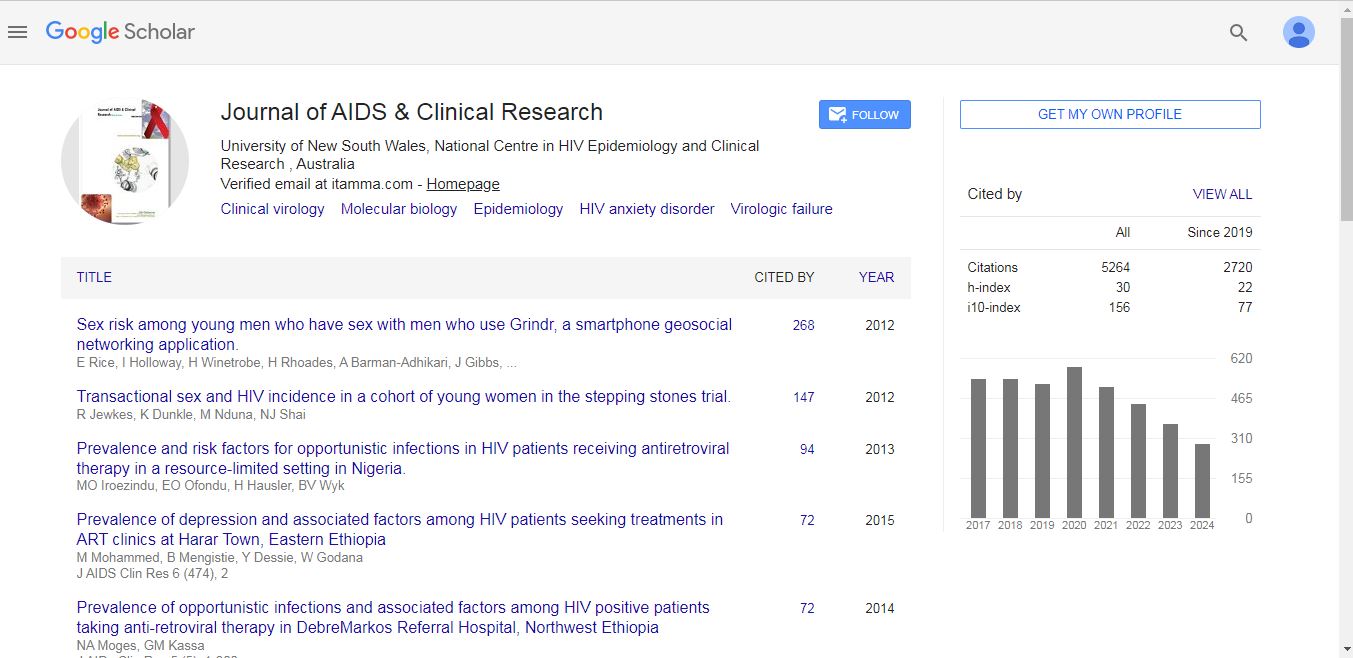
Journal of AIDS & Clinical Research received 5264 citations as per Google Scholar report