Opinion - (2025) Volume 16, Issue 3
Received: 02-Jun-2025, Manuscript No. csj-26-183439;
Editor assigned: 04-Jun-2025, Pre QC No. P-183439;
Reviewed: 18-Jun-2025, QC No. Q-183439;
Revised: 23-Jun-2025, Manuscript No. R-183439;
Published:
30-Jun-2025
, DOI: 10.37421/2160-3494.2025.16.456
Citation: Haddad, Yara. ”Revolutionizing Drug Design: Precision, AI, and Innovation.” Chem Sci J 16 (2025):456.
Copyright: © 2025 Haddad Y. This is an open-access article distributed under the terms of the Creative Commons Attribution License, which permits unrestricted use, distribution and reproduction in any medium, provided the original author and source are credited.
Medicinal chemistry and drug design are undergoing a profound transformation, largely propelled by the integration of advanced computational tools and a progressively deeper understanding of biological targets. This paradigm shift is characterized by a strong emphasis on precision, with the overarching aim of developing highly selective and potent therapeutics. The ultimate goal is to achieve maximum efficacy while concurrently minimizing off-target effects and mitigating potential toxicity, thereby enhancing patient safety and treatment outcomes. The incorporation of artificial intelligence (AI) and machine learning (ML) techniques is significantly accelerating key stages of the drug discovery and development pipeline, from the initial identification of promising lead compounds to their subsequent optimization and even the prediction of critical drug properties. This evolution signifies a move away from traditional empirical approaches towards a more predictive and data-driven scientific methodology, promising to streamline and improve the efficiency of therapeutic innovation [1].
The design of targeted covalent inhibitors has emerged as a powerful and increasingly important strategy for achieving sustained target engagement and, crucially, for overcoming inherent resistance mechanisms that often limit the efficacy of conventional therapies. This approach necessitates careful consideration of several key molecular design elements. The selection of appropriate reactive warheads is paramount for achieving the desired covalent modification of the target protein, while judicious linker design ensures optimal positioning and accessibility of the warhead to the active site. Furthermore, a thorough understanding of the protein's nucleophilic residues is vital for achieving high selectivity and minimizing the unintended covalent modification of other biomolecules, which could lead to off-target toxicities. This sophisticated approach is proving particularly relevant and effective for tackling challenging therapeutic targets, including critical enzyme families such as kinases and proteases, which are implicated in a wide range of diseases [2].
Fragment-based drug discovery (FBDD) presents a robust and versatile approach for identifying novel chemical matter, proving particularly advantageous for targeting proteins that have historically been considered difficult-to-drug. This methodology operates by screening small molecular fragments that exhibit weak but detectable binding to a target protein. These initial low-affinity binders serve as starting points, which can then be iteratively grown or linked together through rational design and chemical optimization to generate larger, more potent ligands with improved binding affinities and pharmacological profiles. FBDD complements traditional high-throughput screening (HTS) by exploring a distinct and often underexplored chemical space, offering a highly effective route for elucidating initial binding modes and guiding the subsequent development of potent drug candidates [3].
The development of proteolysis-targeting chimeras (PROTACs) represents a significant paradigm shift in the field of targeted protein degradation, offering a novel therapeutic modality that goes beyond the inhibition of protein function. PROTACs function by hijacking the cell's own ubiquitin-proteasome system, a natural cellular machinery responsible for protein turnover. By bridging a target protein of interest with an E3 ubiquitin ligase, PROTACs induce the ubiquitination of the target protein, marking it for degradation by the proteasome. This mechanism offers a therapeutic strategy that can potentially overcome resistance mechanisms that plague traditional small molecule inhibitors, as it aims to eliminate the protein entirely rather than merely blocking its activity. The efficacy of PROTACs is critically dependent on the optimization of linker length and the chemical moieties responsible for binding to both the target protein and the E3 ligase [4].
Structure-based drug design (SBDD) continues to hold its position as a cornerstone methodology within medicinal chemistry, offering a rational and powerful approach to guide the design of high-affinity ligands. This strategy leverages detailed three-dimensional structural information of protein targets, obtained through various biophysical techniques, to inform molecular design. Advances in experimental methods such as X-ray crystallography, cryo-electron microscopy (cryo-EM), and nuclear magnetic resonance (NMR) spectroscopy have led to increasingly accurate and high-resolution protein structures. This wealth of structural data enables a more precise and rational design process, facilitating the fine-tuning of drug candidates to achieve optimal binding interactions with the target and desired pharmacological properties, ultimately accelerating the development of effective therapeutics [5].
The successful development of orally bioavailable drugs is a critical determinant of therapeutic success and patient compliance, demanding a sophisticated and integrated understanding of multiple complex factors. This encompasses a thorough evaluation of physicochemical properties, intrinsic metabolic stability, and membrane permeability characteristics of drug candidates. Computational tools and a suite of in vitro assays are routinely employed early in the drug discovery process to predict and optimize these essential ADME (absorption, distribution, metabolism, excretion) properties. Addressing challenges such as poor solubility and low permeability often necessitates the implementation of strategies like prodrug design or advanced formulation enhancements to ensure adequate drug exposure and therapeutic efficacy following oral administration. This meticulous attention to pharmacokinetic properties is indispensable for translating a promising molecule from the bench to a viable therapeutic [6].
Kinase inhibitors have remained a central focus of drug discovery efforts, particularly within the realm of oncology, where kinases play pivotal roles in cell signaling pathways that drive cancer progression. The primary challenge in this area lies in the development of highly selective inhibitors that can specifically target particular kinases within large families, thereby minimizing the detrimental off-target toxicities that can arise from broad-spectrum inhibition. Various innovative strategies are being employed to achieve this selectivity. These include exploiting allosteric binding sites that are unique to specific kinases, designing inhibitors that stabilize or target particular active or inactive conformations of the enzyme, and leveraging sophisticated computational methods to accurately predict kinase selectivity profiles and guide rational drug design [7].
The application of quantum mechanics (QM) and molecular mechanics (MM) computational methods, often in combination through QM/MM approaches, provides a significantly more accurate and detailed description of chemical reactions and molecular interactions occurring at the active site of biological targets. This hybrid computational strategy is particularly invaluable for in-depth studies of complex enzyme mechanisms, the precise prediction of reaction energy barriers, and a comprehensive understanding of the subtle electronic effects that govern ligand binding affinity and specificity. By offering a higher level of theoretical rigor, QM/MM methods facilitate more refined lead optimization processes, enabling medicinal chemists to make more informed design decisions and to develop drug candidates with enhanced potency and selectivity [8].
The development of small molecule inhibitors specifically targeting protein-protein interactions (PPIs) represents a significant and ongoing challenge in drug discovery, despite the immense therapeutic potential offered by this approach. Many diseases are driven by aberrant PPIs, and disrupting these interactions could offer novel treatment avenues. The inherent difficulty in designing inhibitors for PPIs stems from the nature of these interfaces, which are often transient, large, relatively flat, and lack well-defined pockets typically found in enzyme active sites. Innovative strategies are therefore required, including the exploration of allosteric modulation and the design of molecules that can effectively bind to and disrupt these complex interfaces, utilizing novel chemical scaffolds and design principles [9].
De novo drug design, a computational approach augmented by sophisticated algorithms and advanced machine learning techniques, empowers the generation of entirely novel molecular structures possessing precisely desired properties. By learning from extensive datasets of existing drugs, known protein-target characteristics, and binding interactions, these methods can propose entirely new chemical scaffolds that are optimized from the outset for key attributes such as binding affinity, selectivity against off-targets, and favorable pharmacokinetic profiles. This capability fundamentally transforms the initial stages of drug discovery by enabling the exploration of uncharted chemical space and the design of molecules tailored to specific therapeutic needs, rather than relying solely on modifications of existing scaffolds [10].
Medicinal chemistry and drug design are undergoing a significant transformation, driven by the increasing sophistication of computational tools and a more profound understanding of biological targets. This evolution is steering the field towards a paradigm of precision medicine, where the emphasis is on developing therapeutics that are not only highly selective and potent but also possess minimal off-target effects and reduced toxicity. The integration of artificial intelligence and machine learning is proving instrumental in accelerating various facets of the drug discovery and development process. These technologies are instrumental in identifying promising lead compounds, optimizing their structures for improved properties, and accurately predicting their pharmacokinetic and pharmacodynamic profiles. This shift represents a departure from traditional, often empirical, methods towards a more predictive, data-driven approach, promising to enhance the efficiency and success rates of therapeutic innovation [1].
The strategic design of targeted covalent inhibitors has emerged as a potent approach to achieve sustained engagement with therapeutic targets and to effectively circumvent resistance mechanisms that frequently undermine the efficacy of conventional drug therapies. The successful implementation of this strategy hinges on meticulous attention to several critical design considerations. The careful selection of reactive warheads is paramount to ensure specific and efficient covalent modification of the intended target protein. Simultaneously, the design of the linker that connects the warhead to the binding moiety is crucial for positioning the warhead optimally within the target's active site. Understanding the protein's structural features, particularly the presence and accessibility of nucleophilic residues, is vital for achieving high selectivity and preventing unintended covalent modification of other biomolecules, which could precipitate adverse effects. This advanced therapeutic strategy is particularly relevant for addressing challenging targets, such as kinases and proteases, which are frequently implicated in various disease states [2].
Fragment-based drug discovery (FBDD) offers a powerful and efficient methodology for identifying novel chemical entities, especially for targets that have proven recalcitrant to traditional drug discovery techniques. This approach begins with the screening of small molecular fragments that bind weakly to a target protein. These fragments, identified through biophysical or structural methods, serve as starting points from which larger, more potent ligands are constructed through iterative chemical modification and optimization. FBDD complements high-throughput screening (HTS) by exploring a different, often richer, chemical space and is highly effective in elucidating initial binding modes, which can then guide the rational design of optimized drug candidates. This method is particularly valuable for targets with challenging binding sites or complex structural features [3].
The development of proteolysis-targeting chimeras (PROTACs) signifies a groundbreaking advancement in targeted protein degradation, offering a therapeutic modality that differs fundamentally from conventional inhibitors. PROTACs leverage the cell's endogenous ubiquitin-proteasome system to selectively degrade target proteins. These bifunctional molecules are designed to simultaneously bind to a target protein of interest and an E3 ubiquitin ligase. This induced proximity leads to the ubiquitination of the target protein, marking it for destruction by the proteasome. This mechanism provides a therapeutic strategy that can potentially overcome resistance to traditional inhibitors, as it aims to eliminate the target protein rather than merely inhibiting its function. Critical to PROTAC efficacy is the careful optimization of linker length and the chemical moieties responsible for interacting with both the target protein and the E3 ligase, ensuring efficient ternary complex formation and subsequent degradation [4].
Structure-based drug design (SBDD) remains an indispensable cornerstone of modern medicinal chemistry, providing a rational framework for the design of potent and selective drug candidates. This approach relies heavily on the detailed three-dimensional structural information of protein targets, enabling chemists to visualize binding sites and design molecules that fit precisely. Advances in experimental techniques such as X-ray crystallography, cryo-electron microscopy (cryo-EM), and nuclear magnetic resonance (NMR) spectroscopy have dramatically improved the availability and quality of target structures. These high-resolution structural insights allow for the rational design of novel ligands and the iterative optimization of existing drug candidates to enhance their binding affinity, selectivity, and overall pharmacological properties, thereby accelerating the path towards effective therapeutics [5].
The successful translation of promising drug candidates into orally bioavailable therapeutics is contingent upon a deep and integrated understanding of their physicochemical properties, metabolic stability, and capacity for membrane permeation. Computational modeling and a battery of in vitro assays are routinely employed early in the drug discovery pipeline to predict and optimize ADME (absorption, distribution, metabolism, excretion) characteristics. These predictive tools are crucial for identifying potential liabilities and guiding chemical modifications to enhance oral bioavailability. Challenges such as poor aqueous solubility or low membrane permeability are often addressed through strategies like the design of prodrugs or the development of advanced pharmaceutical formulations. This rigorous assessment of pharmacokinetic properties is a critical step in ensuring that a molecule possesses the necessary attributes to become a viable therapeutic agent [6].
Kinase inhibitors have long been a primary focus in drug discovery, particularly for the treatment of cancer, where aberrant kinase signaling is a common driver of disease. A significant challenge in this area is the development of inhibitors that exhibit high selectivity for specific kinases within large families, thereby minimizing off-target effects that can lead to dose-limiting toxicities. To achieve this selectivity, researchers are employing a variety of sophisticated strategies. These include targeting allosteric binding sites that are unique to certain kinases, designing inhibitors that exploit specific conformational states of the enzyme, and utilizing advanced computational methods to accurately predict selectivity profiles and guide the design of next-generation kinase inhibitors [7].
The application of quantum mechanics (QM) and molecular mechanics (MM) computational methods, frequently in a hybrid QM/MM framework, offers a more accurate and nuanced representation of chemical processes within biological systems, such as enzyme catalysis and ligand binding. This advanced computational approach is particularly powerful for elucidating detailed enzyme mechanisms, predicting reaction barriers with greater precision, and understanding the intricate electronic contributions that govern the affinity and specificity of ligand-target interactions. By providing a more rigorous theoretical foundation, QM/MM calculations enable medicinal chemists to refine their understanding of molecular interactions, leading to more informed decisions during lead optimization and the development of molecules with superior pharmacological profiles [8].
The pursuit of small molecule inhibitors targeting protein-protein interactions (PPIs) presents a formidable challenge in drug discovery, yet it holds substantial therapeutic promise for diseases where these interactions are critically involved. Designing molecules capable of disrupting the transient, large-scale, and often flat interfaces characteristic of PPIs necessitates the development of innovative strategies. These include exploring allosteric binding sites that can induce conformational changes to disrupt the interaction, and the investigation of novel chemical scaffolds that possess the unique structural features required to effectively engage these challenging biological targets. Overcoming these design hurdles is essential for unlocking the therapeutic potential of targeting PPIs [9].
De novo drug design, empowered by sophisticated algorithms and advancements in machine learning, enables the computational generation of novel molecular structures tailored to possess specific desired properties. This approach learns from vast datasets encompassing existing drugs, known protein targets, and their interactions to propose entirely new chemical scaffolds. These generated molecules are optimized from conception for key attributes such as binding affinity, selectivity against off-targets, and favorable pharmacokinetic profiles. This capability fundamentally reshapes the early stages of drug discovery by facilitating the exploration of novel chemical space and the design of molecules specifically engineered for therapeutic purposes, moving beyond incremental modifications of known entities [10].
The field of medicinal chemistry and drug design is being revolutionized by computational tools and a deeper biological understanding. This shift prioritizes precision, aiming for selective and potent therapeutics with minimized side effects. AI and machine learning are accelerating lead identification and optimization, moving towards a predictive, data-driven paradigm. Targeted covalent inhibitors offer sustained engagement and resistance overcoming, requiring careful design of warheads and linkers. Fragment-based drug discovery (FBDD) is effective for difficult targets, building potent ligands from small fragments. PROTACs induce targeted protein degradation via the ubiquitin-proteasome system, overcoming resistance mechanisms. Structure-based drug design (SBDD) uses 3D target information for rational ligand design. Developing orally bioavailable drugs requires optimizing ADME properties through computational and in vitro methods. Kinase inhibitors, particularly for cancer, focus on selectivity to avoid toxicity. Quantum mechanics/molecular mechanics (QM/MM) enhance understanding of reactions and binding. Targeting protein-protein interactions (PPIs) is challenging but holds therapeutic potential, requiring innovative strategies. De novo drug design generates novel molecular structures with desired properties using AI and ML, transforming early drug discovery.
None
None
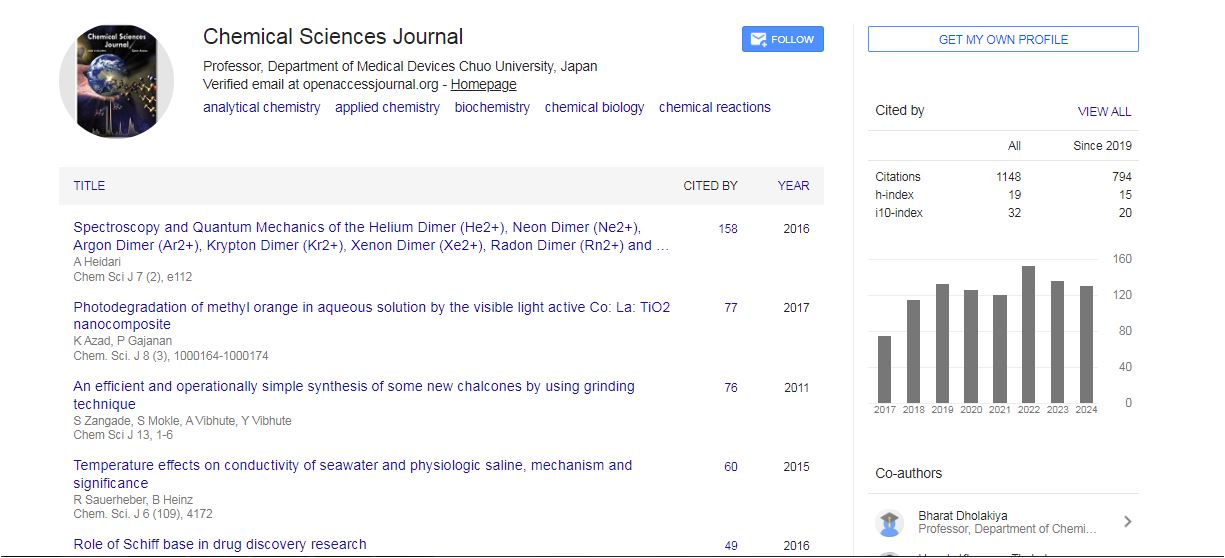
Chemical Sciences Journal received 912 citations as per Google Scholar report