Short Communication - (2025) Volume 16, Issue 2
Received: 01-Mar-2025, Manuscript No. jnmrt-25-172734;
Editor assigned: 03-Mar-2025, Pre QC No. P-172734;
Reviewed: 17-Mar-2025, QC No. Q-172734;
Revised: 24-Mar-2025, Manuscript No. R-172734;
Published:
31-Mar-2025
, DOI: 10.37421/2155-9619.2025.16.643
Citation: O’Donnell, Michael R.. ”Radiation Therapy: Evolving Techniques, Better Outcomes.” J Nucl Med Radiat Ther 16 (2025):643.
Copyright: © 2025 O’Donnell R. Michael This is an open-access article distributed under the terms of the Creative Commons Attribution License, which permits unrestricted use, distribution and reproduction in any medium, provided the original author and source are credited.
Radiation therapy remains a vital component in the multidisciplinary management of cancer, with continuous advancements shaping its application and efficacy across a diverse range of malignancies. The field sees ongoing research into optimizing treatment modalities, refining delivery techniques, and understanding systemic effects to enhance patient outcomes and mitigate adverse events. A pivotal comparison in locally advanced non-small cell lung cancer (NSCLC) highlights the significant advantages of proton therapy over traditional photon radiation. This innovative approach has shown superior overall survival and progression-free survival, coupled with a notable reduction in severe toxicities, positioning it as a highly favorable treatment option for these challenging cases [1].
Guidance for specific cancer sites is critical, and for localized prostate cancer, comprehensive recommendations from bodies such as the American Society for Radiation Oncology (ASTRO) provide essential, evidence-based frameworks. These guidelines inform patient selection, delineate appropriate treatment modalities, and advise on dose fractionation to ensure optimal therapeutic outcomes while rigorously minimizing potential toxicity [2].
This structured approach underscores the commitment to precision and safety in patient care. However, the systemic implications of radiation therapy are also under intensive investigation. A systematic review and meta-analysis shed light on the concerning phenomenon of radiation therapy-induced lymphopenia. This condition, characterized by a significant reduction in lymphocyte count, has been linked to poorer survival outcomes across various cancer types. Identifying its risk factors and understanding its incidence is crucial for developing proactive mitigation strategies to improve patient prognosis [3].
These findings emphasize the importance of considering the broader physiological impact of treatment. The evolution of radiation delivery techniques continues to push boundaries. External beam radiation therapy is a cornerstone for treating both primary and metastatic central nervous system malignancies. Given the delicate and complex anatomy of the brain and spinal cord, current techniques and dose considerations are meticulously reviewed to address the unique challenges of these sensitive sites, ensuring effective tumor control while preserving neurological function [4].
Innovation further extends to adaptive radiation therapy, which represents a significant leap forward in personalized cancer care. This advanced technique allows for real-time adjustments to treatment plans, dynamically responding to changes in tumor volume or patient anatomy during the course of therapy. This capability ensures maximal dose delivery to the target while meticulously sparing surrounding healthy tissues, thereby enhancing therapeutic precision and reducing side effects [5].
For prostate cancer specifically, Stereotactic Body Radiation Therapy (SBRT) has emerged as a highly effective approach. SBRT delivers high doses of radiation in fewer fractions, resulting in favorable oncological outcomes and acceptable toxicity profiles, making it a valuable option for many patients [6].
Similarly, the application of external beam radiotherapy for locally advanced non-small cell lung cancer in elderly patients has been thoroughly evaluated. Studies confirm its feasibility and efficacy in this vulnerable population, although they emphasize the critical need for careful patient selection and diligent toxicity management to ensure favorable results [7].
A particularly groundbreaking area of research is Flash external beam radiation therapy. This systematic review explores its profound potential for utilizing ultra-high dose rates. The aim is to significantly reduce normal tissue toxicity while concurrently maintaining robust tumor control, heralding a potentially transformative paradigm shift in radiation oncology research [8].
Concurrently, recent advancements in external beam radiation therapy for breast cancer are continuously refining treatment protocols. These developments encompass hypofractionation, accelerated partial breast irradiation, and proton therapy, all designed to enhance treatment efficacy, streamline patient experience, and reduce side effects, reflecting a patient-centric approach to care [9].
Finally, the critical role of external beam radiation therapy in managing early-stage unresectable non-small cell lung cancer cannot be overstated. Techniques such as SBRT are central to this management, consistently demonstrating high local control rates. For many patients facing challenging diagnoses, these advanced radiation therapies are often curative, offering a vital lifeline and significant hope for improved long-term outcomes [10].
These collective advancements highlight a dynamic field committed to improving the lives of cancer patients through innovative and precise therapeutic strategies.
The landscape of radiation therapy in cancer treatment is marked by continuous innovation, aiming to enhance efficacy, reduce toxicity, and personalize patient care. A key area of development involves the comparison of different radiation modalities. For instance, in locally advanced non-small cell lung cancer, proton therapy has demonstrated clear advantages over traditional photon radiation. Studies indicate that proton therapy leads to superior overall survival and progression-free survival. Moreover, patients undergoing proton therapy experience fewer severe toxicities (grade â?¥3), solidifying its position as a highly favorable treatment option for this challenging disease [1]. These findings are crucial for guiding clinical decisions and improving patient prognosis.
Beyond specific modalities, comprehensive guidelines are essential for standardized and effective treatment delivery. The ASTRO guideline for localized prostate cancer exemplifies this, offering robust recommendations grounded in evidence-based medicine. These guidelines meticulously detail patient selection criteria, appropriate treatment modalities, and optimal dose fractionation schedules. The overarching goal is to maximize favorable oncological outcomes while diligently minimizing treatment-related toxicity, ensuring that patients receive the most effective and safest care possible [2]. This systematic approach ensures consistency and quality across clinical practice, improving outcomes for men with prostate cancer.
However, the systemic effects of radiation therapy, particularly lymphopenia, are a significant concern requiring attention. A systematic review and meta-analysis highlighted the profound impact of radiation therapy on lymphocyte counts, revealing its association with poorer survival outcomes across a spectrum of cancer types. Understanding the risk factors and incidence of radiation-induced lymphopenia is paramount for developing effective mitigation strategies. Addressing this side effect is crucial for improving patient resilience and long-term survival, moving beyond localized tumor control to holistic patient well-being [3].
Advancements in external beam radiation therapy are also crucial for treating complex cases like primary and metastatic central nervous system malignancies. This approach requires careful consideration of current techniques and dose planning due to the delicate nature of the brain and spinal cord. The ongoing refinement of these methods aims to achieve effective tumor eradication while meticulously safeguarding neurological function, a critical balance in neuro-oncology [4]. Further enhancing precision, adaptive radiation therapy represents a transformative paradigm. This innovative technique allows for real-time adjustments to treatment plans during the course of therapy. By dynamically responding to changes in tumor size or patient anatomy, adaptive radiation therapy ensures that the radiation dose is always optimally delivered to the target while healthy tissues are maximally spared. This level of personalization significantly elevates the therapeutic ratio, promising better outcomes and fewer side effects for patients [5].
For specific indications, specialized techniques like Stereotactic Body Radiation Therapy (SBRT) have proven highly effective. SBRT for prostate cancer, for example, allows for the delivery of high-dose radiation in a significantly reduced number of fractions. This approach has consistently shown favorable oncological outcomes coupled with acceptable toxicity profiles, making it an attractive option for many patients seeking effective treatment with a shorter course [6]. Similarly, the feasibility and efficacy of definitive external beam radiotherapy for locally advanced non-small cell lung cancer in elderly patients have been confirmed. Despite the potential challenges in this patient population, careful selection and diligent toxicity management ensure positive clinical outcomes [7]. SBRT also plays a vital role in managing early-stage unresectable non-small cell lung cancer, offering high local control rates and often proving curative for these challenging cases [10].
Looking ahead, emerging technologies promise to further revolutionize the field. Flash external beam radiation therapy is a prime example, explored for its potential to deliver radiation at ultra-high dose rates. The objective is to dramatically reduce toxicity to normal tissues while maintaining excellent tumor control, representing a groundbreaking area of research with the potential to significantly improve the therapeutic index of radiation therapy [8]. Meanwhile, advancements in external beam radiation therapy for breast cancer continue to evolve, encompassing strategies such as hypofractionation, accelerated partial breast irradiation, and the integration of proton therapy. These innovations collectively aim to enhance treatment efficacy and minimize side effects, aligning with patient-centered care principles [9]. The convergence of these diverse research and clinical efforts ensures that radiation therapy remains a dynamic and increasingly effective tool in the fight against cancer.
Radiation therapy is a cornerstone in cancer treatment, continuously evolving with new techniques and applications across various cancer types. Recent studies underscore the importance of treatment modality selection, with proton therapy demonstrating superior outcomes for locally advanced non-small cell lung cancer (NSCLC) compared to photon therapy, exhibiting better survival rates and reduced severe toxicities. For localized prostate cancer, comprehensive guidelines from organizations like ASTRO offer evidence-based recommendations on patient selection, modalities, and dose fractionation to optimize efficacy and minimize side effects. However, radiation therapy's impact on systemic effects, such as lymphopenia, is also a critical area of research. Lymphopenia, often induced by radiation, correlates with poorer survival outcomes across many cancer types, highlighting the need for strategies to mitigate this effect. Innovations like adaptive radiation therapy are transforming treatment by allowing real-time adjustments based on tumor and anatomical changes, ensuring targeted dose delivery while protecting healthy tissues. Specific applications are advancing significantly. Stereotactic Body Radiation Therapy (SBRT) is increasingly effective for prostate cancer, delivering high radiation doses in fewer fractions with good oncological results and manageable toxicity. SBRT also plays a crucial role in managing early-stage unresectable NSCLC, offering high local control rates. For central nervous system malignancies, external beam radiation therapy techniques are being refined to navigate complex anatomical sites. Advances in breast cancer treatment include hypofractionation, accelerated partial breast irradiation, and proton therapy, all geared towards improving efficacy and reducing side effects. Emerging technologies like Flash external beam radiation therapy are exploring ultra-high dose rates to significantly reduce normal tissue toxicity while maintaining tumor control, marking a potentially groundbreaking advancement in the field. These ongoing developments highlight a concerted effort to enhance therapeutic ratios and patient quality of life in radiation oncology.
None
None
Indexed at, Google Scholar, Crossref
Indexed at, Google Scholar, Crossref
Indexed at, Google Scholar, Crossref
Indexed at, Google Scholar, Crossref
Indexed at, Google Scholar, Crossref
Indexed at, Google Scholar, Crossref
Indexed at, Google Scholar, Crossref
Indexed at, Google Scholar, Crossref
Indexed at, Google Scholar, Crossref
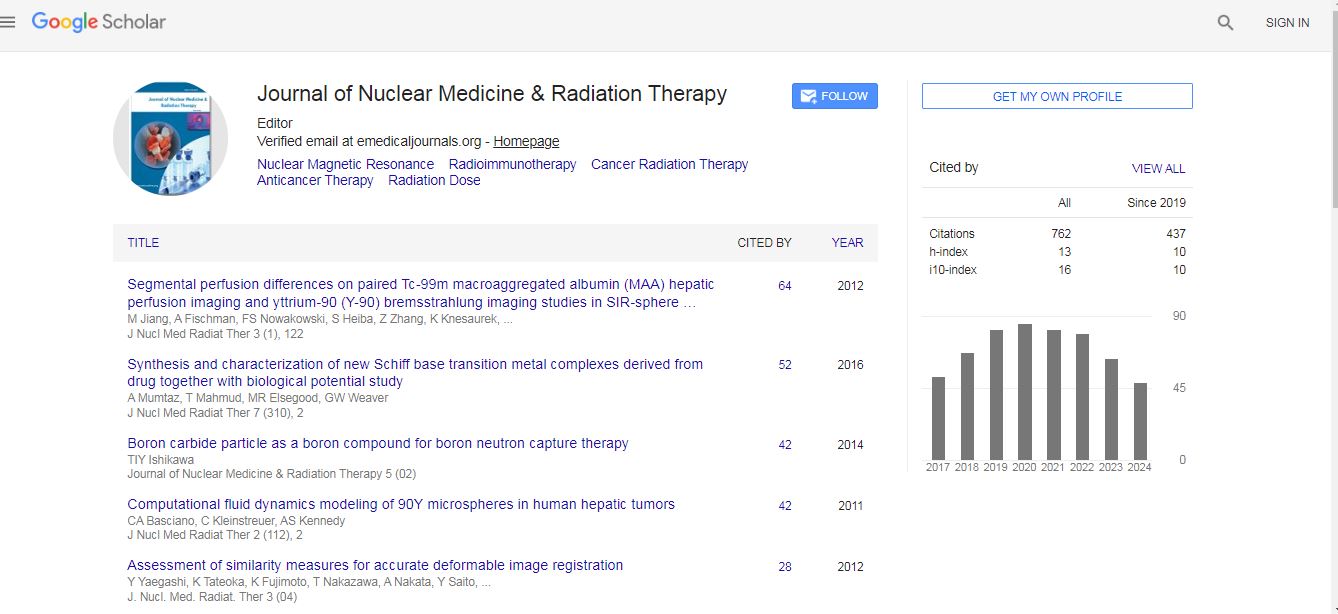
Nuclear Medicine & Radiation Therapy received 706 citations as per Google Scholar report