Opinion - (2025) Volume 16, Issue 4
Received: 01-Jul-2025, Manuscript No. jnmrt-26-186378;
Editor assigned: 03-Jul-2025, Pre QC No. P-186378;
Reviewed: 17-Jul-2025, QC No. Q-186378;
Revised: 22-Jul-2025, Manuscript No. R-186378;
Published:
29-Jul-2025
, DOI: 10.37421/2155-9619.2025.16.659
Citation: Nowicka, Katarzyna. ”Quantitative Bone Marrow Perfusion
With SPECT-CT.” J Nucl Med Radiat Ther 16 (2025):659.
Copyright: © 2025 Nowicka K. This is an open-access article distributed under the terms of the Creative Commons Attribution License, which permits unrestricted use,
distribution and reproduction in any medium, provided the original author and source are credited.
The field of nuclear medicine has seen significant advancements in quantitative imaging techniques, particularly with the integration of SPECT and CT. This synergy allows for improved anatomical localization and functional assessment of various organs and tissues. Bone marrow, a critical component of the hematopoietic and immune systems, is increasingly becoming a focus for quantitative imaging due to its involvement in a wide range of hematological, oncological, and other systemic diseases.
SPECT-CT offers a powerful platform for evaluating bone marrow perfusion, which is a direct indicator of blood flow and metabolic activity within this complex tissue. The ability to quantify perfusion parameters provides objective measures that can aid in disease diagnosis, staging, and monitoring treatment response. This approach moves beyond qualitative assessments, offering a more precise and reproducible understanding of bone marrow function. The methodological considerations for quantitative SPECT-CT in bone marrow perfusion are paramount to ensure the accuracy and reliability of the obtained data. These include the judicious selection of radiotracers that effectively map blood flow, the optimization of imaging protocols to minimize artifacts and maximize signal-to-noise ratio, and the development of robust image analysis techniques for extracting meaningful quantitative metrics. Adherence to these principles is crucial for clinical translation [1].Myelodysplastic syndromes (MDS) represent a group of clonal hematopoietic stem cell disorders characterized by ineffective hematopoiesis and an increased risk of transformation to acute myeloid leukemia. Quantitative SPECT-CT has shown promise in evaluating bone marrow perfusion in these patients. By correlating quantitative metrics with disease severity and response to therapy, this technique offers a novel, non-invasive method for monitoring bone marrow function in MDS, potentially guiding therapeutic decisions [2].
Lymphoma, a malignancy of the lymphatic system, often involves the bone marrow. Conventional imaging modalities have limitations in accurately assessing the extent of bone marrow infiltration. SPECT-CT, with its enhanced sensitivity and specificity, has demonstrated improved diagnostic accuracy and staging capabilities for bone marrow involvement in lymphoma. A systematic review of existing literature highlights its significant role in this context [3].
Further innovation in SPECT-CT imaging for bone marrow microcirculation is being driven by the development of novel radiotracers. These new imaging agents are being investigated for their potential to provide more detailed functional information about bone marrow perfusion than currently available methods. Such advancements could lead to a more nuanced understanding of the microvascular dynamics within the bone marrow, opening new avenues for research and clinical application [4].
The clinical utility of quantitative SPECT-CT for bone marrow perfusion is underpinned by rigorous validation against gold-standard methods. Such validation studies are essential to establish the reliability and reproducibility of SPECT-CT derived quantitative parameters. This crucial step supports the confidence in using SPECT-CT for clinical decision-making and contributes to its wider adoption [5].
In the realm of oncological management, SPECT-CT based bone marrow perfusion assessment is finding its application in treatment planning, particularly in conditions like metastatic breast cancer. Quantitative perfusion data can provide valuable insights into the tumor microenvironment and its interaction with the bone marrow, potentially informing personalized treatment strategies for patients with bone metastases [6].
Beyond oncology, the role of SPECT-CT extends to evaluating the response of bone marrow to therapeutic interventions such as radiation therapy. Quantitative perfusion measurements can serve as a biological marker to assess the impact of radiation on bone marrow function, thereby guiding subsequent treatment adjustments and optimizing patient care [7].
To ensure the widespread and consistent application of quantitative SPECT-CT for bone marrow perfusion, the development and implementation of standardized protocols are of utmost importance. These standardized procedures encompass imaging acquisition and analysis, aiming to guarantee comparability of results across different institutions and patient populations, facilitating multicenter studies and routine clinical practice [8].
Furthermore, the application of quantitative SPECT-CT is being explored in other hematological conditions, such as aplastic anemia. Studies are evaluating changes in bone marrow blood flow in these patients and investigating the potential of SPECT-CT to monitor disease progression and assess treatment efficacy, offering a valuable tool for managing these complex disorders [9].
Finally, understanding the intricate relationship between bone marrow perfusion and the development of skeletal metastases is crucial for improving patient outcomes. SPECT-CT is being employed to investigate this interplay in cancers like prostate cancer, aiming to elucidate how altered bone marrow perfusion dynamics are associated with the genesis and advancement of bone metastases [10].
The application of SPECT-CT technology for the quantitative assessment of bone marrow perfusion represents a significant stride in nuclear medicine, offering precise insights into blood flow dynamics within this vital organ. This methodology involves a meticulous approach encompassing radiotracer selection, imaging protocol optimization, and sophisticated image analysis to ensure the reproducibility and accuracy of bone marrow blood flow measurements. The overarching goal is to provide clinicians with objective data for evaluating a spectrum of hematological and oncological conditions affecting the bone marrow [1].
In the context of myelodysplastic syndromes (MDS), a group of clonal hematopoietic stem cell disorders, quantitative SPECT-CT is being investigated for its utility in characterizing bone marrow perfusion. Research efforts are focused on understanding how specific quantitative metrics derived from SPECT-CT correlate with the severity of MDS and the patient's response to treatment. This exploration aims to establish SPECT-CT as a valuable non-invasive tool for monitoring bone marrow function in these patients, offering a new perspective for managing their condition [2].
The role of SPECT-CT in evaluating bone marrow involvement in lymphoma is a critical area of study. This modality offers enhanced diagnostic capabilities for detecting and staging bone marrow infiltration, which can be challenging with conventional imaging techniques. A systematic review has been conducted to consolidate findings from various studies, emphasizing the improved accuracy and staging power of SPECT-CT for assessing bone marrow infiltration in lymphoma patients [3].
Advancements in SPECT-CT imaging are also being driven by the exploration of novel radiotracers designed to probe bone marrow microcirculation. The development of these new imaging agents holds the promise of providing more detailed functional information about bone marrow perfusion than currently achievable. This research opens doors to a deeper understanding of the intricate microvascular network within the bone marrow [4].
To solidify the clinical integration of quantitative SPECT-CT for bone marrow perfusion, robust validation against established, gold-standard methods is imperative. Such validation studies are fundamental in confirming the reliability and accuracy of the quantitative parameters derived from SPECT-CT. This process is crucial for building confidence in its clinical applicability and facilitating its wider adoption in patient care [5].
The impact of SPECT-CT based bone marrow perfusion assessment is also being recognized in the management of oncological conditions, such as metastatic breast cancer. This technique's ability to quantify perfusion can inform personalized treatment strategies by providing insights into how altered blood flow in the bone marrow influences the progression of bone metastases and patient response to therapy [6].
Furthermore, the utility of SPECT-CT extends to evaluating the biological effects of radiation therapy on bone marrow. By quantitatively assessing bone marrow perfusion, researchers can better understand the response of the bone marrow to radiation and use this information to guide subsequent treatment decisions, optimizing therapeutic outcomes for patients undergoing radiotherapy [7].
To ensure consistency and comparability of quantitative SPECT-CT bone marrow perfusion imaging across different clinical settings, the establishment of standardized protocols is a key focus. This initiative aims to develop uniform procedures for image acquisition and analysis, thereby ensuring that results obtained from various institutions and patient groups can be reliably compared, fostering robust research and clinical practice [8].
The application of quantitative SPECT-CT for assessing bone marrow perfusion is also being investigated in hematological disorders like aplastic anemia. This research focuses on evaluating changes in bone marrow blood flow in patients with aplastic anemia and exploring the potential of SPECT-CT to monitor disease progression and assess the effectiveness of therapeutic interventions, offering a promising tool for patient management [9].
Lastly, a significant area of investigation involves understanding the complex interplay between bone marrow perfusion and the development of skeletal metastases, particularly in prostate cancer. SPECT-CT is being utilized to study how alterations in bone marrow perfusion dynamics are associated with the occurrence and progression of bone metastases, seeking to uncover critical relationships that could lead to improved therapeutic strategies [10].
This collection of research focuses on the quantitative assessment of bone marrow perfusion using SPECT-CT technology. Studies detail methodological considerations for accurate and reproducible measurements, including radiotracer selection and imaging protocols. The utility of SPECT-CT is explored in various conditions, such as myelodysplastic syndromes and lymphoma, for disease diagnosis, staging, and monitoring treatment response. Innovations in novel radiotracers and the validation of quantitative parameters against gold standards are highlighted. Applications in cancer treatment planning, evaluating response to radiation therapy, and understanding the relationship between perfusion and skeletal metastases are discussed. The importance of standardized protocols for consistent clinical application and research is emphasized, along with its role in hematological disorders like aplastic anemia.
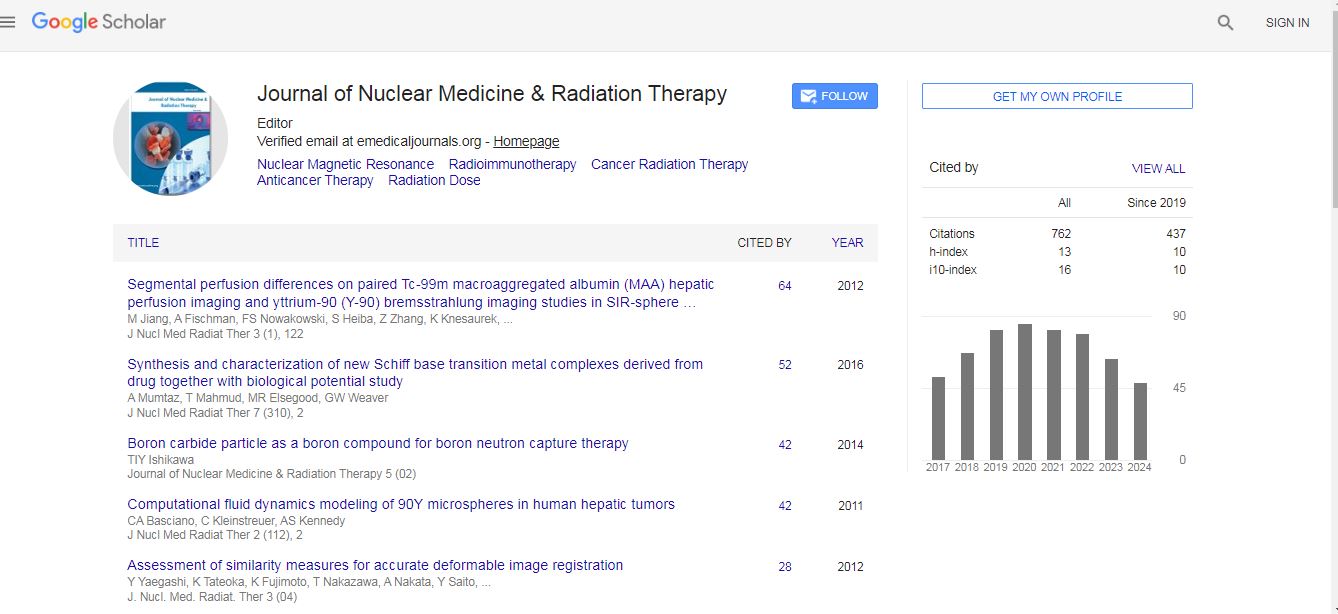
Nuclear Medicine & Radiation Therapy received 706 citations as per Google Scholar report