Short Communication - (2025) Volume 13, Issue 3
Received: 03-Jun-2025, Manuscript No. JGPR-26-188026;
Editor assigned: 05-Jun-2025, Pre QC No. P-188026;
Reviewed: 19-Jun-2025, QC No. Q-188026;
Revised: 24-Jun-2025, Manuscript No. R-188026;
Published:
30-Jun-2025
, DOI: 10.37421/2329-9126.2025.13.622
Citation: Pereira, Lucas. ”Primary Care Early Cancer Screening: Challenges and Strategies.” J Gen Pract 13 (2025):622.
Copyright: © 2025 Pereira L. This is an open-access article distributed under the terms of the Creative Commons Attribution License, which permits unrestricted use, distribution and reproduction in any medium, provided the original author and source are credited.
The landscape of early cancer screening within general clinics is undergoing continuous evolution, driven by advancements in medical knowledge and a growing emphasis on preventative healthcare strategies. Primary care physicians play a pivotal role in this process, serving as the frontline for identifying individuals at risk and initiating timely screening protocols for prevalent cancers. The challenges encountered in this setting are multifaceted, including time constraints for physicians, potential gaps in specialist knowledge, and the persistent issue of patient adherence to recommended screening schedules. Addressing these barriers is crucial for enhancing screening uptake and ultimately improving patient outcomes. Strategies such as targeted patient education and the establishment of streamlined referral pathways are being explored and implemented to bolster screening participation. [1] Understanding the patient's perspective is equally vital for the success of any screening program. Studies investigating patient attitudes and beliefs in community clinic settings reveal key factors influencing their decision to participate in and adhere to screening recommendations. A significant finding is the need for culturally sensitive communication approaches and readily accessible, comprehensible information to empower patients in making informed choices about their cancer screening. Furthermore, the cultivation of a strong, trusting relationship with healthcare providers emerges as a primary motivator for patients to undergo recommended screenings. [2] Innovative models of care delivery are also being developed to optimize cancer screening services. One such model that has shown promising results is the implementation of nurse-led cancer screening programs within primary care. These programs leverage the skills of trained nurses to manage screening responsibilities, leading to improved efficiency and increased screening rates. This approach not only enhances the overall screening capacity but also allows physicians to dedicate more time to complex patient cases requiring their specialized expertise. The successful integration of such programs necessitates well-defined training protocols, clear operational procedures, and robust multidisciplinary support. [3] The field of cancer screening is dynamic, with guidelines and supporting evidence constantly being updated to reflect new research findings. General practitioners must remain diligent in staying abreast of these evolving recommendations and evidence-based practices to ensure they are providing the highest quality of care. A personalized approach to screening, which takes into account individual risk factors such as genetics, lifestyle, and patient preferences, is increasingly being advocated for. This tailored strategy aims to optimize the benefits of screening while minimizing potential harms. [4] The economic dimension of cancer screening is also a critical consideration for healthcare systems. Systematic reviews analyzing the cost-effectiveness of various screening strategies in primary care offer valuable insights for resource allocation and policy development. Early detection through effective screening programs demonstrably leads to reduced morbidity and mortality, yielding significant long-term benefits. Moreover, these reviews help in assessing the economic implications of introducing new screening technologies and implementing comprehensive screening programs. [5] Beyond general risk factors, the integration of genetic risk assessment into primary care represents a significant advancement in personalized cancer screening. Understanding a patient's family history and genetic predispositions can profoundly influence screening plans, identifying individuals who may benefit from more intensive or earlier screening interventions. This approach requires enhanced training for primary care providers in genetic counseling principles related to cancer risk assessment to effectively guide patients. [6] In the digital age, the role of technology in healthcare delivery is rapidly expanding, and cancer screening is no exception. Digital health tools and patient portals are proving to be instrumental in enhancing cancer screening adherence in primary care settings. These platforms improve patient engagement, facilitate seamless communication between patients and providers, and streamline the overall screening process, helping to overcome logistical barriers and empowering patients in their health management. [7] Ensuring the quality of cancer screening services within general practice is paramount for achieving optimal outcomes. Implementing effective quality improvement initiatives requires a systematic approach that includes robust data collection, continuous performance monitoring, and feedback loops. By systematically identifying areas for enhancement and implementing evidence-based interventions, healthcare providers can systematically optimize their screening services and achieve better results. [8] Specific cancer types, such as colorectal and lung cancer, have dedicated screening programs that are being refined for implementation in general clinics. These programs emphasize best practices, clear patient selection criteria, and the critical role of multidisciplinary teams in ensuring effective screening and appropriate follow-up care. Addressing disparities in access, particularly for underserved populations, requires targeted outreach strategies and a commitment to equitable care delivery. [9] Public health campaigns and community engagement play a crucial role in fostering a culture of preventative health, including cancer screening. Tailored messaging and collaborative efforts between healthcare providers and community organizations are essential for raising awareness and encouraging participation in screening programs. Effective communication strategies are vital for reaching diverse populations and addressing their unique needs and concerns regarding cancer screening. [10]
The current state of early cancer detection practices within general clinics is characterized by a continuous effort to refine protocols and improve patient outcomes. Primary care physicians are central to this endeavor, tasked with identifying individuals at elevated risk and initiating appropriate screening measures for common malignancies. Obstacles such as limited consultation times, potential deficiencies in specialized oncological knowledge, and challenges in ensuring patient compliance with screening schedules are frequently encountered. To surmount these impediments, strategic interventions are being developed and deployed, including comprehensive patient education initiatives and the establishment of efficient referral mechanisms to enhance screening uptake. [1] A crucial aspect of successful cancer screening programs lies in understanding the patient's perspective. Research conducted in community clinic environments has illuminated the various factors that influence individuals' willingness to participate in and adhere to screening protocols. A notable outcome of such studies is the recognition of the necessity for communication that is sensitive to cultural nuances and the provision of accessible, clear information to enable patients to make well-informed decisions regarding their screening options. Furthermore, the establishment of a robust and trustworthy relationship between patients and their healthcare providers is identified as a significant determinant in motivating individuals to undergo recommended screenings. [2] Efforts to optimize the delivery of cancer screening services have led to the exploration of novel care models. The implementation of nurse-led cancer screening programs in primary care settings has emerged as a particularly promising avenue. These programs harness the capabilities of trained nursing staff to manage screening responsibilities, thereby enhancing operational efficiency and augmenting screening rates. This model not only expands the capacity for screening but also liberates physician time for more complex clinical challenges, fostering a more effective allocation of healthcare resources. Successful integration hinges on adequate training, standardized protocols, and comprehensive interdisciplinary support. [3] The field of cancer screening is characterized by its dynamic nature, with ongoing revisions to guidelines and the continuous generation of new evidence. General practitioners must remain committed to staying informed about the latest recommendations and evidence-based practices to provide optimal patient care. The adoption of a personalized screening approach, which carefully considers individual risk factors, patient preferences, and genetic predispositions, is increasingly emphasized as a means to maximize benefits and minimize potential harms associated with screening. [4] From an economic standpoint, the evaluation of cancer screening strategies is essential for effective healthcare system management. Systematic reviews focusing on the cost-effectiveness of different screening approaches in primary care provide critical data for informing resource allocation decisions and shaping health policies. Early cancer detection, facilitated by appropriate screening, has a profound impact on reducing disease-related morbidity and mortality, yielding substantial long-term societal benefits. These reviews also contribute to understanding the financial implications of adopting new screening technologies and implementing widespread screening programs. [5] In addition to general risk assessment, the incorporation of genetic risk evaluation into primary care practices represents a significant step towards personalized cancer screening. A thorough understanding of a patient's family medical history and genetic makeup can inform the development of tailored screening plans, identifying individuals who may require earlier or more intensive screening. This sophisticated approach necessitates enhanced training for primary care providers in the principles of genetic counseling as it pertains to cancer risk assessment. [6] The increasing integration of digital technologies into healthcare is transforming various aspects of patient care, including cancer screening. Digital health tools and patient portals are demonstrating a substantial positive impact on improving adherence to cancer screening recommendations within primary care. These technological solutions enhance patient engagement, foster improved communication channels with healthcare providers, and streamline the screening process. Consequently, they serve to mitigate logistical barriers and empower patients in actively managing their health and well-being. [7] Maintaining high standards of quality in cancer screening services provided in general practice is fundamental to achieving favorable patient outcomes. The implementation of effective quality improvement initiatives necessitates a structured methodology encompassing diligent data collection, ongoing performance evaluation, and the establishment of continuous feedback mechanisms. Through a systematic process of identifying areas requiring improvement and implementing evidence-based interventions, healthcare settings can proactively optimize their cancer screening services. [8] Specific cancer types, such as colorectal and lung cancer, have well-defined screening programs that are being progressively integrated into general clinic settings. These programs prioritize the adoption of best practices, establish clear criteria for patient eligibility, and highlight the indispensable role of multidisciplinary healthcare teams in ensuring both effective screening and timely follow-up care. Efforts are also being directed towards addressing the challenges associated with reaching underserved populations through targeted outreach strategies and a commitment to equitable access. [9] Public health campaigns and active community engagement are recognized as indispensable components in promoting a culture of preventative health, including the uptake of cancer screening services. The development of carefully tailored messaging and the fostering of collaborative partnerships between healthcare providers and community-based organizations are essential for escalating awareness and encouraging broader participation in screening programs. The identification and application of effective communication strategies are paramount for reaching diverse demographic groups and addressing their specific concerns related to cancer screening. [10]
This collection of research explores various facets of early cancer screening within primary care settings. It highlights the critical role of general practitioners in identifying at-risk individuals and initiating screening, while acknowledging challenges such as time constraints and patient adherence. Patient perspectives, nurse-led screening programs, evolving guidelines, cost-effectiveness, genetic risk assessment, digital health tools, quality improvement initiatives, specific cancer screening programs, and community engagement are all examined as key components in enhancing screening uptake and improving patient outcomes. Strategies focus on improving patient education, streamlining referrals, fostering trust, leveraging technology, and adopting evidence-based practices for more personalized and effective cancer prevention.
None
None
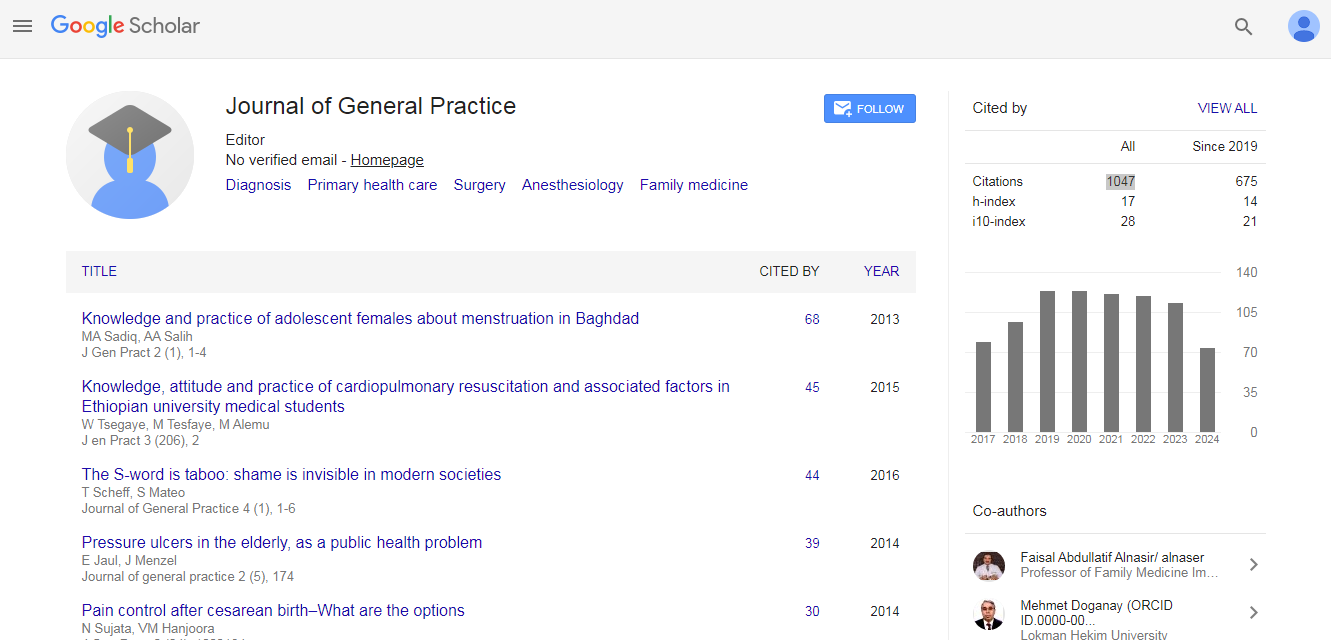
Journal of General Practice received 1047 citations as per Google Scholar report