Opinion - (2025) Volume 16, Issue 4
Received: 04-Aug-2025, Manuscript No. jar-25-177605;
Editor assigned: 06-Aug-2025, Pre QC No. P-177605;
Reviewed: 20-Aug-2025, QC No. Q-177605;
Revised: 25-Aug-2025, Manuscript No. R-177605;
Published:
01-Sep-2025
, DOI: 10.37421/2155-6113.2025.16.1075
Citation: Rossi, Benedetta. ”Pregnant Women’s HIV Care: Challenges,
Progress, Well-being.” J AIDS Clin Res 16 (2025):1075.
Copyright: © 2025 Rossi B. This is an open-access article distributed under the terms of the Creative Commons Attribution License, which permits unrestricted use, distribution
and reproduction in any medium, provided the original author and source are credited.
Ensuring optimal health outcomes for pregnant and breastfeeding women living with HIV remains a critical global health priority. This involves a multifaceted approach, addressing not only viral suppression but also mental health, medication management, and public health interventions. A foundational aspect of this care is adherence to antiretroviral therapy (ART). For instance, a systematic review and meta-analysis underscore the critical need for improved adherence to ART among pregnant and breastfeeding women living with HIV in sub-Saharan Africa. This research identifies various factors influencing adherence, providing insights crucial for designing effective interventions to prevent mother-to-child transmission and improve maternal health outcomes [1].
The ongoing battle against HIV transmission, particularly from mother to child, has seen significant progress in various regions. A comprehensive overview of trends in perinatal HIV transmission across the United States and Puerto Rico demonstrates continued progress in reducing transmission rates. This underscores the effectiveness of current prevention strategies, especially maternal antiretroviral use, while also highlighting areas where ongoing efforts are still needed to achieve elimination goals [2].
However, the challenges extend beyond preventing viral transmission. The mental health burden on HIV-positive pregnant women is substantial. For example, a systematic review and meta-analysis specifically examining the prevalence and contributing factors of antenatal depression among HIV-positive pregnant women in Ethiopia reveals a significant burden of depression in this vulnerable population. This highlights the urgent need for integrated mental health screening and support within HIV care programs to improve overall maternal well-being and treatment outcomes [3].
Managing the complex medication regimens for these women also requires careful attention. Another systematic review delves into drug-drug interactions among pregnant and breastfeeding women on antiretroviral therapy. This work reveals the complexity of managing polypharmacy in this population, emphasizing the potential for adverse effects and the necessity for careful medication monitoring and individualized treatment strategies to optimize both maternal and infant health outcomes [4].
Echoing the positive trends observed regionally, a large cohort study across Europe and North America evaluated mother-to-child HIV transmission rates from 2010 to 2019. It shows continued low rates of transmission, largely attributable to effective prevention strategies. This study further highlights existing disparities and persistent challenges, particularly for marginalized populations, indicating areas where targeted interventions remain crucial for further reduction [5].
Regarding the safety of specific antiretroviral drugs, a systematic review and meta-analysis investigates pregnancy outcomes and birth defects in women exposed to dolutegravir around conception or during pregnancy. The findings provide crucial safety data, reinforcing dolutegravir as a preferred antiretroviral option for women of childbearing potential due to its efficacy and reassuring safety profile regarding birth outcomes, contributing to informed clinical decision-making [6].
Beyond medical adherence and drug safety, the practicalities of infant feeding for HIV-positive mothers present unique challenges. A qualitative study exploring the perceptions and challenges of infant feeding practices among HIV-positive mothers in Tanzania reveals complex decisions influenced by cultural norms, financial constraints, and conflicting advice. This emphasizes the need for tailored, empathetic counseling that supports informed choices and adheres to recommended guidelines while respecting individual circumstances [7].
Moreover, broader public health concerns affect this population. A multi-country survey investigates COVID-19 vaccine uptake and associated factors among pregnant women living with HIV in selected sub-Saharan African countries. It highlights varying vaccination rates and identifies key determinants, including access, information, and trust, which are crucial for informing public health campaigns aimed at increasing vaccine equity and protecting this vulnerable population from infectious diseases [8].
Promoting holistic health also includes self-care practices. A systematic review and meta-analysis explores factors influencing self-care practices among pregnant women living with HIV. It identifies various determinants, including social support, knowledge, and access to healthcare, emphasizing that enhancing self-care is crucial for improving maternal and infant health outcomes. Therefore, interventions should be comprehensive, addressing both individual and systemic barriers [9].
Finally, the overall quality of life for these women is paramount. Another systematic review and meta-analysis evaluates the quality of life among pregnant women living with HIV. It reveals that various factors, including psychological distress, social support, and clinical status, significantly impact their overall well-being. The findings advocate for holistic care that integrates psychosocial support and addresses challenges beyond clinical management to improve their quality of life [10].
Collectively, these studies illuminate the comprehensive nature of HIV care for pregnant and breastfeeding women, moving beyond purely medical interventions to encompass mental health, social support, and individualized care strategies. This body of research underscores the ongoing commitment required to ensure optimal outcomes for both mothers and their infants globally.
Addressing the comprehensive needs of pregnant and breastfeeding women living with HIV is central to global health initiatives. These women face a unique set of challenges, from maintaining their own health to preventing HIV transmission to their infants. A pivotal area of focus is adherence to antiretroviral therapy (ART). Research from sub-Saharan Africa, for example, critically highlights the necessity for improved ART adherence among these women to curb mother-to-child transmission and enhance maternal health outcomes. Understanding the diverse factors that influence adherence is essential for designing effective, culturally sensitive interventions [1]. These factors can range from socio-economic status to healthcare access and individual beliefs, all of which must be considered when developing support programs.
Significant progress has been made globally in reducing mother-to-child HIV transmission. In the United States and Puerto Rico, trends show a continued decline in perinatal HIV transmission rates over recent years [2]. This success underscores the efficacy of existing prevention strategies, particularly the consistent use of maternal antiretroviral medications. Similarly, a comprehensive cohort study across Europe and North America reaffirms these low transmission rates from 2010 to 2019, attributing success to robust prevention efforts [5]. However, these studies also consistently point out that despite overall progress, disparities persist, especially among marginalized populations. These lingering challenges indicate that targeted, equitable interventions are still vital to ensure no mother or child is left behind in the pursuit of elimination goals.
Beyond the biomedical aspects of viral control, the mental well-being of HIV-positive pregnant women is a significant concern. Studies reveal a substantial burden of antenatal depression in this vulnerable group. For instance, a systematic review and meta-analysis from Ethiopia demonstrates a high prevalence of depression among HIV-positive pregnant women, emphasizing an urgent call for integrated mental health screening and robust support systems within existing HIV care programs [3]. This integration is critical not only for improving the women's overall well-being but also for potentially enhancing their adherence to treatment regimens. This point is further reinforced by findings which show that psychological distress significantly impacts the quality of life among pregnant women living with HIV, alongside social support and clinical status [10]. Holistic care, therefore, must encompass robust psychosocial support, moving beyond purely clinical management.
Medication management introduces another layer of complexity. Pregnant and breastfeeding women on ART often manage polypharmacy, which increases the risk of drug-drug interactions. A systematic review on this topic reveals the intricate nature of these interactions, stressing the potential for adverse effects on both mother and infant [4]. This necessitates meticulous medication monitoring and the development of individualized treatment strategies tailored to each woman's specific health profile and concurrent medications. On a more reassuring note, the safety profile of specific ART drugs, such as dolutegravir, has been thoroughly investigated. A systematic review and meta-analysis on pregnancy outcomes and birth defects in women exposed to dolutegravir provides crucial safety data, reinforcing its status as a preferred antiretroviral option for women of childbearing potential due to its proven efficacy and favorable safety profile [6]. This evidence is invaluable for informed clinical decision-making.
Furthermore, several other factors contribute to the holistic care framework. Infant feeding practices among HIV-positive mothers, as explored in a qualitative study from Tanzania, reveal that decisions are often complex, influenced by cultural norms, financial constraints, and sometimes contradictory advice [7]. This highlights the necessity for empathetic, personalized counseling that respects individual circumstances while guiding mothers towards informed choices aligned with public health recommendations. In the realm of public health, a multi-country survey in sub-Saharan Africa examined COVID-19 vaccine uptake among pregnant women living with HIV, identifying access, reliable information, and trust as key determinants of vaccination rates [8]. Such insights are vital for future health campaigns. Lastly, the importance of self-care practices among pregnant women living with HIV cannot be overstated. A systematic review identifies social support, knowledge, and access to healthcare as crucial determinants [9]. Comprehensive interventions that address both individual capacities and systemic barriers are essential to empower women to engage in self-care, thereby significantly improving both maternal and infant health outcomes.
The landscape of HIV care for pregnant and breastfeeding women presents diverse challenges and advancements globally. A critical need exists for improved adherence to antiretroviral therapy (ART) among women in sub-Saharan Africa. This is crucial for preventing mother-to-child transmission and enhancing maternal health, with understanding influencing factors being key to effective interventions. Globally, progress in reducing mother-to-child HIV transmission is evident. The United States, Puerto Rico, Europe, and North America show continued low rates, primarily due to effective prevention strategies like maternal ART. Despite this, disparities persist, particularly in marginalized populations, signaling the need for ongoing, targeted interventions to reach elimination goals. Maternal well-being extends beyond viral suppression to mental health. Studies reveal a high prevalence of antenatal depression among HIV-positive pregnant women, particularly in Ethiopia. This burden underscores the urgent need for integrated mental health screening and support within HIV care programs to improve overall maternal well-being and treatment outcomes. Managing ART also involves addressing complex drug-drug interactions, especially in polypharmacy. This requires careful medication monitoring and individualized strategies to optimize maternal and infant health. Reassuringly, research on specific ART drugs like dolutegravir offers crucial safety data concerning pregnancy outcomes, reinforcing its use for women of childbearing potential. Further research highlights challenges in infant feeding practices among HIV-positive mothers, influenced by cultural norms and conflicting advice, necessitating tailored counseling. Public health efforts also focus on increasing COVID-19 vaccine uptake among pregnant women with HIV, identifying access and trust as key determinants. Finally, enhancing self-care practices, driven by social support and healthcare access, and improving the overall quality of life through holistic psychosocial support are essential for comprehensive care.
Indexed at, Google Scholar, Crossref
Indexed at, Google Scholar, Crossref
Indexed at, Google Scholar, Crossref
Indexed at, Google Scholar, Crossref
Indexed at, Google Scholar, Crossref
Indexed at, Google Scholar, Crossref
Indexed at, Google Scholar, Crossref
Indexed at, Google Scholar, Crossref
Indexed at, Google Scholar, Crossref
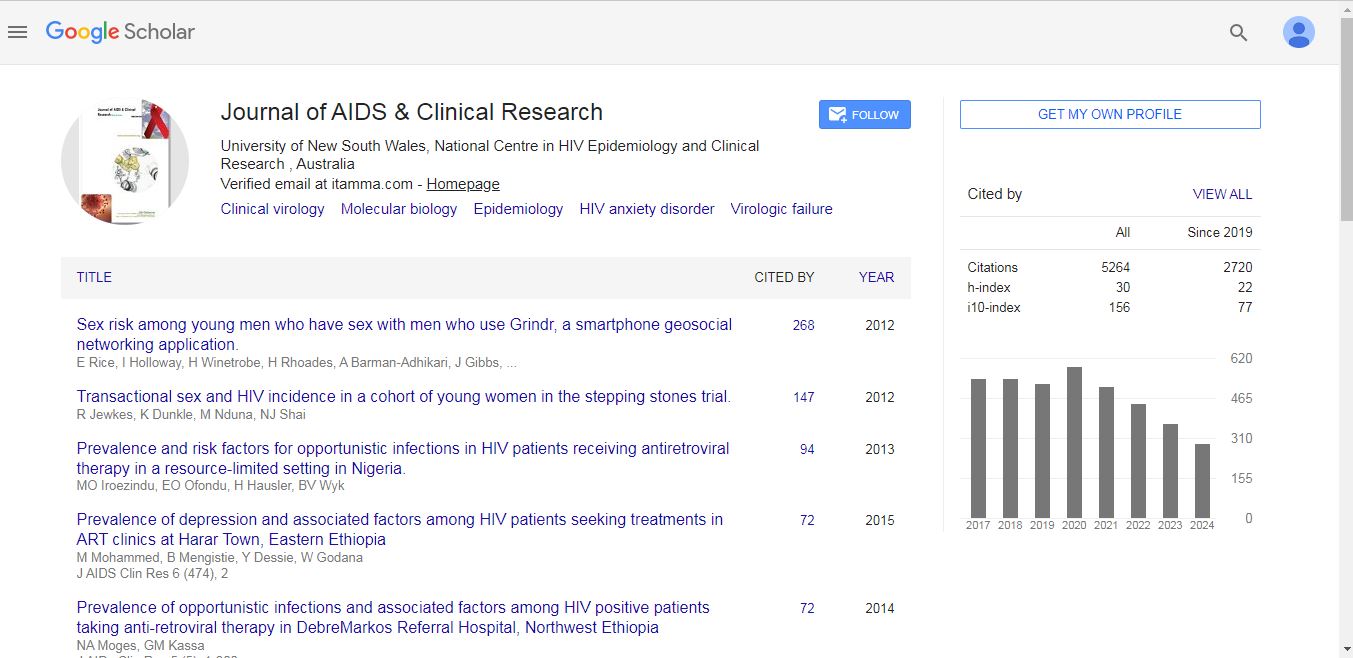
Journal of AIDS & Clinical Research received 5264 citations as per Google Scholar report