Commentary - (2025) Volume 11, Issue 5
Received: 01-Sep-2025, Manuscript No. aso-26-184657;
Editor assigned: 03-Sep-2025, Pre QC No. P-184657;
Reviewed: 17-Sep-2025, QC No. Q-184657;
Revised: 22-Sep-2025, Manuscript No. R-184657;
Published:
29-Sep-2025
, DOI: 10.37421/2471-2671.2025.11.188
Citation: Rodriguez, Elena. ”Precision Surgical Oncology: Advancing
Cancer Treatment.” Arch Surg Oncol 11 (2025):188.
Copyright: © 2025 Rodriguez E. This is an open-access article distributed under the terms of the Creative Commons Attribution License, which permits unrestricted use,
distribution and reproduction in any medium, provided the original author and source are credited.
The field of surgical oncology has undergone a profound transformation, moving away from traditional, extensive surgical interventions towards highly refined and precise techniques. This evolution is largely driven by technological advancements that allow for more targeted tumor removal while prioritizing patient well-being and functional preservation. Early oncologic surgery often involved broad, radical resections aimed at eradicating disease, but this approach frequently came with significant morbidity and a less than ideal quality of life for survivors.
The advent of sophisticated imaging modalities, robotic surgical systems, and increasingly detailed molecular diagnostics has fundamentally reshaped the landscape of cancer surgery, enabling surgeons to operate with unprecedented accuracy and minimal invasiveness. These innovations facilitate the identification and removal of malignant tissues with greater precision, leading to improved oncological control and reduced impact on healthy surrounding tissues. The integration of genetic profiling, which provides insights into the specific molecular characteristics of a patient's tumor, is a crucial component of this paradigm shift. This personalized approach allows for treatment strategies to be tailored to the individual, ensuring that interventions are as effective as possible while minimizing unnecessary toxicity. Furthermore, the widespread adoption of minimal access surgery, encompassing laparoscopic and robotic techniques, has revolutionized surgical practice by reducing the physical trauma associated with operations. These minimally invasive approaches offer substantial benefits, including shorter hospital stays, faster recovery times, and less scarring compared to open procedures. The synergistic effect of these advancementsâ??from enhanced visualization and instrumentation to molecular-level understanding of cancerâ??is paving the way for better patient outcomes and a more personalized approach to cancer care. This ongoing evolution promises to further improve the efficacy and tolerability of surgical interventions for a wide range of oncological conditions. The continuous pursuit of innovation in surgical oncology is therefore essential for advancing patient care and achieving optimal therapeutic results in the fight against cancer. The dedication to developing and implementing these cutting-edge technologies underscores a commitment to improving both survival rates and the overall quality of life for cancer patients worldwide. The collaborative efforts of researchers, clinicians, and engineers are instrumental in driving this progress and ensuring that surgical oncology remains at the forefront of cancer treatment. As we look to the future, the integration of even more advanced technologies and personalized strategies will undoubtedly continue to define the next era of surgical cancer care.Minimally invasive surgical techniques have become a cornerstone of modern oncologic resections, offering a less traumatic alternative to traditional open surgery. Robotic-assisted and laparoscopic approaches, in particular, have demonstrated their safety and efficacy across a spectrum of cancer types. These methods are associated with significant benefits such as reduced hospital stays, faster patient recovery, and improved cosmetic outcomes due to smaller incisions. The comprehensive review of these approaches highlights their potential to enhance the patient experience and expedite return to daily activities following surgery.
However, the successful implementation of these techniques is not without its challenges. A thorough understanding of the learning curve associated with robotic and laparoscopic surgery is crucial for surgeons to achieve proficiency and ensure optimal patient safety. Furthermore, considerations regarding the cost-effectiveness of these advanced technologies are important for widespread adoption and accessibility in various healthcare settings. The impact of neoadjuvant therapies on surgical outcomes in specific cancers, such as rectal cancer, is another critical area of investigation. Multimodal treatment strategies, including chemotherapy and radiation, can effectively downstage tumors, leading to less extensive surgical procedures and improved rates of sphincter preservation. This underscores the importance of a multidisciplinary approach to cancer care, where oncologists, surgeons, and radiologists collaborate to develop individualized treatment plans. The establishment of multidisciplinary tumor boards is essential for coordinating these complex treatment regimens and ensuring that patients receive the most appropriate care. Advanced imaging techniques, such as intraoperative fluorescence imaging with indocyanine green (ICG), are also playing an increasingly vital role in enhancing surgical precision. This technology provides real-time visualization of tumor margins, lymph node involvement, and tissue perfusion, which helps surgeons optimize resection and potentially reduce the risk of cancer recurrence. The ability to accurately delineate tumor boundaries and assess the extent of disease during surgery is paramount for achieving complete eradication of cancer. The integration of molecular profiling and liquid biopsies represents a significant leap towards personalized cancer care. Understanding the specific genomic landscape of a tumor allows for the tailoring of surgical approaches and the identification of patients who may benefit from adjuvant targeted therapies. Liquid biopsies offer a non-invasive method for monitoring treatment response and detecting minimal residual disease, providing valuable information for guiding subsequent management. The evolution of robotic surgery in complex oncologic procedures has been remarkable, with enhanced dexterity, visualization, and instrument articulation offered by robotic platforms. These systems facilitate more precise dissection, nerve preservation, and oncological control, leading to improved functional outcomes in procedures such as prostatectomies, colectomies, and lung resections. The ability of robotic systems to navigate challenging anatomical spaces with greater precision contributes significantly to better functional results. Oncoplastic surgery for breast cancer exemplifies the integration of oncologic principles with plastic surgery techniques to achieve both optimal oncological control and aesthetic outcomes. This approach involves various techniques for breast conservation and reconstruction, emphasizing personalized management tailored to individual patient needs and preferences. The aesthetic considerations in cancer surgery are increasingly recognized as important for a patient's overall well-being and body image. Enhanced recovery after surgery (ERAS) protocols are designed to optimize perioperative care and accelerate patient recovery, leading to shorter hospital stays and improved patient satisfaction. These evidence-based pathways aim to reduce surgical stress and facilitate a faster return to normal function, positively impacting the recovery trajectory of oncologic patients. The systematic review of ERAS protocols provides valuable insights into their effectiveness across various oncologic procedures. Cytoreductive surgery and hyperthermic intraperitoneal chemotherapy (HIPEC) have emerged as critical treatment options for peritoneal malignancies, offering hope for patients with otherwise limited therapeutic choices. Advancements in patient selection, surgical techniques, and the use of novel chemotherapeutic agents are continuously improving survival rates and quality of life in this patient population. The careful selection of patients and the refinement of surgical techniques are crucial for maximizing the benefits of HIPEC. Finally, the integration of artificial intelligence (AI) and machine learning (ML) in surgical oncology signifies a transformative era, with applications ranging from preoperative diagnosis and surgical planning to intraoperative guidance and postoperative outcome prediction. These technologies promise to further enhance precision, personalize care, and ultimately improve outcomes in cancer surgery.Surgical oncology is rapidly advancing, shifting from radical resections to precision techniques driven by innovations in imaging, robotics, and molecular diagnostics. These advancements enable targeted tumor removal with improved functional preservation and reduced morbidity. Minimally invasive approaches, including robotic and laparoscopic surgery, are widely adopted for their safety, efficacy, and patient benefits like faster recovery. Neoadjuvant therapies can downstage tumors, allowing for less extensive procedures and better organ preservation, highlighting the importance of multidisciplinary care. Advanced imaging aids in precise tumor margin identification and disease assessment, while molecular profiling and liquid biopsies facilitate personalized treatment strategies and monitoring. Robotic surgery enhances dexterity and control in complex procedures, leading to better functional outcomes. Oncoplastic surgery integrates reconstruction for optimal oncologic and aesthetic results, and Enhanced Recovery After Surgery (ERAS) protocols expedite patient recovery. Cytoreductive surgery with HIPEC offers treatment for peritoneal malignancies, and emerging AI/ML tools are set to further enhance precision and personalization in cancer surgery.
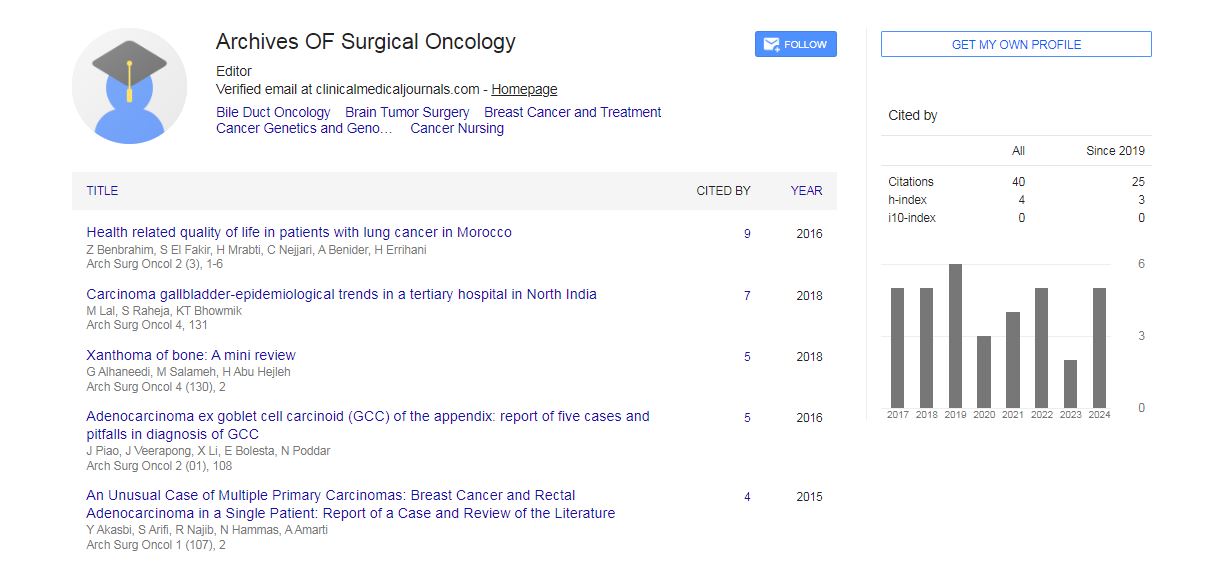
Archives of Surgical Oncology received 37 citations as per Google Scholar report