Opinion - (2025) Volume 10, Issue 2
Received: 01-Apr-2025, Manuscript No. jidm-26-188049;
Editor assigned: 03-Apr-2025, Pre QC No. P-188049;
Reviewed: 17-Apr-2025, QC No. Q-188049;
Revised: 22-Apr-2025, Manuscript No. R-188049;
Published:
29-Apr-2025
, DOI: 10.37421/2576-1420.2025.10.391
Citation: Williams, Michael. ”Precision Medicine for Evolving
Bacterial Infections.” J Infect Dis Med 10 (2025):391.
Copyright: © 2025 Williams M. This is an open-access article distributed under the terms of the Creative Commons Attribution License, which permits unrestricted use,
distribution and reproduction in any medium, provided the original author and source are credited.
The escalating challenge posed by bacterial infectious diseases necessitates continuous innovation in therapeutic strategies, particularly in light of the pervasive threat of antimicrobial resistance (AMR). Recent scientific endeavors have yielded significant progress in developing novel antimicrobial agents designed to effectively combat resistant bacterial strains, representing a critical step forward in safeguarding public health [1].
Concurrent with the development of new drugs, there has been a substantial improvement in diagnostic tools. These advancements facilitate the rapid and accurate identification of bacterial pathogens, enabling clinicians to initiate appropriate treatments more swiftly and thereby mitigate the spread of infection and reduce patient morbidity [4].
Beyond traditional antimicrobial approaches, the exploration of alternative therapies has gained considerable momentum. Phage therapy, which utilizes bacteriophages to infect and lyse specific bacteria, is re-emerging as a viable and promising alternative to conventional antibiotics, especially for infections that have become resistant to multiple drugs [3].
The deep insights derived from the integration of genomics and transcriptomics are revolutionizing our understanding of bacterial pathogenesis. This molecular-level comprehension is instrumental in identifying novel drug targets and unraveling the intricate mechanisms by which bacteria develop resistance, paving the way for more personalized treatment strategies [2].
The emergence of new classes of antibiotics, employing novel mechanisms of action that target essential bacterial processes such as ribosome function or cell wall synthesis, offers renewed hope. These innovative agents are vital for overcoming existing resistance patterns and broadening treatment options for a wide spectrum of bacterial infections [5].
Preventative measures remain a cornerstone of infectious disease management, and significant strides are being made in the development of bacterial vaccines. Modern vaccine technologies, including mRNA and subunit vaccines, are expanding the armamentarium available to prevent infections, thereby reducing the overall reliance on antibiotics and contributing to AMR control [6].
Furthermore, the intricate relationship between the host microbiome and bacterial infections is becoming increasingly recognized as a crucial area of research. Understanding and potentially manipulating the gut microbiota through interventions like probiotics or fecal microbiota transplantation may offer novel avenues for enhancing treatment efficacy and managing infectious diseases [7].
Host-directed therapies represent another promising frontier, aiming to bolster the patient's own immune system to combat bacterial infections or ameliorate the detrimental inflammatory responses they trigger. These strategies complement direct antimicrobial action and hold particular value in managing severe or chronic infections [8].
The growing prevalence of multidrug-resistant organisms (MDROs) underscores the urgent need for innovative treatment strategies. Research focused on novel antibiotic combinations, synergistic antimicrobial peptides, and advanced drug delivery systems is paramount to effectively address infections caused by these challenging pathogens [9].
Ultimately, the integration of these diverse advancements points towards a future of precision medicine in infectious diseases. This approach tailors treatments based on individual patient factors and pathogen-specific characteristics, promising to optimize therapeutic outcomes and minimize adverse effects, ushering in an era of more personalized and effective infectious disease management [10].
The ongoing battle against bacterial infectious diseases is characterized by remarkable advancements in antimicrobial agents, specifically targeting the ever-growing challenge of resistant strains. The development of novel compounds represents a significant stride in our capacity to treat infections that were once intractable, offering renewed hope for patient recovery and improved public health outcomes [1].
Alongside therapeutic innovations, diagnostic capabilities have been considerably enhanced, allowing for the rapid and precise identification of bacterial pathogens. These sophisticated diagnostic tools are crucial for timely intervention, reducing the duration of illness and limiting the transmission of infections within communities [4].
As antibiotic resistance continues to rise, alternative therapeutic modalities are gaining prominence. Bacteriophage therapy, a long-standing yet recently revitalized approach, is demonstrating significant promise as an effective alternative for treating infections caused by antibiotic-resistant bacteria, offering a targeted mechanism of action [3].
The field of infectious disease research is being profoundly reshaped by the application of genomics and transcriptomics. These powerful molecular techniques provide unprecedented insights into the mechanisms of bacterial pathogenesis and resistance, laying the groundwork for the development of precisely targeted therapies [2].
The discovery and development of new classes of antibiotics are essential for circumventing established resistance mechanisms. These novel agents, designed to interact with bacteria through unique pathways, are critical for maintaining our ability to treat infections caused by both Gram-positive and Gram-negative bacteria [5].
Preventative strategies, particularly vaccination, play a pivotal role in reducing the incidence of bacterial infections and, consequently, the need for antibiotic treatments. Advances in vaccine design and delivery are broadening the scope of preventative measures available against a diverse array of bacterial pathogens [6].
The role of the human microbiome in health and disease is a rapidly expanding area of investigation. Understanding how the intricate community of microbes within us influences susceptibility to and outcomes of bacterial infections opens up new therapeutic avenues, including the modulation of the microbiome itself [7].
Host-directed therapies are emerging as a complementary approach to traditional antimicrobial treatments. By enhancing the host's immune response or mitigating damaging inflammation, these strategies offer a multifaceted approach to managing bacterial infections, particularly in complex or severe cases [8].
The persistent threat of multidrug-resistant organisms demands innovative solutions. Research into novel combinations of existing drugs, the use of antimicrobial peptides, and the development of sophisticated drug delivery systems are vital for overcoming the challenges posed by MDROs [9].
Ultimately, these collective advancements are converging towards a paradigm of precision medicine in infectious diseases. This personalized approach, which considers individual patient characteristics and pathogen-specific traits, promises to optimize treatment efficacy and minimize untoward effects, leading to more tailored and effective patient care [10].
The landscape of treating bacterial infections is rapidly evolving due to significant advancements in antimicrobial agents targeting resistant strains and improved diagnostic tools for rapid pathogen identification. Phage therapy is re-emerging as a viable alternative to antibiotics. Genomics and transcriptomics are providing deep insights into bacterial pathogenesis and resistance mechanisms, guiding the development of targeted therapies and precision medicine approaches. New classes of antibiotics are being developed to overcome resistance, while advances in vaccine technology enhance preventative measures. The role of the microbiome and host-directed therapies are also gaining traction as complementary strategies. The increasing incidence of multidrug-resistant organisms necessitates innovative treatment approaches, including novel drug combinations and delivery systems. The overarching goal is to achieve precision medicine, personalizing treatments for optimal outcomes and minimal adverse effects.
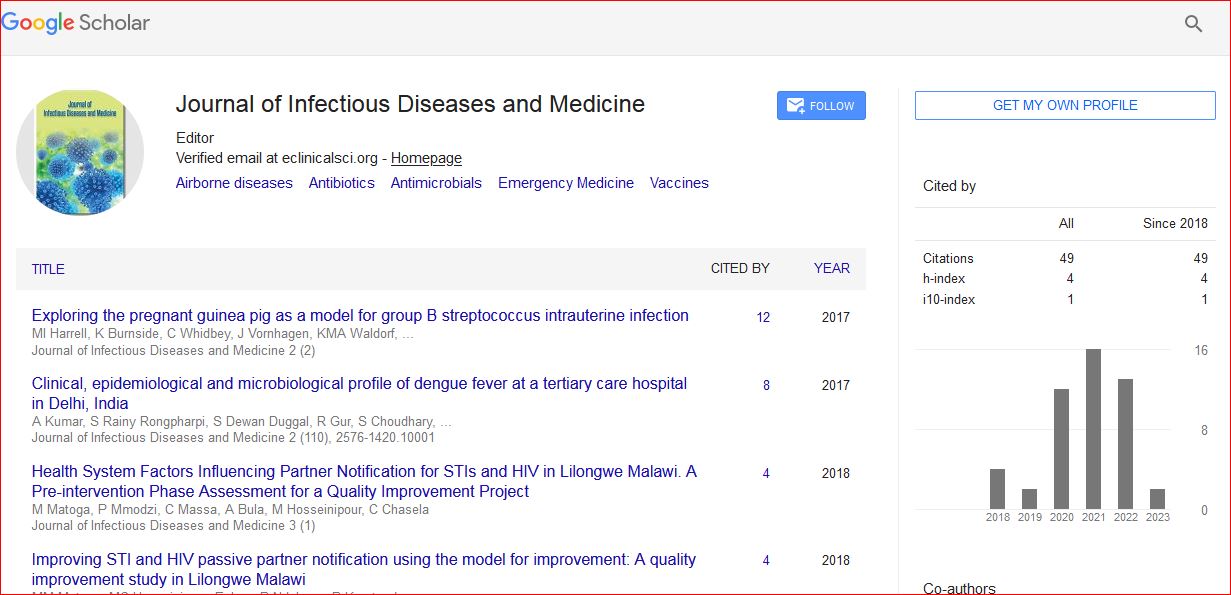
Journal of Infectious Diseases and Medicine received 1059 citations as per Google Scholar report