Perspective - (2025) Volume 9, Issue 3
Received: 02-Jun-2025, Manuscript No. jcao-26-187138;
Editor assigned: 04-Jun-2025, Pre QC No. P-187138;
Reviewed: 18-Jun-2025, QC No. Q-187138;
Revised: 23-Jun-2025, Manuscript No. R-187138;
Published:
30-Jun-2025
, DOI: 10.37421/2684-6004.2025.9.297
Citation: Ivanova, Natalia. ”Preanesthesia Assessment: Personalized Risk Mitigation For Safer Surgery.” J Clin Anesthesiol 09 (2025):297.
Copyright: © 2025 Ivanova N. This is an open-access article distributed under the terms of the Creative Commons Attribution License, which permits unrestricted use, distribution and reproduction in any medium, provided the original author and source are credited.
The preoperative anesthesia assessment is a fundamental aspect of patient safety, designed to identify and mitigate potential risks associated with surgery and anesthesia [1].
This comprehensive evaluation includes a detailed review of the patient's medical history, a thorough physical examination, and an analysis of prior anesthetic records to inform the anesthetic plan and optimize patient outcomes [1].
Recent advancements in perioperative care emphasize enhanced recovery after surgery (ERAS) protocols and prehabilitation strategies, alongside the integration of advanced monitoring technologies to further refine this critical phase [1].
This review critically examines the evolving methodologies in preoperative risk stratification, underscoring the paramount importance of personalized anesthetic planning tailored to each individual patient's needs [2].
The integration of patient-reported outcome measures (PROMs) and frailty assessments are highlighted as key tools for more accurately predicting perioperative outcomes and guiding clinical decisions [2].
Furthermore, the article discusses the significant utility of advanced imaging and functional tests in identifying subtle physiological derangements that might otherwise go unnoticed [2].
A significant focus within preoperative evaluation is the assessment of the airway, particularly in cases of anticipated difficult airways, outlining strategies for their identification and management [3].
Various assessment tools, including the LEMON mnemonic and specific visualization techniques, are discussed for their role in predicting difficult intubation, a critical aspect of airway management [3].
The authors strongly advocate for a proactive approach, emphasizing the necessity of having appropriate airway equipment and skilled personnel readily available to manage potential airway emergencies, thereby ensuring patient safety [3].
The critical role of preoperative cardiac assessment in predicting and managing perioperative cardiovascular events is explored in detail [4].
The review highlights the utilization of biomarkers such as troponin and natriuretic peptides, alongside non-invasive testing like electrocardiography and echocardiography, to comprehensively evaluate cardiac risk [4].
It emphasizes the importance of optimizing medical therapy for patients with pre-existing cardiac conditions prior to undergoing surgical procedures [4].
Furthermore, the article examines how risk prediction models can effectively guide anesthetic and surgical decisions for these vulnerable patient groups [4].
This paper specifically addresses the integration of enhanced recovery after surgery (ERAS) protocols into the preoperative anesthesia assessment process, aiming to optimize patient recovery by minimizing surgical stress and enhancing postoperative function [5].
The key components of ERAS pathways, including preoperative nutritional optimization, intraoperative fluid management, and multimodal analgesia, are outlined [5].
The article stresses that a well-executed preoperative assessment is indispensable for identifying patients who stand to benefit most from ERAS and for customizing the protocol to meet individual patient requirements [5].
The evaluation of patients with pre-existing respiratory diseases, such as asthma and chronic obstructive pulmonary disease (COPD), undergoing anesthesia is a key area of focus [6].
This assessment involves a thorough evaluation of lung function, effective symptom control, and careful review of medication adherence to ensure optimal respiratory status [6].
The authors discuss the selection of appropriate anesthetic techniques and adjuvant therapies designed to minimize respiratory complications during and after surgical procedures [6].
Evidence-based recommendations for the effective management of these patients are also presented [6].
Elderly patients undergoing anesthesia present unique challenges due to age-related physiological changes and a higher incidence of comorbidities, making their preoperative assessment particularly complex [7].
This review highlights frailty, cognitive impairment, and polypharmacy as crucial factors requiring careful consideration during the preoperative evaluation [7].
The authors discuss specific strategies for tailoring anesthetic management to preserve functional independence and reduce the risk of adverse outcomes such as postoperative delirium in this vulnerable demographic [7].
The assessment and management of preoperative anxiety in surgical patients is examined for its significant psychological impact and its influence on perioperative outcomes [8].
The article explores the psychological effects of surgery and anesthesia, underscoring the benefits derived from interventions such as comprehensive patient education, the judicious use of anxiolytic premedication, and intraoperative awareness monitoring [8].
The authors strongly emphasize that effectively addressing preoperative anxiety can lead to improved patient satisfaction and potentially contribute to better overall perioperative outcomes [8].
This article delves into the perioperative implications of obesity, specifically examining its impact on anesthetic management, and highlights associated challenges [9].
These challenges include difficulties in airway assessment, altered drug pharmacokinetics, and issues related to patient positioning during surgical procedures [9].
The authors offer evidence-based recommendations for optimizing anesthetic techniques and postoperative care for obese patients, with the overarching goal of reducing the incidence of complications like postoperative hypoxemia and venous thromboembolism [9].
Finally, this paper elucidates the critical role of the preoperative anesthesia assessment in patients undergoing major surgery, particularly within the framework of enhanced recovery after surgery (ERAS) protocols [10].
It underscores the necessity of a multidisciplinary approach, involving collaboration among anesthesiologists, surgeons, nurses, and allied health professionals [10].
The authors assert that a comprehensive preoperative assessment, including the identification and optimization of comorbidities, is paramount for the successful implementation of ERAS and the achievement of improved patient outcomes [10].
The preoperative anesthesia assessment is a cornerstone of safe patient care, aiming to identify and mitigate perioperative risks through a comprehensive evaluation of medical history, physical examination, and prior anesthetic records [1].
This process is essential for tailoring the anesthetic plan to the individual patient, optimizing outcomes, and minimizing complications, with recent advancements focusing on ERAS protocols, prehabilitation, and advanced monitoring technologies [1].
This review delves into the evolving landscape of preoperative risk stratification, emphasizing the importance of personalized anesthetic planning by integrating patient-reported outcome measures (PROMs) and frailty assessments to better predict perioperative outcomes [2].
The utility of advanced imaging and functional tests in identifying subtle physiological derangements is discussed, alongside the role of improved communication and shared decision-making between anesthesiologists and patients in enhancing satisfaction and adherence to postoperative care [2].
A significant aspect of preoperative evaluation involves a detailed focus on airway assessment, particularly concerning the challenges posed by difficult airways and outlining strategies for their identification and management [3].
The article discusses the effectiveness of various assessment tools, such as the LEMON mnemonic and visualization techniques, in predicting difficult intubation, advocating for a proactive approach with readily available equipment and skilled personnel to manage potential airway emergencies [3].
The impact of preoperative cardiac assessment on perioperative cardiovascular events is thoroughly explored, highlighting the use of biomarkers like troponin and natriuretic peptides, along with non-invasive tests like ECG and echocardiography, for risk evaluation [4].
The importance of optimizing medical therapy for patients with cardiac conditions prior to surgery is stressed, and the role of risk prediction models in guiding anesthetic and surgical decisions for these vulnerable patients is examined [4].
This paper highlights the integration of enhanced recovery after surgery (ERAS) protocols into preoperative anesthesia assessment, aiming to optimize patient recovery by minimizing surgical stress and improving postoperative function [5].
Key components of ERAS, including preoperative nutritional optimization, intraoperative fluid management, and multimodal analgesia, are outlined, emphasizing that a robust preoperative assessment is crucial for identifying suitable candidates and tailoring the protocol effectively [5].
The preoperative optimization of patients with respiratory diseases, such as asthma and COPD, undergoing anesthesia is examined, focusing on assessing lung function, controlling symptoms, and reviewing medication adherence [6].
The selection of appropriate anesthetic techniques and adjuvant therapies to minimize respiratory complications is discussed, with evidence-based recommendations provided for managing these patients [6].
Unique challenges in the preoperative assessment of elderly patients are discussed, primarily due to physiological aging and a higher prevalence of comorbidities, with a focus on identifying frailty, cognitive impairment, and polypharmacy [7].
Strategies for tailoring anesthetic management to preserve functional independence and reduce risks like postoperative delirium are presented for this population [7].
The crucial role of preoperative anxiety assessment and management in surgical patients is explored, examining the psychological impact of surgery and anesthesia [8].
The benefits of interventions such as patient education, anxiolytic premedication, and intraoperative awareness monitoring are highlighted, emphasizing that addressing preoperative anxiety can lead to improved patient satisfaction and potentially better perioperative outcomes [8].
This article examines the perioperative implications of obesity and its impact on anesthetic management, detailing challenges related to airway assessment, drug pharmacokinetics, and positioning [9].
Evidence-based recommendations are provided for optimizing anesthetic techniques and postoperative care for obese patients to reduce the incidence of complications such as postoperative hypoxemia and venous thromboembolism [9].
Finally, this paper underscores the essential role of the preoperative anesthesia assessment for patients undergoing major surgery, particularly within the context of ERAS protocols, emphasizing a multidisciplinary approach [10].
A thorough preoperative assessment, including risk identification and optimization of comorbidities, is deemed essential for successful ERAS implementation and improved patient outcomes [10].
The preoperative anesthesia assessment is a critical component of safe patient care, focusing on identifying and mitigating perioperative risks. It involves a comprehensive evaluation of a patient's medical history, physical condition, and past anesthetic experiences to tailor an individualized anesthetic plan. Modern approaches incorporate enhanced recovery after surgery (ERAS) protocols, prehabilitation, and advanced monitoring technologies. Risk stratification is increasingly personalized, utilizing patient-reported outcomes and frailty assessments. Specific attention is given to airway management, cardiac risk assessment through biomarkers and non-invasive tests, and optimizing patients with respiratory conditions. Special considerations are highlighted for elderly patients, addressing frailty and cognitive status, as well as for obese patients, tackling challenges in airway management and drug pharmacokinetics. Managing preoperative anxiety through education and interventions is also crucial for improving patient satisfaction and outcomes. A multidisciplinary approach is emphasized for major surgeries and ERAS protocols, ensuring optimized patient preparation and recovery.
None
None
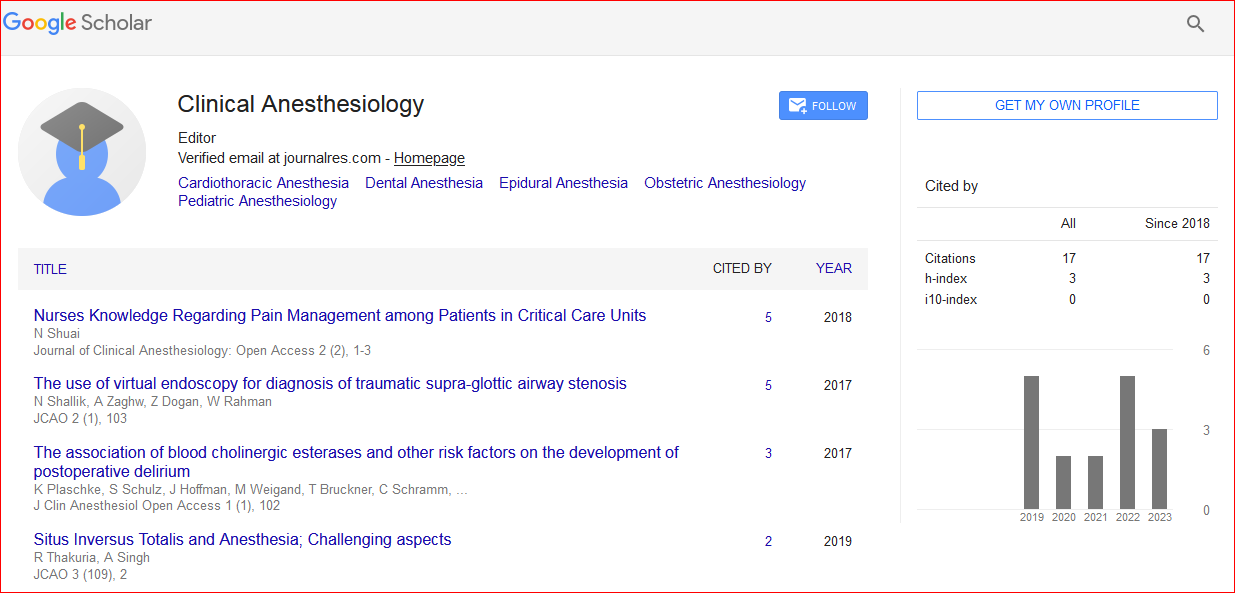
Journal of Clinical Anesthesiology: Open Access received 31 citations as per Google Scholar report