Brief Report - (2025) Volume 11, Issue 3
Received: 02-Jun-2025, Manuscript No. jpnp-25-175492;
Editor assigned: 04-Jun-2025, Pre QC No. P-175492;
Reviewed: 18-Jun-2025, QC No. Q-175492;
Revised: 23-Jun-2025, Manuscript No. R-175492;
Published:
30-Jun-2025
, DOI: 10.37421/2472-0992.2025.11.364
Citation: Osei, Samuel T.. ”Pervasive Signaling: Universal Life Regulators.” J Pharmacogn Nat Prod 11 (2025):364.
Copyright: © 2025 Osei T. Samuel This is an open-access article distributed under the terms of the Creative Commons Attribution License, which permits unrestricted use, distribution and reproduction in any medium, provided the original author and source are credited.
This article dives into how various signaling pathways play a crucial role in cancer progression and response to treatment. It highlights specific pathways often dysregulated in different cancers and explores current therapeutic strategies that target these pathways, offering insights into developing more effective anti-cancer therapies. What's clear is that understanding these molecular conversations within cells is key to fighting the disease. This comprehensive understanding is crucial for developing targeted interventions and improving patient outcomes[1].
Here's the thing: immune signaling pathways are central to how our bodies react to inflammation, and this paper gives us a solid look at their involvement in various inflammation-related diseases. It outlines the latest understanding of these pathways, suggesting new targets for therapies that could help manage or resolve chronic inflammatory conditions. Essentially, cracking the code of these immune signals holds significant promise. By deciphering these intricate networks, we can pave the way for novel therapeutic avenues for various inflammatory conditions[2].
This paper highlights the critical role of specific signaling pathways in neuroinflammation and neurodegeneration, focusing intensely on microglial cells. What this really means is that how these immune cells in the brain communicate and respond via signaling pathways directly impacts the onset and progression of neurodegenerative diseases. Understanding these pathways could open doors for new treatments for conditions like Alzheimer's and Parkinson's. Ultimately, focusing on these microglial pathways presents a significant opportunity for therapeutic innovation in neurological disorders[3].
Let's break it down: this article explores how metabolic signaling pathways go awry in metabolic syndrome and related diseases. It provides an overview of the dysregulation in these pathways, which are essential for energy balance and nutrient sensing, and discusses their contribution to conditions like diabetes and obesity. The insights here point to the potential for targeting these pathways to restore metabolic health. Such targeted approaches hold substantial promise for effectively managing and reversing prevalent metabolic conditions[4].
This paper offers a comprehensive look at the intricate signaling pathways that orchestrate early mammalian development. It describes how precise molecular communication guides cell fate, tissue patterning, and organ formation from a single fertilized egg. Essentially, it's about the fundamental instructions that build an organism, showing how errors in these signals can lead to developmental defects. Delving into these developmental cues provides fundamental insights into both healthy formation and the origins of congenital anomalies[5].
Focusing on plants, this article illuminates the complex signaling pathways that enable them to respond to drought stress. It details how plants perceive water scarcity and activate cascades of molecular events to adapt and survive under harsh conditions. Understanding these pathways is incredibly important for developing drought-resistant crops and ensuring food security in a changing climate. These findings are paramount for agricultural resilience, particularly as global climate patterns become increasingly unpredictable[6].
This review takes on the fascinating world of bacterial signaling pathways that mediate host-microbe interactions. It shows how bacteria communicate with each other and with their hosts, influencing everything from pathogenesis to mutualistic relationships. Grasping these intricate signaling networks is vital for understanding infectious diseases and harnessing beneficial microbiomes. Unraveling these bacterial communication methods is fundamental for both disease prevention and leveraging beneficial microbial communities[7].
What's emerging here is the crucial role of autophagy signaling pathways in cardiovascular diseases. This article explores how cellular self-eating processes, regulated by complex signaling, impact heart health and disease progression. Understanding these pathways offers new perspectives on how to prevent and treat conditions like heart failure and atherosclerosis by manipulating cellular recycling mechanisms. Manipulating autophagy could prove to be a powerful strategy for mitigating the progression of cardiovascular ailments[8].
This paper sheds light on how epigenetic signaling pathways contribute to cancer drug resistance. It describes the molecular mechanisms by which changes in gene expression, without altering the DNA sequence, allow cancer cells to evade therapeutic agents. What this means is that targeting these epigenetic signals could offer a fresh strategy to overcome resistance and make treatments more effective. This strategy could revolutionize cancer treatment by overcoming one of its most persistent challenges[9].
Here's a deep dive into the signaling pathways and cellular metabolism involved in aging. This article explains how alterations in key metabolic and signaling networks contribute to the aging process and age-related diseases. Understanding these fundamental molecular conversations is crucial for developing interventions to promote healthy aging and extend lifespan, making a real difference in how we approach longevity. A deeper insight into these molecular underpinnings is vital for unlocking new strategies for healthy aging and extending longevity effectively[10].
Signaling pathways are fundamental to biological systems, dictating cellular responses and overall organismal health. For instance, this article dives into how various signaling pathways play a crucial role in cancer progression and response to treatment [1]. It highlights specific pathways often dysregulated in different cancers and explores current therapeutic strategies that target these pathways, offering insights into developing more effective anti-cancer therapies. What's clear is that understanding these intricate molecular conversations within cells is absolutely key to fighting the disease. Similarly, immune signaling pathways are central to how our bodies react to inflammation, and this paper gives us a solid look at their involvement in various inflammation-related diseases [2]. It outlines the latest understanding of these pathways, suggesting new targets for therapies that could help manage or resolve chronic inflammatory conditions. Essentially, cracking the code of these complex immune signals holds significant promise for future medical advancements.
This paper highlights the critical role of specific signaling pathways in neuroinflammation and neurodegeneration, focusing intensely on microglial cells [3]. What this really means is that how these immune cells in the brain communicate and respond via signaling pathways directly impacts the onset and progression of neurodegenerative diseases. Understanding these pathways could thus open valuable doors for new treatments for conditions like Alzheimer's and Parkinson's. Let's break it down: another article explores how metabolic signaling pathways go awry in metabolic syndrome and related diseases [4]. It provides an overview of the dysregulation in these pathways, which are essential for energy balance and nutrient sensing, and discusses their contribution to conditions like diabetes and obesity. The insights here strongly point to the potential for targeting these pathways to restore vital metabolic health. Furthermore, this paper offers a comprehensive look at the intricate signaling pathways that orchestrate early mammalian development [5]. It meticulously describes how precise molecular communication guides cell fate, tissue patterning, and organ formation from a single fertilized egg. Essentially, it's about the fundamental instructions that build an organism, showing how errors in these signals can indeed lead to significant developmental defects.
Focusing on plants, this article illuminates the complex signaling pathways that enable them to respond effectively to drought stress [6]. It details exactly how plants perceive water scarcity and activate cascades of molecular events to adapt and ultimately survive under harsh conditions. Understanding these pathways is incredibly important for developing robust drought-resistant crops and ensuring global food security in a changing climate. Furthermore, this review takes on the fascinating world of bacterial signaling pathways that mediate host-microbe interactions [7]. It shows how bacteria communicate with each other and with their hosts, influencing everything from pathogenesis to mutualistic relationships. Grasping these intricate signaling networks is absolutely vital for understanding infectious diseases and effectively harnessing beneficial microbiomes for human health.
What's emerging here is the crucial role of autophagy signaling pathways in cardiovascular diseases [8]. This article explores how cellular self-eating processes, regulated by complex signaling, profoundly impact heart health and disease progression. Understanding these pathways offers new perspectives on how to prevent and treat conditions like heart failure and atherosclerosis by manipulating cellular recycling mechanisms. In addition, this paper sheds light on how epigenetic signaling pathways contribute to cancer drug resistance [9]. It describes the molecular mechanisms by which changes in gene expression, without altering the DNA sequence, allow cancer cells to evade therapeutic agents. What this means is that targeting these epigenetic signals could offer a fresh and powerful strategy to overcome resistance and make treatments significantly more effective. Finally, here's a deep dive into the signaling pathways and cellular metabolism involved in aging [10]. This article explains how alterations in key metabolic and signaling networks contribute directly to the aging process and age-related diseases. Understanding these fundamental molecular conversations is thus crucial for developing interventions to promote healthy aging and effectively extend lifespan, making a real difference in how we approach longevity.
The studies highlight the pervasive importance of signaling pathways across biological disciplines, from molecular mechanisms to organismal responses and disease. These pathways are central to understanding cancer progression and therapeutic resistance, where dysregulated signals offer targets for new treatments. Immune signaling is critical in inflammation-related diseases, suggesting avenues for managing chronic conditions. In neurological health, microglial cell signaling impacts neuroinflammation and neurodegeneration, promising new therapies for conditions like Alzheimer's and Parkinson's. Metabolic signaling pathways, when dysregulated, contribute to metabolic syndrome, diabetes, and obesity, indicating potential for restoring health through targeted interventions. Fundamental to life, these pathways also orchestrate early mammalian development, with errors leading to defects. Environmental challenges are met through signaling, as seen in plant responses to drought stress, crucial for food security. Even microorganisms rely on complex signaling for host-microbe interactions, vital for understanding infectious diseases and microbiomes. Autophagy signaling plays a key role in cardiovascular diseases, providing insights for preventing and treating heart conditions. Finally, epigenetic signaling contributes to cancer drug resistance, offering new strategies to overcome therapeutic evasion, while metabolic and signaling networks in aging are crucial for developing interventions to promote healthy longevity. Collectively, this research underscores signaling pathways as universal regulators with profound implications for health, disease, and environmental adaptation.
None
None
Indexed at, Google Scholar, Crossref
Indexed at, Google Scholar, Crossref
Indexed at, Google Scholar, Crossref
Indexed at, Google Scholar, Crossref
Indexed at, Google Scholar, Crossref
Indexed at, Google Scholar, Crossref
Indexed at, Google Scholar, Crossref
Indexed at, Google Scholar, Crossref
Indexed at, Google Scholar, Crossref
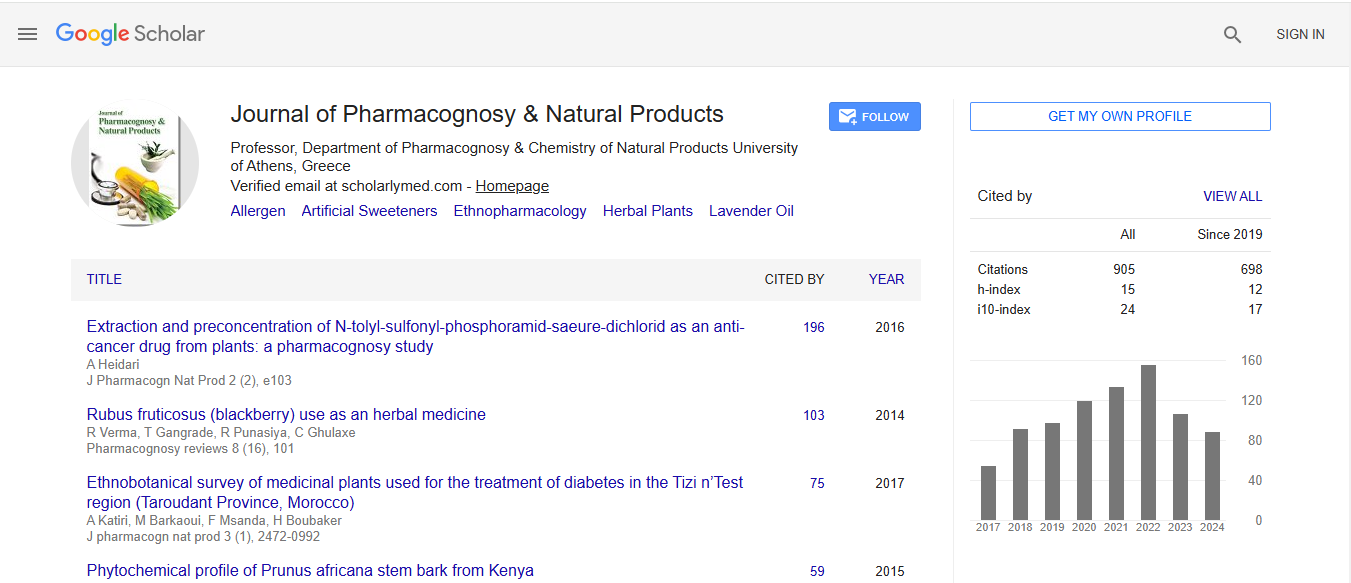
Journal of Pharmacognosy & Natural Products received 606 citations as per Google Scholar report