Commentary - (2025) Volume 16, Issue 1
Received: 01-Jan-2025, Manuscript No. jnmrt-25-172717;
Editor assigned: 03-Jan-2025, Pre QC No. P-172717;
Reviewed: 18-Jan-2025, QC No. Q-172717;
Revised: 24-Jan-2025, Manuscript No. R-172717;
Published:
31-Jan-2025
, DOI: 10.37421/2155-9619.2025.16.625
Citation: Menon, Rajesh K.. ”Personalized Radiation Oncology: Tailoring Cancer Treatment.” J Nucl Med Radiat Ther 16 (2025):625.
Copyright: © 2025 Menon K. Rajesh This is an open-access article distributed under the terms of the Creative Commons Attribution License, which permits unrestricted use, distribution and reproduction in any medium, provided the original author and source are credited.
This article delves into how data science, encompassing radiomics, genomics, and artificial intelligence, is transforming radiation oncology from a one-size-fits-all approach to a highly personalized one. It emphasizes the integration of multi-omics data with clinical information to predict treatment response, identify biomarkers for toxicity, and optimize individual patient care pathways. The goal is to create predictive models that guide dose prescription and target delineation with unprecedented precision [1].
This review explores how radiogenomics integrates imaging features with genomic data to enhance personalized radiation therapy. It highlights the potential of using these combined datasets to predict individual tumor response, identify radio-resistant or radio-sensitive phenotypes, and guide treatment intensification or de-escalation, ultimately aiming for improved therapeutic outcomes and reduced toxicity [2].
This article presents adaptive radiation therapy (ART) as a crucial advancement in personalizing cancer treatment. It discusses how ART enables real-time adjustments to treatment plans based on changes in tumor size, shape, and position, as well as patient anatomy, thereby maximizing tumor control while minimizing toxicity to healthy tissues. The paper highlights the technological innovations driving ART and its clinical implications across various cancer types [3].
This comprehensive review examines the rapidly evolving role of artificial intelligence (AI) in personalizing radiation oncology. It covers how AI tools are being applied across the entire treatment workflow, from auto-segmentation and treatment planning to dose optimization, response prediction, and toxicity management. The article underscores AI's potential to enhance efficiency, accuracy, and ultimately, patient outcomes by tailoring treatments to individual biological and anatomical characteristics [4].
This article explores the critical role of biomarkers in personalizing radiation oncology by predicting both tumor response and normal tissue toxicity. It reviews various types of biomarkers, including genetic, proteomic, and imaging-based markers, discussing their current utility in patient stratification and guiding individualized treatment strategies. The focus is on moving towards precision medicine where these biomarkers inform dose prescription and treatment techniques to optimize outcomes [5].
This review focuses on the application of personalized approaches within high-dose-rate (HDR) brachytherapy for prostate cancer. It highlights how patient-specific anatomical variations, tumor characteristics, and treatment goals drive individualized planning and delivery of radiation, improving local control and reducing treatment-related side effects. The article emphasizes the role of advanced imaging and dosimetry in optimizing this highly conformal treatment modality [6].
This article explores the growing impact of molecular imaging techniques in advancing personalized radiation oncology. It discusses how modalities like PET and SPECT, when combined with conventional anatomical imaging, provide crucial functional and biological information about tumors and surrounding healthy tissues. This allows for more precise target delineation, dose escalation to resistant sub-volumes, and early assessment of treatment response, tailoring therapy to individual patient biology [7].
This article highlights the specific challenges and promising opportunities in applying personalized radiation therapy to head and neck cancers. It addresses the complexity of anatomical structures, heterogeneity of tumors, and varying patient responses, emphasizing the need for advanced imaging, biological markers, and adaptive planning to optimize treatment. The paper discusses how precision approaches can improve local control while mitigating severe toxicities inherent to this disease site [8].
This article explores the application of personalized proton therapy in treating pediatric cancers, highlighting its advantages in minimizing radiation exposure to healthy developing tissues due to its precise dose deposition. It discusses how treatment plans are meticulously tailored to each child's unique anatomy and tumor characteristics, considering factors like growth and organ sensitivity, to maximize disease control while reducing long-term side effects and secondary cancer risk [9].
This paper investigates the utility of genomic profiling in tailoring radiation therapy for breast cancer patients. It discusses how understanding individual tumor genetics and genomic signatures can help identify patients likely to benefit most from radiation, those at higher risk of toxicity, or those for whom de-escalation of therapy might be appropriate. The aim is to integrate these molecular insights into clinical decision-making to optimize treatment efficacy and minimize side effects [10].
Personalized radiation oncology represents a significant paradigm shift, moving treatment from a standardized, one-size-fits-all approach to a highly individualized and patient-specific strategy. This transformation is heavily reliant on the effective integration of data science, which encompasses diverse fields such as radiomics, genomics, and the rapidly advancing capabilities of Artificial Intelligence (AI) [1]. AI tools, in particular, are becoming indispensable across the entire radiation therapy workflow, from automating precise tumor segmentation and refining treatment planning to optimizing dose delivery, predicting treatment response, and effectively managing potential toxicities. This underscores AI's profound potential to significantly enhance the efficiency and accuracy of radiation treatments, ultimately improving patient outcomes by meticulously tailoring therapies to each individualâ??s unique biological and anatomical characteristics [4].
A central pillar of this personalized approach involves leveraging comprehensive multi-omics data alongside detailed clinical information to create more precise treatment pathways [1]. Radiogenomics exemplifies this, by integrating detailed imaging features with genomic data to build robust predictive models. These models can forecast individual tumor responses, identify specific radio-resistant or radio-sensitive phenotypes, and consequently guide either the intensification or de-escalation of treatment. The overarching goal here is to achieve superior therapeutic outcomes while simultaneously minimizing adverse effects [2]. Furthermore, the exploration and utilization of various biomarkers, including genetic, proteomic, and advanced imaging-based markers, play a critical role. These markers are vital for accurately predicting both tumor response and potential normal tissue toxicity, guiding patient stratification, and informing individualized treatment strategies towards true precision medicine, where they influence dose prescription and treatment techniques to optimize results [5]. In specific contexts, such as breast cancer, genomic profiling offers profound insights. Understanding individual tumor genetics and genomic signatures empowers clinicians to identify patients most likely to benefit from radiation, those at higher risk of toxicity, or even candidates for therapy de-escalation, thereby optimizing treatment efficacy and reducing unwanted side effects [10].
Technological innovations are indispensable for the practical implementation of personalized radiation therapy. Adaptive Radiation Therapy (ART) stands out as a crucial advancement, allowing for real-time, dynamic adjustments to treatment plans. These adjustments are made in response to evolving factors such as changes in tumor size, shape, and position, as well as shifts in patient anatomy. This dynamic adaptability maximizes tumor control while crucially minimizing toxicity to surrounding healthy tissues, highlighting ART's transformative clinical implications across a wide spectrum of cancer types [3]. Concurrently, molecular imaging techniques are increasingly impacting personalized radiation oncology. Modalities like Positron Emission Tomography (PET) and Single-Photon Emission Computed Tomography (SPECT), when integrated with conventional anatomical imaging, provide essential functional and biological information about both tumors and adjacent healthy tissues. This fusion of data facilitates more precise target delineation, enables strategic dose escalation to identified radio-resistant sub-volumes, and permits early, accurate assessment of treatment response, thereby finely tuning therapy to individual patient biology [7]. Another powerful tool is personalized proton therapy, which offers distinct advantages, particularly in the treatment of pediatric cancers. Its ability for precise dose deposition significantly minimizes radiation exposure to healthy, developing tissues. Treatment plans are meticulously crafted for each child's unique anatomy and tumor characteristics, carefully considering factors like ongoing growth and organ sensitivity, to maximize disease control while significantly reducing long-term side effects and the critical risk of secondary cancers [9].
Personalized approaches are also being meticulously developed and applied to address the unique complexities of specific cancer sites and treatment modalities. For prostate cancer, individualized High-Dose-Rate (HDR) brachytherapy leverages patient-specific anatomical variations, detailed tumor characteristics, and tailored treatment goals to guide highly individualized planning and radiation delivery. This approach has demonstrably improved local control rates and reduced treatment-related side effects, largely due to advancements in imaging and dosimetry that optimize this conformal treatment [6]. Similarly, the application of personalized radiation therapy to head and neck cancers faces particular challenges due to the intricate anatomical structures, the inherent heterogeneity of tumors in this region, and varied patient responses. Consequently, there is an urgent need for advanced imaging, precise biological markers, and flexible adaptive planning. Precision approaches here are vital for optimizing treatment outcomes, improving local control, and effectively mitigating the severe toxicities that are unfortunately common in this disease site [8].
Personalized radiation oncology is revolutionizing cancer treatment, shifting from uniform strategies to highly tailored patient care. This evolution is driven by integrating advanced data science, including radiomics, genomics, and Artificial Intelligence (AI), which allow for the creation of predictive models to optimize dose prescription and target delineation [1, 4]. Techniques like radiogenomics combine imaging and genomic data to predict tumor response and guide treatment adjustments, ensuring better outcomes with reduced toxicity [2]. The identification and utilization of various biomarkers â?? genetic, proteomic, and imaging-based â?? are crucial for predicting treatment response and normal tissue toxicity, leading to individualized treatment strategies [5]. Technological innovations significantly support this personalized approach. Adaptive Radiation Therapy (ART) allows for real-time adjustments to treatment plans based on dynamic changes in tumor and patient anatomy, maximizing control while minimizing harm [3]. Molecular imaging, such as PET and SPECT, provides vital functional and biological insights for precise target delineation and dose escalation [7]. Specialized therapies like personalized proton therapy are particularly beneficial for sensitive cases like pediatric cancers, minimizing radiation exposure and long-term side effects [9]. This personalized paradigm is also being refined for specific cancer types, including prostate cancer with personalized High-Dose-Rate (HDR) brachytherapy [6], and head and neck cancers where advanced imaging and adaptive planning address complex challenges [8]. Genomic profiling further enhances personalized treatment in cancers like breast cancer, guiding optimal therapy intensity and reducing side effects [10]. Overall, the goal is to enhance efficacy and reduce toxicity across diverse cancer types by leveraging comprehensive patient-specific data.
None
None
Indexed at, Google Scholar, Crossref
Indexed at, Google Scholar, Crossref
Indexed at, Google Scholar, Crossref
Indexed at, Google Scholar, Crossref
Indexed at, Google Scholar, Crossref
Indexed at, Google Scholar, Crossref
Indexed at, Google Scholar, Crossref
Indexed at, Google Scholar, Crossref
Indexed at, Google Scholar, Crossref
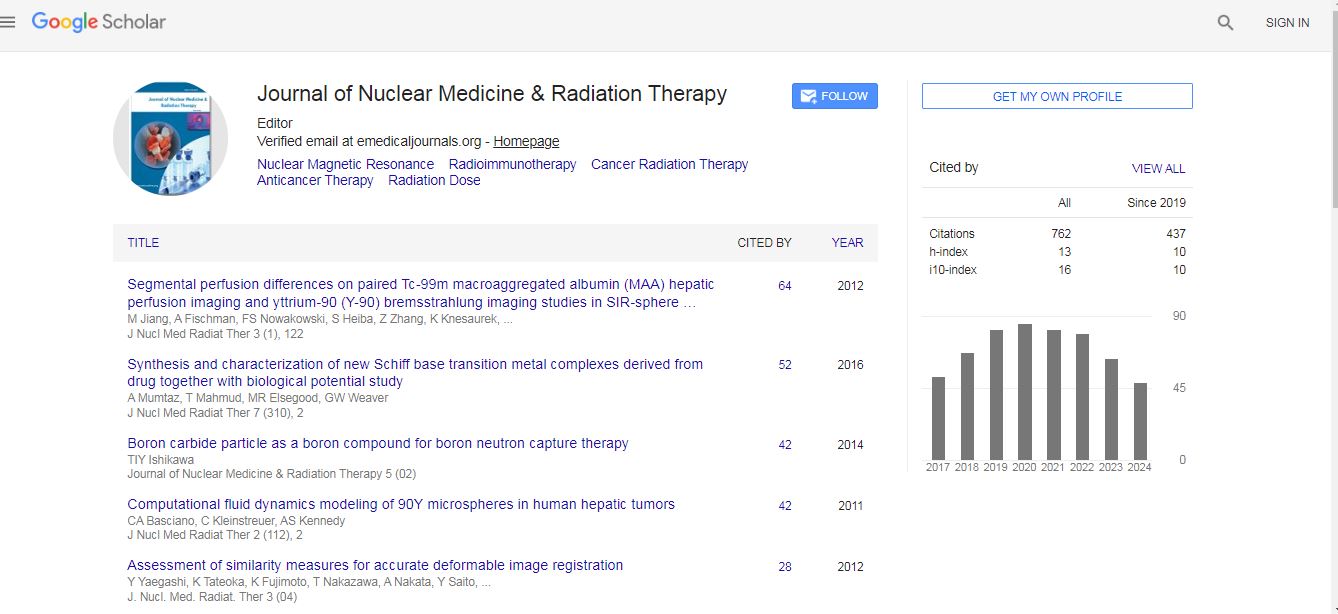
Nuclear Medicine & Radiation Therapy received 706 citations as per Google Scholar report