Perspective - (2025) Volume 9, Issue 6
Received: 01-Nov-2025, Manuscript No. fsb-26-189982;
Editor assigned: 03-Nov-2025, Pre QC No. P-189982;
Reviewed: 17-Nov-2025, QC No. Q-189982;
Revised: 24-Nov-2025, Manuscript No. R-189982;
Published:
29-Nov-2025
, DOI: 10.37421/2577-0543.2025.9.268
Citation: Mehta, Arjun. ”Personalized Medicine: Targeted Therapies Driven By Science.” J. Formul. Sci. Bioavailability 09 (2025):268.
Copyright: © 2025 Mehta A. This is an open-access article distributed under the terms of the Creative Commons Attribution License, which permits unrestricted use, distribution and reproduction in any medium, provided the original author and source are credited.
Personalized medicine represents a paradigm shift in healthcare, moving away from generalized treatment approaches toward strategies tailored to the individual [1].
This evolution is propelled by significant advancements in fields such as genomics, proteomics, and sophisticated data analytics, enabling the design of therapeutic interventions optimized for unique patient profiles [1].
The development of novel drug formulations is paramount to the effective delivery of these personalized therapies, focusing on enhancing factors like bioavailability, stability, and precise targeting [1].
In this context, nanotechnology has emerged as a critical enabler, facilitating the creation of advanced drug delivery systems capable of targeting diseased cells with remarkable accuracy while minimizing adverse off-target effects, thus improving efficacy and reducing toxicity [1].
The integration of diverse omics data with comprehensive clinical information forms the bedrock for realizing truly personalized medicine, allowing for the identification of specific biomarkers that predict an individual's response to drugs or their susceptibility to diseases [2].
As a result, advanced drug formulations, including nanoparticles, liposomes, and hydrogels, are under extensive development to facilitate the delivery of these precisely targeted therapies [2].
These sophisticated systems are engineered to surmount biological barriers, enhance the solubility of challenging drugs, and achieve controlled or sustained release profiles, all of which are indispensable for optimizing treatment outcomes within a personalized framework [2].
Nanotechnology, in particular, offers transformative potential by enabling the development of highly specific drug delivery vehicles [3].
These nanocarriers can be designed to respond to specific biological cues within the body, ensuring the release of their therapeutic payload exclusively at the disease site [3].
This level of precision significantly curtails systemic exposure and mitigates adverse effects, a central objective in personalized treatment paradigms [3].
Furthermore, nanotechnology plays a vital role in improving the bioavailability of drugs that exhibit poor solubility, a common hurdle in developing effective treatments for heterogeneous patient populations [3].
The development of advanced drug formulations is thus indispensable for unlocking the full promise of personalized medicine [4].
This encompasses strategies aimed at augmenting drug solubility, enhancing stability, and achieving controlled release mechanisms [4].
For instance, lipid-based nanoparticles and polymeric micelles are being extensively investigated for their capacity to encapsulate hydrophobic drugs and thereby improve their bioavailability [4].
The design of these specialized formulations explicitly considers individual patient characteristics, including their genetic makeup and the specific stage of their disease, to ensure optimal therapeutic efficacy and safety [4].
Pharmacogenomics stands as a fundamental pillar of personalized medicine, guiding the selection of appropriate drugs and dosages based on an individual's unique genetic profile [5].
This personalized approach seeks to maximize therapeutic benefits while concurrently minimizing the occurrence of adverse drug reactions [5].
Advanced formulations are progressively being developed to complement these pharmacogenomic insights, ensuring that drugs are administered in a manner that is most effective for each patient [5].
Strategies for controlled drug release, for example, are crucial for maintaining therapeutic drug concentrations within a patient's individual therapeutic window [5].
The formulation science underpinning advanced drug delivery systems is absolutely critical for the successful implementation of personalized therapies [6].
Innovative approaches are predominantly focused on enhancing drug targeting, improving bioavailability, and increasing patient compliance [6].
This includes the judicious use of stimuli-responsive materials that can trigger drug release in response to specific physiological conditions, such as variations in pH or temperature, which can differ significantly among individuals [6].
The overarching goal is to achieve a more precise and effective delivery of therapeutics that are meticulously tailored to meet individual patient needs [6].
Biopharmaceutical characterization and formulation development represent key stages in translating the conceptual frameworks of personalized medicine into tangible clinical practices [7].
Understanding how a drug interacts with a patient's biological system on an individual level provides the essential information required to design optimal drug formulations [7].
Advanced analytical techniques, alongside sophisticated in vitro and in vivo models, are extensively employed to meticulously assess the absorption, distribution, metabolism, and excretion (ADME) profiles for specific patient subgroups, ultimately leading to the creation of more effective and safer drug products [7].
The realm of precision oncology serves as a prominent exemplification of the advancements within personalized medicine [8].
Identifying specific molecular alterations within tumors empowers clinicians to select highly targeted therapies [8].
Advanced drug formulations, particularly those leveraging nanotechnology, are indispensable for the effective delivery of these targeted agents to cancer cells, thereby sparing healthy tissues [8].
This strategic approach aims to elevate treatment response rates and mitigate the debilitating side effects frequently associated with conventional chemotherapy [8].
The synergistic convergence of big data, artificial intelligence, and omics technologies is significantly accelerating the pace of personalized medicine development [9].
These powerful tools facilitate the analysis of vast quantities of patient data, enabling the identification of novel therapeutic targets and the prediction of individual drug responses [9].
Subsequently, advanced formulations are engineered to deliver these newly identified therapies with exceptional precision [9].
This encompasses the development of novel delivery systems capable of navigating complex biological barriers and achieving sustained or triggered drug release mechanisms tailored to patient-specific requirements [9].
Drug delivery systems are undergoing continuous evolution to satisfy the increasingly sophisticated demands of personalized medicine, with a primary focus on enhancing bioavailability, enabling targeted delivery, and facilitating controlled release [10].
Innovations in materials science and nanotechnology are instrumental in the creation of sophisticated drug carriers, such as polymer-drug conjugates and mesoporous silica nanoparticles [10].
These advanced formulations are meticulously designed to improve the therapeutic index of drugs by ensuring their precise delivery to the site of action, thereby minimizing systemic toxicity and maximizing patient benefit [10].
Personalized medicine, also known as precision medicine, signifies a transformative approach in healthcare that tailors medical treatment to the individual characteristics of each patient [1].
This paradigm shift is largely driven by rapid progress in genomic sequencing, proteomic analysis, and sophisticated data analytics, which collectively enable the development of therapeutic strategies that move beyond a one-size-fits-all model [1].
Emerging drug formulations are central to the successful implementation of these personalized therapies, with a focus on optimizing parameters such as bioavailability, drug stability, and the precision of targeted delivery [1].
Nanotechnology plays a pivotal role in this advancement, facilitating the creation of intricate drug delivery systems that can accurately target diseased cells while simultaneously minimizing unwanted off-target effects, thereby enhancing therapeutic efficacy and reducing toxicity [1].
The integration of omics data, encompassing genomics, proteomics, and metabolomics, with comprehensive clinical information is fundamental to the realization of personalized medicine's full potential [2].
This integration allows for the precise identification of specific biomarkers that can predict an individual's response to particular drugs or their susceptibility to various diseases [2].
Consequently, advanced drug formulations such as nanoparticles, liposomes, and hydrogels are being actively developed to ensure the effective delivery of these targeted therapies [2].
These sophisticated delivery systems are designed to overcome biological barriers, improve the solubility of challenging drug compounds, and achieve controlled or sustained drug release kinetics, all of which are critical for optimizing treatment outcomes in a personalized context [2].
Nanotechnology offers a truly transformative potential for personalized medicine by enabling the design and development of highly specific drug delivery vehicles, often referred to as nanocarriers [3].
These nanocarriers can be meticulously engineered to respond to specific biological cues present within the body, thereby releasing their therapeutic payload exclusively at the disease site [3].
This precise targeting mechanism significantly minimizes systemic exposure to the drug and consequently reduces the likelihood of adverse effects, a key objective in the pursuit of personalized treatment [3].
Furthermore, nanotechnology is instrumental in enhancing the bioavailability of drugs that suffer from poor solubility, a persistent challenge in the development of effective therapeutic options for diverse patient populations [3].
The development of advanced drug formulations is therefore an essential prerequisite for realizing the comprehensive potential of personalized medicine [4].
This includes the implementation of innovative strategies focused on improving drug solubility, enhancing drug stability, and achieving precise control over drug release [4].
For example, lipid-based nanoparticles and polymeric micelles are currently under extensive investigation for their inherent ability to encapsulate hydrophobic drugs, thereby significantly improving their bioavailability [4].
The design of these specialized formulations takes into account individual patient characteristics, such as their unique genetic makeup and the specific stage of their disease, to optimize both therapeutic efficacy and patient safety [4].
Pharmacogenomics, the study of how genes affect a person's response to drugs, serves as a cornerstone of personalized medicine [5].
It guides the selection of appropriate drugs and their optimal dosages based on an individual's genetic profile, aiming to maximize therapeutic benefits while minimizing the risk of adverse drug reactions [5].
Advanced drug formulations are being actively developed to complement these pharmacogenomic insights, ensuring that drugs are delivered in a manner that is most effective for each individual patient [5].
For instance, strategies employing controlled-release mechanisms can help maintain therapeutic drug concentrations within a patient's personalized therapeutic window, thereby optimizing treatment efficacy and safety [5].
The formulation science that underlies advanced drug delivery systems is absolutely critical for the successful clinical translation and implementation of personalized therapies [6].
Innovative approaches are predominantly focused on improving drug targeting accuracy, enhancing bioavailability, and increasing patient compliance with treatment regimens [6].
This includes the utilization of stimuli-responsive materials that are capable of releasing their therapeutic payload in response to specific physiological conditions, such as localized changes in pH or temperature, which can exhibit considerable variation between individuals [6].
The ultimate goal is to achieve a more precise, effective, and individualized delivery of therapeutics tailored to meet the unique needs of each patient [6].
Biopharmaceutical characterization and the subsequent formulation development are pivotal steps in the process of translating the conceptual advancements in personalized medicine into practical clinical applications [7].
A thorough understanding of how a specific drug interacts with the biological system at an individual level provides the foundational knowledge required for designing optimal drug formulations [7].
Advanced analytical techniques, coupled with sophisticated in vitro and in vivo models, are extensively employed to meticulously assess the absorption, distribution, metabolism, and excretion (ADME) profiles for distinct patient subgroups. This detailed analysis leads to the development of more effective and safer drug products tailored to individual needs [7].
The field of precision oncology stands as a significant exemplification of the progress and success achieved within personalized medicine [8].
The ability to identify specific molecular alterations within a patient's tumor allows for the precise selection of targeted therapies that act directly on these cancer-driving mechanisms [8].
Advanced drug formulations, particularly those that leverage nanotechnology, are crucial for the effective delivery of these targeted therapeutic agents directly to cancer cells, while simultaneously sparing healthy tissues from damage [8].
This targeted approach aims to improve treatment response rates and substantially reduce the debilitating side effects often associated with traditional, non-specific chemotherapy regimens [8].
The synergistic convergence of big data analytics, artificial intelligence (AI), and omics technologies is significantly accelerating the development and application of personalized medicine [9].
These powerful computational tools enable the analysis of vast and complex datasets derived from patients, facilitating the identification of novel therapeutic targets and the prediction of individual drug responses with increasing accuracy [9].
Subsequently, advanced formulations are designed to deliver these newly identified therapies with exceptional precision [9].
This includes the development of novel delivery systems engineered to overcome complex biological barriers and to achieve sustained or triggered drug release mechanisms that are responsive to patient-specific physiological conditions and needs [9].
Drug delivery systems are continuously evolving to meet the complex and diverse demands posed by personalized medicine, with a primary focus on enhancing drug bioavailability, achieving highly targeted delivery to specific sites within the body, and enabling controlled drug release profiles [10].
Innovations stemming from advancements in materials science and nanotechnology are instrumental in the creation of sophisticated drug carriers, such as polymer-drug conjugates and mesoporous silica nanoparticles [10].
These advanced formulations are meticulously designed with the objective of improving the therapeutic index of drugs by ensuring their precise delivery to the intended site of action. This targeted approach is crucial for minimizing systemic toxicity and maximizing the overall therapeutic benefit for each individual patient [10].
Personalized medicine is rapidly advancing, driven by breakthroughs in genomics, proteomics, and data analytics, enabling tailored therapeutic strategies that move beyond one-size-fits-all approaches to treatments optimized for individual patient profiles [1].
Emerging drug formulations are crucial for delivering these personalized therapies effectively, enhancing bioavailability, stability, and targeted delivery [1].
Nanotechnology plays a pivotal role in creating sophisticated drug delivery systems that can precisely target diseased cells while minimizing off-target effects, thereby improving therapeutic efficacy and reducing toxicity [1].
The integration of omics data with clinical information is fundamental to realizing personalized medicine, allowing for the identification of specific biomarkers that predict drug response or disease susceptibility [2].
Advanced drug formulations, such as nanoparticles, liposomes, and hydrogels, are being developed to deliver these targeted therapies [2].
These advanced systems are designed to overcome biological barriers, improve drug solubility, and achieve controlled or sustained release, all critical for optimizing treatment outcomes in a personalized context [2].
Nanotechnology offers transformative potential for personalized medicine by enabling the development of highly specific drug delivery vehicles [3].
These nanocarriers can be engineered to respond to specific biological cues within the body, releasing their therapeutic payload only at the disease site [3].
This precision minimizes systemic exposure and adverse effects, a key goal in personalized treatment [3].
Furthermore, nanotechnology aids in enhancing the bioavailability of poorly soluble drugs, a common challenge in developing effective treatments for diverse patient populations [3].
The development of advanced drug formulations is essential for realizing the full potential of personalized medicine [4].
This includes strategies for improving drug solubility, stability, and targeted release [4].
For instance, lipid-based nanoparticles and polymeric micelles are being explored for their ability to encapsulate hydrophobic drugs and improve their bioavailability [4].
The design of these formulations considers individual patient characteristics, such as genetic makeup and disease stage, to optimize therapeutic efficacy and safety [4].
Pharmacogenomics is a cornerstone of personalized medicine, guiding the selection of drugs and dosages based on an individual's genetic profile [5].
This approach aims to maximize therapeutic benefit while minimizing adverse drug reactions [5].
Advanced formulations are being developed to complement pharmacogenomic insights, ensuring that drugs are delivered in a manner that is most effective for each patient [5].
For example, strategies for controlled release can help maintain therapeutic drug concentrations within the patient's individual therapeutic window [5].
The formulation science behind advanced drug delivery systems is critical for the success of personalized therapies [6].
Innovative approaches are focused on improving drug targeting, bioavailability, and patient compliance [6].
This includes the use of stimuli-responsive materials that can release drugs in response to specific physiological conditions, such as pH or temperature changes, which can vary between individuals [6].
The goal is to achieve a more precise and effective delivery of therapeutics tailored to individual needs [6].
Biopharmaceutical characterization and formulation development are key steps in translating personalized medicine concepts into clinical practice [7].
Understanding how a drug interacts with the biological system at an individual level informs the design of optimal formulations [7].
Advanced analytical techniques and in vitro/in vivo models are employed to assess drug absorption, distribution, metabolism, and excretion (ADME) profiles for specific patient subgroups, leading to the development of more effective and safer drug products [7].
The rise of precision oncology exemplifies the progress in personalized medicine [8].
Identifying specific molecular alterations in tumors allows for the selection of targeted therapies [8].
Advanced drug formulations, particularly those utilizing nanotechnology, are crucial for delivering these targeted agents effectively to cancer cells while sparing healthy tissues [8].
This approach aims to improve treatment response rates and reduce the debilitating side effects often associated with traditional chemotherapy [8].
The convergence of big data, artificial intelligence, and omics technologies is accelerating the development of personalized medicine [9].
These tools enable the analysis of vast amounts of patient data to identify novel therapeutic targets and predict individual drug responses [9].
Advanced formulations are then designed to deliver these newly identified therapies precisely [9].
This includes developing novel delivery systems capable of overcoming complex biological barriers and achieving sustained or triggered drug release based on patient-specific needs [9].
Drug delivery systems are evolving to meet the demands of personalized medicine, focusing on enhanced bioavailability, targeted delivery, and controlled release [10].
Innovations in materials science and nanotechnology are enabling the creation of sophisticated carriers, such as polymer-drug conjugates and mesoporous silica nanoparticles [10].
These advanced formulations are designed to improve the therapeutic index of drugs by delivering them precisely to the site of action, thereby minimizing systemic toxicity and maximizing patient benefit [10].
Personalized medicine is transforming healthcare by tailoring treatments to individual patient profiles, moving beyond generalized approaches. This shift is powered by advances in genomics, proteomics, and data analytics. Key to its success are novel drug formulations designed to enhance bioavailability, stability, and targeted delivery. Nanotechnology plays a crucial role in developing sophisticated delivery systems that precisely target diseased cells and minimize side effects. The integration of omics data with clinical information allows for biomarker identification, predicting drug response and disease susceptibility. Advanced formulations like nanoparticles and liposomes are essential for delivering these targeted therapies and overcoming biological barriers. Pharmacogenomics guides drug selection and dosage based on genetic makeup, aiming to maximize benefits and minimize adverse reactions. Innovative formulation science, including stimuli-responsive materials, is critical for precise and effective drug delivery. Biopharmaceutical characterization and advanced analytical techniques inform the design of optimal formulations for specific patient subgroups. Precision oncology demonstrates personalized medicine's impact through targeted therapies for specific molecular alterations in tumors. The convergence of big data, AI, and omics technologies accelerates the identification of therapeutic targets and prediction of drug responses, leading to precisely delivered therapies. Emerging drug delivery technologies focus on improved bioavailability, targeting, and controlled release, ultimately maximizing patient benefit and minimizing toxicity.
None
None
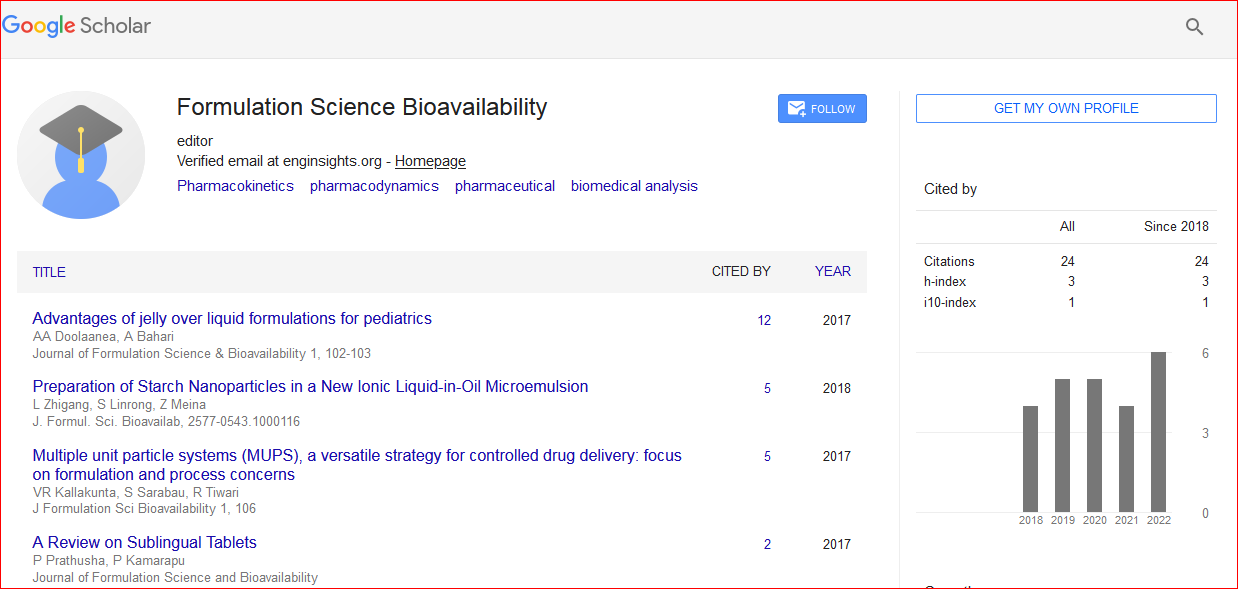
Journal of Formulation Science & Bioavailability received 23 citations as per Google Scholar report