Brief Report - (2025) Volume 13, Issue 6
Received: 01-Dec-2025, Manuscript No. JCMG-26-185577;
Editor assigned: 03-Dec-2025, Pre QC No. P-185577;
Reviewed: 17-Dec-2025, QC No. Q-185577;
Revised: 22-Dec-2025, Manuscript No. R-185577;
Published:
29-Dec-2025
, DOI: 10.37421/2472-128X.2025.13.367
Citation: Petrovic, Ana. ”Personalized Medicine: Genomics Revolutionizing Healthcare.” J Clin Med Genomics 13 (2025):367.
Copyright: © 2025 Petrovic A. This is an open-access article distributed under the terms of the Creative Commons Attribution License, which permits unrestricted use, distribution and reproduction in any medium, provided the original author and source are credited.
Therapeutic genomics is ushering in a new era of medicine by enabling treatments tailored to an individual's genetic makeup, moving beyond the limitations of one-size-fits-all approaches. This paradigm shift focuses on precise interventions targeting the fundamental genomic causes of diseases. By meticulously analyzing a patient's unique DNA, clinicians can pinpoint specific mutations or variations that influence susceptibility to illness, disease progression, and how individuals respond to medications. This capability is crucial for the development of personalized medicines, advanced gene therapies, and sophisticated pharmacogenomic strategies designed to maximize treatment effectiveness and minimize adverse side effects, thus inaugurating a period of truly individualized healthcare [1].
The integration of comprehensive whole-genome sequencing into routine clinical practice is proving instrumental in identifying genetic predispositions to a wide spectrum of health conditions. This detailed genetic information is paramount for proactive health management and timely early intervention strategies. Beyond its established role in diagnosing rare genetic disorders, whole-genome sequencing is increasingly vital in understanding the complex interplay of genetic factors in common diseases such as cardiovascular disease and diabetes, thereby paving the way for innovative preventative genomic strategies and personalized risk assessments [2].
Cutting-edge gene editing technologies, most notably the CRISPR-Cas9 system, are fundamentally transforming the landscape of therapeutic genomics. These powerful tools offer the unprecedented potential to directly correct specific genetic mutations within a patient's cells. Although many applications are still in their nascent stages of development and clinical trial, gene editing technologies hold immense promise for the treatment of inherited diseases. Conditions like sickle cell anemia and cystic fibrosis, caused by specific genetic defects, could potentially be cured by directly fixing the underlying genetic errors at their source [3].
Pharmacogenomics, a critical component of therapeutic genomics, plays a pivotal role in optimizing drug therapy by meticulously considering a patient's unique genetic profile. This field allows for the prediction of how an individual will metabolize and respond to specific medications, enabling precise dose adjustments or the selection of alternative therapeutic agents. The careful application of pharmacogenomic principles significantly reduces the risk of adverse drug reactions and demonstrably improves treatment outcomes, particularly in challenging therapeutic areas such as oncology and psychiatry, where genetic variability can profoundly impact drug efficacy and safety [4].
The ethical considerations inherent in the advancement and application of therapeutic genomics are profound and necessitate careful, thoughtful navigation. Significant issues surrounding patient data privacy, the potential for genetic discrimination in various aspects of life, and ensuring equitable access to these highly advanced genomic therapies must be rigorously addressed. The establishment of clear ethical guidelines, robust regulatory frameworks, and transparent policies is absolutely essential to guarantee that the transformative benefits of this rapidly evolving technology are realized in a responsible, equitable, and ethically sound manner for all [5].
Genomic screening is rapidly advancing as a sophisticated tool in cancer management. The identification of germline mutations not only informs comprehensive risk assessments for individuals and families but also guides the development of early detection strategies and the selection of highly targeted therapies. This personalized approach to cancer care, which aims to align treatments with the specific molecular profile of a patient's tumor, holds the potential to significantly improve survival rates and enhance the overall quality of life for individuals diagnosed with cancer [6].
The development and application of RNA-based therapeutics, including revolutionary mRNA vaccines and RNA interference (RNAi) therapies, represent another exciting frontier within therapeutic genomics. These innovative approaches skillfully leverage the transient and adaptable nature of RNA molecules to precisely modulate gene expression or provide cells with instructions for producing specific proteins. This opens up entirely new avenues for combating diseases that were previously considered untreatable or extremely difficult to manage [7].
Significant challenges persist in achieving the widespread adoption and seamless integration of therapeutic genomics into mainstream healthcare. These hurdles include the substantial cost associated with advanced genomic sequencing and sophisticated data analysis, the requirement for specialized bioinformatics infrastructure and expertise, and the continuous and rapid evolution of our understanding of human genetics. Overcoming these obstacles demands a concerted and collaborative effort involving researchers, clinicians, policymakers, and the broader industry to ensure these advanced therapies become both accessible and affordable to a wider patient population [8].
The broader 'omic' revolution, which encompasses a range of disciplines including genomics, transcriptomics, proteomics, and metabolomics, is providing an unprecedentedly holistic view of cellular function and the complex mechanisms underlying disease development. The integration of these diverse data layers is crucial for achieving a more comprehensive understanding of intricate biological pathways and for identifying novel therapeutic targets that might be missed by single-discipline approaches. This multi-omic strategy is indispensable for unraveling the multifaceted nature of diseases and for designing more effective and precisely tailored personalized treatments [9].
The increasing application of artificial intelligence (AI) and machine learning (ML) is acting as a powerful accelerant for discovery within therapeutic genomics. These advanced computational tools are capable of analyzing vast and complex datasets of genomic information to accurately identify disease-associated variants, reliably predict individual drug responses, and even assist in the design of entirely novel therapeutic molecules. AI/ML is therefore instrumental in translating complex genomic insights into actionable clinical decisions and highly personalized treatment plans, thereby streamlining the path from research to patient care [10].
Therapeutic genomics represents a profound shift in medical practice, moving towards highly personalized treatment strategies based on an individual's unique genetic makeup. This approach allows for interventions that precisely target the root causes of diseases at the genomic level. By analyzing a patient's DNA, clinicians can identify specific genetic variations influencing disease susceptibility and drug response, facilitating the development of personalized medicines and gene therapies that enhance efficacy and minimize side effects, heralding an era of truly individualized healthcare [1].
The integration of whole-genome sequencing into clinical settings enables the comprehensive identification of genetic predispositions to various health conditions. This data is invaluable for proactive health management and early intervention. Beyond diagnosing rare genetic disorders, it is crucial for understanding complex diseases like cardiovascular disease and diabetes, paving the way for preventative genomic strategies and personalized risk assessments [2].
Gene editing technologies, particularly CRISPR-Cas9, are revolutionizing therapeutic genomics by offering the ability to correct specific genetic mutations directly within a patient's cells. While many applications are in early stages, gene editing holds significant promise for treating inherited diseases such as sickle cell anemia and cystic fibrosis by addressing the underlying genetic defects [3].
Pharmacogenomics, a core element of therapeutic genomics, optimizes drug therapy by analyzing a patient's genetic profile to predict their response to specific medications. This allows for personalized dose adjustments or the selection of alternative drugs, thereby reducing adverse drug reactions and improving treatment outcomes, particularly in oncology and psychiatry where genetic variability plays a significant role [4].
Ethical considerations surrounding therapeutic genomics are substantial and require careful management. Issues such as data privacy, the risk of genetic discrimination, and ensuring equitable access to advanced genomic therapies must be addressed. Establishing clear guidelines and regulations is vital to ensure the responsible and ethical implementation of this technology [5].
Genomic screening for cancer is becoming increasingly sophisticated. Identifying germline mutations aids in risk assessment, early detection, and the selection of targeted therapies. This personalized approach aims to improve patient survival and quality of life by matching treatments to the specific molecular profile of their tumors [6].
The development of RNA-based therapeutics, including mRNA vaccines and RNA interference (RNAi) therapies, represents a significant advancement in therapeutic genomics. These approaches use RNA to modulate gene expression or deliver instructions for protein production, offering novel treatment options for previously untreatable diseases [7].
Challenges to the widespread adoption of therapeutic genomics include high costs, the need for specialized bioinformatics infrastructure, and the rapidly evolving nature of genetic knowledge. Collaborative efforts among researchers, clinicians, policymakers, and industry are necessary to make these advanced therapies accessible and affordable [8].
The 'omic' revolution, integrating genomics, transcriptomics, proteomics, and metabolomics, provides a holistic view of cellular function and disease. Integrating these data layers facilitates a deeper understanding of biological pathways and the identification of novel therapeutic targets, crucial for unraveling disease complexity and designing effective personalized treatments [9].
Artificial intelligence (AI) and machine learning (ML) are accelerating discoveries in therapeutic genomics. These tools analyze vast genomic datasets to identify disease variants, predict drug responses, and design novel therapeutics, translating complex genetic information into actionable clinical insights and personalized treatment plans [10].
Therapeutic genomics is transforming medicine by tailoring treatments to individual genetic profiles, moving away from one-size-fits-all approaches. This involves analyzing DNA to identify genetic variations that influence disease susceptibility and drug response, enabling personalized medicines, gene therapies, and pharmacogenomic strategies. Whole-genome sequencing aids in identifying genetic predispositions for proactive health management and understanding complex diseases. Gene editing technologies like CRISPR-Cas9 offer potential cures for inherited diseases by correcting genetic mutations. Pharmacogenomics optimizes drug therapy by predicting individual responses, reducing adverse reactions. Ethical considerations regarding data privacy, discrimination, and access are significant. Genomic screening for cancer helps in risk assessment and targeted therapies. RNA-based therapeutics offer new treatment modalities. Challenges like high costs and infrastructure needs persist, requiring collaborative efforts for accessibility. The integration of multi-omics data and AI/ML further accelerates discoveries and the development of personalized treatments.
None
None
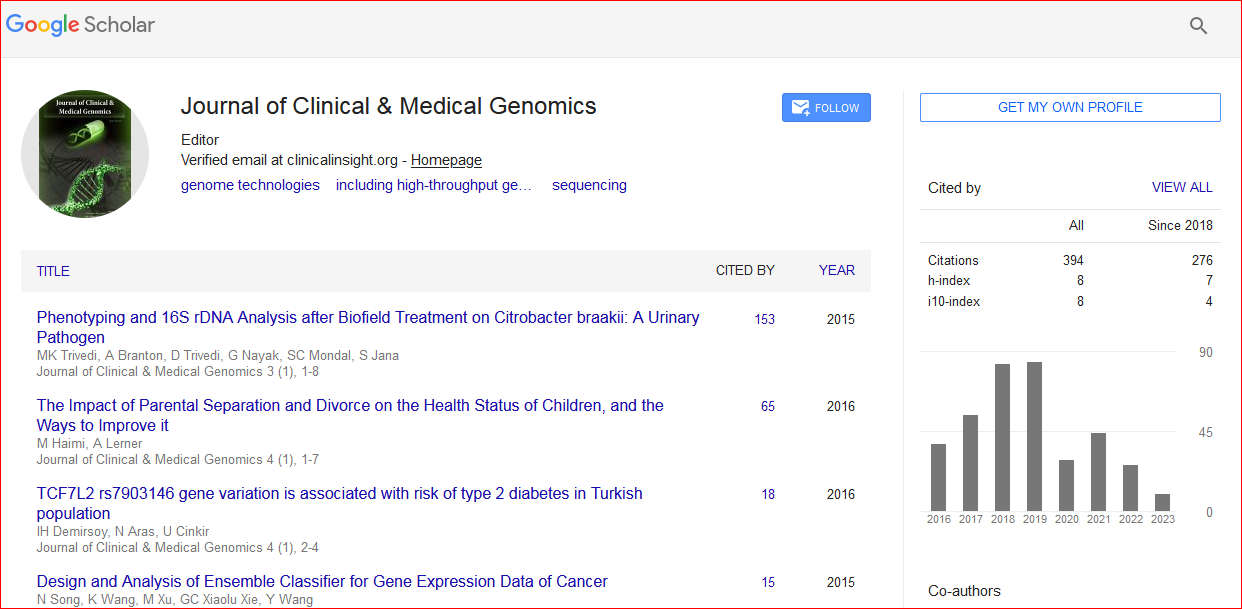
Journal of Clinical & Medical Genomics received 391 citations as per Google Scholar report