Commentary - (2025) Volume 11, Issue 4
Received: 01-Jul-2025, Manuscript No. aso-26-184644;
Editor assigned: 03-Jul-2025, Pre QC No. P-184644;
Reviewed: 17-Jul-2025, QC No. Q-184644;
Revised: 22-Jul-2025, Manuscript No. R-184644;
Published:
29-Jul-2025
, DOI: 10.37421/2471-2671.2025.11.179
Citation: Anderson, Michael. ”Personalized Cancer Treatment:
Surgery Meets Systemic Therapies.” Arch Surg Oncol 11 (2025):179.
Copyright: © 2025 Anderson M. This is an open-access article distributed under the terms of the Creative Commons Attribution License, which permits unrestricted use,
distribution and reproduction in any medium, provided the original author and source are credited.
The integration of surgery with systemic therapy in multidisciplinary cancer care is paramount for optimizing patient outcomes, ensuring that treatment plans are personalized and consider the unique biological and clinical characteristics of each patient's cancer. Multidisciplinary teams, comprising surgeons, medical oncologists, radiation oncologists, pathologists, radiologists, and other specialists, collaborate to tailor treatment strategies, often involving neoadjuvant or adjuvant systemic therapies alongside surgical intervention. This coordinated effort aims to improve local control, reduce recurrence rates, and enhance overall survival while minimizing treatment toxicity [1].
The timing and sequence of surgery and systemic therapy significantly impact treatment efficacy, with neoadjuvant systemic therapy, administered before surgery, capable of downstaging tumors, making them more amenable to resection, and allowing for early assessment of tumor response to systemic agents. Conversely, adjuvant therapy, given after surgery, aims to eradicate micrometastatic disease, and integrating these modalities requires careful consideration of tumor biology, treatment goals, and potential synergistic or antagonistic effects [2].
Precision medicine plays a crucial role in tailoring systemic therapy within the multidisciplinary cancer care framework, where molecular profiling of tumors allows for the selection of targeted therapies or immunotherapies that are most likely to benefit the individual patient, often in conjunction with surgical management. This personalized approach enhances treatment effectiveness and can mitigate the risk of resistance or toxicity [3].
The multidisciplinary team's expertise is vital in navigating complex treatment decisions, such as the optimal timing of surgery after neoadjuvant therapy and the management of treatment-related toxicities, emphasizing that effective communication and shared decision-making among team members and with the patient are essential for successful integration of surgical and systemic treatments [4].
Challenges in integrating surgery with systemic therapy include managing treatment sequencing, addressing drug resistance, and coordinating care across different specialties, underscoring the need for robust clinical pathways, standardized protocols, and continuous evaluation of treatment outcomes to overcome these hurdles [5].
The impact of novel systemic agents, such as immunotherapies and antibody-drug conjugates, on surgical planning and outcomes is an evolving area of research, as these agents can alter tumor biology and host immune responses, necessitating a dynamic and adaptive approach to surgical intervention within the multidisciplinary setting [6].
Data-driven decision-making, utilizing real-world evidence and clinical trial results, is crucial for refining the integration of surgery and systemic therapy, highlighting that continuous learning and adaptation based on patient outcomes are essential for advancing the field of multidisciplinary cancer care [7].
Patient-centered care is a cornerstone of multidisciplinary cancer management, involving shared decision-making, addressing patient preferences, and managing treatment side effects to improve quality of life alongside oncologic outcomes when combining surgery and systemic therapy [8].
The evolving landscape of systemic therapies, including advancements in targeted agents and immunotherapies, necessitates a reevaluation of surgical strategies and timing, requiring multidisciplinary teams to remain agile in adapting treatment paradigms to incorporate these innovations for the benefit of cancer patients [9].
Ultimately, the integration of surgical and systemic therapies in cancer care is a dynamic process that requires continuous collaboration, adaptation to new scientific discoveries, and a steadfast commitment to personalized patient management, with the multidisciplinary team being central to achieving optimal outcomes in this complex domain [10].
Optimizing patient outcomes in cancer care fundamentally relies on the seamless integration of surgical interventions with systemic therapies within a multidisciplinary framework. This approach ensures that treatment strategies are highly personalized, meticulously accounting for the unique biological and clinical profiles of each patient's malignancy. The collaborative efforts of multidisciplinary teams, encompassing surgeons, medical oncologists, radiation oncologists, pathologists, radiologists, and other essential specialists, are directed towards tailoring treatment regimens. These often involve the strategic application of neoadjuvant or adjuvant systemic therapies in conjunction with surgical procedures, aiming to enhance local disease control, diminish recurrence rates, and ultimately improve overall survival while simultaneously mitigating treatment-related toxicity [1].
The efficacy of cancer treatment is substantially influenced by the precise timing and sequencing of surgical procedures and systemic therapy administration. Neoadjuvant systemic therapy, when administered prior to surgical resection, can lead to tumor downstaging, rendering the malignancy more susceptible to surgical removal and providing an early opportunity to assess the tumor's response to systemic agents. Conversely, adjuvant therapy, administered post-surgery, targets the eradication of microscopic metastatic disease. The successful integration of these modalities mandates a thorough evaluation of tumor biology, the overarching treatment objectives, and the potential for either synergistic or antagonistic interactions between different therapeutic approaches [2].
Within the context of multidisciplinary cancer care, precision medicine assumes a pivotal role in personalizing systemic therapy. Through comprehensive molecular profiling of tumors, clinicians can identify and select targeted therapies or immunotherapies that offer the greatest potential benefit to individual patients, often in parallel with surgical management. This individualized strategy not only heightens treatment efficacy but also serves to reduce the likelihood of developing treatment resistance or experiencing adverse toxicities [3].
The collective expertise of the multidisciplinary team is indispensable when navigating intricate treatment decisions. This includes determining the optimal timing for surgery following neoadjuvant therapy and effectively managing the toxicities associated with various treatments. Crucially, open communication and robust shared decision-making processes among team members, as well as active engagement with the patient, are foundational to the successful integration of surgical and systemic therapeutic modalities [4].
Several challenges arise in the process of integrating surgical and systemic therapies for cancer. These include the complexities of managing treatment sequencing, the persistent issue of drug resistance, and the logistical demands of coordinating care across diverse medical specialties. Addressing these challenges effectively necessitates the establishment of well-defined clinical pathways, the implementation of standardized protocols, and a commitment to the ongoing evaluation of treatment outcomes [5].
The advent of novel systemic agents, such as cutting-edge immunotherapies and sophisticated antibody-drug conjugates, presents a dynamic and evolving landscape that significantly influences surgical planning and patient outcomes. These advanced agents possess the capability to modify tumor biology and modulate the host's immune responses, thereby demanding a flexible and adaptive strategy for surgical intervention within the collaborative multidisciplinary setting [6].
The refinement of integrated surgical and systemic therapy approaches is significantly propelled by data-driven decision-making, which leverages both real-world evidence and the findings from rigorous clinical trials. This continuous cycle of learning and adaptation, informed by actual patient outcomes, is essential for the progressive advancement of multidisciplinary cancer care [7].
Central to comprehensive multidisciplinary cancer management is the principle of patient-centered care. This involves fostering shared decision-making, actively incorporating patient preferences into treatment plans, and diligently managing treatment-related side effects. The ultimate goal is to enhance the patient's quality of life concurrently with achieving optimal oncologic outcomes when surgery and systemic therapy are combined [8].
The continually evolving spectrum of available systemic therapies, marked by significant progress in targeted agents and immunotherapies, compels a continuous reevaluation of established surgical strategies and their optimal timing. Multidisciplinary teams must maintain a high degree of agility, adeptly adapting treatment paradigms to integrate these innovations, thereby maximizing benefits for cancer patients [9].
In essence, the integration of surgical and systemic therapies within the broader context of cancer care represents an ongoing, dynamic process. It necessitates unceasing collaboration, a proactive approach to incorporating new scientific discoveries, and an unwavering dedication to highly personalized patient management. The multidisciplinary team stands as the pivotal element in realizing the best possible outcomes in this intricate and challenging field [10].
Optimizing cancer treatment involves integrating surgery with systemic therapies through a multidisciplinary approach that personalizes care based on individual patient characteristics. This collaborative effort aims to improve outcomes by strategically sequencing treatments like neoadjuvant and adjuvant therapies, leveraging precision medicine for targeted agents, and managing complex decisions through expert consensus. Key challenges include treatment sequencing, drug resistance, and care coordination, which are addressed by robust clinical pathways and continuous outcome evaluation. The impact of novel systemic agents necessitates adaptive surgical strategies. Patient-centered care, emphasizing shared decision-making and quality of life, is crucial. The dynamic nature of systemic therapies requires agile multidisciplinary teams to adapt treatment paradigms, ultimately centering on personalized management for the best possible patient outcomes.
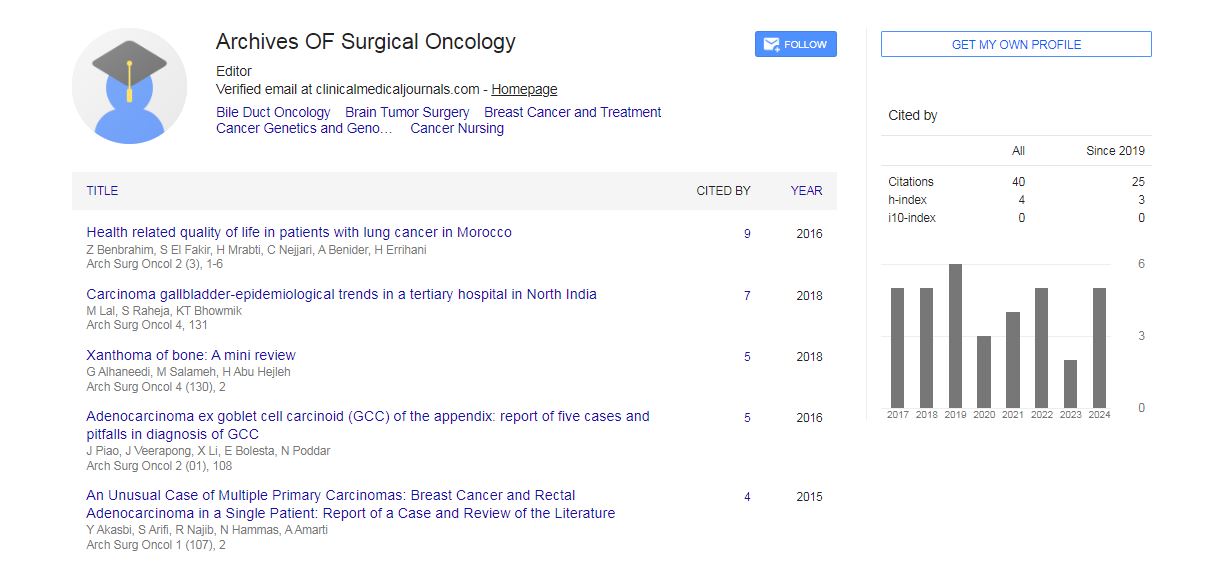
Archives of Surgical Oncology received 37 citations as per Google Scholar report