Brief Report - (2025) Volume 15, Issue 2
Received: 01-Apr-2025, Manuscript No. jeat-26-188594;
Editor assigned: 03-Apr-2025, Pre QC No. P-188594;
Reviewed: 17-Apr-2025, QC No. Q-188594;
Revised: 22-Apr-2025, Manuscript No. R-188594;
Published:
29-Apr-2025
, DOI: 10.37421/2161-0525.2025.15.836
Citation: Carter, Emily. ”Persistent Organic Pollutants: Ecosystems,
Health, and Management.” J Environ Anal Toxicol 15 (2025):836.
Copyright: © 2025 Carter E. This is an open-access article distributed under the terms of the Creative Commons Attribution License, which permits unrestricted use, distribution
and reproduction in any medium, provided the original author and source are credited.
Persistent Organic Pollutants (POPs) represent a critical environmental and public health challenge due to their inherent resistance to degradation, tendency to accumulate in living organisms, and significant toxicity. These characteristics underscore the urgent need for comprehensive research into their distribution and impact within aquatic ecosystems [1].
The complexity of POPs is further amplified by the emergence of new classes of these compounds, often referred to as emerging POPs (ePOPs), which may exhibit even greater persistence and toxicity than their legacy counterparts, necessitating the development of advanced detection and risk assessment methodologies [2].
Understanding the movement and accumulation of POPs within aquatic food webs is paramount for evaluating ecological risks, as these contaminants can biomagnify from lower trophic levels to apex predators, leading to substantial exposure and adverse health effects in higher-level consumers [3].
The environmental fate of POPs is governed by intricate transformation and degradation processes, which are influenced by a multitude of environmental factors and can result in the formation of potentially harmful transformation products, thus demanding thorough risk assessments that consider these complex pathways [4].
Direct exposure of human populations to POPs through contaminated drinking water and seafood consumption poses significant health risks, including endocrine disruption and carcinogenicity, highlighting the importance of robust human health risk assessment models [5].
Accurate quantification of POPs in diverse and complex aquatic matrices is a prerequisite for effective monitoring and management, driving the development of sophisticated analytical techniques that offer improved sensitivity and selectivity [6].
The interplay between climate change and POPs is an emerging area of concern, with factors like altered precipitation, rising water temperatures, and changing ice cover potentially influencing POP distribution, volatilization, and degradation, possibly exacerbating contamination in vulnerable regions [7].
Identifying and quantifying the primary sources and pathways of POPs entering riverine systems, such as industrial discharges, agricultural runoff, and atmospheric deposition, is crucial for designing targeted pollution control strategies and mitigating their input into aquatic environments [8].
The ecotoxicological effects of POPs extend to non-target aquatic invertebrates, which play vital roles in ecosystem functioning, with sublethal impacts such as behavioral changes, reduced growth, and reproductive impairment often being underestimated but critical for assessing overall ecosystem health [9].
Addressing the pervasive issue of POP contamination in water bodies necessitates the development and application of effective remediation technologies, ranging from physical and chemical methods to biological approaches, to facilitate environmental recovery and reduce long-term risks [10].
Persistent Organic Pollutants (POPs) are a group of chemicals that remain intact in the environment for long periods, become widely distributed geographically, accumulate in the fatty tissue of living organisms, and are toxic. Their persistence, coupled with their ability to bioaccumulate and biomagnify, makes them a serious threat to aquatic ecosystems and human health [1].
The continued release of both legacy POPs and the emergence of new, potentially more hazardous ePOPs into freshwater environments present ongoing challenges, requiring sophisticated analytical tools for their detection and rigorous assessment of their ecological impact [2].
Studies focusing on the bioaccumulation and biomagnification of POPs within aquatic food webs reveal how these contaminants move from primary producers to top predators, leading to magnified concentrations in organisms at higher trophic levels and posing significant risks to their health and reproductive capabilities [3].
The complex transformation and degradation processes that POPs undergo in aquatic environments, influenced by factors like photodegradation and biodegradation, can lead to the formation of intermediate compounds that may also pose environmental risks, emphasizing the need for a comprehensive understanding of these pathways [4].
Human exposure to POPs occurs through various routes, including the consumption of contaminated drinking water and seafood, and these exposures are linked to a range of adverse health outcomes, such as endocrine disruption and carcinogenicity, necessitating the development of precise risk assessment models for public health protection [5].
Advancements in analytical methodologies are critical for accurately measuring POP concentrations in complex aquatic matrices, with techniques like Gas Chromatography-Tandem Mass Spectrometry (GC-MS/MS) and Liquid Chromatography-High-Resolution Mass Spectrometry (LC-HRMS) offering enhanced sensitivity and selectivity for the detection of a broad spectrum of POPs [6].
The influence of climate change on the environmental behavior of POPs is a growing concern, as changing climatic conditions can alter their distribution, mobility, and persistence in aquatic systems, potentially leading to increased contamination in certain areas [7].
Effective management of POPs in aquatic environments hinges on a thorough understanding of their sources, which can include industrial effluent, agricultural runoff, and atmospheric deposition, guiding the implementation of targeted control measures at the point of origin [8].
The ecotoxicological effects of POPs on aquatic invertebrates, which are crucial components of aquatic food webs, are a significant area of research, with studies documenting sublethal impacts that can affect their behavior, growth, and reproduction, thereby influencing ecosystem structure and function [9].
The development and application of innovative remediation technologies, encompassing physical, chemical, and biological methods, are essential for cleaning up POP-contaminated water bodies and sediments, with ongoing research focused on identifying the most efficient and sustainable approaches for environmental restoration [10].
Persistent Organic Pollutants (POPs) in aquatic ecosystems pose significant environmental and health risks due to their persistence, bioaccumulation, and toxicity. Research is investigating their distribution, fate, and ecotoxicological effects, including challenges in monitoring and the need for integrated management strategies. Emerging POPs (ePOPs) present new concerns, requiring advanced analytical techniques. Bioaccumulation and biomagnification in food webs lead to elevated exposure in apex consumers. Transformation and degradation pathways are complex, with potential for harmful byproducts. Human health risks from POPs in drinking water and seafood are a major concern, prompting the development of risk assessment models. Advanced analytical methods improve detection sensitivity. Climate change may exacerbate POP contamination. Understanding POP sources and pathways is crucial for targeted pollution control. Sublethal effects on aquatic invertebrates are critical for ecosystem health. Remediation technologies are being developed for contaminated water bodies.
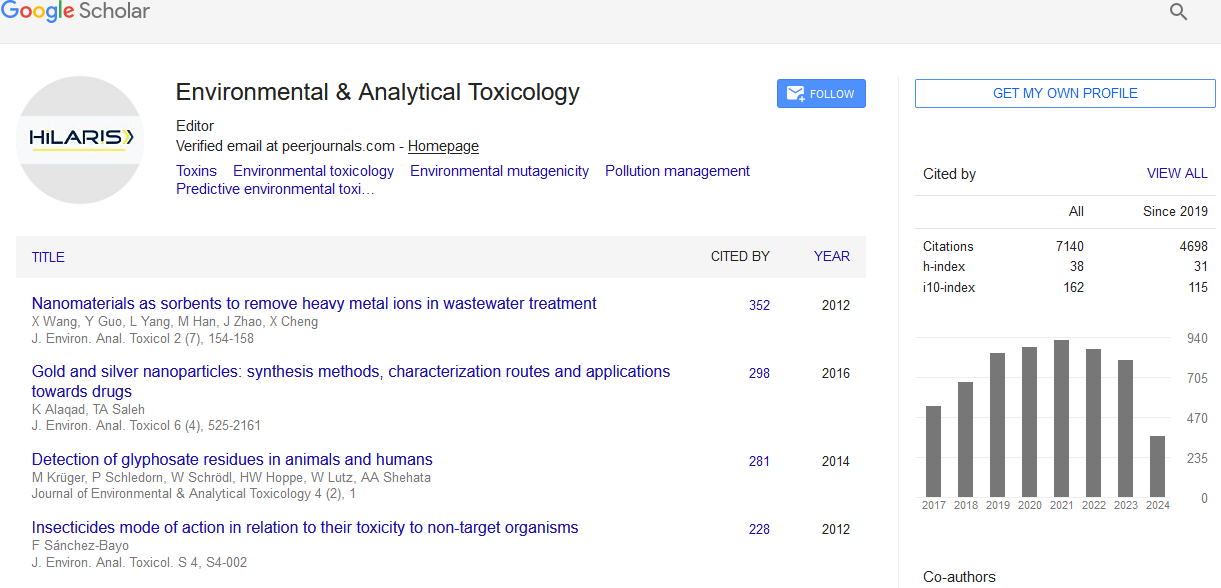
Environmental & Analytical Toxicology received 6818 citations as per Google Scholar report