Perspective - (2025) Volume 11, Issue 3
Received: 01-May-2025, Manuscript No. ohcr-25-174264;
Editor assigned: 05-May-2025, Pre QC No. P-174264;
Reviewed: 19-May-2025, QC No. Q-174264;
Revised: 22-May-2025, Manuscript No. R-174264;
Published:
29-May-2025
, DOI: 10.37421/2471-8726.2025.11.195
Citation: Karthik, Priya. ”Periodontal Disease: Systemic Links, Integrated Strategies.” Oral Health Case Rep 11 (2025):195.
Copyright: © 2025 Karthik P. This is an open-access article distributed under the terms of the Creative Commons Attribution License, which permits unrestricted use, distribution and reproduction in any medium, provided the original author and source are credited.
This umbrella review rigorously assesses the connection between periodontal disease and cardiovascular diseases, confirming a strong association across various evidence levels. It highlights how chronic inflammation stemming from the oral cavity can significantly impact systemic health, particularly cardiovascular function, underscoring the importance of comprehensive dental care in managing heart health risks.[1] This consensus report delves into the intricate immune-inflammatory pathways driving periodontal disease progression, emphasizing both destructive and regulatory mechanisms. It outlines how the host immune response, when dysregulated, contributes to tissue damage, offering critical insights for developing targeted immunomodulatory therapies and improving diagnostic approaches.[2] This article examines the bidirectional relationship between diabetes and periodontal disease, detailing how each condition exacerbates the other through shared inflammatory pathways and impaired immune responses. It emphasizes that managing one condition can positively impact the other, highlighting the necessity of integrated care approaches for diabetic patients with periodontal issues.[3] This systematic review and meta-analysis evaluates the effectiveness of non-surgical periodontal therapy, both alone and with various adjuncts, in treating periodontitis. It concludes that while traditional non-surgical methods are effective, certain adjuncts might offer additional benefits, guiding clinicians toward evidence-based treatment strategies for better patient outcomes.[4] This systematic review synthesizes current evidence on genetic factors influencing susceptibility to periodontitis. It identifies several gene polymorphisms associated with increased risk, shedding light on the complex interplay between genetic predisposition and environmental triggers in disease development. This understanding is crucial for personalized risk assessment and preventive strategies.[5] This paper discusses the latest advancements in periodontal regeneration, exploring innovative materials and techniques aimed at restoring lost periodontal tissues. It covers progress in guided tissue regeneration, bone grafts, and growth factors, offering insights into how these evolving methods promise improved outcomes for patients suffering from severe periodontal defects.[6] This review explores the potential of salivary biomarkers for the diagnosis and monitoring of periodontal disease. It identifies various proteins, enzymes, and microbial products in saliva that correlate with disease activity, suggesting that non-invasive salivary tests could complement traditional clinical assessments for early detection and personalized treatment strategies.[7] This article provides a comprehensive and updated overview of the global prevalence and incidence of periodontal diseases. It discusses the significant public health burden, identifying risk factors and disparities across populations. Understanding these epidemiological trends is crucial for informing public health policies and developing effective prevention and treatment programs worldwide.[8] This systematic review investigates the emerging link between periodontal disease and the severity of COVID-19. It suggests that individuals with periodontitis may be at a higher risk for developing severe COVID-19 outcomes, potentially due to shared inflammatory pathways. This highlights the importance of maintaining oral health, especially in the context of viral infections.[9] This comprehensive review article in The Lancet provides an in-depth understanding of periodontal diseases, covering their etiology, pathogenesis, clinical features, and management. It emphasizes the multifactorial nature of these diseases, highlighting the critical roles of microbial biofilms, host immune response, and various risk factors, guiding both clinicians and researchers.[10]
Periodontal diseases represent a substantial global public health burden, with ongoing research providing updated overviews of their prevalence and incidence. Understanding these epidemiological trends, along with identified risk factors and disparities across populations, is crucial for informing public health policies and developing effective prevention and treatment programs worldwide [8]. A comprehensive review in The Lancet offers an in-depth understanding of these diseases, covering their etiology, pathogenesis, clinical features, and management. This work emphasizes the multifactorial nature of periodontal diseases, highlighting the critical roles of microbial biofilms, host immune response, and various risk factors, thereby guiding both clinicians and researchers in their respective fields [10].
Beyond cardiovascular connections, a strong association between periodontal disease and cardiovascular diseases has been rigorously assessed through umbrella reviews, confirming the connection across various evidence levels. This research highlights how chronic inflammation originating from the oral cavity can significantly impact systemic health, particularly cardiovascular function, underscoring the critical importance of comprehensive dental care in managing heart health risks [1]. In a similar vein, the intricate immune-inflammatory pathways driving periodontal disease progression are being delved into through consensus reports. These reports emphasize both destructive and regulatory mechanisms, outlining how a dysregulated host immune response contributes to tissue damage. This offers critical insights for developing targeted immunomodulatory therapies and improving diagnostic approaches [2]. Furthermore, the bidirectional relationship between diabetes and periodontal disease has been extensively examined. This work details how each condition exacerbates the other through shared inflammatory pathways and impaired immune responses, emphasizing that managing one condition can positively impact the other and highlighting the necessity of integrated care approaches for diabetic patients with periodontal issues [3]. An emerging link between periodontal disease and the severity of COVID-19 suggests that individuals with periodontitis may be at a higher risk for developing severe COVID-19 outcomes, potentially due to shared inflammatory pathways. This highlights the importance of maintaining oral health, especially in the context of viral infections [9].
Beyond inflammation, genetic factors influencing susceptibility to periodontitis are synthesized in systematic reviews. Such research identifies several gene polymorphisms associated with increased risk, shedding light on the complex interplay between genetic predisposition and environmental triggers in disease development. This understanding is crucial for personalized risk assessment and preventive strategies [5].
Regarding therapeutic interventions, the effectiveness of non-surgical periodontal therapy, both alone and with various adjuncts, in treating periodontitis has been systematically reviewed and meta-analyzed. It concludes that while traditional non-surgical methods are effective, certain adjuncts might offer additional benefits, guiding clinicians toward evidence-based treatment strategies for better patient outcomes [4]. Moreover, significant advancements are occurring in periodontal regeneration. This involves exploring innovative materials and techniques aimed at restoring lost periodontal tissues, covering progress in guided tissue regeneration, bone grafts, and growth factors, offering insights into how these evolving methods promise improved outcomes for patients suffering from severe periodontal defects [6].
Lastly, the potential of salivary biomarkers for the diagnosis and monitoring of periodontal disease is an active area of review. This research identifies various proteins, enzymes, and microbial products in saliva that correlate with disease activity, suggesting that non-invasive salivary tests could complement traditional clinical assessments for early detection and personalized treatment strategies [7].
Periodontal diseases pose a global health challenge, influenced by complex interactions between microbial biofilms, host immunity, and genetic predispositions. Research consistently links these oral health issues to significant systemic conditions. For example, a strong association exists with cardiovascular diseases, where oral inflammation contributes to systemic health risks. Similarly, a bidirectional relationship with diabetes underscores how each condition can exacerbate the other, necessitating integrated care approaches. Emerging evidence even suggests a connection between periodontitis and severe COVID-19 outcomes, highlighting the broader impact of oral health. Understanding the immune-inflammatory pathways driving periodontal disease progression is crucial for developing targeted therapies. Concurrently, identifying genetic factors helps in personalized risk assessment and prevention. In terms of management, non-surgical therapies remain effective, with ongoing exploration into beneficial adjuncts. Advances in periodontal regeneration promise improved outcomes through innovative materials and techniques like guided tissue regeneration and bone grafts. Diagnostic capabilities are also evolving, with salivary biomarkers showing potential for non-invasive early detection and personalized monitoring. Overall, the field emphasizes comprehensive care, integrated health strategies, and continuous research to address the multifaceted nature and widespread systemic implications of periodontal diseases.
None
None
1. Jussara SM, Mariana B, Victor APG. "Periodontal Disease and Cardiovascular Diseases: An Umbrella Review".J Clin Periodontol 49 (2022):1185-1196.
Indexed at, Google Scholar, Crossref
2. Michael K, Søren J, Nezih B. "Consensus report of the 2nd International Consensus Workshop on Immunoinflammatory Aspects of Periodontal Diseases: Immune-mediated destruction and regulation".J Clin Periodontol 50 (2023):7-23.
Indexed at, Google Scholar, Crossref
3. Philip MP, Gottfried S, Timo S. "Diabetes and Periodontal Disease: A Pathophysiological Interrelationship".Periodontol 2000 86 (2021):1-5.
Indexed at, Google Scholar, Crossref
4. David H, Andreas B, Søren J. "Efficacy of non-surgical periodontal therapy with and without adjuncts in periodontitis patients: A systematic review and meta-analysis".J Clin Periodontol 47 (2020):241-260.
Indexed at, Google Scholar, Crossref
5. Andreas SS, Susanne R, Laura K. "Genetic susceptibility to periodontitis: A systematic review".J Clin Periodontol 47 (2020):29-45.
Indexed at, Google Scholar, Crossref
6. Luigi N, Angeliki K, Kimon D. "Advances in periodontal regeneration".Periodontol 2000 93 (2023):1-5.
Indexed at, Google Scholar, Crossref
7. Mirja G, Annukka S, Eija K. "Salivary biomarkers in periodontal disease: A review".J Periodontal Res 55 (2020):514-531.
Indexed at, Google Scholar, Crossref
8. Panos NP, Maurizio ST, Claudio S. "Global epidemiology of periodontal diseases: An update".Nat Rev Dis Primers 7 (2021):81.
Indexed at, Google Scholar, Crossref
9. Rishabh S, Rahul S, Shivani G. "Periodontal Disease as a Risk Factor for COVID-19: A Systematic Review".J Contemp Dent Pract 23 (2022):114-119.
Indexed at, Google Scholar, Crossref
10. Bruce LP, Bryan SM, Noel WJ. "Periodontal diseases".Lancet 396 (2020):183-194.
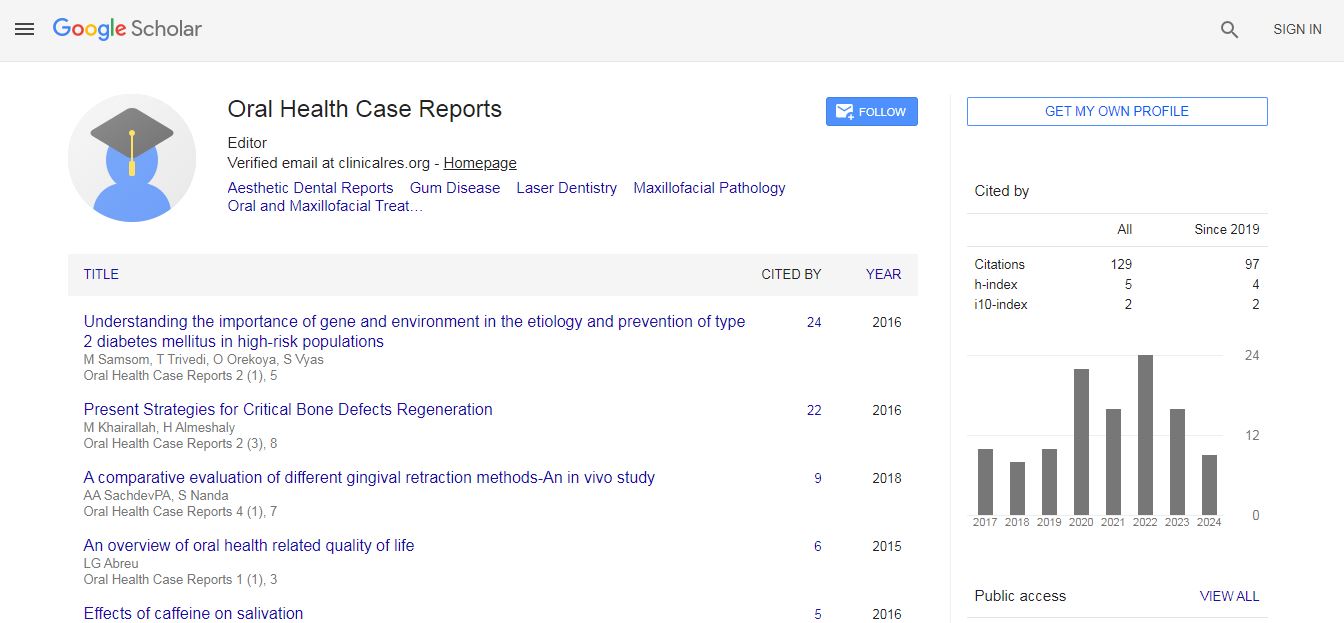
Oral Health Case Reports received 120 citations as per Google Scholar report