Opinion - (2025) Volume 10, Issue 6
Received: 01-Dec-2025, Manuscript No. jidm-26-188110;
Editor assigned: 03-Dec-2025, Pre QC No. P-188110;
Reviewed: 17-Dec-2025, QC No. Q-188110;
Revised: 22-Dec-2025, Manuscript No. R-188110;
Published:
29-Dec-2025
, DOI: 10.37421/2576-1420.2025.10.432
Citation: Demir, Mehmet. ”Pediatric Infectious Disease: Advances,
Challenges, and Management.” J Infect Dis Med 10 (2025):432.
Copyright: © 2025 Demir M. This is an open-access article distributed under the terms of the Creative Commons Attribution License, which permits unrestricted use, distribution
and reproduction in any medium, provided the original author and source are credited.
Recent advancements in the clinical management of pediatric infectious diseases have been significantly shaped by evolving diagnostic techniques and evidence-based treatment strategies, with a particular emphasis on antimicrobial stewardship and the utilization of novel diagnostics such as rapid molecular assays. This ongoing evolution is crucial for addressing the complexities of common pediatric infections and emerging threats within this vulnerable population, necessitating a comprehensive approach to diagnosis and management to minimize morbidity and mortality [1].
The landscape of antibiotic resistance in pediatric infections presents a growing challenge, demanding proactive strategies for effective management. These strategies encompass the implementation of rapid diagnostics to guide therapy, the optimization of antibiotic selection to combat resistant strains, and the critical role of robust infection prevention and control measures within both healthcare settings and the broader community. Addressing the escalating threat of multidrug-resistant organisms requires a coordinated, multidisciplinary effort [2].
Significant progress has been made in the development and evaluation of novel antiviral therapies targeting common viral infections in children, including influenza and respiratory syncytial virus (RSV). Current treatment guidelines are being refined, with a focus on the benefits derived from early diagnosis and prompt intervention, while ongoing research explores promising new therapeutic agents. The ultimate goal is to enhance patient outcomes and reduce the burden of hospitalization associated with these prevalent viral pathogens [3].
In pediatric oncology, the management of febrile neutropenia remains a critical area of focus due to the profound immunocompromise of these patients. Detailed diagnostic workups, sophisticated risk stratification, and adherence to current management protocols, including the judicious use of broad-spectrum antibiotics and granulocyte colony-stimulating factors, are paramount. Prompt recognition and aggressive treatment are essential to prevent life-threatening infections in this highly susceptible patient group [4].
Urinary tract infections (UTIs) in infants and children require careful clinical management, with particular attention to diagnostic criteria, appropriate imaging recommendations, and optimal antimicrobial therapy aimed at preventing renal scarring and subsequent long-term complications. Recent guideline updates underscore the importance of accurately distinguishing between complicated and uncomplicated UTIs to ensure the most effective treatment approaches are employed [5].
Community-acquired pneumonia (CAP) in children presents a complex clinical scenario that necessitates a thorough understanding of its epidemiology, common pathogens, clinical presentation, and diagnostic workup. Emphasis is placed on the judicious use of antibiotics, the strategic role of imaging in diagnosis and management, and the protocols for managing severe cases, including the provision of supplemental oxygen and mechanical ventilation when indicated [6].
The diagnosis and management of sepsis in neonates and infants represent a high-stakes clinical challenge, demanding the recognition of subtle signs and symptoms, identification of common causative organisms, and the critical implementation of early, aggressive treatment with antibiotics and fluid resuscitation. Navigating the complexities of distinguishing sepsis from other conditions in this vulnerable population, alongside the evolving role of biomarkers, remains a key focus [7].
Invasive fungal infections pose a significant threat to immunocompromised children, necessitating a comprehensive review of diagnostic modalities and treatment strategies. Understanding the spectrum of fungal pathogens, utilizing diagnostic markers and imaging effectively, and implementing current antifungal treatment protocols are crucial. Early diagnosis and tailored therapy are vital for improving outcomes in this high-risk demographic [8].
Vaccination stands as a cornerstone of infectious disease prevention in children, with current immunization schedules, vaccine efficacy, and safety profiles continually reviewed and updated. Strategies to address vaccine hesitancy are also a critical component, reinforcing that vaccination remains one of the most impactful public health interventions for mitigating childhood morbidity and mortality from vaccine-preventable diseases [9].
Parasitic infections in children, particularly helminthic and protozoal diseases, require specific diagnostic and management considerations. This includes proficiency in diagnostic methods such as stool microscopy and serological tests, alongside an understanding of the efficacy of various antiparasitic medications. Furthermore, public health measures focused on sanitation and hygiene play a pivotal role in controlling the spread of these infections [10].
The clinical management of common pediatric infectious diseases has seen notable advancements, driven by updated diagnostic approaches and evidence-based treatment strategies. A central theme is the emphasis on antimicrobial stewardship, coupled with the integration of novel diagnostics like rapid molecular assays to improve patient care. The management of emerging infectious threats in the pediatric population also occupies a significant portion of current research, covering key areas such as respiratory infections, febrile neutropenia, and vaccine-preventable diseases, all with a stress on timely intervention and prevention to reduce overall morbidity and mortality [1].
The evolving landscape of antibiotic resistance in pediatric infections necessitates a strategic approach to effective management. This includes leveraging rapid diagnostics to guide appropriate therapy, optimizing the selection of antibiotics to overcome resistance, and implementing robust infection prevention and control measures in both healthcare settings and the community. The challenges posed by multidrug-resistant organisms require a concerted, multidisciplinary effort to combat this growing public health concern [2].
Significant strides have been made in the development of novel antiviral therapies for common viral infections affecting children, such as influenza and RSV. Current treatment guidelines are being refined, highlighting the benefits of early diagnosis and intervention, while actively exploring new therapeutic agents in development. The primary objective remains to enhance patient outcomes and reduce hospitalization rates associated with these viral pathogens [3].
In the realm of pediatric oncology, the management of febrile neutropenia is of paramount importance due to the severe immunocompromise experienced by these patients. Comprehensive diagnostic workups, risk stratification, and adherence to current management protocols, including the use of broad-spectrum antibiotics and granulocyte colony-stimulating factors, are critical. Prompt recognition and immediate treatment are essential to prevent life-threatening infections in this vulnerable population [4].
The clinical management of urinary tract infections (UTIs) in infants and children involves careful consideration of diagnostic criteria, imaging recommendations, and optimal antimicrobial therapy. The goal of treatment is to prevent renal scarring and long-term complications. Recent guideline changes emphasize the distinction between complicated and uncomplicated UTIs, guiding more precise therapeutic interventions [5].
Community-acquired pneumonia (CAP) in children requires a comprehensive clinical approach, encompassing an understanding of its epidemiology, causative pathogens, clinical presentation, and diagnostic workup. The appropriate use of antibiotics, the role of imaging in diagnosis, and the management of severe cases, including supportive care such as supplemental oxygen and mechanical ventilation, are key components of effective management [6].
The diagnosis and management of sepsis in neonates and infants are critical, requiring early recognition of signs and symptoms and prompt, aggressive treatment with antibiotics and fluid resuscitation. Identifying common causative organisms and distinguishing sepsis from other conditions in this age group, alongside the role of biomarkers, remain central to improving outcomes [7].
Invasive fungal infections in immunocompromised children present a serious clinical challenge. Management strategies involve a thorough understanding of the spectrum of fungal pathogens, utilizing diagnostic modalities such as fungal markers and imaging, and applying current antifungal treatment protocols. Early diagnosis and tailored therapy are vital for improving survival rates in this high-risk group [8].
Vaccination plays a crucial role in preventing infectious diseases in children. The current pediatric immunization schedule, vaccine efficacy, and safety are continually assessed, and strategies are developed to address vaccine hesitancy. Vaccination remains a highly effective public health intervention for reducing childhood illness and mortality from preventable diseases [9].
Pediatric parasitic infections, particularly helminthic infections and protozoal diseases, necessitate specific diagnostic and management considerations. This includes mastering diagnostic methods like stool microscopy and serological tests, and understanding the efficacy of antiparasitic medications. Public health measures focused on sanitation and hygiene are also vital for controlling these infections [10].
This compilation of research addresses critical aspects of pediatric infectious disease management. It covers recent advancements in common infections, the growing challenge of antibiotic resistance, and the development of novel antiviral therapies. Specific conditions like febrile neutropenia in oncology patients, UTIs, community-acquired pneumonia, neonatal sepsis, and invasive fungal infections are detailed, emphasizing early diagnosis and appropriate treatment. The importance of vaccination for prevention and strategies for managing parasitic infections are also highlighted. The articles collectively underscore the need for evidence-based practices, rapid diagnostics, antimicrobial stewardship, and a multidisciplinary approach to improve outcomes for children.
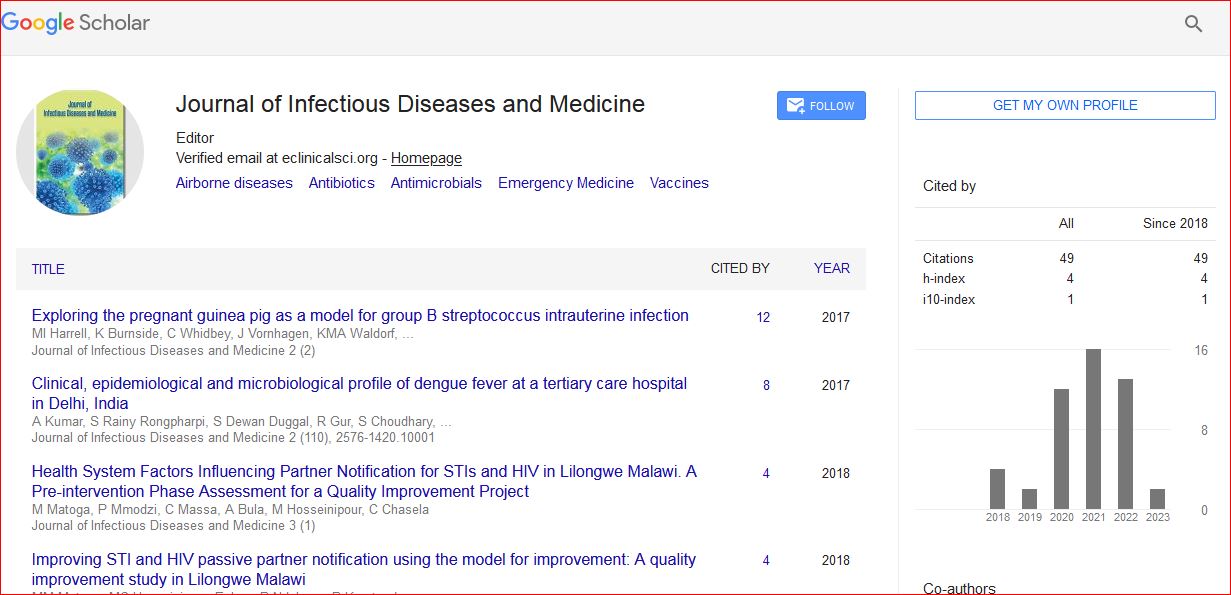
Journal of Infectious Diseases and Medicine received 1059 citations as per Google Scholar report