Brief Report - (2025) Volume 17, Issue 5
Received: 02-Oct-2025, Manuscript No. jbabm-26-182355;
Editor assigned: 05-Oct-2025, Pre QC No. P-182355;
Reviewed: 19-Oct-2025, QC No. Q-182355;
Revised: 23-Oct-2025, Manuscript No. R-182355;
Published:
30-Oct-2025
, DOI: 10.37421/1948-593X.2025.17.513
Citation: Green, Samantha L.. ”Oxidative Stress Biomarkers: Diagnosis and Disease Management.” J Bioanal Biomed 17 (2025):513.
Copyright: © 2025 Green L. Samantha This is an open-access article distributed under the terms of the Creative Commons Attribution License, which permits unrestricted use, distribution and reproduction in any medium, provided the original author and source are credited.
Oxidative stress, a fundamental biological phenomenon characterized by an imbalance between reactive oxygen species (ROS) production and antioxidant defense mechanisms, is intricately involved in the pathogenesis of a wide spectrum of human diseases. Understanding the molecular underpinnings of this imbalance is crucial for developing effective therapeutic strategies. This article aims to provide a comprehensive overview of the bioanalytical methodologies employed to assess key oxidative stress markers, emphasizing their significance in elucidating disease mechanisms and guiding treatment interventions. We will explore the diverse challenges and recent advancements encountered in the precise quantification of critical biomarkers such as malondialdehyde (MDA), 8-hydroxy-2'-deoxyguanosine (8-OHdG), and glutathione (GSH) across various biological matrices. The accurate and sensitive detection of these markers is paramount for enabling early disease diagnosis, monitoring therapeutic efficacy, and advancing the field of personalized medicine, thereby offering a more tailored approach to patient care [1].
Central to the investigation of oxidative damage is the development and validation of highly sensitive analytical methods. For instance, a sensitive liquid chromatography-tandem mass spectrometry (LC-MS/MS) method has been developed for the simultaneous quantification of lipid peroxidation products, specifically malondialdehyde equivalents (MDA) and 4-hydroxynonenal (4-HNE), in human plasma. Oxidative damage to lipids is a well-recognized hallmark of numerous inflammatory and degenerative diseases. The validated method demonstrates high specificity, accuracy, and precision, which are essential for the reliable assessment of lipid peroxidation in clinical samples. This contributes significantly to a better understanding of oxidative stress in complex conditions such as cardiovascular disease and neurodegeneration [2].
Furthermore, the intricate role of mitochondrial dysfunction and its associated oxidative stress in the progression of Alzheimer's disease (AD) is a critical area of research. Bioanalytical approaches, including fluorescence microscopy and flow cytometry, have been utilized to quantify mitochondrial ROS production and assess mitochondrial membrane potential in patient-derived fibroblasts. Findings have revealed elevated mitochondrial ROS and impaired mitochondrial function in AD fibroblasts when compared to controls, strongly suggesting these as potential therapeutic targets. This work underscores the indispensable importance of evaluating mitochondrial health in unraveling AD pathogenesis [3].
Oxidative DNA damage, a significant contributor to various cancers and the aging process, necessitates reliable detection methods. A novel enzyme-linked immunosorbent assay (ELISA) has been developed for the detection of 8-hydroxy-2'-deoxyguanosine (8-OHdG) in urine samples. 8-OHdG is a well-established marker of oxidative DNA damage. The developed ELISA exhibits commendable sensitivity and specificity, rendering it suitable for high-throughput screening and monitoring of DNA damage in epidemiological studies. These findings highlight the potential of urinary 8-OHdG as a non-invasive biomarker for assessing oxidative stress-induced DNA damage [4].
Type 2 diabetes (T2D) is another disease where oxidative stress plays a pivotal role. This article examines the intricate relationship between oxidative stress and T2D pathogenesis, focusing on the utility of glutathione (GSH) and oxidized glutathione (GSSG) levels as key biomarkers. An electrochemical method has been presented for the simultaneous determination of GSH and GSSG in blood serum. Significantly altered GSH/GSSG ratios were observed in T2D patients, which are indicative of increased oxidative stress. This bioanalytical approach offers a cost-effective and rapid means to assess redox status in diabetic individuals, potentially aiding in risk stratification and personalized management strategies [5].
Protein carbonylation, a prominent marker of protein oxidation induced by ROS, is implicated in a variety of age-related diseases, including neurodegenerative disorders and cardiovascular disease. This review consolidates recent advancements in bioanalytical techniques specifically designed for measuring protein carbonylation. It discusses various detection methods, such as Western blotting, ELISA, and mass spectrometry, for the accurate identification and quantification of specific carbonylated proteins. The article emphasizes the critical need for validated methods to precisely assess the impact of protein oxidation on cellular function and disease progression, ensuring reliable diagnostic and prognostic capabilities [6].
The complex interplay between systemic oxidative stress and the development of rheumatoid arthritis (RA) is the subject of ongoing investigation. A combination of bioanalytical methods, including spectrophotometry for measuring total antioxidant capacity and LC-MS/MS for quantifying specific oxidative stress markers like F2-isoprostanes in serum, has been employed. Significantly, elevated F2-isoprostanes and reduced antioxidant capacity were found to be strongly associated with RA disease activity. This research highlights the substantial potential of these markers for effectively monitoring disease progression and guiding therapeutic interventions in RA patients [7].
Developing reliable bioanalytical assays for reactive oxygen species (ROS) and reactive nitrogen species (RNS) in complex biological systems presents unique challenges and opportunities. This paper provides an overview of these challenges and discusses various detection methods, including fluorescent probes, electron paramagnetic resonance (EPR) spectroscopy, and chemiluminescence assays. The precise measurement of these transient species is critical for comprehending their dual role in both physiological processes and disease states. The article underscores the paramount importance of meticulous experimental design and rigorous validation to ensure the accuracy of ROS/RNS measurements, thereby enhancing our understanding of cellular redox signaling [8].
Non-alcoholic fatty liver disease (NAFLD) is another condition where oxidative stress is believed to play a significant role. This research investigates the association between systemic oxidative stress and the development of NAFLD, evaluating the diagnostic potential of serum malondialdehyde (MDA) levels. A colorimetric assay was utilized to quantify MDA in serum samples obtained from NAFLD patients and healthy controls. Results indicated significantly elevated MDA levels in NAFLD patients, which correlated with disease severity. This study suggests that serum MDA can function as a simple and readily accessible biomarker for assessing oxidative stress in the context of NAFLD [9].
Finally, the intricate relationship between advanced glycation end products (AGEs) and oxidative stress in chronic kidney disease (CKD) is explored. AGEs, formed through non-enzymatic glycation, are known contributors to oxidative stress. This paper describes a high-performance liquid chromatography (HPLC) method developed for the quantification of specific AGEs in plasma. Elevated levels of AGEs were observed in CKD patients, and these elevations were found to correlate with established markers of oxidative stress. This work emphasizes the critical interconnectedness of glycation and oxidation in the complex pathogenesis of CKD [10].
The field of bioanalysis plays a pivotal role in understanding complex biological processes and disease mechanisms, particularly concerning oxidative stress. Oxidative stress, an imbalance between ROS and antioxidant defenses, is a fundamental contributor to numerous human diseases. This article delves into the bioanalytical methodologies that are essential for assessing key oxidative stress markers, underscoring their importance in disease comprehension and therapeutic strategy development. The authors explore the inherent challenges and recent advancements in the accurate quantification of biomarkers such as malondialdehyde (MDA), 8-hydroxy-2'-deoxyguanosine (8-OHdG), and glutathione (GSH) in diverse biological matrices. The precise and sensitive detection of these markers is critical for early disease diagnosis, monitoring treatment efficacy, and advancing personalized medicine approaches [1].
A significant aspect of this research involves the development and validation of sensitive analytical techniques. A prominent example is the establishment of a highly sensitive liquid chromatography-tandem mass spectrometry (LC-MS/MS) method for the simultaneous quantification of lipid peroxidation products, namely malondialdehyde equivalents (MDA) and 4-hydroxynonenal (4-HNE), within human plasma. Lipid peroxidation is a widely recognized hallmark of various inflammatory and degenerative conditions. The rigorously validated LC-MS/MS method exhibits exceptional specificity, accuracy, and precision, thereby ensuring the reliable assessment of lipid peroxidation in clinical samples and contributing to a deeper understanding of oxidative stress in diseases like cardiovascular disease and neurodegeneration [2].
Moreover, the role of mitochondrial dysfunction and its resultant oxidative stress in the progression of Alzheimer's disease (AD) is extensively investigated. The study presents a bioanalytical approach utilizing fluorescence microscopy and flow cytometry to quantify mitochondrial ROS production and evaluate mitochondrial membrane potential in fibroblasts derived from AD patients. The findings consistently show elevated mitochondrial ROS and impaired mitochondrial function in these fibroblasts compared to control samples, indicating that these factors represent potential therapeutic targets. This research highlights the critical necessity of evaluating mitochondrial health in understanding AD pathogenesis [3].
Oxidative DNA damage, a key factor implicated in the development of various cancers and the aging process, necessitates robust detection methods. This paper details the development of a novel enzyme-linked immunosorbent assay (ELISA) designed for the detection of 8-hydroxy-2'-deoxyguanosine (8-OHdG) in urine. 8-OHdG is a well-established biomarker for oxidative DNA damage. The newly developed ELISA demonstrates significant sensitivity and specificity, making it highly suitable for high-throughput screening and epidemiological studies focused on monitoring DNA damage. The findings strongly suggest that urinary 8-OHdG can serve as a valuable non-invasive biomarker for assessing oxidative stress-induced DNA damage [4].
The pathogenesis of type 2 diabetes (T2D) is significantly influenced by oxidative stress, and this article focuses on the utility of glutathione (GSH) and oxidized glutathione (GSSG) levels as critical biomarkers. An electrochemical method has been developed for the simultaneous determination of both GSH and GSSG in blood serum. The study observed notably altered GSH/GSSG ratios in T2D patients, indicative of heightened oxidative stress. This bioanalytical methodology provides a cost-effective and rapid approach for evaluating the redox status in individuals with diabetes, potentially improving risk stratification and management strategies [5].
Protein carbonylation, a distinct marker of protein oxidation triggered by ROS, is recognized for its involvement in several age-related diseases, including neurodegenerative disorders and cardiovascular disease. This review synthesizes recent advancements in bioanalytical techniques specifically aimed at measuring protein carbonylation. It thoroughly discusses a range of detection methods, such as Western blotting, ELISA, and mass spectrometry, for the precise identification and quantification of particular carbonylated proteins. The article emphasizes the critical need for validated methodologies to accurately ascertain the impact of protein oxidation on cellular function and the overall progression of disease [6].
The intricate association between systemic oxidative stress and the pathogenesis of rheumatoid arthritis (RA) is explored through a comprehensive bioanalytical investigation. The study employs a multifaceted approach, incorporating spectrophotometry to measure total antioxidant capacity and LC-MS/MS to quantify specific oxidative stress markers, such as F2-isoprostanes, in serum. Significantly, elevated levels of F2-isoprostanes and diminished antioxidant capacity were found to be strongly correlated with RA disease activity. This research highlights the considerable potential of these biomarkers for monitoring disease progression and informing therapeutic interventions in RA management [7].
Developing reliable bioanalytical assays for reactive oxygen species (ROS) and reactive nitrogen species (RNS) within biological systems presents a complex set of challenges and opportunities. This paper offers a detailed overview of these challenges, discussing a variety of detection methodologies that include fluorescent probes, electron paramagnetic resonance (EPR) spectroscopy, and chemiluminescence assays. The accurate measurement of these short-lived species is fundamental to understanding their dual roles in both physiological functions and pathological conditions. The article strongly emphasizes the critical importance of careful experimental design and rigorous validation to ensure the accuracy of ROS/RNS measurements [8].
Oxidative stress is a significant factor in the development of non-alcoholic fatty liver disease (NAFLD), and this study evaluates the diagnostic potential of serum malondialdehyde (MDA) levels. A colorimetric assay was employed to quantify MDA in serum samples collected from both NAFLD patients and healthy control subjects. The results revealed significantly elevated MDA levels in the NAFLD cohort, which demonstrated a correlation with disease severity. This investigation suggests that serum MDA can serve as a straightforward and easily accessible biomarker for assessing oxidative stress in the context of NAFLD [9].
Finally, this study addresses the intricate interplay between advanced glycation end products (AGEs) and oxidative stress in the progression of chronic kidney disease (CKD). AGEs, which are formed via non-enzymatic glycation, are known to exacerbate oxidative stress. The paper describes a high-performance liquid chromatography (HPLC) method developed for the accurate quantification of specific AGEs in plasma samples. Elevated concentrations of AGEs were consistently observed in CKD patients, and these findings correlated with established markers of oxidative stress. This research underscores the profound interconnectedness of glycation and oxidation in the complex pathogenesis of CKD [10].
This collection of research highlights the critical role of oxidative stress in the pathogenesis of various human diseases, including Alzheimer's disease, type 2 diabetes, rheumatoid arthritis, and non-alcoholic fatty liver disease. The studies emphasize the development and application of advanced bioanalytical techniques for the accurate quantification of key oxidative stress biomarkers such as malondialdehyde (MDA), 8-hydroxy-2'-deoxyguanosine (8-OHdG), glutathione (GSH), lipid peroxidation products, and protein carbonyls. These methods, including LC-MS/MS, ELISA, electrochemical assays, and HPLC, are crucial for early disease diagnosis, monitoring disease progression, assessing therapeutic efficacy, and advancing personalized medicine. Challenges in measuring reactive oxygen and nitrogen species (ROS/RNS) are also discussed, underscoring the need for rigorous validation of analytical approaches. The research collectively demonstrates the potential of these biomarkers for risk stratification and guiding therapeutic interventions across a spectrum of chronic conditions.
None
None
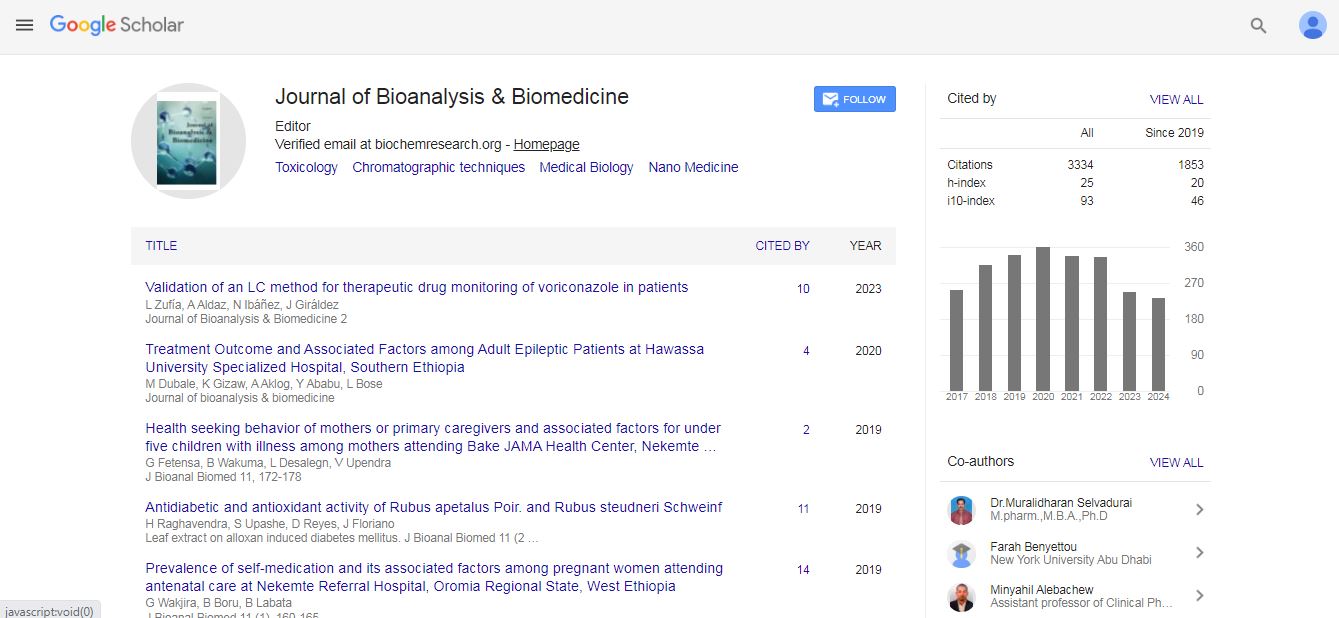
Journal of Bioanalysis & Biomedicine received 3099 citations as per Google Scholar report