Perspective - (2025) Volume 16, Issue 5
Received: 01-Sep-2025, Manuscript No. bej-26-182526;
Editor assigned: 03-Sep-2025, Pre QC No. P-182526;
Reviewed: 17-Sep-2025, QC No. Q-182526;
Revised: 22-Sep-2025, Manuscript No. R-182526;
Published:
29-Sep-2025
, DOI: 10.37421/2161-6219.2025.16.579
Citation: Tavares, Marco. ”Organizational Agility for Economic
Transformation and Resilience.” Bus Econ J 16 (2025):579.
Copyright: © 2025 Tavares M. This is an open-access article distributed under the terms of the Creative Commons Attribution License, which permits unrestricted use,
distribution and reproduction in any medium, provided the original author and source are credited.
The intricate relationship between evolving business organization structures and broader economic transformations is a subject of significant academic and practical interest. Contemporary research increasingly highlights how shifts in how businesses are structured are not merely internal adjustments but are intrinsically linked to the overarching dynamics of the global economy. This phenomenon is particularly evident in the wake of technological advancements and changing market demands, which necessitate a reevaluation of traditional organizational models and strategies. As economic landscapes morph, so too must the architectures of the firms that operate within them. The adaptive capabilities of organizations have emerged as a critical determinant of their success in navigating these economic shifts and achieving sustained growth, underscoring the dynamic interplay between organizational design and economic resilience. In this context, the impact of digitalization on economic structures stands as a pivotal driver of change.
Digital technologies are profoundly reshaping competitive dynamics, forcing businesses to adopt new organizational strategies and paradigms to remain relevant. The rise of platform economies and the pervasive influence of data-driven decision-making are compelling enterprises to rethink their fundamental operational frameworks. This transformation underscores the imperative for businesses to embrace innovation and adaptability to thrive in a digitally interconnected world, where agility is paramount for sustained competitive advantage. Further examination reveals a strong correlation between firm-level organizational change and macroeconomic performance. Longitudinal data consistently demonstrates that flexible and responsive organizational structures are instrumental in fostering economic resilience and promoting growth, especially during periods of economic shock or disruption. The research strongly suggests that actively cultivating organizational agility can serve as a key policy lever for enhancing national economic stability and fostering robust economic development. The pervasive influence of globalization on the structure and strategy of multinational corporations presents another critical dimension of this evolving landscape. Intensified global competition and the increasing interconnectedness of markets necessitate the adoption of more decentralized and adaptive organizational models. Firms are actively reconfiguring their operations and decision-making processes to effectively navigate the complexities and opportunities presented by a globalized economic environment, highlighting the strategic adjustments required for international competitiveness. Innovation ecosystems have also emerged as potent drivers of economic change and the proliferation of new business models. These ecosystems, characterized by collaborative networks encompassing firms, universities, and government entities, foster environments conducive to radical innovation and the emergence of novel organizational forms. The strategic importance of building, nurturing, and effectively managing such collaborative ecosystems cannot be overstated in fostering economic dynamism and organizational evolution. The intricate interplay between regulatory changes and business organization structures is another significant factor shaping economic competitiveness. Evolving legal and policy frameworks exert a profound influence on firm strategies, market entry decisions, and the overall structure of industries. This dynamic relationship between regulatory environments and organizational adaptation is crucial in shaping economic outcomes and determining the trajectory of economic development. Entrepreneurship plays a vital role as a catalyst for economic transformation, primarily through the formation and development of new business organizations. Entrepreneurial ventures, often distinguished by their innovative structures and forward-thinking strategies, possess the capacity to challenge established market dynamics and inject considerable dynamism into the economy. The essential function of entrepreneurship in driving economic evolution is therefore a fundamental aspect of understanding modern economic development. The growing imperative for sustainability is also reshaping business organization design and economic strategy. An increasing focus on environmental, social, and governance (ESG) factors is compelling organizations to restructure their operations and develop new economic models. These models are increasingly centered on long-term value creation and the well-being of all stakeholders, reflecting a broader shift towards responsible and sustainable business practices. Organizational learning is recognized as a critical factor in enabling adaptation to economic change. Firms that actively cultivate a robust learning culture and possess effective mechanisms for knowledge acquisition and dissemination are demonstrably better equipped to navigate dynamic economic environments. This capacity for learning facilitates the successful implementation of strategic changes and provides a significant competitive advantage in the face of economic uncertainty. Finally, technological disruption stands as a powerful force compelling organizations to fundamentally rethink their structures and approaches to economic value creation. Emerging technologies such as artificial intelligence and blockchain are pressuring organizations to re-evaluate their internal processes, governance frameworks, and overall business models. This adaptation is essential for capturing new economic opportunities and avoiding the risks of obsolescence in an increasingly technologically advanced world.The modern business landscape is characterized by a profound and ongoing evolution of organizational structures, intricately interwoven with wider economic transformations. Research indicates that shifts from traditional hierarchical models to more agile, networked forms are directly influenced by technological advancements and evolving market demands. Organizations that demonstrate strong adaptive capabilities are better positioned to navigate economic shifts and achieve sustainable growth, highlighting the critical link between organizational flexibility and economic success. A significant driver of these changes is the ongoing digital transformation impacting economic structures. Digital technologies are fundamentally altering competitive dynamics and organizational strategies, leading to the emergence of platform economies and an increased reliance on data-driven decision-making. Businesses must adopt new organizational paradigms to maintain competitiveness in this digitally transformed economy, emphasizing the need for continuous innovation and adaptability.
Empirical investigations have established a clear relationship between firm-level organizational change and macroeconomic performance. Studies utilizing longitudinal data reveal that flexible and responsive organizational structures are crucial for economic resilience and growth, particularly during periods of economic instability. Consequently, fostering organizational agility is identified as a key policy strategy for enhancing national economic stability. Globalization further influences the structure and strategy of multinational corporations. The intensification of global competition and market interconnectedness compel firms to adopt more decentralized and adaptive organizational models. Companies are actively reconfiguring their operations and decision-making processes to thrive within a globalized economic environment, showcasing the necessity of strategic adjustments in international business. Innovation ecosystems play a crucial role in propelling economic change and facilitating the development of new business models. Collaborative networks between firms, academic institutions, and government bodies create environments that are highly conducive to innovation and the formation of novel organizational structures. The strategic cultivation and management of these ecosystems are vital for fostering economic dynamism. Regulatory dynamics also exert a significant impact on business organization structures and economic competitiveness. Changes in legal and policy frameworks directly influence firm strategies, market entry, and the overall configuration of industries. The ongoing interaction between regulatory evolution and organizational adaptation is a key determinant of economic outcomes. Entrepreneurship acts as a powerful catalyst for economic transformation through the creation of new business organizations. Entrepreneurial ventures, often characterized by their innovative organizational designs and strategies, are instrumental in challenging existing market structures and driving economic dynamism. The fundamental role of entrepreneurship in economic evolution is therefore a key area of study. Sustainability imperatives are increasingly reshaping business organization design and economic strategy. The growing emphasis on environmental, social, and governance (ESG) factors is prompting firms to restructure their operations and develop new economic models. These models prioritize long-term value creation and the well-being of all stakeholders, signaling a shift towards more responsible business practices. Organizational learning is essential for adapting to economic change. Businesses that foster a strong learning culture and possess effective knowledge management systems are better equipped to navigate volatile economic conditions. This capacity for learning and knowledge diffusion provides a significant strategic advantage in implementing successful organizational changes. Technological disruption is a potent force compelling organizations to rethink their structures and their methods of economic value creation. Emerging technologies like artificial intelligence and blockchain necessitate a re-evaluation of internal processes, governance, and business models to seize new economic opportunities and avoid becoming obsolete.This collection of research explores the dynamic interplay between business organization structures and economic transformations. It highlights how technological advancements, digitalization, globalization, and sustainability imperatives are driving shifts from traditional hierarchical models to more agile and networked forms. Studies emphasize the importance of organizational adaptability, innovation, and learning for navigating economic change and achieving sustained growth. Entrepreneurship is identified as a key catalyst for economic transformation through new business ventures. Regulatory dynamics also significantly influence organizational structures and competitiveness. Ultimately, the research underscores that the evolution of business organizations is a critical component of broader economic resilience and development in the contemporary global landscape.
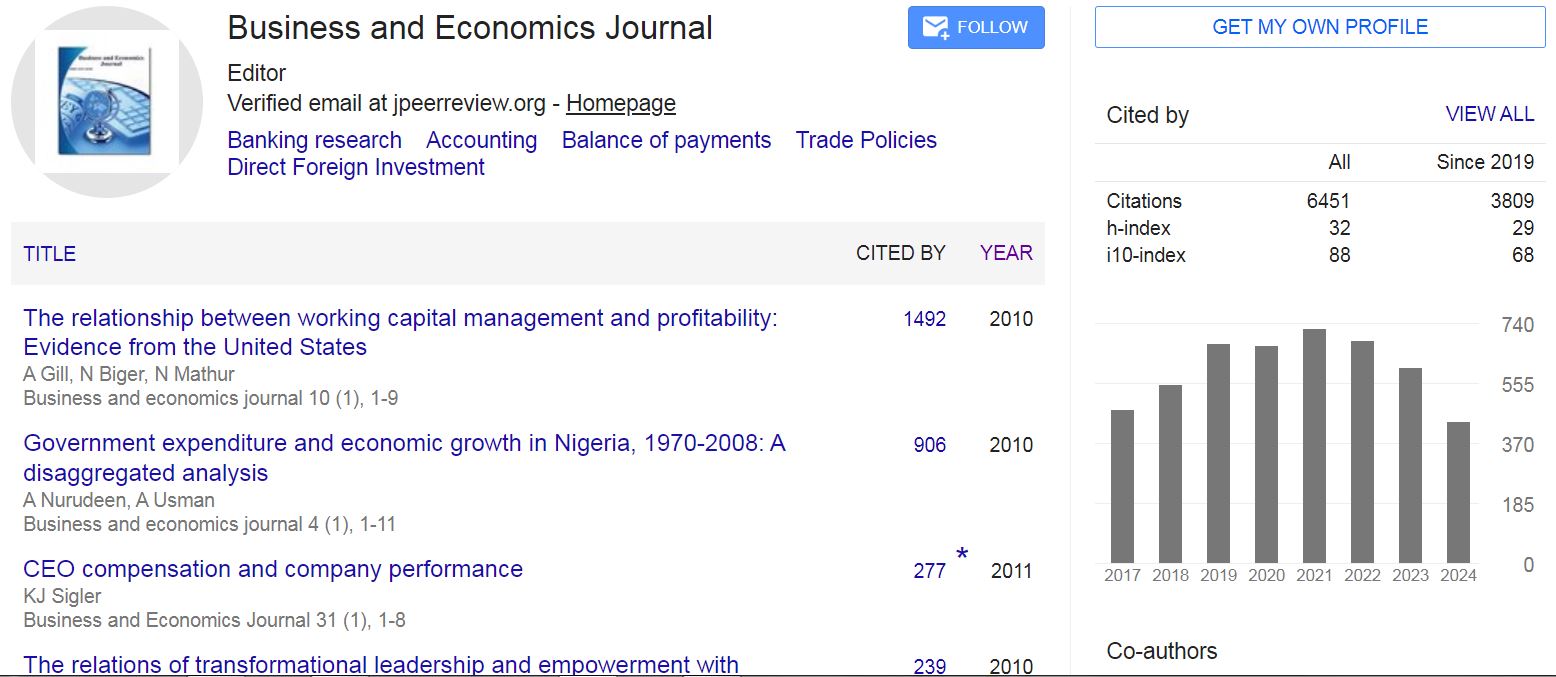
Business and Economics Journal received 6451 citations as per Google Scholar report