Perspective - (2025) Volume 15, Issue 4
Received: 01-Dec-2025, Manuscript No. jttr-25-175458;
Editor assigned: 03-Dec-2025, Pre QC No. P-175458;
Reviewed: 17-Dec-2025, QC No. Q-175458;
Revised: 22-Dec-2025, Manuscript No. R-175458;
Published:
29-Dec-2025
, DOI: 10.37421/2161-0991.2025.15.322
Citation: Santos, Miguel R.. ”Organ Transplantation: Progress, Challenges, and Future.” J Transplant Technol Res 15 (2025):322.
Copyright: © 2025 Santos R. Miguel This is an open-access article distributed under the terms of the Creative Commons Attribution License, which permits unrestricted use, distribution and reproduction in any medium, provided the original author and source are credited.
Significant strides have been made in kidney transplantation, with a keen focus on developing more refined immunosuppressive strategies [1].
These advancements, coupled with the emerging field of precision medicine, are fundamentally transforming patient care. What this really means is that personalized approaches are actively improving graft survival rates and effectively reducing post-transplant complications, leading to more effective and patient-specific treatment regimens. The evolving landscape of liver transplantation, particularly concerning alcohol-associated liver disease, represents a critical area of ongoing research and clinical practice [2].
This condition remains a primary indication for transplantation, necessitating careful consideration of patient selection criteria. The critical role of sustained abstinence is widely recognized, and new strategies are continuously being explored to optimize recipient outcomes, offering a comprehensive overview of current practices and future directions within this challenging medical field. Heart transplantation continues to see remarkable progress, offering a broad perspective on advancements in patient selection, meticulous perioperative care, and comprehensive long-term management [3].
New technologies and innovative immunosuppressive regimens are crucial in addressing persistent challenges like graft rejection and transplant vasculopathy. This consistent innovation paints a clear picture of ongoing efforts aimed at significantly improving both the survival rates and overall quality of life for heart transplant recipients. Lung transplantation presents its own set of significant hurdles, including the pervasive issues of chronic rejection, opportunistic infections, and the persistent scarcity of suitable donor organs [4].
Despite these difficulties, there are promising research areas emerging, such as ex vivo lung perfusion and highly personalized immunosuppression. These initiatives aim to directly overcome existing challenges, thereby extending graft survival and notably improving patient outcomes in what remains a highly complex and demanding area of transplant surgery. Reviewing the current standing and future trajectory of pancreas transplantation reveals substantial progress, primarily benefiting patients with Type 1 diabetes often coupled with end-stage renal disease [5].
Improvements in both surgical techniques and immunosuppression protocols have demonstrably enhanced outcomes. Looking ahead, novel immunomodulatory strategies and advanced beta-cell replacement therapies hold significant promise to further refine and optimize this crucial treatment modality. Intestinal transplantation, a highly complex procedure designed for intestinal failure, has seen important updates [6].
It now features detailed advancements in surgical techniques, more precise patient selection protocols, and refined post-transplant management strategies. Despite these improvements, the field acknowledges persistently high rates of complications such as infection and rejection, emphasizing ongoing efforts geared towards enhancing long-term graft and patient survival. The critical role of immunosuppression in preventing organ rejection cannot be overstated, and this field has seen continuous advancements [7].
Here's the thing, the evolution of drug regimens, alongside the emergence of personalized medicine approaches, marks a significant shift. The ultimate pursuit of immunotolerance highlights how balancing therapeutic efficacy with managing side effects remains a central and ongoing challenge in improving long-term transplant outcomes. Delving into the intricate immunobiology of allograft rejection reveals the complex cellular and humoral mechanisms at play [8].
Understanding these biological processes is vital, as it directly translates into crucial clinical implications for accurate diagnosis, effective monitoring, and tailored treatment. This deep insight into the mechanisms is absolutely essential for developing more targeted therapies and, critically, for preventing graft loss in transplant recipients. Xenotransplantation, involving the transplantation of organs between different species, is increasingly being explored as a potential solution to the severe global organ shortage [9].
Recent breakthroughs, particularly involving genetically modified pigs, have brought this concept closer to reality. However, significant immunological and physiological hurdles still need to be comprehensively overcome for this exceptionally promising field to transition into a routine clinical reality. Finally, machine perfusion represents an advanced and highly effective technique for preserving donor organs outside the body [10].
This method is crucial because it significantly improves organ viability, allows for meticulous assessment and reconditioning of marginal organs, and effectively extends the critical window for transplantation. What this really means is a direct increase in the number of usable organs and a substantial improvement in recipient outcomes by ensuring superior graft quality.
The field of organ transplantation is in a phase of dynamic evolution, continually bringing renewed hope and improved quality of life to patients globally. Kidney transplantation, for instance, has seen significant progress, largely driven by refined immunosuppressive strategies that precisely target immune responses and the burgeoning promise of precision medicine [1]. These cutting-edge, personalized approaches are demonstrably enhancing graft survival rates and effectively mitigating complications, moving towards much more effective and patient-specific treatment protocols. Concurrently, liver transplantation, particularly for cases involving alcohol-associated liver diseaseâ??a leading indicationâ??is characterized by evolving criteria for patient selection and a critical emphasis on sustained abstinence to optimize outcomes [2]. This area represents a challenging yet vital field with ongoing research shaping future practices. Meanwhile, heart transplantation offers a broad perspective on continuous innovation, detailing advancements in rigorous patient selection, meticulous perioperative care, and comprehensive long-term management protocols. New technologies and sophisticated immunosuppressive regimens are consistently being developed and deployed to address persistent challenges like graft rejection and vasculopathy, ultimately aiming to improve both the survival and overall quality of life for recipients [3].
Despite these successes, the journey towards universal transplant efficacy is marked by significant hurdles that demand persistent innovation. Lung transplantation, for example, is a complex area confronting issues such as chronic rejection, the ever-present risk of infection, and the critical scarcity of viable donor organs [4]. However, there are highly promising research avenues, including ex vivo lung perfusionâ??a technique that can recondition marginal organsâ??and increasingly personalized immunosuppression, all designed to extend graft survival and notably improve patient outcomes in this demanding surgical field. Furthermore, pancreas transplantation, primarily utilized for patients grappling with Type 1 diabetes and concomitant end-stage renal disease, has witnessed substantial improvements in both surgical techniques and immunosuppression protocols, leading to enhanced outcomes. The future trajectory for pancreas transplants includes novel immunomodulatory strategies and advanced beta-cell replacement therapies that could further refine treatment options [5]. Similarly, intestinal transplantation, an inherently complex procedure for addressing intestinal failure, continues to see advancements in surgical methods, patient selection, and post-transplant management. Yet, the persistent high rates of complications, such as infection and rejection, underscore the ongoing imperative for research and development to improve long-term graft and patient survival [6].
Central to all these organ-specific advances are foundational scientific understandings and forward-looking technological breakthroughs. The critical role of immunosuppression in effectively preventing organ rejection cannot be overstated, and this field is characterized by continuous advancements in drug regimens and the strategic emergence of personalized medicine approaches [7]. Here's the thing: the ultimate pursuit of achieving immunotolerance highlights the persistent challenge of balancing therapeutic efficacy with the imperative to manage side effects, all for the betterment of long-term transplant outcomes. What this really means is a deeper insight into the intricate immunobiology of allograft rejection, meticulously explaining the cellular and humoral mechanisms involved [8]. This comprehensive understanding is absolutely vital, as it directly translates into crucial clinical implications for more accurate diagnosis, effective monitoring, and the development of targeted treatments, which are essential for preventing graft loss in transplant recipients. Looking further ahead, xenotransplantation, which involves the transplantation of organs from one species to another, is rapidly being explored as a groundbreaking potential solution to the severe global organ shortage [9]. Recent breakthroughs, particularly those involving genetically modified pigs, have brought this concept significantly closer to clinical reality, even though substantial immunological and physiological hurdles still need to be meticulously addressed before it can become a routine clinical practice.
A pivotal element in expanding the accessibility and enhancing the success of transplantation lies in advanced organ preservation techniques. Machine perfusion stands out as an advanced and highly effective method for preserving donor organs outside the human body [10]. This innovative technique is crucial because it not only significantly improves organ viability but also allows for the meticulous assessment and subsequent reconditioning of marginal organs, thereby crucially extending the window during which transplantation can safely occur. The impact of this technology is profound, directly leading to an increased number of usable organs and a substantial improvement in recipient outcomes, precisely by ensuring a superior graft quality. This highlights its transformative role across the entire transplant process, from procurement to implantation.
The landscape of organ transplantation is rapidly evolving, driven by significant advancements across various organ types. For kidney transplantation, there's a clear focus on refined immunosuppressive strategies and the promise of precision medicine, leading to better graft survival and fewer complications. Similarly, liver transplantation, particularly for alcohol-associated liver disease, emphasizes careful patient selection and the crucial role of abstinence to optimize long-term outcomes. Heart transplantation is also seeing continuous innovation, with new technologies and advanced immunosuppressive regimens actively addressing persistent issues like graft rejection and vasculopathy, ultimately improving both survival and quality of life for patients. In other areas, lung transplantation grapples with significant challenges such as chronic rejection, infection, and the critical scarcity of donor organs. However, promising research into techniques like ex vivo lung perfusion and highly personalized immunosuppression offers real hope for extending graft survival. Pancreas transplantation, primarily for individuals with Type 1 diabetes and end-stage renal disease, has seen improved surgical techniques and immunosuppression, with future directions pointing towards novel immunomodulatory strategies and beta-cell replacement therapies. Intestinal transplantation, a notably complex procedure, also benefits from advancements in surgical methods and post-transplant care, though the high rates of infection and rejection remain a key focus for ongoing improvement. Beyond specific organ systems, general advancements in immunosuppression are critical for preventing rejection, moving towards personalized medicine and the eventual goal of immunotolerance. This balance between efficacy and managing side effects is a constant challenge. Deeper understanding of the intricate immunobiology of allograft rejection helps inform better diagnosis, monitoring, and treatment, crucial for preventing graft loss. Looking to the future, xenotransplantation, using genetically modified pig organs, represents a bold frontier aiming to solve the severe organ shortage, despite the complex immunological barriers. Finally, advanced techniques like machine perfusion are revolutionizing organ preservation, significantly improving donor organ viability and expanding the pool of usable organs, directly contributing to better recipient outcomes.
None
None
Flavio V, Mary S, John RL. "Advances in Kidney Transplantation: Immunosuppression, Precision Medicine, and Emerging Therapies".Clin J Am Soc Nephrol 18 (2023):1361-1372.
Indexed at, Google Scholar, Crossref
Ashwani KS, Philippe M, Michael DL. "Liver Transplantation for Alcohol-Associated Liver Disease: Current Status and Future Directions".Gastroenterology 162 (2022):284-297.e1.
Indexed at, Google Scholar, Crossref
Kiran KK, Randall CS, Jon AK. "Current state and future directions in heart transplantation".Nat Rev Cardiol 18 (2021):795-812.
Indexed at, Google Scholar, Crossref
Ankit B, Elizabeth DL, Scott HP. "Current Challenges and Future Perspectives in Lung Transplantation".Am J Respir Crit Care Med 201 (2020):1201-1209.
Indexed at, Google Scholar, Crossref
Ramasamy K, Rainer WG, Ty BD. "Pancreas transplantation: State-of-the-art and future perspectives".Am J Transplant 19 (2019):339-346.
Indexed at, Google Scholar, Crossref
Andreas GT, Peter T, David L. "Intestinal Transplantation: Current Status and Future Directions".Clin Liver Dis 25 (2021):479-490.
Indexed at, Google Scholar, Crossref
Manuel P, Mohamed HS, Paolo MF. "Immunosuppression in Organ Transplantation: Recent Advances and Future Perspectives".N Engl J Med 382 (2020):854-867.
Indexed at, Google Scholar, Crossref
Philip FH, Daniel S, Carmen L. "Mechanisms of allograft rejection: Immunobiology and clinical implications".Nat Rev Nephrol 17 (2021):601-618.
Indexed at, Google Scholar, Crossref
David KCC, Richard NP, Leonardo VR. "Xenotransplantation: The next frontier for organ replacement".Lancet 401 (2023):375-384.
Indexed at, Google Scholar, Crossref
Thomas M, Wolfram TK, Andreas B. "Machine Perfusion for Organ Preservation in Transplantation: State of the Art".Transpl Int 33 (2020):136-147.
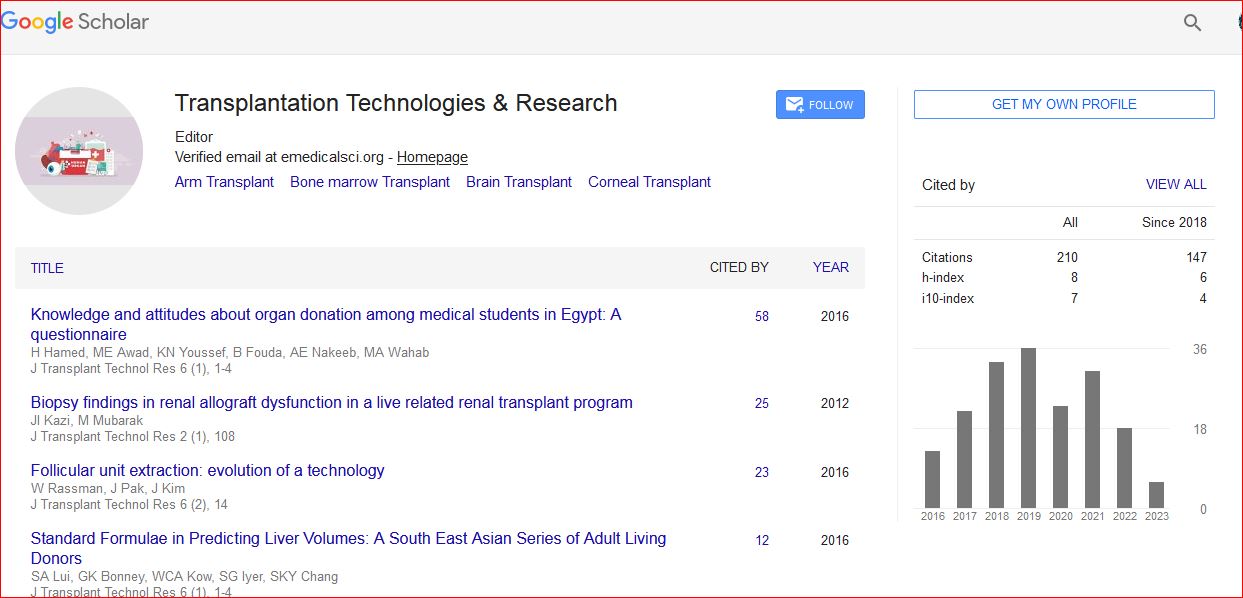
Transplantation Technologies & Research received 223 citations as per Google Scholar report