Short Communication - (2025) Volume 15, Issue 2
Received: 02-Jun-2025, Manuscript No. jttr-25-175390;
Editor assigned: 04-Jun-2025, Pre QC No. P-175390;
Reviewed: 18-Jun-2025, QC No. Q-175390;
Revised: 23-Jun-2025, Manuscript No. R-175390;
Published:
30-Jun-2025
, DOI: 10.37421/2161-0991.2025.15.302
Citation: DeLuca, Marco. ”Optimizing Multi-Organ Graft Survival: Risks and Innovations.” J Transplant Technol Res 15 (2025):302.
Copyright: © 2025 DeLuca M. This is an open-access article distributed under the terms of the Creative Commons Attribution License, which permits unrestricted use, distribution and reproduction in any medium, provided the original author and source are credited.
This article investigates the critical role of donor-specific antibodies (DSAs) in influencing long-term kidney graft survival. It highlights that DSAs, particularly those appearing de novo post-transplant, are significant risk factors for chronic rejection and eventual graft loss, emphasizing the need for robust monitoring strategies to mitigate their impact [1].
This study examines the prognostic utility of donor-derived cell-free DNA (dd-cfDNA) in predicting allograft rejection and graft survival following kidney transplantation. It suggests that elevated dd-cfDNA levels are a strong indicator of rejection episodes and are associated with poorer long-term graft outcomes, offering a promising non-invasive biomarker [2].
This systematic review and meta-analysis underscore the significant negative impact of non-adherence to immunosuppressive medication on long-term graft survival after kidney transplantation. The findings emphasize the critical need for improved patient education, monitoring, and interventions to enhance adherence and prevent graft loss [3].
This systematic review explores the application of machine learning (ML) techniques in predicting graft survival after kidney transplantation. It highlights the potential of ML algorithms to identify complex patterns and risk factors, offering improved predictive accuracy over traditional statistical methods for personalized patient management and optimizing outcomes [4].
This article discusses the crucial role of complement activation in the pathogenesis of heart transplant rejection and its ultimate impact on graft survival. It emphasizes that uncontrolled complement activation contributes to both antibody-mediated and cellular rejection, suggesting complement inhibitors as potential therapeutic targets to improve outcomes [5].
This retrospective cohort study investigates the impact of various perioperative factors on lung graft survival. It identifies several modifiable and non-modifiable factors, such as ischemia time, donor characteristics, and early post-transplant complications, that significantly influence long-term outcomes, providing insights for optimizing clinical practice [6].
This article delves into the mechanisms underlying long-term liver graft survival after transplantation, with a particular focus on immune regulation and the potential for operational tolerance. It discusses how the unique immunological environment of the liver may contribute to lower rates of rejection and better outcomes compared to other solid organs [7].
This retrospective analysis identifies key risk factors for kidney graft loss in the contemporary transplantation era. It systematically reviews clinical, immunological, and demographic factors contributing to graft failure, highlighting evolving challenges and opportunities for intervention to improve patient and graft outcomes [8].
This multicenter study investigates the significant impact of pre-transplant donor-specific antibodies (DSAs) on kidney graft survival. It reveals that the presence of DSAs before transplantation is strongly associated with an increased risk of acute rejection and inferior long-term graft function, emphasizing the importance of comprehensive immunological assessment [9].
This systematic review and meta-analysis assess the relationship between early allograft dysfunction (EAD) and long-term graft survival following liver transplantation. It concludes that EAD is a strong predictor of reduced long-term graft survival, highlighting the necessity of early identification and management to improve outcomes for liver transplant recipients [10].
Long-term graft survival following transplantation is a central focus in improving patient outcomes across various organ systems. For kidney transplant recipients, specific immunological responses represent significant hurdles. Donor-specific antibodies (DSAs), especially those that emerge de novo after transplantation, are critically linked to chronic rejection and eventual graft loss, underscoring the necessity for vigilant and robust monitoring protocols to mitigate their detrimental effects [1]. The presence of DSAs even before transplantation is a powerful predictor, strongly correlating with an elevated risk of acute rejection and inferior long-term graft function, thereby highlighting the indispensable role of comprehensive immunological assessment prior to the procedure [9]. Beyond immunological considerations, patient adherence to prescribed immunosuppressive medication poses a practical challenge. A significant negative impact on long-term kidney graft survival is observed when patients are non-adherent to their medication regimens. This points to a crucial need for enhanced patient education, diligent monitoring, and targeted interventions to improve adherence and ultimately prevent graft loss [3].
The development of non-invasive biomarkers and advanced predictive analytics offers promising avenues for improving prognostic capabilities in kidney transplantation. Donor-derived cell-free DNA (dd-cfDNA) has emerged as a particularly useful biomarker. Elevated dd-cfDNA levels are recognized as strong indicators of active rejection episodes and are consistently associated with poorer long-term graft outcomes, presenting a valuable, non-invasive tool for early detection [2]. Complementing biomarker strategies, machine learning (ML) techniques are increasingly being applied to predict graft survival. These sophisticated algorithms have the capacity to identify complex patterns and intricate risk factors that might be overlooked by traditional statistical methods, leading to improved predictive accuracy. Such advancements pave the way for more personalized patient management and optimization of long-term post-transplant outcomes [4]. Moreover, a thorough retrospective analysis has pinpointed key clinical, immunological, and demographic factors that contribute to kidney graft loss in the contemporary transplantation landscape. This ongoing identification of risk factors is vital for understanding evolving challenges and creating opportunities for targeted interventions to enhance both patient and graft survival [8].
The dynamics of graft survival vary significantly among different solid organ transplants, each presenting distinct immunological and clinical challenges. In heart transplantation, for instance, complement activation plays a pivotal and often detrimental role in the pathogenesis of rejection. Uncontrolled complement activation actively contributes to both antibody-mediated and cellular rejection pathways, directly impacting ultimate graft survival. This understanding strongly suggests that complement inhibitors could serve as viable therapeutic targets, holding potential to improve overall heart transplant outcomes [5]. Similarly, for lung transplantation, a detailed retrospective cohort study shed light on the substantial influence of various perioperative factors. Both modifiable aspects, such as ischemia time, and non-modifiable elements, including specific donor characteristics and the occurrence of early post-transplant complications, were found to significantly affect long-term lung graft survival. These findings offer crucial insights for refining current clinical practices and optimizing care pathways for lung transplant recipients [6].
Liver transplantation presents a unique immunological environment that influences graft survival in distinct ways. The mechanisms underpinning long-term liver graft survival often involve intricate immune regulation and the intriguing potential for operational tolerance, where the graft functions without chronic immunosuppression. The liver's distinctive immunological profile may contribute to a lower incidence of rejection and, consequently, better long-term outcomes when compared to other solid organs [7]. Despite this, early allograft dysfunction (EAD) is recognized as a formidable challenge in liver transplantation. A systematic review and meta-analysis confirmed that EAD is a robust predictor of significantly reduced long-term graft survival. This highlights the absolute necessity for prompt identification and aggressive management of EAD to improve the prognosis and long-term success for liver transplant recipients [10].
Research highlights crucial factors affecting long-term graft survival across kidney, heart, lung, and liver transplants. Donor-specific antibodies (DSAs), whether pre-existing or de novo, are major risk factors for kidney graft rejection and loss, necessitating robust monitoring and comprehensive immunological assessment [1, 9]. Non-adherence to immunosuppression also significantly impairs kidney graft longevity, emphasizing patient education and interventions [3]. Promising advancements include donor-derived cell-free DNA (dd-cfDNA) as a non-invasive biomarker for kidney rejection [2], and machine learning techniques for improved predictive accuracy in kidney graft outcomes [4]. For heart transplants, uncontrolled complement activation drives rejection, suggesting complement inhibitors as therapeutic targets [5]. Lung graft survival is influenced by various perioperative factors like ischemia time and donor characteristics, guiding clinical optimization [6]. Liver transplantation benefits from its unique immune regulation leading to potential tolerance, but early allograft dysfunction (EAD) remains a strong predictor of reduced long-term survival, requiring early intervention [7, 10]. Collectively, these studies identify diverse immunological, clinical, and technological avenues for enhancing graft and patient outcomes in transplantation [8].
None
None
Michael JO, Kimberly CJWVdB, Remi VDM. "The impact of donor-specific antibodies on long-term kidney graft survival".Kidney Int 104 (2023):699-707.
Indexed at, Google Scholar, Crossref
Marc MSVC, Guy LAEVL, Eline LMEVdW. "Prognostic impact of donor-derived cell-free DNA on allograft rejection and graft survival in kidney transplantation".Am J Transplant 23 (2023):1598-1607.
Indexed at, Google Scholar, Crossref
Jan LPEVdH, Mark LPEVD, Sander LPEVG. "Non-Adherence to Immunosuppression and Its Impact on Long-Term Graft Survival after Kidney Transplantation: A Systematic Review and Meta-Analysis".Clin J Am Soc Nephrol 17 (2022):856-869.
Indexed at, Google Scholar, Crossref
Sarah LPEVD, Martijn LPEVG, Anna LPEVL. "Machine learning in predicting graft survival after kidney transplantation: a systematic review".Nephrol Dial Transplant 37 (2022):2356-2365.
Indexed at, Google Scholar, Crossref
Tim LPEVG, Judith LPEVL, Margot LPEVL. "The Role of Complement Activation in Heart Transplant Rejection and Graft Survival".J Am Heart Assoc 10 (2021):e021029.
Indexed at, Google Scholar, Crossref
Geert RSVdH, Marielle FCVD, Agnes GTVG. "Impact of perioperative factors on lung graft survival: a retrospective cohort study".J Heart Lung Transplant 40 (2021):439-447.
Indexed at, Google Scholar, Crossref
Kevin LPEVL, Jeroen LPEVL, Maaike LPEVdW. "Long-term liver graft survival after transplantation: the role of immune regulation and tolerance".Liver Transpl 26 (2020):1160-1171.
Indexed at, Google Scholar, Crossref
Joost MOVL, Koos SJVdW, Agnes BCVdH. "Risk factors for kidney graft loss in the current era: a retrospective analysis".Transpl Int 33 (2020):1558-1568.
Indexed at, Google Scholar, Crossref
Dirk HMVdW, Eva GHVdH, Mees NOVD. "The impact of pre-transplant donor-specific antibodies on kidney graft survival: a multicenter study".Transplantation 103 (2019):2157-2166.
Indexed at, Google Scholar, Crossref
Pieter IJVdH, Quinten KLVD, Rick MNVG. "Early allograft dysfunction and long-term graft survival after liver transplantation: a systematic review and meta-analysis".Clin Transplant 33 (2019):e13501.
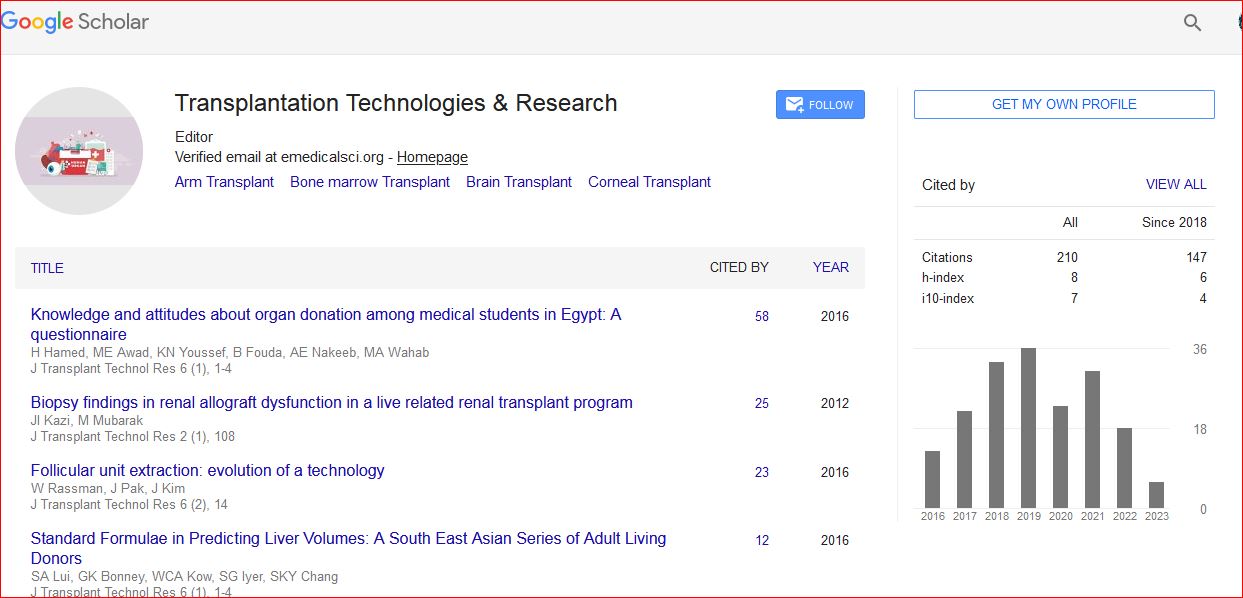
Transplantation Technologies & Research received 223 citations as per Google Scholar report