Opinion - (2025) Volume 15, Issue 6
Received: 01-Nov-2025, Manuscript No. jbpbt-25-178532;
Editor assigned: 03-Nov-2025, Pre QC No. P-178532;
Reviewed: 17-Nov-2025, QC No. Q-178532;
Revised: 24-Nov-2025, Manuscript No. R-178532;
Published:
29-Nov-2025
, DOI: 10.37421/2155-9821.2025.15.708
Citation: Papadopoulos, George A.. âOptimizing Bioreactor Oxygen Transfer For Efficiency.â J Bioprocess Biotech 15 (2025): 708.
Copyright: © 2025 Papadopoulos A. George This is an open-access article distributed under the terms of the Creative Commons Attribution License, which permits unrestricted use, distribution and reproduction in any medium, provided the original author and source are credited.
The critical role of enhanced oxygen transfer in bioreactors for optimizing microbial growth and product yield is a well-established principle in bioprocessing. Significant research efforts have been dedicated to developing and refining strategies to overcome oxygen mass transfer limitations, thereby boosting the efficiency and productivity of aerobic fermentations. Various advanced biotechniques have emerged, focusing on improving the volumetric mass transfer coefficients (kLa) through innovative engineering solutions. One key area of investigation involves the exploration of novel impeller designs. Different impeller geometries have been evaluated for their ability to enhance gas-liquid mass transfer by promoting better shear thinning and gas dispersion. Findings indicate that specific designs can lead to substantial improvements in oxygen transfer efficiency while simultaneously reducing power consumption, highlighting the importance of mechanical agitation in oxygen supply [1].
Complementary to impeller design, sparging strategies play a pivotal role in introducing oxygen into the bioreactor. Research has focused on optimizing sparger design, gas flow rate, and bubble size distribution to maximize the volumetric oxygen transfer coefficient. Practical guidelines are being developed for implementing intelligent sparging configurations to improve oxygen supply in industrial settings [2].
In addition to mechanical and sparging approaches, the use of microbubbles has shown considerable promise. Studies investigating the application of microbubbles to improve oxygen transfer in stirred tank bioreactors have demonstrated significantly higher oxygen mass transfer coefficients compared to conventional sparging by optimizing microbubble generation and distribution. This approach offers a viable avenue for enhancing aerobic fermentation processes [3].
The application of biosurfactants presents another innovative method for oxygen transfer enhancement. These natural compounds can effectively reduce the surface tension of the liquid phase, leading to smaller bubble sizes and an increased interfacial area for oxygen dissolution. Their efficacy in improving oxygen availability in challenging fermentation systems has been demonstrated [4].
Computational fluid dynamics (CFD) has become an indispensable tool for modeling and optimizing oxygen transfer in bioreactors. By simulating fluid flow, bubble dynamics, and mass transfer phenomena, CFD provides deep insights into reactor design and operating conditions that are crucial for maximizing oxygen availability for cell growth and production [5].
Shear stress, an inherent factor in bioreactor operation, also exerts a significant influence on oxygen transfer. Research has meticulously examined how different mixing intensities and impeller types generate shear forces that affect bubble coalescence and breakup, ultimately impacting the overall oxygen mass transfer rate. Optimization strategies are being proposed to mitigate these negative effects [6].
Membrane aeration techniques offer a bubble-free method for oxygen transfer in bioreactors. This approach can be particularly advantageous for shear-sensitive cells. Reviews covering different membrane materials, configurations, and their performance in enhancing oxygen supply highlight the advancements in this field [7].
An innovative approach involves the use of oscillating grid bioreactors. The induced oscillation leads to enhanced mixing and bubble dispersion, resulting in a significantly improved volumetric oxygen transfer coefficient. The potential for scaling up this technology for industrial bioprocesses is a subject of ongoing discussion and development [8].
Furthermore, dynamic oxygen enrichment strategies are being explored to optimize cell growth and productivity. By precisely controlling the dissolved oxygen concentration, these processes can avoid oxygen limitation while minimizing potential oxidative stress. This approach has demonstrated a significant increase in biomass and product formation compared to static aeration methods [9].
Strategies to enhance oxygen transfer in bioreactors are paramount for achieving optimal microbial performance and maximizing product yields in biotechnological applications. A comprehensive review of advanced biotechniques, including novel impeller designs, refined sparging strategies, and the integration of biosurfactants, addresses oxygen mass transfer limitations and their impact on volumetric mass transfer coefficients, ultimately leading to improved bioprocess efficiency [1].
The study of microbubbles for oxygen transfer in stirred tank bioreactors has revealed their potential to significantly elevate oxygen mass transfer coefficients. By meticulously optimizing microbubble generation and distribution, researchers have achieved substantial improvements over conventional sparging methods, marking a promising advancement for aerobic fermentation processes [2].
Investigating the effect of impeller design on gas-liquid mass transfer in bioreactors has provided valuable insights. Evaluations of various impeller geometries have shown that specific designs, particularly those that enhance shear thinning and gas dispersion, can substantially improve oxygen transfer efficiency and reduce energy consumption, underscoring the importance of mechanical agitation design [3].
Computational fluid dynamics (CFD) simulation has emerged as a powerful tool for understanding and optimizing oxygen mass transfer within stirred tank bioreactors. This approach allows for detailed modeling of fluid flow, bubble dynamics, and mass transfer phenomena, providing critical data for designing reactors and operating conditions that maximize oxygen availability for cellular processes [4].
The utilization of biosurfactants as agents for oxygen transfer enhancement is a notable area of research. These naturally occurring compounds function by lowering the surface tension of the liquid phase, which facilitates the formation of smaller bubbles and a greater interfacial area for oxygen absorption, thereby improving oxygen availability in demanding fermentation environments [5].
An innovative approach employing an oscillating grid bioreactor demonstrates significant enhancements in oxygen transfer. The oscillatory motion promotes superior mixing and bubble dispersion, leading to a markedly improved volumetric oxygen transfer coefficient, with considerable potential for industrial scalability [6].
The impact of shear stress on oxygen transfer in bioreactors is a crucial consideration. Mechanistic studies have elucidated how varying mixing intensities and impeller configurations generate shear forces that influence bubble behavior, such as coalescence and breakup, ultimately affecting the overall oxygen mass transfer rate. Strategies to mitigate adverse effects are being developed [7].
Membrane aeration techniques represent a bubble-free alternative for oxygen supply in bioreactors, offering distinct advantages, especially for shear-sensitive microorganisms. A review of recent advancements in this area covers various membrane materials, system configurations, and their demonstrated performance in augmenting oxygen delivery [8].
Optimization of sparging strategies is a key focus for enhancing oxygen transfer in aerobic bioreactors. Research examines the intricate relationship between sparger design, gas flow rates, and bubble size distribution and their collective impact on the volumetric oxygen transfer coefficient, offering practical guidance for industrial applications [9].
Dynamic oxygen enrichment strategies are being explored to boost cell growth and productivity in bioreactors. This method involves precise control over dissolved oxygen levels, ensuring sufficient oxygen availability while minimizing oxidative stress, and has shown marked improvements in biomass and product formation compared to traditional static aeration methods [10].
Bioreactor efficiency is significantly influenced by oxygen transfer rates, a challenge addressed by various advanced biotechniques. These include optimizing impeller designs and sparging strategies, utilizing microbubbles and biosurfactants to enhance gas-liquid contact, and employing computational fluid dynamics for modeling and optimization. Membrane aeration offers a bubble-free alternative, while oscillating grid bioreactors and dynamic oxygen enrichment provide innovative solutions for improving oxygen supply. Understanding and controlling factors like shear stress are also crucial for maximizing oxygen availability and overall bioprocess performance.
None
None
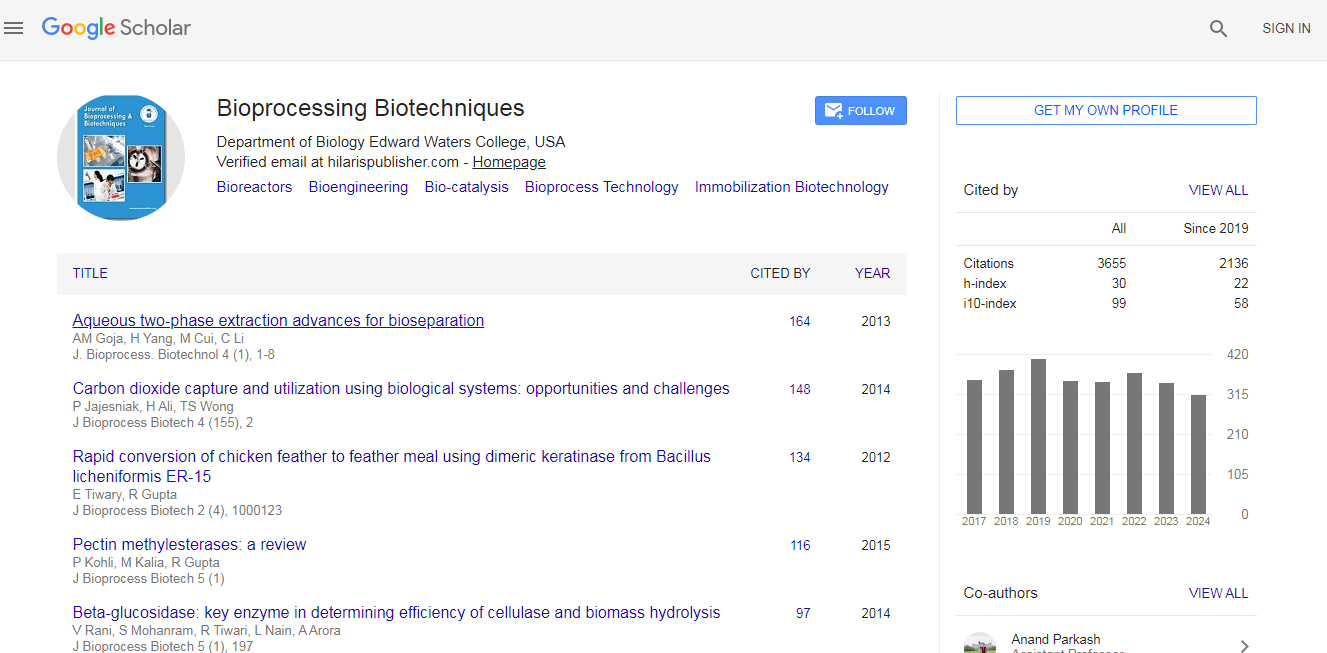
Journal of Bioprocessing & Biotechniques received 3351 citations as per Google Scholar report