Opinion - (2025) Volume 16, Issue 3
Received: 02-Jun-2025, Manuscript No. jmbd-26-179396;
Editor assigned: 04-Jun-2025, Pre QC No. P-179396;
Reviewed: 15-Jun-2025, QC No. Q-179396;
Revised: 23-Jun-2025, Manuscript No. R-179396;
Published:
30-Jun-2025
, DOI: 10.37421/2155-9929.2025.16.707
Citation: Torres, Miguel. ”NGS: Revolutionizing Diagnostics and Personalized Medicine.” J Mol Biomark Diagn 16 (2025):707.
Copyright: © 2025 Torres M. This is an open-access article distributed under the terms of the Creative Commons Attribution License, which permits unrestricted use, distribution and reproduction in any medium, provided the original author and source are credited.
Next-generation sequencing (NGS) is fundamentally reshaping the landscape of biomarker discovery and diagnostic applications by enabling high-throughput and comprehensive analyses of genomic and transcriptomic data [1].
This transformative technology facilitates the identification of novel biomarkers that are intricately linked to disease susceptibility, the progression of various ailments, and an individual's response to therapeutic interventions, thereby paving the way for the development of truly personalized medicine strategies [1].
The application of NGS in diagnostic settings spans a broad spectrum, from the earliest detection and prognosis of diseases to its crucial role in guiding treatment decisions across diverse medical fields such as oncology, infectious diseases, and the diagnosis of rare genetic disorders [1].
The continuous decrease in the cost and the expanding accessibility of NGS platforms are accelerating their integration into the fabric of routine clinical practice, making advanced genomic analysis more attainable [1].
In the specific domain of cancer diagnostics, the integration of NGS has markedly enhanced our capacity to pinpoint actionable mutations within tumors, accurately predict treatment outcomes, and diligently monitor for disease recurrence [2].
Techniques like whole-exome and whole-genome sequencing offer an in-depth panorama of tumor heterogeneity, while more focused, targeted gene panels provide cost-effective solutions for investigating specific oncogenic pathways critical to cancer development and progression [2].
Furthermore, the emerging field of liquid biopsies, which leverages the detection of circulating tumor DNA (ctDNA) through NGS, is proving to be an exceptionally powerful tool for non-invasive cancer screening, facilitating early detection efforts, and enabling precise assessment of treatment response [2].
This approach holds significant promise for improving patient management and outcomes in oncology. Within the critical area of infectious disease diagnostics, NGS provides an unprecedented level of speed and accuracy in identifying causative pathogens, detecting the presence of antimicrobial resistance, and characterizing the dynamics of infectious disease outbreaks [3].
Metagenomic sequencing, in particular, allows for the simultaneous detection of a multitude of microbial agents present in a single sample, thereby offering a comprehensive overview of the microbial community under investigation [3].
This comprehensive microbial profiling capability is especially valuable when diagnosing complex or previously unknown infections and plays a vital role in public health surveillance efforts, enabling the tracking of pathogen evolution and the monitoring of their spread within populations [3].
Such insights are crucial for timely and effective public health responses. The diagnosis of rare genetic diseases, which often presents considerable challenges, has been profoundly impacted by NGS [4].
Technologies such as whole-genome and whole-exome sequencing have become indispensable tools for pinpointing the specific genetic variants responsible for these often-undiagnosed conditions in affected individuals [4].
The capacity to sequence entire genomes or exomes offers a far more exhaustive search for disease-causing mutations when compared to traditional genetic testing methodologies, leading to more rapid and accurate diagnoses [4].
Consequently, this improved diagnostic accuracy enables better-informed clinical management strategies and more effective genetic counseling for families affected by rare inherited disorders. Beyond DNA analysis, transcriptome sequencing (RNA-Seq) employing NGS platforms provides a dynamic and detailed snapshot of gene expression profiles within cells and tissues [5].
This information is instrumental in identifying novel biomarkers that can indicate disease state and predict its progression, offering early insights into biological changes [5].
These changes in gene expression patterns can signal the incipient stages of disease, forecast a patient's likely response to various therapies, and illuminate the specific molecular pathways involved in disease pathogenesis, thus advancing our understanding of disease mechanisms and the development of targeted interventions [5].
Next-generation sequencing (NGS) is revolutionizing biomarker identification and diagnostic applications by enabling high-throughput, comprehensive analysis of genomic and transcriptomic data [1]. This technology allows for the discovery of novel biomarkers associated with disease susceptibility, progression, and therapeutic response, facilitating the development of personalized medicine strategies [1]. Its application in diagnostics ranges from early disease detection and prognosis to guiding treatment decisions in oncology, infectious diseases, and rare genetic disorders [1]. The increasing affordability and accessibility of NGS platforms are driving its integration into routine clinical practice [1]. The integration of NGS into cancer diagnostics has significantly advanced our ability to identify actionable mutations, predict treatment outcomes, and monitor disease recurrence [2].
Whole-exome and whole-genome sequencing provide a detailed landscape of tumor heterogeneity, while targeted gene panels offer cost-effective solutions for specific oncogenic pathways [2]. Liquid biopsies, utilizing circulating tumor DNA (ctDNA) detected by NGS, are emerging as a powerful tool for non-invasive cancer screening, early detection, and response assessment [2]. In the realm of infectious disease diagnostics, NGS offers unprecedented speed and accuracy in identifying pathogens, detecting antimicrobial resistance, and characterizing outbreaks [3]. Metagenomic sequencing allows for the simultaneous detection of multiple microbial agents in a single sample, providing a comprehensive view of the microbial community [3]. This is particularly valuable in diagnosing complex or novel infections and in public health surveillance to track pathogen evolution and spread [3].
Rare genetic diseases present significant diagnostic challenges [4]. NGS, particularly whole-genome and whole-exome sequencing, has become an indispensable tool for identifying causative genetic variants in undiagnosed patients [4]. The ability to sequence entire genomes or exomes provides a more comprehensive search for mutations compared to traditional genetic testing, leading to faster and more accurate diagnoses, and consequently, enabling better management and genetic counseling for affected families [4]. Transcriptome sequencing (RNA-Seq) using NGS platforms provides a dynamic snapshot of gene expression profiles, enabling the identification of novel biomarkers for disease state and progression [5]. Changes in gene expression patterns can reveal early signs of disease, predict patient response to therapy, and identify molecular pathways involved in pathogenesis [5]. This approach is crucial for understanding disease mechanisms and developing targeted interventions [5]. The clinical utility of NGS in diagnostics is underpinned by advancements in bioinformatics and data analysis [6]. Robust algorithms and pipelines are essential for processing and interpreting the vast amounts of data generated by NGS [6]. Standardization of analytical workflows and quality control measures are critical for ensuring the reliability and reproducibility of NGS-based diagnostic results [6].
Epigenetic modifications, such as DNA methylation and histone modifications, play a crucial role in gene regulation and disease development [7]. NGS-based epigenomic profiling techniques, like whole-genome bisulfite sequencing (WGBS) and ChIP-sequencing, are powerful tools for identifying epigenetic biomarkers [7]. These biomarkers can offer insights into disease initiation and progression, and may serve as targets for epigenetic therapies [7]. The development of pharmacogenomic biomarkers through NGS is transforming drug development and personalized treatment [8]. By identifying genetic variations that influence drug metabolism, efficacy, and toxicity, NGS enables the selection of the most appropriate drug and dosage for individual patients, thereby minimizing adverse drug reactions and maximizing therapeutic benefit [8]. Single-cell sequencing technologies, powered by NGS, are providing unprecedented resolution in biomarker discovery by dissecting cellular heterogeneity within tissues and tumors [9].
This allows for the identification of rare cell populations with specific functional roles or disease-driving capabilities, which can be missed by bulk sequencing [9]. These single-cell insights are crucial for understanding complex biological processes and developing highly targeted therapeutic strategies [9]. The clinical implementation of NGS requires careful consideration of ethical, legal, and social implications (ELSI) [10]. Issues surrounding data privacy, informed consent, genetic discrimination, and equitable access to NGS technologies need to be addressed to ensure responsible integration into healthcare systems [10]. Establishing clear guidelines and educational initiatives is vital for navigating these complexities [10].
Next-generation sequencing (NGS) is revolutionizing biomarker discovery and diagnostics across various fields, including oncology, infectious diseases, and rare genetic disorders. Its high-throughput capabilities enable comprehensive analysis of genomic and transcriptomic data, leading to the identification of novel biomarkers for disease susceptibility, progression, and therapeutic response, facilitating personalized medicine. NGS applications in cancer diagnostics allow for actionable mutation identification, outcome prediction, and monitoring of recurrence, with liquid biopsies emerging as a powerful non-invasive tool. In infectious diseases, NGS offers rapid and accurate pathogen identification and resistance detection, with metagenomics providing a broad microbial community view. For rare genetic diseases, whole-genome and whole-exome sequencing are essential for identifying causative variants. RNA-Seq provides insights into gene expression for biomarker discovery, while epigenomic profiling aids in understanding disease mechanisms. Pharmacogenomic applications of NGS personalize drug selection and dosage. Single-cell sequencing dissects cellular heterogeneity for targeted therapies. The successful clinical integration of NGS hinges on robust bioinformatics and addressing ethical, legal, and social implications.
None
None
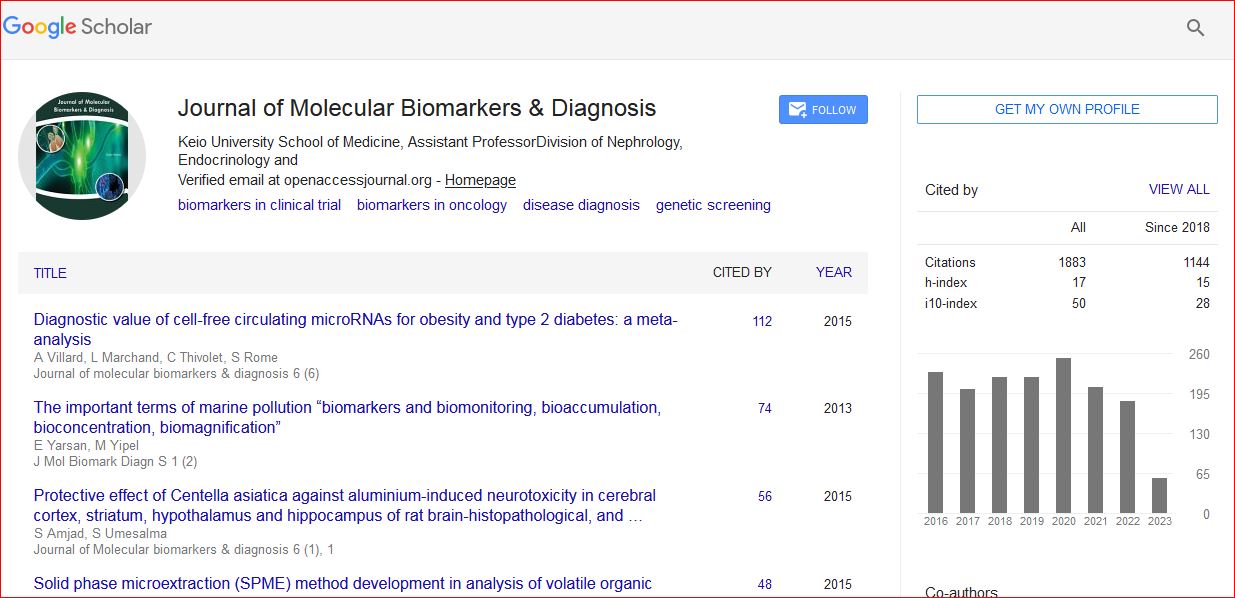
Journal of Molecular Biomarkers & Diagnosis received 2054 citations as per Google Scholar report