Commentary - (2025) Volume 16, Issue 5
Received: 01-Sep-2025, Manuscript No. bej-26-182500;
Editor assigned: 03-Sep-2025, Pre QC No. P-182500;
Reviewed: 17-Sep-2025, QC No. Q-182500;
Revised: 22-Sep-2025, Manuscript No. R-182500;
Published:
29-Sep-2025
, DOI: 10.37421/2161-6219.2025.16.574
Citation: Figueroa, Marta. ”Navigating Global Economic Challenges:
Business Strategy and Resilience.” Bus Econ J 16 (2025):574.
Copyright: © 2025 Figueroa M. This is an open-access article distributed under the terms of the Creative Commons Attribution License, which permits unrestricted use,
distribution and reproduction in any medium, provided the original author and source are credited.
The global economic landscape is characterized by dynamic shifts that profoundly influence the strategic decisions and operational frameworks of businesses worldwide. Understanding these complex interactions is paramount for fostering resilience and achieving sustained profitability in an increasingly unpredictable environment. For instance, the interplay of inflation, evolving interest rate policies, and pervasive geopolitical instability necessitates a proactive approach to corporate strategy and risk management, as elucidated by analyses of contemporary economic phenomena [1].
Simultaneously, the rapid advancement and integration of technologies, particularly artificial intelligence and automation, are reshaping labor markets and productivity benchmarks, especially within the service sector. Strategic adoption of these tools requires careful consideration of workforce adaptation and retraining to harness their full potential effectively [2].
Furthermore, consumer behavior is undergoing a significant transformation, driven by both economic considerations and a growing awareness of environmental sustainability. Businesses must align their marketing and product development with these evolving consumer priorities to maintain relevance and market share [3].
The integrity and adaptability of supply chains have also emerged as critical factors in mitigating the impact of global disruptions, such as pandemics and international trade disputes. Implementing strategies for supplier diversification and leveraging digital tools are essential for building resilient supply networks [4].
The financial health and growth trajectories of small and medium-sized enterprises (SMEs) are intrinsically linked to fiscal and monetary policies. Fluctuations in interest rates, tax reforms, and government stimulus packages directly influence investment, expansion, and survival rates within this vital economic segment [5].
In developing economies, foreign direct investment (FDI) plays a pivotal role in driving economic growth, creating employment opportunities, and facilitating technological transfer. Navigating the complexities of attracting and managing FDI presents both significant challenges and considerable opportunities for these nations [6].
Exchange rate volatility poses a substantial risk to international trade and business operations, impacting profitability and competitiveness. Effective hedging strategies and robust risk management techniques are indispensable for mitigating the adverse effects of fluctuating currency values [7].
The global commodity markets are subject to significant price fluctuations, which directly affect industries reliant on these resources. Understanding these volatilities is crucial for managing production costs, refining pricing strategies, and safeguarding the financial stability of businesses [8].
Investment in innovation and research & development (R&D) stands as a key determinant of firm competitiveness and long-term growth. Strategic R&D efforts foster product differentiation, enhance cost efficiencies, and ultimately lead to market leadership, especially in dynamic industry sectors [9].
Finally, the intricate web of global trade agreements and the resurgence of protectionist policies significantly shape the international business environment. Changes in trade regulations, tariffs, and geopolitical alliances critically influence market access, sourcing strategies, and the overall cost structures of multinational corporations [10].
The contemporary business environment is significantly shaped by a confluence of global economic factors, demanding adaptive strategies for corporate survival and prosperity. Economic shifts, including inflationary pressures, interest rate adjustments, and geopolitical uncertainties, directly influence a company's strategic decision-making processes, its operational efficiency, and ultimately, its profitability. Businesses must therefore cultivate agile strategies and implement comprehensive risk management frameworks to effectively navigate these volatile economic conditions [1].
Technological advancements, particularly in artificial intelligence and automation, are profoundly impacting the labor market and productivity within the service industry. The strategic integration of these technologies can significantly enhance operational effectiveness, but this necessitates substantial investment in workforce retraining and adaptation to ensure a smooth transition and maximize benefits [2].
Consumer behavior is increasingly influenced by a complex interplay of economic conditions and heightened environmental consciousness. Identifying the key drivers behind purchasing decisions is crucial for businesses, enabling them to align their marketing efforts and product development strategies with the evolving priorities of consumers in this new economic era [3].
The resilience of supply chains is a critical component in mitigating disruptions stemming from global events such as pandemics or trade conflicts. Strategies involving supplier diversification, enhanced inventory management, and the adoption of digital technologies are fundamental to building robust and adaptable supply chains capable of withstanding unforeseen challenges [4].
The fiscal and monetary policies enacted by governments have a direct and substantial impact on small and medium-sized enterprises (SMEs). Fluctuations in interest rates, the implementation of tax reforms, and the provision of government stimulus packages all affect SME investment capacity, their potential for growth, and their very survival rates, underscoring the need for targeted policy support [5].
In the context of developing economies, foreign direct investment (FDI) serves as a vital catalyst for economic growth, job creation, and the transfer of technology. Attracting and effectively managing FDI involves addressing a range of challenges while simultaneously capitalizing on the significant opportunities it presents for economic advancement [6].
Exchange rate volatility presents a considerable risk to international trade and the operational continuity of businesses engaged in global commerce. Implementing effective hedging strategies and risk management techniques is essential for businesses to mitigate the adverse financial impacts of fluctuating currency values on their profitability and competitive standing [7].
Global commodity price fluctuations exert a significant influence on industries that depend heavily on these resources. Understanding and forecasting these price volatilities are crucial for managing production costs, optimizing pricing strategies, and ensuring the overall financial health and stability of businesses operating in these sectors [8].
Investment in innovation and research & development (R&D) is a primary economic driver that significantly influences a firm's competitiveness and its capacity for long-term growth. Strategic R&D initiatives enable companies to achieve product differentiation, realize cost efficiencies, and secure market leadership, particularly within rapidly evolving and competitive industries [9].
The global business landscape is continuously being reshaped by international trade agreements and the implementation of protectionist policies. Changes in trade regulations, the imposition of tariffs, and the formation of geopolitical alliances have a profound effect on market access, the strategic decisions related to sourcing, and the overall cost structures experienced by multinational corporations [10].
This collection of research explores the multifaceted economic challenges and opportunities facing businesses in the current global climate. It highlights the impact of economic volatility, technological integration, evolving consumer demands, and supply chain disruptions on corporate strategy and resilience. The influence of fiscal and monetary policies on SMEs, the role of FDI in developing economies, and the risks associated with exchange rate and commodity price fluctuations are also examined. Furthermore, the importance of innovation and R&D investment for firm competitiveness and the shaping effect of global trade dynamics are discussed. The overarching theme emphasizes the necessity for businesses to adopt agile strategies, robust risk management, and strategic foresight to thrive amidst complexity and uncertainty.
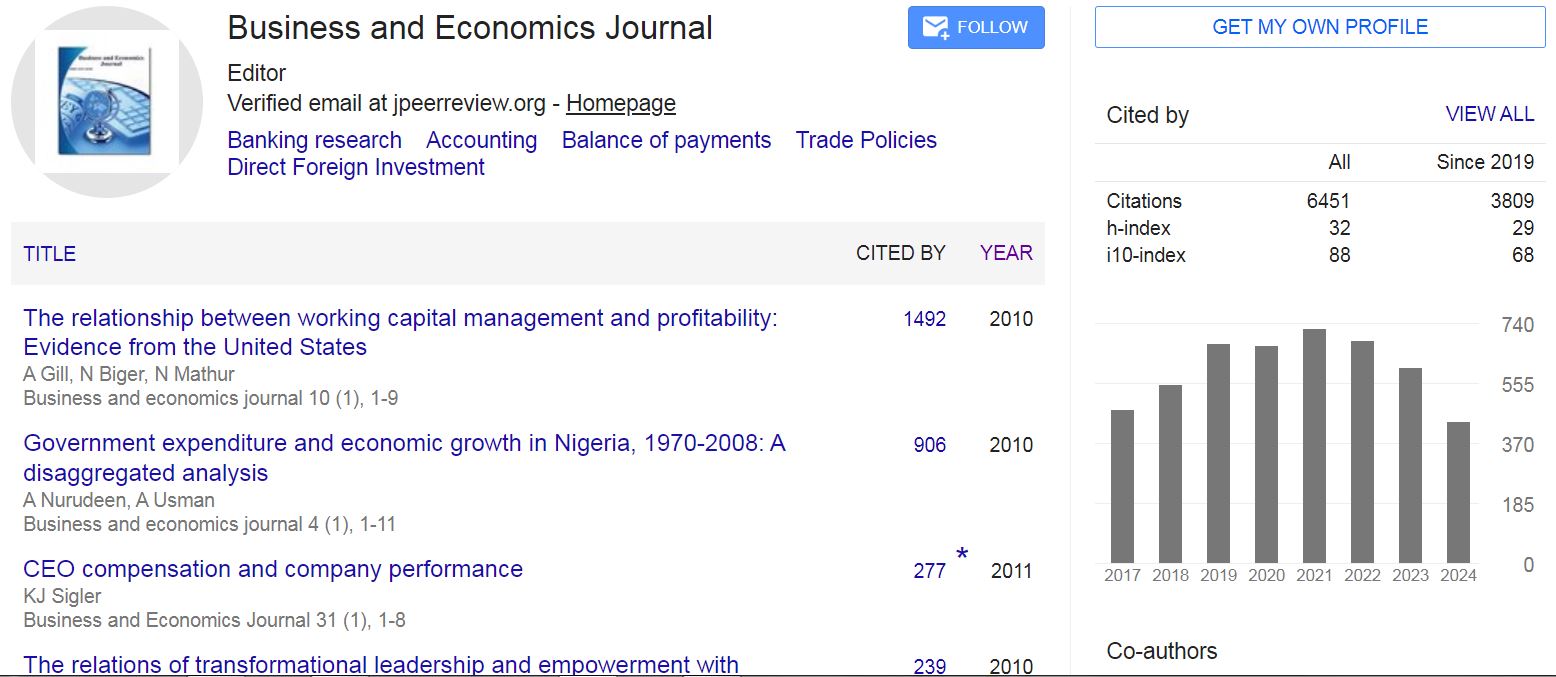
Business and Economics Journal received 6451 citations as per Google Scholar report