Perspective - (2025) Volume 15, Issue 4
Received: 01-Jul-2025, Manuscript No. jnt-26-178949;
Editor assigned: 03-Jul-2025, Pre QC No. P-178949;
Reviewed: 17-Jul-2025, QC No. Q-178949;
Revised: 22-Jul-2025, Manuscript No. R-178949;
Published:
29-Jul-2025
, DOI: 10.37421/2161-0959.2025.15.575
Citation: Rahman, Ayesha. ”Natural Compounds: Guarding Kidney Health Holistically.” J Nephrol Ther 15 (2025):575.
Copyright: © 2025 Rahman A. This is an open-access article distributed under the terms of the Creative Commons Attribution License, which permits unrestricted use, distribution and reproduction in any medium, provided the original author and source are credited.
Natural compounds and nutraceuticals are emerging as potent agents in safeguarding kidney health, presenting therapeutic strategies that complement traditional medical interventions. Extensive research underscores the multifaceted protective capabilities of various phytochemicals and dietary supplements, including their significant antioxidant, anti-inflammatory, and antifibrotic properties. These beneficial attributes play a crucial role in moderating the advancement of chronic kidney disease (CKD) and acute kidney injury, addressing core pathogenic mechanisms within the renal system such as oxidative stress, inflammatory cascades, and cellular senescence [1].
Curcumin, a well-known polyphenol derived from turmeric, has demonstrated remarkable renoprotective effects. Its therapeutic potential lies in its ability to suppress key inflammatory mediators, notably NF-κB, and effectively reduce oxidative stress within the kidneys. Scientific investigations have highlighted its efficacy in protecting against conditions like diabetic nephropathy and kidney injury induced by aristolochic acid, partly by enhancing renal microcirculation and inhibiting the development of fibrosis [2].
Resveratrol, a stilbenoid compound abundant in grapes and berries, offers substantial renoprotection through its potent antioxidant and anti-inflammatory actions. Studies have indicated its capacity to ameliorate kidney damage in preclinical models of hypertension and kidney fibrosis. This protective effect is mediated by its modulation of critical signaling pathways involved in cellular stress responses and inflammatory processes within the renal tissue [3].
Omega-3 fatty acids, specifically eicosapentaenoic acid (EPA) and docosahexaenoic acid (DHA), commonly found in fish oil, exert beneficial effects on kidney health. They contribute to renoprotection by reducing systemic inflammation and improving lipid profiles, factors of paramount importance in the management of CKD. Their anti-inflammatory mechanisms involve the suppression of pro-inflammatory cytokines and eicosanoids, thereby mitigating inflammatory damage to the kidneys [4].
Quercetin, a widely distributed flavonoid found in various fruits and vegetables, provides renoprotection through several mechanisms, including the scavenging of free radicals, inhibition of inflammatory pathways, and enhancement of endothelial function. Preclinical studies suggest its potential in mitigating kidney damage associated with conditions such as diabetes and ischemia-reperfusion injury, underscoring its therapeutic value [5].
Green tea extract, particularly its rich content of catechins like epigallocatechin gallate (EGCG), possesses significant antioxidant and anti-inflammatory properties that are highly beneficial for overall kidney health. EGCG has been shown to shield renal cells from oxidative stress and the progression of fibrosis, presenting a promising therapeutic avenue in preclinical models of CKD [6].
Silymarin, a complex of flavonoids extracted from milk thistle, has exhibited protective effects against a spectrum of kidney injuries, including nephrotoxicity induced by pharmacological agents and environmental toxins. Its renoprotective capabilities are primarily attributed to its potent antioxidant and anti-inflammatory actions, which help preserve renal function and integrity [7].
Anthocyanins, the natural pigments responsible for the vibrant red, purple, and blue hues in many fruits and vegetables, possess strong antioxidant and anti-inflammatory properties that contribute significantly to renal protection. These compounds can effectively mitigate oxidative stress and inflammation within kidney cells, showing particular promise in the prevention and management of diabetic nephropathy [8].
Berberine, an alkaloid compound found in various medicinal plants, demonstrates renoprotective effects through a combination of anti-inflammatory, antioxidant, and antifibrotic mechanisms. Research indicates its efficacy in improving renal function and reducing kidney damage in experimental models of diabetic nephropathy and polycystic kidney disease, highlighting its therapeutic potential [9].
Genistein, a prominent isoflavone predominantly found in soybeans, contributes to renoprotection by reducing oxidative stress, inflammation, and endoplasmic reticulum stress within renal cells. Its potential therapeutic role has been investigated in mitigating kidney damage associated with autoimmune conditions like lupus nephritis and metabolic disorders such as diabetic nephropathy [10].
The investigation into natural compounds and nutraceuticals for kidney protection reveals a promising frontier in therapeutic development, offering alternative and supplementary approaches to conventional treatments. These natural agents are characterized by their significant antioxidant, anti-inflammatory, and antifibrotic properties, which collectively contribute to mitigating the progression of both chronic and acute kidney injuries. Their mechanisms of action often target fundamental pathogenic pathways in renal disease, including oxidative stress, inflammatory responses, and cellular senescence, providing a comprehensive protective effect against renal damage [1].
Curcumin, a bioactive polyphenol extracted from turmeric, stands out for its notable renoprotective attributes. It exerts its beneficial effects by actively suppressing pro-inflammatory signaling molecules like NF-κB and by combating oxidative stress within the renal tissues. Evidence from scientific studies supports its efficacy in safeguarding against conditions such as diabetic nephropathy and acute kidney injury triggered by aristolochic acid, partly through its capacity to improve renal blood flow and inhibit fibrotic processes [2].
Resveratrol, a stilbenoid found in sources like grapes and berries, offers significant renoprotection via its potent antioxidant and anti-inflammatory capacities. It has been shown to effectively alleviate kidney damage in preclinical models that mimic hypertension and kidney fibrosis. This protective action is attributed to its ability to modulate key signaling pathways that govern cellular stress and inflammation in the kidneys [3].
Omega-3 fatty acids, particularly EPA and DHA found in fish oil, play a crucial role in maintaining kidney health by reducing inflammation and improving essential lipid profiles, which are critical determinants in managing chronic kidney disease. Their anti-inflammatory effects are achieved through the suppression of key pro-inflammatory cytokines and other inflammatory mediators, thereby safeguarding renal structures [4].
Quercetin, a flavonoid commonly found in fruits and vegetables, provides renoprotective benefits through multiple pathways. It acts as a free radical scavenger, inhibits inflammatory cascades, and enhances endothelial function, all of which are vital for maintaining kidney health. Its potential to attenuate kidney damage associated with diabetes and ischemia-reperfusion injury is a significant area of research [5].
Green tea extract, rich in valuable polyphenols such as epigallocatechin gallate (EGCG), is recognized for its strong antioxidant and anti-inflammatory properties that positively impact kidney health. EGCG has demonstrated its ability to protect renal cells from the detrimental effects of oxidative stress and fibrosis, making it a promising agent in the context of chronic kidney disease management [6].
Silymarin, a therapeutic complex derived from milk thistle, has documented protective effects against various forms of kidney injury, including nephrotoxicity caused by drugs and toxins. Its renoprotective efficacy is primarily linked to its potent antioxidant and anti-inflammatory activities, which help preserve the structural and functional integrity of the kidneys [7].
Anthocyanins, the natural pigments responsible for the characteristic colors of many fruits and vegetables, possess powerful antioxidant and anti-inflammatory properties that are beneficial for renal protection. They contribute to mitigating oxidative stress and inflammation in kidney cells, showing particular promise in the prevention and treatment of diabetic nephropathy [8].
Berberine, an alkaloid extracted from several medicinal plants, exhibits significant renoprotective effects through its multifaceted actions, including anti-inflammatory, antioxidant, and antifibrotic properties. Studies have shown its effectiveness in improving kidney function and reducing damage in experimental models of diabetic nephropathy and polycystic kidney disease [9].
Genistein, a major isoflavone found in soybeans, offers renoprotection by reducing key pathological factors in renal cells, such as oxidative stress, inflammation, and endoplasmic reticulum stress. Its potential therapeutic applications are being explored for mitigating kidney damage in conditions like lupus nephritis and diabetic nephropathy [10].
Natural compounds and nutraceuticals offer promising renoprotective effects by combating oxidative stress, inflammation, and fibrosis, key drivers of kidney damage. Compounds like curcumin, resveratrol, omega-3 fatty acids, quercetin, green tea extract (EGCG), silymarin, anthocyanins, berberine, and genistein have demonstrated efficacy in preclinical studies across various kidney disease models, including diabetic nephropathy and acute kidney injury. These agents target specific molecular pathways to preserve renal function and integrity, presenting valuable therapeutic avenues beyond conventional treatments. Their diverse mechanisms of action highlight a holistic approach to kidney health management.
None
None
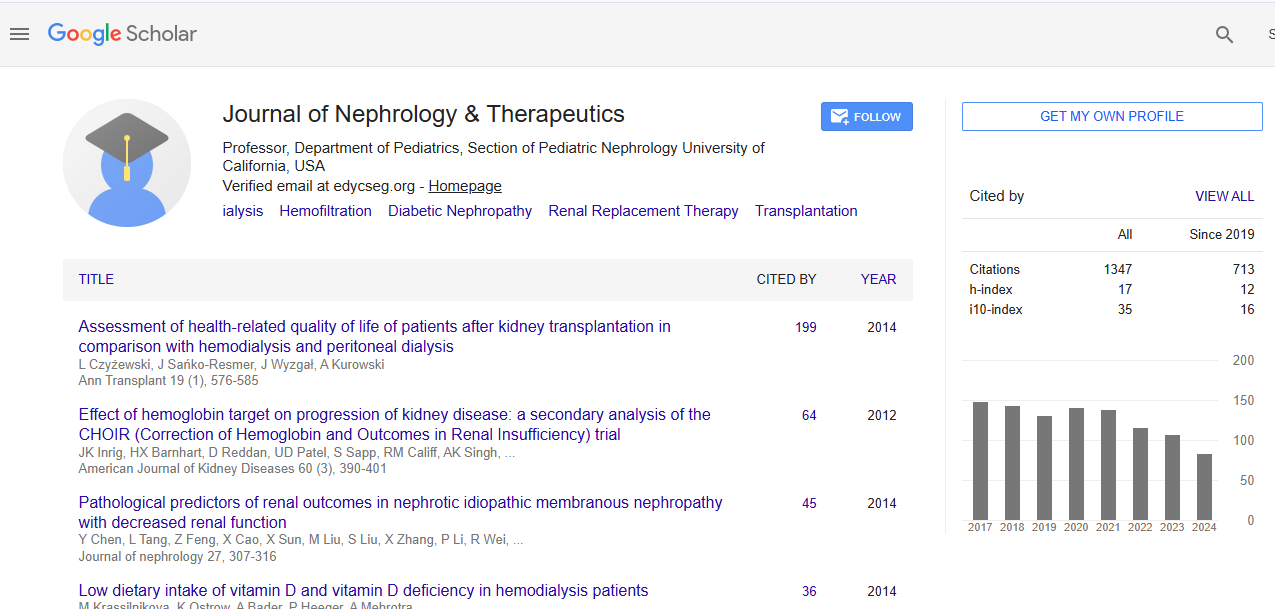
Journal of Nephrology & Therapeutics received 784 citations as per Google Scholar report