Opinion - (2025) Volume 10, Issue 6
Received: 01-Dec-2025, Manuscript No. jcct-26-183277;
Editor assigned: 03-Dec-2025, Pre QC No. P-183277;
Reviewed: 17-Dec-2025, QC No. Q-183277;
Revised: 22-Dec-2025, Manuscript No. R-183277;
Published:
29-Dec-2025
, DOI: 10.37421/2577-0535.2025.9.340
Citation: Conti, Valeria. ”Imaging Biomarkers Revolutionize Cancer Trials.” J Cancer Clin Trials 10 (2025):340.
Copyright: © 2025 Conti V. This is an open-access article distributed under the terms of the Creative Commons Attribution License, which permits unrestricted use, distribution and reproduction in any medium, provided the original author and source are credited.
The integration of imaging biomarkers into cancer clinical trials is revolutionizing the landscape of oncology research and patient care by offering objective and quantifiable measures of disease progression and treatment response [1].
These advanced imaging techniques are crucial for enhancing trial efficiency and enabling precise patient stratification, leading to more personalized and effective therapeutic strategies [1].
Quantitative imaging techniques, encompassing methods like radiomics and texture analysis, provide a powerful means to extract comprehensive data from medical images, extending beyond traditional visual assessments [2].
These advanced analytical approaches offer profound insights into tumor heterogeneity and the tumor microenvironment, which are critical for predicting therapeutic outcomes and identifying novel treatment targets [2].
The advent of artificial intelligence (AI) and machine learning (ML) has further propelled the utility of imaging biomarkers, enabling automated complex image segmentation, feature extraction, and predictive modeling [3].
This acceleration is vital for both the development and widespread implementation of imaging biomarkers in clinical trials and routine patient care [3].
Functional imaging techniques, such as Positron Emission Tomography (PET) and Magnetic Resonance Imaging (MRI), are increasingly leveraged to assess treatment response and predict prognoses across diverse cancer types [4].
Their capacity to capture dynamic biological processes and metabolic activity offers a more nuanced understanding of tumor behavior compared to solely relying on anatomical imaging [4].
Despite the immense potential, the integration of imaging biomarkers into clinical trials is not without its challenges, including the need for standardization of imaging protocols and rigorous validation of biomarker performance [5].
Addressing these issues, alongside the development of clear regulatory guidelines, is paramount to ensure the reliable and reproducible application of imaging biomarkers in drug development and clinical practice [5].
Diffusion-weighted imaging (DWI) has emerged as a particularly promising imaging biomarker for assessing tumor cellularity and early treatment response, especially in gliomas and other solid tumors, by monitoring changes in the apparent diffusion coefficient (ADC) [6].
Perfusion imaging techniques, including dynamic contrast-enhanced MRI (DCE-MRI) and dynamic susceptibility contrast MRI (DSC-MRI), are instrumental in evaluating tumor vascularity and response to anti-angiogenic therapies by detecting alterations in blood flow and permeability [7].
Radiomics holds significant promise in identifying imaging phenotypes that can predict patient response to immunotherapy, revealing subtle patterns related to immune cell infiltration and tumor microenvironment through extensive quantitative feature extraction from standard radiological images [8].
The ongoing development and validation of novel imaging biomarkers for early cancer detection and prognosis underscore the critical need for robust validation processes to guarantee their clinical utility and reliability in guiding treatment decisions [9].
Implementing AI-driven imaging biomarkers in multicenter clinical trials presents unique challenges, necessitating harmonized imaging acquisition protocols and standardized analysis pipelines to maximize their potential and ensure consistency [10].
The transformative role of imaging biomarkers in cancer clinical trials is fundamentally enhancing trial efficiency and patient stratification through objective, quantifiable measures of tumor response and disease progression [1].
Advanced imaging techniques provide insights into molecular characteristics, paving the way for more personalized treatment strategies and earlier assessment of therapeutic efficacy [1].
Quantitative imaging, through methods like radiomics and texture analysis, moves beyond visual assessment to extract comprehensive data from medical images, revealing crucial aspects of tumor heterogeneity and microenvironment [2].
This detailed information is vital for predicting treatment outcomes and identifying novel therapeutic targets in precision oncology [2].
The application of artificial intelligence (AI) and machine learning (ML) in analyzing imaging biomarkers is accelerating progress by automating complex image segmentation, feature extraction, and predictive modeling [3].
These AI/ML capabilities are instrumental in both the development of new biomarkers and their integration into routine clinical practice [3].
Functional imaging modalities, including PET and MRI, offer a dynamic perspective on cancer, enabling the assessment of treatment response and prediction of outcomes by capturing biological processes and metabolic activity [4].
This provides a deeper understanding of tumor behavior than anatomical imaging alone [4].
However, the successful integration of imaging biomarkers into clinical settings necessitates addressing significant challenges related to standardization and validation [5].
Establishing clear regulatory pathways and guidelines is essential for ensuring the reliability and reproducibility of these biomarkers in drug development [5].
Diffusion-weighted MRI (DWI) has demonstrated significant potential as an imaging biomarker for evaluating tumor cellularity and early treatment response, particularly in solid tumors, by observing changes in the apparent diffusion coefficient (ADC) [6].
Perfusion imaging, utilizing DCE-MRI and DSC-MRI, plays a crucial role in assessing tumor vascularity and response to therapies targeting angiogenesis, by monitoring changes in blood flow and permeability as early indicators of treatment efficacy [7].
Radiomics is emerging as a powerful tool for predicting immunotherapy response by extracting numerous quantitative features from radiological images that correlate with immune cell infiltration and the tumor microenvironment [8].
The ongoing development and validation of new imaging biomarkers for early cancer detection and prognosis are crucial, emphasizing the importance of robust validation processes to ensure their clinical utility and impact on treatment decision-making [9].
The deployment of AI-driven imaging biomarkers in multicenter trials requires careful consideration of implementation challenges, including the harmonization of imaging acquisition and analysis to achieve reliable and consistent results across different institutions [10].
Imaging biomarkers are revolutionizing cancer clinical trials by improving efficiency and patient selection through objective, quantifiable data. Advanced techniques like radiomics, texture analysis, AI, and machine learning extract deep insights into tumor characteristics, aiding in treatment response prediction and target identification. Functional imaging modalities such as PET and MRI offer dynamic assessments of tumor behavior. While promising, challenges in standardization, validation, and regulatory pathways need to be addressed for widespread clinical adoption. Techniques like DWI and perfusion imaging are showing efficacy in monitoring treatment effects, and radiomics is showing potential in predicting immunotherapy response. Robust validation is key for new biomarkers guiding treatment decisions, and multicenter implementation of AI-driven biomarkers requires harmonization.
None
None
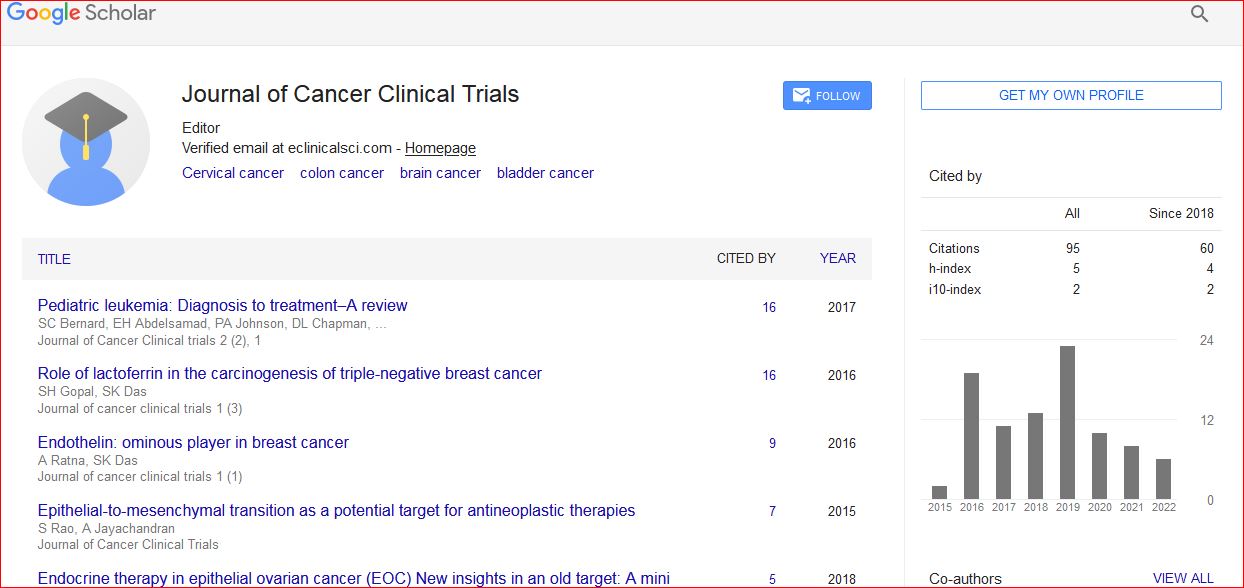
Journal of Cancer Clinical Trials received 95 citations as per Google Scholar report