Short Communication - (2025) Volume 15, Issue 5
Received: 02-Oct-2025, Manuscript No. jbbs-25-174259;
Editor assigned: 06-Oct-2025, Pre QC No. P-174259;
Reviewed: 20-Oct-2025, QC No. Q-174259;
Revised: 23-Oct-2025, Manuscript No. R-174259;
Published:
30-Oct-2025
, DOI: 10.37421/2155-9538.2025.15.503
Citation: Wei, Chen. ”Nanobiotechnology: Revolutionizing Health, Environment, Food Security.” J Bioengineer & Biomedical Sci 15 (2025):503.
Copyright: © 2025 Wei C. This is an open-access article distributed under the terms of the Creative Commons Attribution License, which permits unrestricted use, distribution and reproduction in any medium, provided the original author and source are credited.
The burgeoning field of nanobiotechnology is rapidly transforming our approach to complex challenges across medicine, environmental science, and agriculture. One significant advancement involves the use of nanomaterials to effectively overcome biological barriers, dramatically boosting drug delivery efficacy in various therapeutic contexts [1].
These sophisticated nanobiotechnological strategies are engineered to improve drug bioavailability and ensure targeted release, representing a monumental leap forward in treating intricate diseases. Concurrently, the realm of disease diagnosis is being reshaped by recent developments in nanobiotechnology-based biosensors [2].
These innovative tools are celebrated for their exceptional sensitivity, specificity, and capacity for rapid detection. What this really means is that medical professionals now have access to superior instruments for early and accurate assessment, which directly leads to quicker and more effective interventions, ultimately enhancing patient outcomes. Targeted cancer therapy is another area witnessing profound advancements through nanobiotechnology. Researchers are developing strategies that precisely deliver therapeutic agents directly to cancer cells while diligently minimizing systemic toxicity [3].
This precise targeting mechanism marks a crucial progression toward creating more effective and significantly less harmful treatments for cancer, addressing a long-standing challenge in oncology. Beyond healthcare, nanobiotechnology is offering groundbreaking solutions to pressing environmental challenges. This includes the development of highly effective remediation processes for pollutants and sophisticated monitoring systems, clearly demonstrating its potential for establishing more sustainable and proactive environmental management practices [4].
The versatility of nanomaterials is further evident in their application within bioimaging and theranostics. Here, these materials exhibit dual capabilities, enabling both precise disease detection and targeted therapeutic intervention [5].
This powerful combination offers an integrated approach to medical advancements, providing comprehensive tools for both diagnosis and treatment within a single platform. In the agricultural sector, nanobiotechnology is poised to introduce revolutionary changes. A comprehensive review outlines recent advancements and future prospects, highlighting its immense potential to significantly enhance crop yield, refine pest management techniques, and develop intelligent delivery systems for essential nutrients and agrochemicals [6].
The ultimate goal is to achieve more efficient and sustainable food production globally, ensuring food security for a growing population. Furthermore, the landscape of genetic medicine is being fundamentally altered by nanomaterial-assisted gene editing. This groundbreaking methodology is opening new avenues for therapeutic applications by enabling the precise and highly efficient delivery of gene-editing tools directly to target cells [7].
This pushes the very boundaries of genetic medicine, offering unprecedented opportunities for addressing and potentially curing genetic disorders. Simultaneously, nanobiotechnology is facilitating the creation of advanced platforms for point-of-care diagnostics. The core objective here is to deliver rapid, accurate, and easily accessible diagnostic results beyond the confines of traditional laboratory settings [8].
This critical development markedly improves healthcare accessibility, particularly in remote or underserved communities. Significant innovation is also being driven by nanobiotechnology in the specialized fields of tissue engineering and regenerative medicine. This involves the ingenious creation of novel scaffolds and sophisticated delivery systems specifically designed for promoting cell growth and facilitating tissue repair [9].
Such breakthroughs hold tremendous promise for developing advanced treatments for injuries and chronic diseases, leading to improved patient recovery and quality of life. Finally, nanobiotechnology plays a pivotal role in bolstering global health security by being harnessed for antiviral therapeutics and diagnostics. What this means is the ongoing development of highly sophisticated tools for accurately detecting viral infections and delivering targeted antiviral agents [10].
These advancements are indispensable for effectively managing and preventing the spread of viral diseases, thereby safeguarding public health on a global scale. The collective applications of nanobiotechnology underscore its critical role in shaping future solutions for health, environmental sustainability, and agricultural productivity.
Nanobiotechnology is revolutionizing how we approach therapeutic challenges, particularly in drug delivery and cancer treatment. Nanomaterials are proving instrumental in overcoming the complex biological barriers that often hinder effective drug delivery. By utilizing these advanced strategies, researchers are significantly enhancing drug delivery efficacy across various therapeutic applications. This directly improves drug bioavailability and facilitates targeted release, representing a major advancement in treating complex diseases [1]. In a related vein, nanobiotechnology approaches are central to developing targeted cancer therapies. The focus here is on delivering therapeutic agents directly to cancerous cells while minimizing systemic toxicity to healthy tissues [3]. This precise targeting is a critical step towards creating more effective treatments with fewer harsh side effects, fundamentally changing the landscape of cancer care.
The field of diagnostics has also seen immense transformation through nanobiotechnology. Nanobiotechnology-based biosensors are leading the charge in disease diagnosis, offering high sensitivity, specificity, and rapid detection capabilities [2]. This means better tools for early and accurate medical assessment, which enables quicker intervention and improves patient outcomes. Expanding on this, nanobiotechnology is driving the development of platforms for point-of-care diagnostics [8]. The goal is to make diagnostic results rapid, accurate, and accessible outside traditional laboratory settings, dramatically improving healthcare accessibility for a wider population.
Beyond medical applications, nanobiotechnology extends its reach to crucial environmental and agricultural domains. Innovative nanobiotechnology solutions are actively addressing environmental challenges, including the effective remediation of pollutants and the creation of advanced monitoring systems [4]. This demonstrates a substantial potential for implementing more sustainable and efficient environmental management practices. Similarly, nanobiotechnology holds significant promise for agriculture. Recent advancements highlight its potential to enhance crop yield, improve pest management strategies, and develop intelligent delivery systems for nutrients and agrochemicals [6]. These innovations are designed to foster more efficient and sustainable food production, vital for global food security.
The convergence of nanomaterials with bioimaging and theranostics offers powerful tools for comprehensive disease management. This involves utilizing nanomaterials for both precise disease detection and targeted therapeutic intervention, providing a dual capability that is critical for medical advancements [5]. Parallel to this, nanomaterials are fundamentally revolutionizing gene editing [7]. New avenues for therapeutic applications are emerging by enabling the precise and efficient delivery of gene-editing tools to target cells, pushing the boundaries of genetic medicine and opening possibilities for treating previously incurable conditions.
Finally, nanobiotechnology is making significant strides in tissue engineering, regenerative medicine, and antiviral strategies. Advancements in nanobiotechnology are driving innovation in tissue engineering and regenerative medicine through the creation of novel scaffolds and sophisticated delivery systems for cell growth and tissue repair [9]. These efforts promise breakthroughs in treating injuries and diseases, leading to improved recovery. Additionally, nanobiotechnology is being harnessed effectively for antiviral therapeutics and diagnostics [10]. This means the development of sophisticated tools for detecting viral infections and delivering targeted antiviral agents, which is essential for global health security and effective response to viral outbreaks. The pervasive influence of nanobiotechnology across these diverse applications underscores its role as a key enabler for future scientific and societal progress.
Nanobiotechnology stands as a pivotal scientific domain, introducing groundbreaking solutions across various critical sectors. In healthcare, it profoundly impacts drug delivery by utilizing nanomaterials to overcome biological barriers, significantly enhancing the efficacy and targeted release of therapeutic agents for complex diseases. This progression is also evident in advanced disease diagnosis, where nanobiotechnology-based biosensors offer high sensitivity and rapid detection. Furthermore, it plays a key role in targeted cancer therapy, enabling precise delivery of treatments directly to cancer cells while minimizing systemic toxicity. The utility of nanomaterials extends to bioimaging and theranostics, providing powerful tools for both accurate disease detection and integrated therapeutic interventions. Nanomaterial-assisted approaches are also revolutionizing gene editing, facilitating the precise and efficient delivery of genetic tools for novel therapeutic applications. To improve healthcare accessibility, nanobiotechnology contributes to developing point-of-care diagnostic platforms that yield rapid and accurate results outside conventional laboratory settings. It also fosters innovation in tissue engineering and regenerative medicine, creating novel scaffolds and delivery systems essential for cell growth and tissue repair. Additionally, its application in antiviral therapeutics and diagnostics is crucial for global health security. Beyond medicine, nanobiotechnology addresses environmental challenges by offering effective remediation of pollutants and advanced monitoring systems, paving the way for more sustainable management practices. In agriculture, it promises to enhance crop yield, improve pest management, and develop smart delivery systems for nutrients and agrochemicals, aiming for more efficient and sustainable food production. These diverse applications collectively underscore nanobiotechnology's transformative potential to tackle major global issues in health, environment, and food security.
None
None
1. Gaurav SS, Pankaj P, Nitesh G. "Nanomaterials-based strategies for enhancing drug delivery across biological barriers".Int J Pharm 649 (2023):123689.
Indexed at, Google Scholar, Crossref
2. Ujala S, Priyanka Y, Rakesh K. "Recent advances in nanobiotechnology-based biosensors for disease diagnosis".Sens Actuators B Chem 373 (2022):132714.
Indexed at, Google Scholar, Crossref
3. Manpreet K, Sarabjeet S, Rakesh K. "Nanobiotechnology approaches in targeted cancer therapy: Recent advancements and future perspectives".Colloids Surf B Biointerfaces 204 (2021):111815.
Indexed at, Google Scholar, Crossref
4. Monika G, Aman S, Surbhi K. "Nanobiotechnology-driven solutions for environmental remediation and monitoring".Chemosphere 350 (2024):141018.
Indexed at, Google Scholar, Crossref
5. Niyaz K, Mazhar K, Ishtiaq A. "Nanomaterials in bioimaging and theranostics: Current status and future directions".Mater Sci Eng C 147 (2023):113264.
Indexed at, Google Scholar, Crossref
6. Zahid SS, Maliha J, Absar A. "Nanobiotechnology in agriculture: A comprehensive review of recent advancements and future prospects".J Nanobiotechnology 20 (2022):1-28.
Indexed at, Google Scholar, Crossref
7. Wenqian Z, Zhongwei C, Yingjuan M. "Nanomaterial-assisted gene editing: A new era for therapeutic applications".Biomaterials 275 (2021):120938.
Indexed at, Google Scholar, Crossref
8. Rupa D, Biswajit D, Bhagyashree G. "Nanobiotechnology-based platforms for point-of-care diagnostics".Biosens Bioelectron 236 (2023):115424.
Indexed at, Google Scholar, Crossref
9. Naveen K, Dilip PS, Shanu G. "Advancements in nanobiotechnology for tissue engineering and regenerative medicine".Mater Today Chem 26 (2022):101037.
Indexed at, Google Scholar, Crossref
10. Anjana S, Arun K, Puja K. "Nanobiotechnology strategies for antiviral therapeutics and diagnostics".J Biomed Mater Res A 109 (2021):2337-2350.
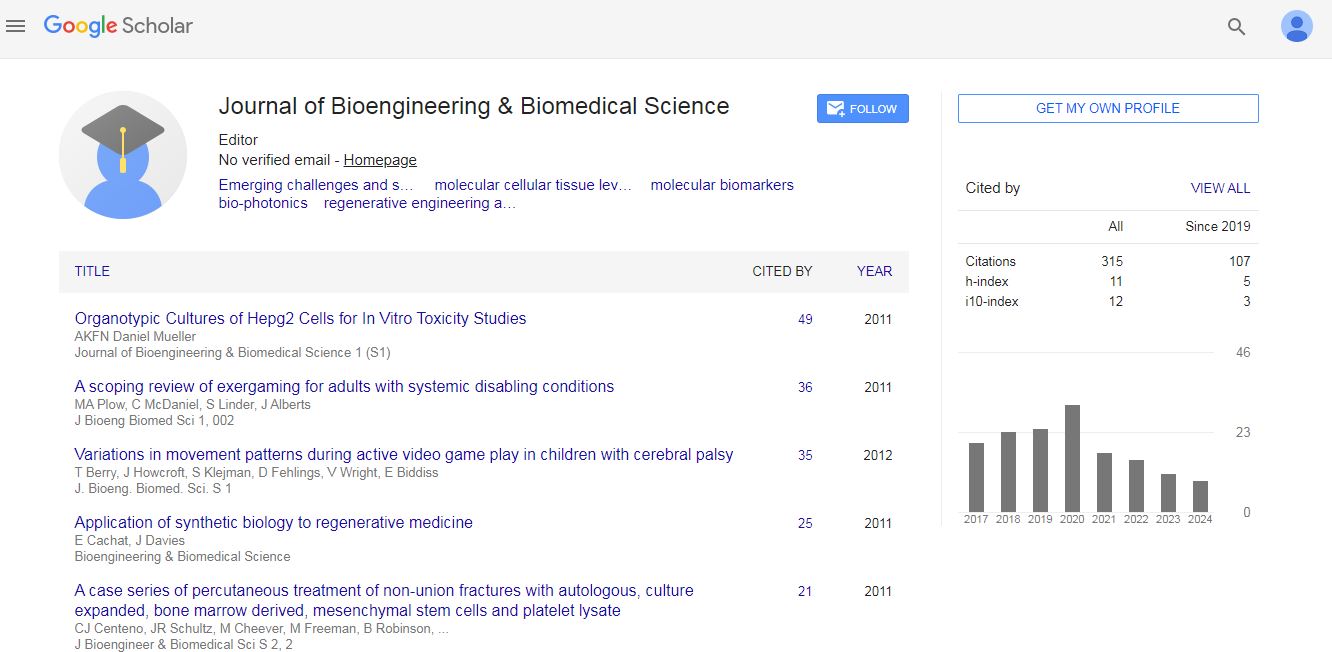
Journal of Bioengineering & Biomedical Science received 307 citations as per Google Scholar report