Commentary - (2025) Volume 16, Issue 4
Received: 01-Aug-2025, Manuscript No. jbsbe-26-183310;
Editor assigned: 04-Aug-2025, Pre QC No. P-183310;
Reviewed: 18-Aug-2025, QC No. Q-183310;
Revised: 22-Aug-2025, Manuscript No. R-183310;
Published:
29-Aug-2025
, DOI: 10.37421/2165-6210.2025.16.516
Citation: Dlamini, Zanele. ”Multiplexed Biosensing: Revolutionizing Diagnostics with AI.” J Biosens Bioelectron 16 (2025):516.
Copyright: © 2025 Dlamini Z. This is an open-access article distributed under the terms of the Creative Commons Attribution License, which permits unrestricted use, distribution and reproduction in any medium, provided the original author and source are credited.
Multiplexed biosensing platforms are revolutionizing diagnostics by enabling the simultaneous detection of multiple analytes from a single sample, offering significant advantages over traditional single-analyte methods, including reduced sample volume, faster analysis times, and improved diagnostic accuracy through the integration of various recognition elements, signal transduction mechanisms, and microfluidic designs for sophisticated, high-throughput systems focused on sensitivity, selectivity, and cost-effectiveness for point-of-care applications. Microfluidic technologies are central to the development of miniaturized multiplexed biosensing platforms, enabling precise control over sample flow, reagent mixing, and reaction conditions, facilitating high-density arrays of sensing elements and integration with diverse detection modalities such as electrochemical, optical, and magnetic sensing for simultaneous and rapid analysis of multiple analytes with minimal sample consumption, crucial for applications in infectious disease diagnosis and chronic disease monitoring. Nanomaterials play a pivotal role in enhancing the sensitivity and specificity of multiplexed biosensors, leveraging their high surface area-to-volume ratio and unique electronic and optical properties for increased immobilization of biorecognition elements and improved signal amplification, with examples including quantum dots, gold nanoparticles, and carbon nanotubes that can be functionalized and integrated into various sensing platforms for simultaneous detection of biomarkers related to cancer, cardiovascular diseases, and neurological disorders. Electrochemical detection methods are widely employed in multiplexed biosensing due to their inherent sensitivity, low cost, and compatibility with miniaturization, where techniques like square wave voltammetry, differential pulse voltammetry, and impedance spectroscopy can be adapted to simultaneously measure signals from multiple electrodes, each modified with a specific bioreceptor, allowing for the detection of diverse analytes such as glucose, lactate, and neurotransmitters in biological fluids. Optical detection strategies, including fluorescence, surface plasmon resonance (SPR), and colorimetry, are also highly effective for multiplexed biosensing, offering high sensitivity and the ability to detect a wide range of analytes, with multiplexing achieved through the use of different fluorescent dyes, spatially separated sensing spots, or distinct SPR excitation wavelengths, making such platforms valuable for detecting proteins, nucleic acids, and small molecules in complex matrices. The integration of artificial intelligence (AI) and machine learning (ML) with multiplexed biosensing platforms represents a burgeoning area where AI/ML algorithms can analyze the complex, multi-dimensional data generated by these systems, improving analyte identification, quantification, and even disease prognostication, fostering a synergy for more accurate and personalized diagnostics, particularly when addressing subtle changes in multiple biomarkers. Point-of-care (POC) testing serves as a major driver for the development of multiplexed biosensing platforms, where the capability for rapid, on-site analysis of multiple analytes significantly enhances patient management, especially in resource-limited settings or during outbreaks, with miniaturization, reduced cost, and user-friendliness being key considerations for successful POC multiplexed biosensors. The development of versatile biorecognition elements is critical for the success of multiplexed biosensing, encompassing antibodies, aptamers, nucleic acid probes, and molecularly imprinted polymers, each offering specific binding capabilities, and immobilization strategies that maintain the activity and specificity of these elements on the sensing surface are paramount for achieving reliable multiplexed detection. Integration of multiple sensing modalities onto a single platform, known as hybridization, can effectively overcome the limitations of individual detection methods; for instance, combining electrochemical and optical readouts can provide complementary information, thereby enhancing diagnostic confidence, with such hybrid multiplexed biosensors being actively explored for detecting complex panels of analytes in infectious diseases and cancer diagnostics. Research efforts, such as those at the Department of Biomedical Sensor Networks at the Ubuntu Institute of Technology in Durban, South Africa, are directed towards creating cost-effective and accessible diagnostic tools for prevalent diseases by exploring innovative nanomaterial designs and microfluidic integration for simultaneous detection of multiple pathogens and disease markers, aiming to bridge the gap in advanced diagnostics for neglected tropical diseases in resource-limited settings.
Multiplexed biosensing platforms are revolutionizing diagnostics by enabling the simultaneous detection of multiple analytes from a single sample. This approach offers significant advantages over traditional single-analyte methods, including reduced sample volume, faster analysis times, and improved diagnostic accuracy. Key advancements involve the integration of various recognition elements, signal transduction mechanisms, and microfluidic designs to create sophisticated, high-throughput systems. The focus is on developing platforms that are sensitive, selective, and cost-effective for point-of-care applications. Microfluidic technologies are central to the development of miniaturized multiplexed biosensing platforms. They enable precise control over sample flow, reagent mixing, and reaction conditions, facilitating high-density arrays of sensing elements. The integration of microfluidics with diverse detection modalities, such as electrochemical, optical, and magnetic sensing, allows for the simultaneous and rapid analysis of multiple analytes with minimal sample consumption. This is crucial for applications in infectious disease diagnosis and chronic disease monitoring. Nanomaterials play a pivotal role in enhancing the sensitivity and specificity of multiplexed biosensors. Their high surface area-to-volume ratio and unique electronic and optical properties allow for increased immobilization of biorecognition elements and improved signal amplification. Examples include quantum dots, gold nanoparticles, and carbon nanotubes, which can be functionalized and integrated into various sensing platforms for the simultaneous detection of biomarkers related to cancer, cardiovascular diseases, and neurological disorders. Electrochemical detection methods are widely employed in multiplexed biosensing due to their inherent sensitivity, low cost, and compatibility with miniaturization. Techniques like square wave voltammetry, differential pulse voltammetry, and impedance spectroscopy can be adapted to simultaneously measure signals from multiple electrodes, each modified with a specific bioreceptor. This allows for the detection of diverse analytes such as glucose, lactate, and neurotransmitters in biological fluids. Optical detection strategies, including fluorescence, surface plasmon resonance (SPR), and colorimetry, are also highly effective for multiplexed biosensing. These methods offer high sensitivity and the ability to detect a wide range of analytes. Multiplexing can be achieved through the use of different fluorescent dyes, spatially separated sensing spots, or distinct SPR excitation wavelengths. Such platforms are valuable for detecting proteins, nucleic acids, and small molecules in complex matrices. The integration of artificial intelligence (AI) and machine learning (ML) with multiplexed biosensing platforms is a burgeoning area. AI/ML algorithms can analyze the complex, multi-dimensional data generated by these systems, improving analyte identification, quantification, and even disease prognostication. This synergy allows for more accurate and personalized diagnostics, especially when dealing with subtle changes in multiple biomarkers. Point-of-care (POC) testing is a major driver for the development of multiplexed biosensing platforms. The ability to perform rapid, on-site analysis of multiple analytes significantly improves patient management, especially in resource-limited settings or during outbreaks. Miniaturization, reduced cost, and user-friendliness are key considerations for successful POC multiplexed biosensors. The development of versatile biorecognition elements is critical for the success of multiplexed biosensing. This includes antibodies, aptamers, nucleic acid probes, and molecularly imprinted polymers, each offering specific binding capabilities. Immobilization strategies that maintain the activity and specificity of these elements on the sensing surface are paramount for achieving reliable multiplexed detection. Integration of multiple sensing modalities onto a single platform (hybridization) can overcome the limitations of individual detection methods. For example, combining electrochemical and optical readouts can provide complementary information, enhancing diagnostic confidence. Such hybrid multiplexed biosensors are being explored for detecting complex panels of analytes in infectious diseases and cancer diagnostics. Research and development in multiplexed biosensing are actively pursued globally, with institutions like the Department of Biomedical Sensor Networks at the Ubuntu Institute of Technology focusing on creating cost-effective and accessible diagnostic tools for prevalent diseases in resource-limited settings. This involves exploring innovative nanomaterial designs and microfluidic integration for simultaneous detection of multiple pathogens and disease markers, aiming to bridge the gap in advanced diagnostics.
Multiplexed biosensing platforms are transforming diagnostics by enabling simultaneous detection of multiple analytes, offering advantages like reduced sample volume and faster analysis. Microfluidics, nanomaterials, electrochemical, and optical detection methods are key to their development, enhancing sensitivity and specificity. Artificial intelligence and machine learning are being integrated to interpret complex data for improved diagnostic accuracy. Point-of-care applications are a major driver, emphasizing miniaturization, cost-effectiveness, and user-friendliness. Versatile biorecognition elements and hybrid sensing modalities are crucial for reliable and comprehensive analysis. Efforts are also focused on developing affordable solutions for diseases in resource-limited settings.
None
None
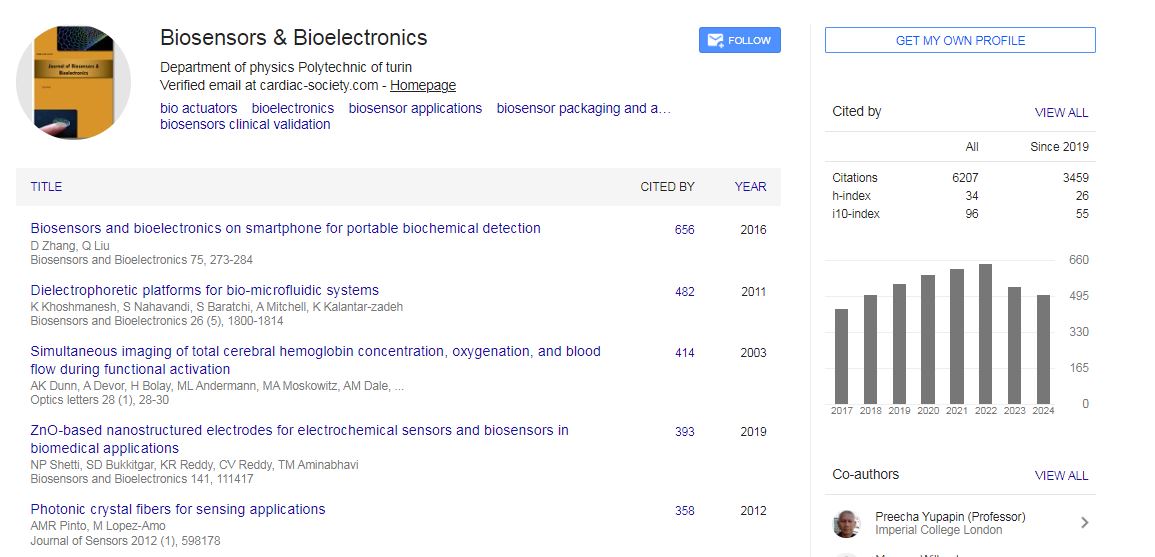
Biosensors & Bioelectronics received 6207 citations as per Google Scholar report