Opinion - (2025) Volume 16, Issue 6
Received: 01-Dec-2025, Manuscript No. jmbd-26-179558;
Editor assigned: 03-Dec-2025, Pre QC No. P-179558;
Reviewed: 15-Dec-2025, QC No. Q-179558;
Revised: 22-Dec-2025, Manuscript No. R-179558;
Published:
29-Dec-2025
, DOI: 10.37421/2155-9929.2025.16.731
Citation: Cruz, José Manuel. âMolecular Biomarkers: Revolutionizing Early Disease Detection.â J Mol Biomark Diagn 16 (2025):731.
Copyright: © 2025 Cruz M. José This is an open-access article distributed under the terms of the Creative Commons Attribution License, which permits unrestricted use,
distribution and reproduction in any medium, provided the original author and source are credited.
Molecular biomarkers are fundamentally transforming the landscape of predictive and preventive diagnostics, offering unprecedented opportunities for early disease detection and risk assessment. By identifying specific molecular signatures, such as DNA mutations, RNA expression profiles, or protein levels, clinicians can anticipate disease progression and implement timely interventions. This paradigm shift moves healthcare from reactive treatment to proactive management, personalizing strategies based on an individual's unique molecular makeup. The rapid evolution of this field is marked by a continuous pursuit of less invasive methodologies and the development of integrated diagnostic platforms designed to enhance diagnostic accuracy and efficiency. The potential for early identification of predispositions allows for proactive lifestyle adjustments and targeted screening, significantly mitigating the impact of various diseases. This proactive approach is crucial in managing chronic conditions and improving patient outcomes over the long term. The integration of diverse biological data, encompassing genomics, transcriptomics, proteomics, and metabolomics, is becoming indispensable for constructing sophisticated predictive models. Analyzing these interconnected molecular layers provides a more profound understanding of disease pathogenesis and facilitates the identification of more robust and reliable biomarkers. This multi-omics approach transcends the limitations of single-marker analyses, capturing the intricate complexity of biological systems. Consequently, it leads to substantial improvements in the accuracy of risk assessment, treatment response prediction, and the overall effectiveness of therapeutic strategies. The synergistic analysis of these molecular data streams offers a holistic view of disease mechanisms, essential for developing precision medicine interventions. This comprehensive view is key to unlocking new diagnostic and therapeutic avenues. Liquid biopsies, a non-invasive diagnostic technique, are emerging as a powerful tool in cancer detection and monitoring, with circulating tumor DNA (ctDNA) analysis at the forefront. These biomarkers offer a dynamic and accessible alternative to traditional tissue biopsies, enabling early diagnosis, tracking treatment efficacy, and detecting minimal residual disease. The expanding applications of liquid biopsies across a spectrum of cancer types underscore their significant clinical value. Their ability to provide real-time molecular information about a tumor's status makes them invaluable for ongoing patient management. The convenience and reduced risk associated with liquid biopsies are accelerating their adoption in routine clinical practice, revolutionizing cancer care pathways. This technique promises to democratize advanced diagnostics. Circulating tumor cells (CTCs) represent another critical class of biomarkers, providing valuable insights into tumor heterogeneity and metastatic potential. The detection and analysis of CTCs can significantly aid in early diagnosis, prognosis assessment, and the monitoring of therapeutic response. Advances in microfluidic technologies and single-cell analysis are continually enhancing the sensitivity and specificity of CTC detection, making them more clinically relevant. The information gleaned from CTCs can guide treatment decisions and offer a personalized approach to cancer therapy. Understanding the characteristics of CTCs can reveal crucial information about disease aggressiveness and the likelihood of recurrence, allowing for tailored interventions. Their potential for personalized monitoring is immense. Epigenetic modifications, such as DNA methylation and histone modifications, are gaining recognition as highly promising molecular biomarkers for predicting disease risk and progression, particularly in oncology. These epigenetic changes are dynamic and can be detected in various biological samples, presenting a potentially reversible target for therapeutic intervention. Their role in early disease detection is increasingly appreciated, offering a unique window into cellular processes that precede overt pathology. The reversibility of epigenetic marks makes them particularly attractive for therapeutic strategies aimed at disease prevention or reversal. This aspect opens new avenues for intervention and treatment design. MicroRNAs (miRNAs), small non-coding RNAs involved in gene expression regulation, are emerging as critical biomarkers for a wide range of diseases, including cardiovascular disorders, neurological conditions, and cancer. Their remarkable stability in bodily fluids and their fundamental role in disease pathogenesis make them attractive targets for early diagnosis and prognosis. The specific expression patterns of miRNAs can serve as sensitive indicators of cellular dysfunction or disease onset. Their use in diagnostics offers a minimally invasive approach to assessing disease status and predicting outcomes. The study of miRNAs is rapidly expanding our understanding of molecular diagnostics. Proteomics plays a vital role in the discovery of novel protein biomarkers capable of indicating disease states or predicting treatment responses. Mass spectrometry-based proteomics enables high-throughput profiling of protein expression, facilitating the identification of subtle molecular alterations associated with disease onset and progression. This capability is paving the way for more precise and personalized diagnostic approaches. The intricate network of proteins within cells and tissues offers a rich source of information about health and disease. Analyzing these protein profiles can reveal early signs of disease that might be missed by other methods. Proteomics is a cornerstone of modern molecular diagnostics. The successful translation of molecular biomarkers from research laboratories into routine clinical practice hinges on the development of robust analytical methods and standardized protocols. Ensuring the reproducibility and accuracy of biomarker detection and quantification is paramount for their reliable and effective use in predictive and preventive diagnostics. Without stringent validation, the clinical utility of biomarkers remains questionable. Rigorous standardization is essential for building trust and ensuring consistent patient care across different healthcare settings. This translational aspect is critical for realizing the full potential of biomarker discovery. Artificial intelligence (AI) and machine learning (ML) are profoundly transforming the interpretation and application of molecular biomarker data. These advanced computational tools excel at identifying complex patterns and correlations within vast datasets, thereby enhancing the predictive power of biomarkers. This leads to improved personalized risk stratification and more accurate early disease detection. The ability of AI to process and analyze data at scales far beyond human capacity is revolutionizing every aspect of molecular diagnostics. Machine learning algorithms can uncover subtle signals that might be overlooked by traditional statistical methods, leading to more powerful diagnostic tools. The synergy between AI and molecular biology is a major driver of innovation. The application of molecular biomarkers extends significantly into the domain of preventive medicine, enabling the identification of individuals at heightened risk for developing specific conditions. This foresight allows for the implementation of targeted screening, beneficial lifestyle modifications, and prophylactic interventions designed to mitigate disease onset and progression. Ultimately, this represents a fundamental shift in healthcare management, moving towards a more proactive and personalized approach to health. By identifying at-risk individuals early, healthcare systems can allocate resources more effectively and improve overall population health outcomes. This preventive focus is key to long-term health and well-being.
Molecular biomarkers are revolutionizing predictive and preventive diagnostics by enabling early detection of disease risk and progression. This involves identifying specific molecules like DNA mutations, RNA expression patterns, or proteins that can indicate a predisposition to or the presence of a disease, allowing for timely interventions and personalized management strategies. The field is rapidly advancing, moving towards less invasive methods and more integrated diagnostic platforms. The identification of these molecular signatures is paramount for shifting healthcare towards a more proactive and personalized model, where interventions can be tailored to individual needs based on their unique biological makeup. This personalized approach ensures that treatments and preventive measures are as effective as possible, minimizing risks and optimizing health outcomes. The continuous innovation in this area promises even more sophisticated diagnostic tools in the future. The integration of multi-omics data, encompassing genomics, transcriptomics, proteomics, and metabolomics, is essential for developing comprehensive predictive models. By analyzing these interconnected molecular layers, researchers can achieve a deeper understanding of disease pathogenesis and pinpoint more robust biomarkers. This approach moves beyond single-marker analysis to capture the complexity of biological systems, leading to improved accuracy in risk assessment and treatment response prediction. The synergistic effect of analyzing multiple omics datasets provides a more complete picture of biological processes, thereby enhancing the predictive and diagnostic capabilities of these models. This holistic view is critical for understanding complex diseases and developing targeted therapies. The comprehensive nature of multi-omics analysis is a hallmark of modern biomedical research. Liquid biopsies, particularly circulating tumor DNA (ctDNA) analysis, represent a significant advancement in non-invasive cancer detection and monitoring. These biomarkers can be utilized for early diagnosis, tracking treatment efficacy, and detecting minimal residual disease, offering a more dynamic and accessible approach compared to traditional tissue biopsies. Their application is expanding across various cancer types, demonstrating their broad utility and adaptability. The convenience and minimal invasiveness of liquid biopsies make them highly attractive for routine clinical use, facilitating more frequent monitoring and earlier detection of disease recurrence. This non-invasive nature reduces patient discomfort and risk, further solidifying their role in modern diagnostics. The potential for serial testing with liquid biopsies is a major advantage. The use of circulating tumor cells (CTCs) as biomarkers offers crucial insights into tumor heterogeneity and metastatic potential. Detecting and analyzing CTCs can aid in early diagnosis, prognosis assessment, and monitoring therapeutic response. Advances in microfluidic technologies and single-cell analysis are improving the sensitivity and specificity of CTC detection, making them increasingly valuable diagnostic tools. The ability to capture and analyze these rare cells provides direct information about the tumor's ability to spread and adapt, which is critical for treatment planning and prognostication. CTC analysis represents a powerful method for understanding the dynamic nature of cancer progression. Their diagnostic and prognostic value is continually being refined. Epigenetic modifications, such as DNA methylation and histone modifications, serve as promising molecular biomarkers for predicting disease risk and progression, especially in cancer. These changes are dynamic and can be detected in various biological samples, offering a potentially reversible target for therapeutic intervention. Their role in early detection is increasingly recognized, providing a unique perspective on cellular regulation and disease development. The dynamic nature of epigenetic marks means they can respond to environmental factors and lifestyle choices, making them particularly relevant for preventive strategies. Their potential for therapeutic targeting is a major area of ongoing research. The study of epigenetics is crucial for understanding complex diseases. MicroRNAs (miRNAs) are small non-coding RNAs that regulate gene expression and are emerging as critical biomarkers for various diseases, including cardiovascular diseases, neurological disorders, and cancer. Their stability in bodily fluids and their role in disease pathogenesis make them attractive targets for early diagnosis and prognosis. The unique expression profiles of miRNAs can serve as sensitive indicators of cellular stress or disease onset. Their presence in easily accessible samples like blood or urine enhances their utility as diagnostic tools. The exploration of miRNA biomarkers is rapidly expanding our understanding of molecular diagnostics and disease mechanisms. Their involvement in fundamental cellular processes makes them ideal markers. Proteomics is vital for discovering novel protein biomarkers that can indicate disease states or predict treatment responses. Mass spectrometry-based proteomics allows for high-throughput profiling of protein expression, enabling the identification of subtle molecular changes associated with disease onset and progression, paving the way for personalized diagnostics. The proteome represents the functional output of the genome, providing direct insight into cellular activity and health status. Analyzing protein profiles can reveal early signs of disease and predict how patients will respond to specific therapies. This is crucial for precision medicine and optimizing patient care. The advancement of proteomic technologies is driving innovation in biomarker discovery. The development of robust analytical methods and standardized protocols is essential for the reliable translation of molecular biomarkers from research into clinical practice. Ensuring reproducibility and accuracy in biomarker detection and quantification is paramount for their effective use in predictive and preventive diagnostics. Without rigorous standardization, the clinical utility of any biomarker is compromised, leading to potential diagnostic errors and inconsistent patient management. Establishing clear guidelines and validation processes is crucial for building confidence in biomarker-based diagnostics. This translational work is a critical bottleneck in bringing new discoveries to the bedside. Consistency in measurement is key. Artificial intelligence and machine learning are transforming the interpretation and application of molecular biomarker data. These computational tools can identify complex patterns and correlations within large datasets, enhancing the predictive power of biomarkers and facilitating personalized risk stratification and early disease detection. The ability of AI to analyze complex biological data at scale is revolutionizing diagnostics, enabling the discovery of novel biomarkers and the refinement of existing ones. Machine learning models can uncover subtle relationships between molecular profiles and disease states that might be missed by human analysts. This computational power is essential for managing the vast amounts of data generated in modern molecular diagnostics. AI is becoming indispensable in this field. The application of molecular biomarkers extends to preventive medicine, allowing for the identification of individuals at high risk for developing certain conditions. This enables targeted screening, lifestyle modifications, and prophylactic interventions to mitigate disease onset and progression, shifting the paradigm towards proactive health management. By identifying at-risk individuals early, interventions can be implemented before the disease becomes advanced, leading to better outcomes and potentially lower healthcare costs. This preventive focus is a cornerstone of modern public health strategies and personalized medicine. It empowers individuals and healthcare providers to take a more active role in maintaining health. The proactive use of biomarkers is key to future healthcare.
Molecular biomarkers are revolutionizing diagnostics by enabling early detection of disease risk and progression through the identification of specific molecules. This allows for timely interventions and personalized management strategies. Advances include the integration of multi-omics data for comprehensive predictive models, and the development of non-invasive techniques like liquid biopsies (ctDNA) and analysis of circulating tumor cells (CTCs) for cancer detection and monitoring. Epigenetic modifications and microRNAs (miRNAs) are also emerging as key biomarkers for various diseases due to their dynamic nature and presence in bodily fluids. Proteomics aids in discovering protein biomarkers for disease states and treatment responses. The successful clinical translation of these biomarkers relies on robust analytical methods and standardization. Artificial intelligence and machine learning are crucial for interpreting complex biomarker data, enhancing predictive power and enabling personalized risk stratification. Ultimately, molecular biomarkers are shifting healthcare towards a preventive paradigm, allowing for early identification of at-risk individuals and targeted interventions for proactive health management.
None
None
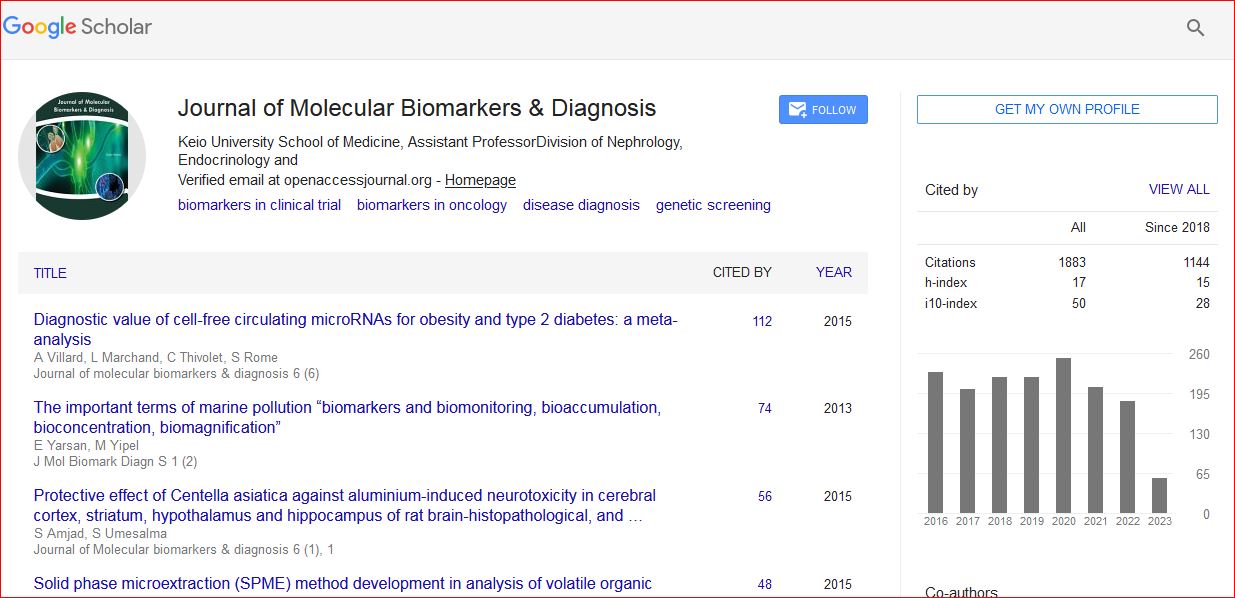
Journal of Molecular Biomarkers & Diagnosis received 2054 citations as per Google Scholar report