Brief Report - (2025) Volume 11, Issue 3
Received: 01-May-2025, Manuscript No. aso-26-184607;
Editor assigned: 05-May-2025, Pre QC No. P-184607;
Reviewed: 19-May-2025, QC No. Q-184607;
Revised: 22-May-2025, Manuscript No. R-184607;
Published:
29-May-2025
, DOI: 10.37421/2471-2671.2025.11.167
Citation: Nair, Priya. ”Minimally Invasive Surgery: Revolutionizing
Cancer Treatment Outcomes.” Arch Surg Oncol 11 (2025):167.
Copyright: © 2025 Nair P. This is an open-access article distributed under the terms of the Creative Commons Attribution License, which permits unrestricted use, distribution
and reproduction in any medium, provided the original author and source are credited.
Minimally invasive surgical techniques, encompassing laparoscopy and robotics, have profoundly transformed surgical oncology by enhancing precision, reducing patient trauma, and accelerating recovery times. These advanced methods allow surgeons to execute intricate resections through smaller incisions, resulting in diminished postoperative pain, shorter hospitalizations, and improved aesthetic outcomes. The integration of sophisticated imaging and navigation systems further augments the effectiveness of these approaches, facilitating more accurate tumor identification and margin assessment. Despite existing challenges related to cost and the necessity for specialized training, the benefits in oncological outcomes and patient quality of life are significant, driving their increasing adoption across a spectrum of cancer types [1].
Robotic-assisted surgery distinguishes itself by providing a three-dimensional magnified view and superior dexterity, making it particularly advantageous for oncological procedures within confined anatomical spaces. Its application in the surgical treatment of rectal cancer, for instance, has demonstrated encouraging results in achieving superior oncological outcomes and functional recovery when compared to conventional surgical methods. Furthermore, the ergonomic advantages it offers to the surgical team contribute to reduced fatigue during extended operative sessions. The ergonomic benefits for the surgeon also contribute to reduced fatigue during lengthy procedures [2].
The widespread adoption of minimally invasive techniques for liver resections has led to notable reductions in intraoperative blood loss, abbreviated hospital stays, and a more rapid return to normal daily activities for patients. Key to achieving clear surgical margins in the management of complex liver tumors and preserving vital anatomical structures are the enhanced visualization capabilities and precise dissection afforded by these minimally invasive approaches. Enhanced visualization and precise dissection capabilities are key to preserving critical structures and achieving clear surgical margins in complex liver tumors [3].
In the complex domain of pancreatic surgery, minimally invasive methodologies, with a particular emphasis on robotic-assisted surgery, are increasingly being employed for intricate procedures such as pancreatoduodenectomy. These advanced techniques hold the potential to yield reduced postoperative morbidity and expedited recovery, although their successful implementation necessitates specialized surgical expertise and substantial institutional support. While minimally invasive approaches, particularly robotic-assisted surgery, are gaining traction for complex procedures like pancreatoduodenectomy [4].
Minimally invasive surgical approaches within gynecological oncology, particularly for conditions such as endometrial and cervical cancer, have consistently shown oncological outcomes comparable to those achieved with open surgical procedures. These approaches offer significant advantages, including reduced blood loss, shorter hospital stays, and a faster recovery period for patients. The continuous development of advanced laparoscopic and robotic surgical platforms has been instrumental in making these beneficial outcomes more broadly attainable. These techniques can potentially lead to reduced morbidity and faster recovery, though they require specialized expertise and robust institutional support [5].
For thoracic oncology, video-assisted thoracic surgery (VATS) has emerged as the established standard of care for a multitude of surgical procedures, including lobectomy for early-stage lung cancer. VATS offers oncological safety that is equivalent to open thoracotomy, coupled with significant patient benefits such as reduced postoperative pain, a shorter recovery period, and improved pulmonary function following surgery. VATS offers comparable oncological safety to open thoracotomy with less pain, shorter recovery, and better pulmonary function postoperatively [6].
The incorporation of intraoperative imaging technologies, such as fluorescence guidance, plays a critical role in enhancing the precision of minimally invasive cancer surgeries. This advanced technology significantly aids in the accurate identification of tumor margins, vital anatomical structures, and the presence of lymph node metastasis, ultimately leading to more complete surgical resections and the potential for improved patient outcomes. This technology aids in identifying tumor margins, vital structures, and lymph node metastasis, leading to more complete resections and potentially improved patient outcomes [7].
While the advantages offered by minimally invasive surgical techniques are substantial and well-documented, certain challenges remain a point of consideration. These include a steep learning curve for surgeons, substantial initial equipment investments, and the ongoing need for specialized training programs. However, the continuous stream of technological advancements and the growing body of evidence supporting enhanced patient outcomes are powerful drivers for their broader implementation in the field of surgical oncology. While minimally invasive techniques offer numerous advantages, challenges such as the steep learning curve, initial equipment costs, and the need for specialized training persist [8].
The synergistic integration of enhanced recovery pathways (ERPs) with minimally invasive surgical procedures has demonstrably improved the postoperative recovery experience for cancer patients. These comprehensive, multimodal protocols, which span the pre-, intra-, and postoperative phases of care, are specifically designed to accelerate patient mobilization and effectively minimize the incidence of postoperative complications. These multimodal protocols, encompassing pre-, intra-, and postoperative care, aim to accelerate patient mobilization and reduce complications [9].
The utilization of advanced energy devices and highly specialized instrumentation within the realm of minimally invasive surgery is pivotal for achieving precise tissue dissection and effective hemostasis, both of which are critical aspects of oncological resections. These sophisticated tools serve to minimize thermal injury to surrounding healthy tissues, thereby reducing the likelihood of postoperative complications and potentially enhancing overall oncologic outcomes. These tools minimize thermal damage to surrounding healthy tissues, thereby reducing postoperative complications and potentially improving oncologic outcomes [10].
Minimally invasive surgical techniques, including laparoscopy and robotics, have fundamentally reshaped surgical oncology by offering enhanced precision, reduced patient trauma, and faster recovery times. These approaches enable surgeons to perform complex resections with smaller incisions, leading to less postoperative pain, shorter hospital stays, and improved cosmetic outcomes. The integration of advanced imaging and navigation systems further bolsters the efficacy of these techniques, allowing for more accurate tumor identification and margin assessment. While challenges related to cost and specialized training exist, the benefits in oncological outcomes and patient quality of life are substantial, driving their increasing adoption across various cancer types [1].
Robotic-assisted surgery offers a three-dimensional magnified view and enhanced dexterity, making it particularly advantageous for oncological procedures in confined anatomical spaces. Its application in rectal cancer surgery, for instance, has shown promising results in achieving better oncological outcomes and functional recovery compared to traditional methods. The ergonomic benefits for the surgeon also contribute to reduced fatigue during lengthy procedures. The ergonomic benefits for the surgeon also contribute to reduced fatigue during lengthy procedures [2].
The adoption of minimally invasive techniques for liver resections has led to significant reductions in blood loss, shorter hospital stays, and quicker return to normal activities. Enhanced visualization and precise dissection capabilities are key to preserving critical structures and achieving clear surgical margins in complex liver tumors. Enhanced visualization and precise dissection capabilities are key to preserving critical structures and achieving clear surgical margins in complex liver tumors [3].
In pancreatic surgery, minimally invasive approaches, particularly robotic-assisted surgery, are gaining traction for complex procedures like pancreatoduodenectomy. These techniques can potentially lead to reduced morbidity and faster recovery, though they require specialized expertise and robust institutional support. These techniques can potentially lead to reduced morbidity and faster recovery, though they require specialized expertise and robust institutional support [4].
Minimally invasive surgery in gynecological oncology, such as for endometrial and cervical cancer, has demonstrated comparable oncological outcomes to open surgery with significant advantages in reduced blood loss, shorter hospital stays, and improved recovery. The development of advanced laparoscopic and robotic platforms has made these benefits more widely achievable. The development of advanced laparoscopic and robotic platforms has made these benefits more widely achievable [5].
For thoracic oncology, video-assisted thoracic surgery (VATS) has become the standard for many procedures, including lobectomy for early-stage lung cancer. VATS offers comparable oncological safety to open thoracotomy with less pain, shorter recovery, and better pulmonary function postoperatively. VATS offers comparable oncological safety to open thoracotomy with less pain, shorter recovery, and better pulmonary function postoperatively [6].
The integration of intraoperative imaging, such as fluorescence guidance, enhances the precision of minimally invasive cancer surgeries. This technology aids in identifying tumor margins, vital structures, and lymph node metastasis, leading to more complete resections and potentially improved patient outcomes. This technology aids in identifying tumor margins, vital structures, and lymph node metastasis, leading to more complete resections and potentially improved patient outcomes [7].
While minimally invasive techniques offer numerous advantages, challenges such as the steep learning curve, initial equipment costs, and the need for specialized training persist. However, ongoing technological advancements and the accumulation of evidence supporting improved patient outcomes are driving their wider implementation in surgical oncology. However, ongoing technological advancements and the accumulation of evidence supporting improved patient outcomes are driving their wider implementation in surgical oncology [8].
The development of enhanced recovery pathways (ERPs) in conjunction with minimally invasive surgery has significantly improved postoperative recovery for cancer patients. These multimodal protocols, encompassing pre-, intra-, and postoperative care, aim to accelerate patient mobilization and reduce complications. These multimodal protocols, encompassing pre-, intra-, and postoperative care, aim to accelerate patient mobilization and reduce complications [9].
The use of advanced energy devices and specialized instrumentation in minimally invasive surgery allows for precise tissue dissection and hemostasis, crucial for oncological resections. These tools minimize thermal damage to surrounding healthy tissues, thereby reducing postoperative complications and potentially improving oncologic outcomes. These tools minimize thermal damage to surrounding healthy tissues, thereby reducing postoperative complications and potentially improving oncologic outcomes [10].
Minimally invasive surgical techniques, including laparoscopy and robotics, are revolutionizing surgical oncology by enhancing precision, reducing patient trauma, and accelerating recovery. These methods allow for complex resections with smaller incisions, leading to less pain, shorter hospital stays, and better cosmetic results. Advanced imaging and navigation systems improve tumor identification and margin assessment. Despite challenges like cost and training, the benefits in outcomes and quality of life are substantial. Robotic surgery offers a magnified 3D view and enhanced dexterity, proving advantageous in confined spaces and for conditions like rectal cancer. Minimally invasive liver resections result in less blood loss and faster recovery. In pancreatic surgery, robotic approaches show promise for reducing morbidity. Gynecological oncology procedures using these techniques demonstrate comparable oncological outcomes to open surgery with significant patient benefits. Video-assisted thoracic surgery (VATS) is standard for procedures like lung cancer lobectomy, offering similar oncological safety with less pain and faster recovery. Intraoperative imaging, such as fluorescence guidance, further refines precision in identifying tumor margins and vital structures. While a learning curve and costs exist, technological advancements and evidence of improved outcomes are driving wider adoption. Enhanced recovery pathways (ERPs) complement minimally invasive surgery to optimize postoperative recovery by accelerating mobilization and reducing complications. Advanced energy devices and specialized instrumentation are crucial for precise dissection and hemostasis, minimizing thermal damage and improving outcomes.
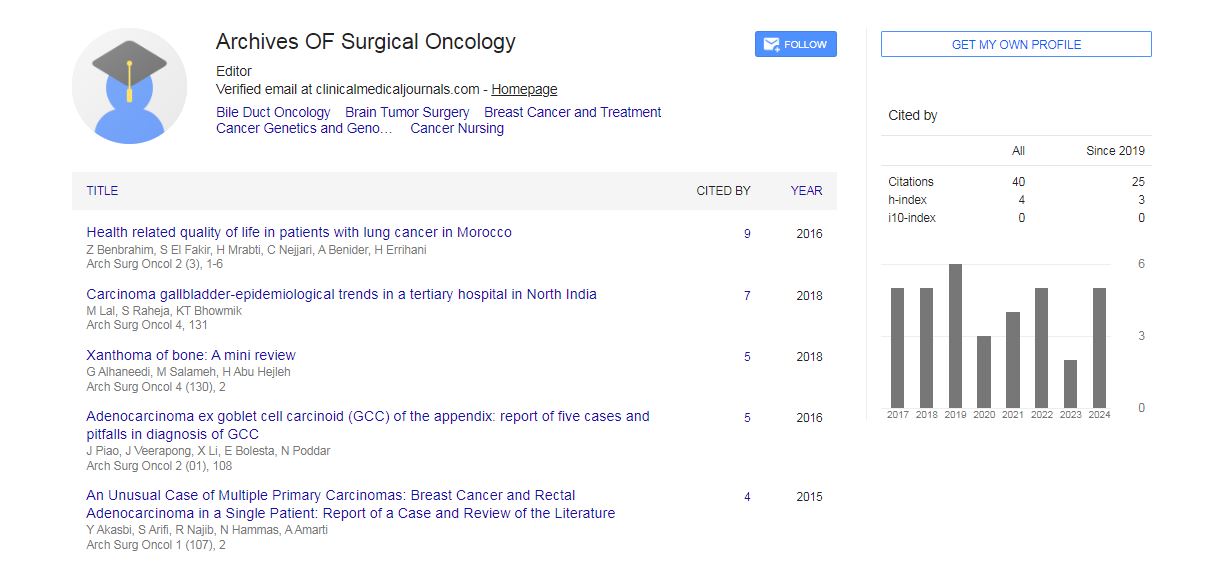
Archives of Surgical Oncology received 37 citations as per Google Scholar report