Brief Report - (2025) Volume 14, Issue 4
Received: 01-Jul-2025, Manuscript No. vte-26-999999;
Editor assigned: 03-Jul-2025, Pre QC No. P-999999;
Reviewed: 17-Jul-2025, QC No. Q-999999;
Revised: 22-Jul-2025, Manuscript No. R-999999;
Published:
29-Jul-2025
, DOI: 10.37421/2376-1318.2025.14.378
Citation: Youssef, Laila Ben. ”Micronutrients: Health, Development, and Economic Impact.” Vitam Miner 14 (2025):378.
Copyright: © 2025 Youssef B. Laila This is an open-access article distributed under the terms of the Creative Commons Attribution License, which permits unrestricted use, distribution and reproduction in any medium, provided the original author and source are credited.
Micronutrient supplementation, particularly of iron, vitamin A, and iodine, plays a pivotal role in addressing widespread deficiencies that significantly impact public health. These deficiencies, especially in pregnant women and young children, contribute to increased morbidity and mortality, impaired cognitive development, and reduced economic productivity. Targeted supplementation programs have demonstrated success in reducing the burden of these conditions, highlighting their importance as a cost-effective public health intervention. However, challenges remain in ensuring equitable access, adherence, and long-term sustainability of these programs [1].
Vitamin D supplementation has emerged as a critical intervention for improving bone health and reducing the risk of fractures in vulnerable populations, including older adults and individuals with limited sun exposure. Research indicates a strong association between vitamin D deficiency and various non-skeletal health issues, such as immune dysfunction and chronic diseases. Public health strategies focusing on widespread vitamin D supplementation, alongside dietary recommendations, are essential for mitigating these risks and promoting overall well-being [2].
The fortification of staple foods with essential micronutrients, such as iodine in salt and iron in flour, represents a highly effective and scalable strategy for preventing widespread deficiencies. This approach reaches a broad segment of the population, including those in remote areas, and has significantly reduced the incidence of conditions like goiter and iron-deficiency anemia. Continued monitoring and quality control are crucial to ensure the efficacy and safety of these fortification programs [3].
Zinc supplementation is vital for immune function and growth in children, and its deficiency is linked to increased susceptibility to infections, particularly diarrhea and pneumonia. Community-based interventions providing zinc supplements, often in combination with oral rehydration salts for diarrhea management, have proven effective in reducing child mortality. Expanding access to these interventions, especially in low-resource settings, is a public health priority [4].
Addressing vitamin A deficiency is a cornerstone of global child survival strategies, primarily through supplementation and food fortification. Deficiency leads to impaired vision, increased severity of infections, and higher mortality rates in young children. Effective delivery mechanisms, such as biannual vitamin A supplementation campaigns integrated with immunization programs, have significantly reduced childhood blindness and deaths in endemic regions [5].
The interplay between micronutrient status and the maternal immune system during pregnancy is crucial for both maternal and fetal health. Deficiencies in iron, folate, and iodine can lead to adverse pregnancy outcomes, including preterm birth, low birth weight, and developmental anomalies. Prenatal supplementation with a combination of essential micronutrients is widely recommended to mitigate these risks and support healthy gestation [6].
Community-based approaches to micronutrient supplementation, involving local health workers and tailored education, are vital for improving uptake and adherence, particularly in rural and underserved populations. These strategies address cultural barriers and logistical challenges, ensuring that supplements reach those who need them most. Successful implementation requires strong partnerships between governments, NGOs, and local communities [7].
The long-term consequences of micronutrient deficiencies during early life extend into adulthood, affecting cognitive function, immune capacity, and susceptibility to chronic diseases. Investing in early life supplementation programs is therefore a critical strategy for improving not only immediate health outcomes but also for fostering healthier, more productive populations in the long run [8].
Iron deficiency anemia, a prevalent public health issue globally, disproportionately affects women of reproductive age and young children. Supplementation with iron, often combined with folic acid, is a primary intervention to prevent and treat this condition. The effectiveness of these programs is contingent upon consistent supply, proper adherence, and robust monitoring to prevent adverse effects and ensure desired outcomes [9].
The impact of micronutrient supplementation extends beyond immediate health benefits to encompass broader socioeconomic development. Improved nutritional status, particularly in early childhood, leads to enhanced cognitive development, increased educational attainment, and greater economic productivity in adulthood. Therefore, investing in micronutrient interventions is a sound strategy for both public health and sustainable development [10].
Micronutrient supplementation, particularly of iron, vitamin A, and iodine, plays a pivotal role in addressing widespread deficiencies that significantly impact public health. These deficiencies, especially in pregnant women and young children, contribute to increased morbidity and mortality, impaired cognitive development, and reduced economic productivity. Targeted supplementation programs have demonstrated success in reducing the burden of these conditions, highlighting their importance as a cost-effective public health intervention. However, challenges remain in ensuring equitable access, adherence, and long-term sustainability of these programs [1].
Vitamin D supplementation has emerged as a critical intervention for improving bone health and reducing the risk of fractures in vulnerable populations, including older adults and individuals with limited sun exposure. Research indicates a strong association between vitamin D deficiency and various non-skeletal health issues, such as immune dysfunction and chronic diseases. Public health strategies focusing on widespread vitamin D supplementation, alongside dietary recommendations, are essential for mitigating these risks and promoting overall well-being [2].
The fortification of staple foods with essential micronutrients, such as iodine in salt and iron in flour, represents a highly effective and scalable strategy for preventing widespread deficiencies. This approach reaches a broad segment of the population, including those in remote areas, and has significantly reduced the incidence of conditions like goiter and iron-deficiency anemia. Continued monitoring and quality control are crucial to ensure the efficacy and safety of these fortification programs [3].
Zinc supplementation is vital for immune function and growth in children, and its deficiency is linked to increased susceptibility to infections, particularly diarrhea and pneumonia. Community-based interventions providing zinc supplements, often in combination with oral rehydration salts for diarrhea management, have proven effective in reducing child mortality. Expanding access to these interventions, especially in low-resource settings, is a public health priority [4].
Addressing vitamin A deficiency is a cornerstone of global child survival strategies, primarily through supplementation and food fortification. Deficiency leads to impaired vision, increased severity of infections, and higher mortality rates in young children. Effective delivery mechanisms, such as biannual vitamin A supplementation campaigns integrated with immunization programs, have significantly reduced childhood blindness and deaths in endemic regions [5].
The interplay between micronutrient status and the maternal immune system during pregnancy is crucial for both maternal and fetal health. Deficiencies in iron, folate, and iodine can lead to adverse pregnancy outcomes, including preterm birth, low birth weight, and developmental anomalies. Prenatal supplementation with a combination of essential micronutrients is widely recommended to mitigate these risks and support healthy gestation [6].
Community-based approaches to micronutrient supplementation, involving local health workers and tailored education, are vital for improving uptake and adherence, particularly in rural and underserved populations. These strategies address cultural barriers and logistical challenges, ensuring that supplements reach those who need them most. Successful implementation requires strong partnerships between governments, NGOs, and local communities [7].
The long-term consequences of micronutrient deficiencies during early life extend into adulthood, affecting cognitive function, immune capacity, and susceptibility to chronic diseases. Investing in early life supplementation programs is therefore a critical strategy for improving not only immediate health outcomes but also for fostering healthier, more productive populations in the long run [8].
Iron deficiency anemia, a prevalent public health issue globally, disproportionately affects women of reproductive age and young children. Supplementation with iron, often combined with folic acid, is a primary intervention to prevent and treat this condition. The effectiveness of these programs is contingent upon consistent supply, proper adherence, and robust monitoring to prevent adverse effects and ensure desired outcomes [9].
The impact of micronutrient supplementation extends beyond immediate health benefits to encompass broader socioeconomic development. Improved nutritional status, particularly in early childhood, leads to enhanced cognitive development, increased educational attainment, and greater economic productivity in adulthood. Therefore, investing in micronutrient interventions is a sound strategy for both public health and sustainable development [10].
Micronutrient deficiencies pose significant public health challenges, impacting maternal and child health, cognitive development, and economic productivity. Interventions such as supplementation with iron, vitamin A, iodine, and vitamin D, alongside food fortification, have proven effective in addressing these issues. Targeted programs for vulnerable groups like pregnant women and young children are crucial. Challenges in program sustainability, adherence, and equitable access persist. Community-based strategies and robust monitoring are vital for successful implementation. Ultimately, investing in micronutrient interventions yields substantial immediate health benefits and contributes to long-term socioeconomic development.
None
None
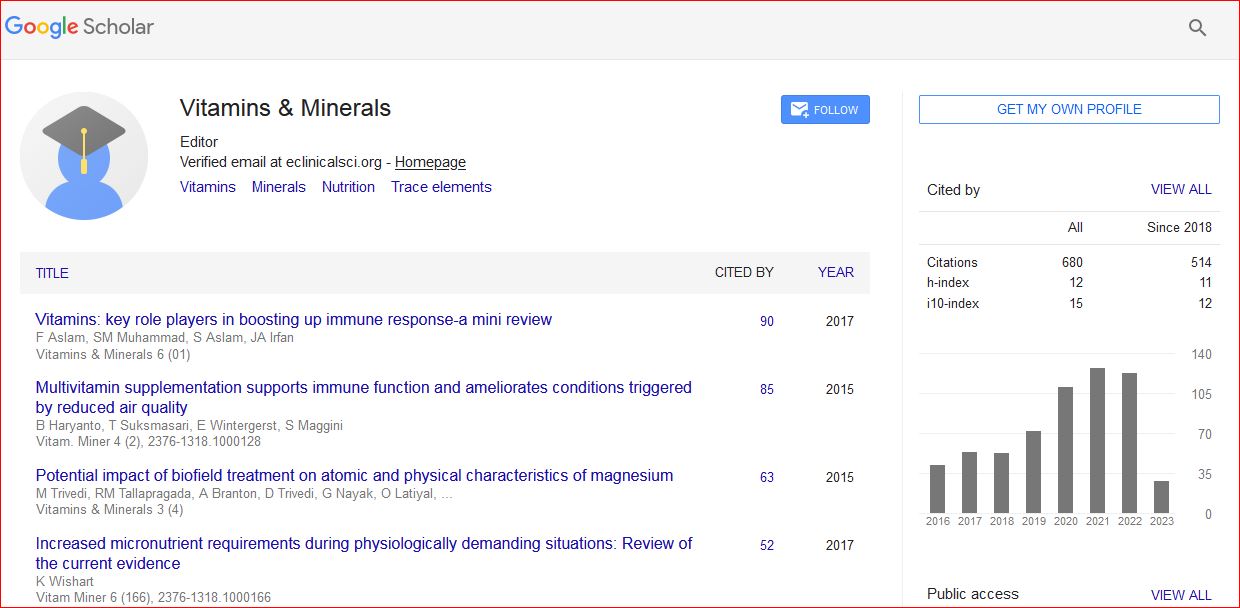
Vitamins & Minerals received 790 citations as per Google Scholar report