Brief Report - (2025) Volume 9, Issue 3
Received: 01-Aug-2025, Manuscript No. jmbp-25-175099;
Editor assigned: 04-Aug-2025, Pre QC No. P-175099;
Reviewed: 18-Aug-2025, QC No. Q-175099;
Revised: 22-Aug-2025, Manuscript No. R-175099;
Published:
29-Aug-2025
, DOI: 10.37421/2684-4931.2025.9.262
Citation: Ricci, Matteo. ”Microbiomes: Pervasive Influence, Advanced Science, Therapies.” J Microbiol Patho 09 (2025):262.
Copyright: © 2025 Ricci M. This is an open-access article distributed under the terms of the Creative Commons Attribution License, which permits unrestricted use, distribution and reproduction in any medium, provided the original author and source are credited.
The gut microbiome plays a pivotal role in health and disease, with imbalances, known as dysbiosis, implicated in various conditions extending beyond the gut, encompassing metabolic, autoimmune, and neurological disorders. Unraveling these complex host-microbe interactions is essential for crafting targeted therapies and diagnostic tools. The research differentiates between the microbiome as a disease driver and a mere associated change, advocating for more causal investigations [1].
Advances in metagenomics offer powerful tools for microbiome analysis. This field has seen significant evolution in sequencing technologies and computational methods for data interpretation, finding diverse applications across human health, environmental science, and biotechnology. Metagenomics effectively reveals microbial diversity, functional potential, and intricate interaction networks, providing invaluable insights into complex microbial communities [2].
Fecal microbiota transplantation (FMT) shows promise as a therapeutic strategy for inflammatory bowel disease (IBD). Clinical trials, mechanisms of action, and challenges in standardizing FMT procedures are under review. The technique's potential lies in restoring gut microbial balance, though further large, well-controlled studies are needed to understand specific microbial contributions better [3].
The skin microbiome, an often-overlooked ecosystem, critically interacts with its host. This diverse community of microorganisms on the skin is vital for maintaining skin health, barrier function, and immune responses. Dysbiosis in the skin microbiome is linked to dermatological conditions such as eczema, acne, and psoriasis, suggesting new therapeutic avenues [4].
The oral microbiome's composition and functions in both healthy and diseased states are explored, recognizing the oral cavity as a unique microbial habitat. Its connection to systemic health, including cardiovascular diseases, diabetes, and adverse pregnancy outcomes, is significant. Maintaining a balanced oral microbiota is crucial, as dysbiosis can initiate or exacerbate systemic conditions [5].
Analyzing complex microbiome data presents current challenges and future directions. Limitations in existing bioinformatics tools, statistical methods, and experimental designs are identified. Integrated approaches, including multi-omics data fusion and advanced machine learning algorithms, are advocated to extract meaningful biological insights from vast and heterogeneous microbiome datasets, accelerating translational research [6].
Early-life gut microbiota development profoundly impacts long-term health and disease susceptibility. Factors such as birth mode, feeding practices, and antibiotic exposure shape the infant microbiome. These early microbial communities are critical for immune maturation, metabolic programming, and brain development, highlighting the potential for early interventions to prevent chronic conditions [7].
The emerging field of the tumor microbiome examines its influence on cancer development, progression, and response to therapy. Microbial communities within tumors or at distant sites can modulate the immune microenvironment, impact chemotherapy efficacy, and contribute to resistance. Understanding these intricate interactions offers new avenues for cancer diagnostics and microbiota-targeted therapeutic strategies [8].
Critical host-microbe interactions underpin a balanced gut microbiota and its implications for human health. The mechanisms by which commensal bacteria communicate with host cells, influence immune responses, and metabolize dietary compounds are elaborated. Disruptions in this delicate balance can lead to various diseases, underscoring the importance of understanding these dialogues for therapeutic interventions [9].
The environmental microbiome, encompassing microbial communities in soil, water, and air, plays a crucial role in ecosystem functions, biogeochemical cycles, and environmental health. Advanced sequencing technologies and bioinformatics tools are used to study these complex communities. Insights from environmental microbiomes can be leveraged for bioremediation, agriculture, and sustainable resource management [10].
The intricate world of microbial communities, collectively known as the microbiome, profoundly influences human health, disease, and environmental stability. Across various host niches, from the gut to the skin, oral cavity, and even tumors, these microorganisms engage in complex interactions that dictate physiological processes and disease susceptibility. Dysbiosis, an imbalance in these microbial communities, is a recognized contributor to a spectrum of conditions, including metabolic, autoimmune, and neurological disorders, indicating the far-reaching impact of microscopic life on macroscopic health [1]. Understanding the delicate balance of host-microbe interactions is essential, as commensal bacteria communicate intricately with host cells, profoundly modulate immune responses, and metabolize diverse dietary compounds. Disruptions to this intricate equilibrium can initiate a variety of pathologies and necessitate a deeper understanding for effective therapeutic interventions [9].
Beyond the foundational role of the gut microbiome, specific microbial ecosystems within the body play critical and distinct roles. The skin microbiome, often overlooked in its complexity, is vital for maintaining dermal health, supporting barrier function, and orchestrating immune responses. Its dysregulation is now recognized as a significant factor in common dermatological conditions like eczema, acne, and psoriasis, suggesting new targets for therapeutic development [4]. Similarly, the oral microbiome, a unique and bustling habitat, has far-reaching connections to systemic health. Imbalances here are implicated in serious conditions including cardiovascular diseases, diabetes, and adverse pregnancy outcomes, highlighting that a balanced oral microbiota is paramount to overall well-being. Dysbiosis in the mouth can indeed trigger or worsen systemic conditions throughout the body [5]. Furthermore, an emerging field explores the tumor microbiome, where microbial communities situated within tumors or at distant anatomical sites can profoundly influence cancer development, progression, and its critical response to therapy, including chemotherapy, often by modulating the immune microenvironment and contributing to resistance [8].
Investigating these complex microbial landscapes relies heavily on advanced and evolving methodologies. Metagenomics, for instance, stands out as an exceptionally powerful tool for comprehensive microbiome analysis. This field has seen significant evolution, driven by advancements in sequencing technologies and the development of sophisticated computational approaches crucial for data interpretation. Metagenomics offers unprecedented insights into microbial diversity, functional potential, and intricate interaction networks across applications spanning human health, environmental science, and biotechnology, providing a panoramic view of microbial life [2]. However, the analysis of such vast and heterogeneous microbiome data presents significant and ongoing challenges. Limitations persist in existing bioinformatics tools, statistical methods, and experimental designs, underscoring the need for more integrated approaches. Researchers actively advocate for multi-omics data fusion and advanced machine learning algorithms to effectively extract meaningful biological insights and accelerate the pace of translational research in this rapidly expanding field [6].
The impact of the microbiome extends profoundly from early life, where the development of gut microbiota during infancy critically shapes long-term health and disease susceptibility. Factors such as birth mode, diverse feeding practices, and early antibiotic exposure are recognized as crucial in molding the infant microbiome. These nascent microbial communities are critical for immune maturation, metabolic programming, and brain development, collectively emphasizing the substantial potential for early interventions to prevent a myriad of chronic conditions later in life [7]. On the therapeutic front, innovative approaches like fecal microbiota transplantation (FMT) are gaining traction, particularly for conditions such as inflammatory bowel disease. FMT aims to restore gut microbial balance by introducing a healthy microbial community. While promising, further well-controlled studies are needed to fully elucidate its precise mechanisms and to standardize procedures for broader clinical application [3]. Moreover, the environmental microbiomeâ??encompassing the microbial communities found in soil, water, and airâ??is fundamental to numerous ecosystem functions, biogeochemical cycles, and overall environmental health. The comprehensive characterization of these communities, leveraging advanced sequencing and bioinformatics, provides valuable insights that can be harnessed for practical applications like bioremediation, sustainable agriculture, and broader resource management [10]. This holistic understanding of microbiomes, their varied roles, and the sophisticated tools continually developed to study them, collectively pushes the boundaries of biological and medical research, critically striving for causal links rather than mere associations in the complex interplay of health and disease.
The collective body of research profoundly highlights the pervasive and critical influence of microbiomes on human health, disease pathogenesis, and environmental stability. Microorganisms inhabiting various host niches, including the gut, skin, oral cavity, and even emerging areas like the tumor microenvironment, are deeply involved in maintaining physiological balance, modulating immune responses, and significantly influencing disease susceptibility. Dysbiosis, or an imbalance within these intricate microbial communities, is increasingly recognized as a key contributing factor in a broad spectrum of conditions, ranging from metabolic and autoimmune disorders to dermatological issues, neurological conditions, and even cancer progression. The early-life gut microbiome, crucially shaped by factors such as birth mode, feeding practices, and antibiotic exposure, is particularly vital for long-term health, impacting immune maturation, metabolic programming, and brain development. Advanced scientific tools like metagenomics are revolutionizing our ability to characterize microbial diversity, functional potential, and complex interaction networks with unprecedented detail. However, analyzing these vast and heterogeneous datasets presents significant bioinformatics and statistical challenges, necessitating the development and application of integrated multi-omics and advanced machine learning approaches to extract meaningful biological insights. Therapeutic strategies such as fecal microbiota transplantation (FMT) are being explored to restore microbial balance for conditions like inflammatory bowel disease, though a stronger emphasis is placed on conducting more causal research to definitively distinguish disease drivers from mere associated changes. The profound influence of microbiomes extends beyond human health to encompass environmental microbiomes, which are vital for ecosystem functions, biogeochemical cycles, and offer significant potential for applications in bioremediation, agriculture, and sustainable resource management. Overall, a comprehensive understanding of these intricate host-microbe interactions and the leveraging of advanced analytical methodologies are pivotal for developing targeted diagnostics and effective therapies across diverse biological systems, pushing the frontiers of modern science.
None
None
Herbert T, Nadav Z, Tobias EA. "The Gut Microbiome as a Driver of Disease: Cause or Effect?".Cell Host Microbe 30 (2022):622-632.
Indexed at, Google Scholar, Crossref
Timothy JS, Eric AF, J. L. "Advances in Metagenomics: Tools and Applications".Genome Biol 23 (2022):96.
Indexed at, Google Scholar, Crossref
Peng L, Qi D, Xiao Z. "Fecal microbiota transplantation for the treatment of inflammatory bowel disease: current landscape and future perspectives".Gut Microbes 15 (2023):2201944.
Indexed at, Google Scholar, Crossref
Audrey LB, Julia AS, Jaehwan O. "The Skin Microbiome and Its Interaction with the Host: A Review".Nat Rev Microbiol 20 (2022):11-25.
Indexed at, Google Scholar, Crossref
Yu Z, Xiaoli W, Hua L. "Oral microbiome in health and disease: a narrative review".J Oral Microbiol 13 (2021):1969854.
Indexed at, Google Scholar, Crossref
Maria LC, Georg Z, Aleksandar DK. "Current challenges and future directions in microbiome data analysis".Nat Microbiol 8 (2023):181-190.
Indexed at, Google Scholar, Crossref
Evelyn SL, Cristina R, Ying T. "Early-life gut microbiota and its role in health and disease".Nat Rev Gastroenterol Hepatol 20 (2023):651-667.
Indexed at, Google Scholar, Crossref
Enriqueta R, Miguel F, Trina A. "The tumor microbiome in cancer development and therapy".Nat Med 29 (2023):569-583.
Indexed at, Google Scholar, Crossref
Amelia LK, P. PA, Nicholas WG. "Host-Microbe Interactions: The Importance of a Balanced Gut Microbiota".Cell Host Microbe 27 (2020):512-520.
Indexed at, Google Scholar, Crossref
Xian Z, Xi L, Jia W. "Environmental Microbiome: From Characterization to Application".Sci Total Environ 867 (2023):161833.
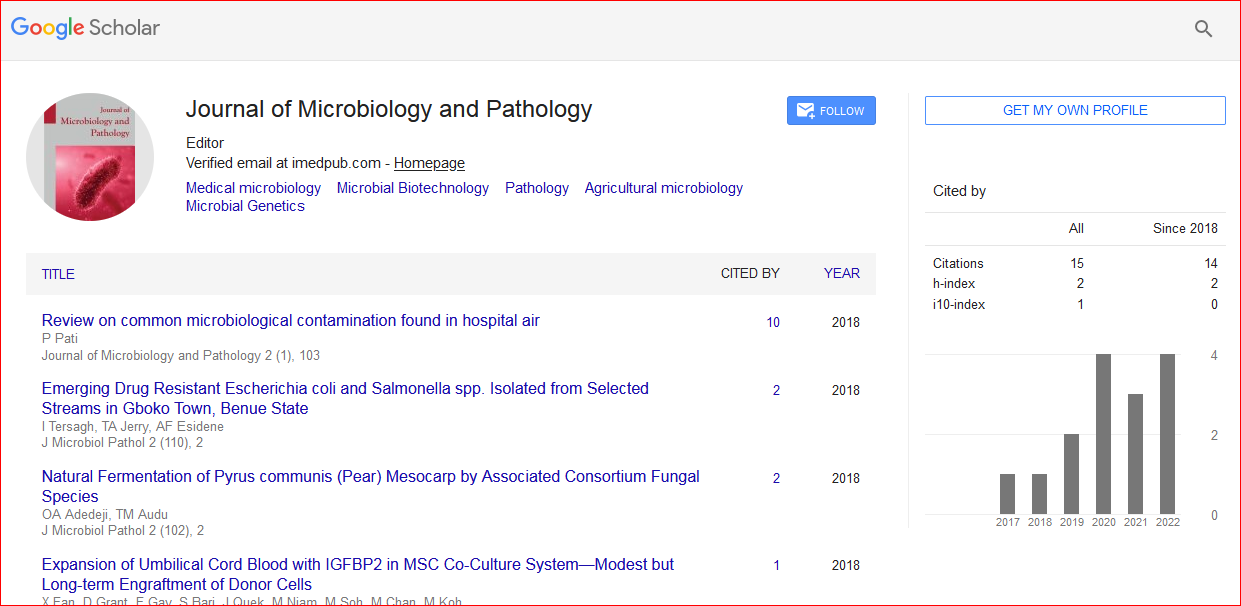
Journal of Microbiology and Pathology received 18 citations as per Google Scholar report