Brief Report - (2025) Volume 16, Issue 3
Received: 02-Jun-2025, Manuscript No. jfr-26-184100;
Editor assigned: 04-Jun-2025, Pre QC No. P-184100;
Reviewed: 18-Jun-2025, QC No. Q-184100;
Revised: 23-Jun-2025, Manuscript No. R-184100;
Published:
30-Jun-2025
, DOI: 10.37421/2157-7145.2025.16.661
Citation: Okeke, Daniel. ”Microbial Forensics: Tracing Crime
with Genetic Signatures.” J Forensic Res 16 (2025):661.
Copyright: © 2025 Okeke D. This is an open-access article distributed under the terms of the Creative Commons Attribution License, which permits unrestricted use, distribution
and reproduction in any medium, provided the original author and source are credited.
Microbial forensics represents a rapidly evolving field that leverages the unique genetic fingerprints of microorganisms to aid in criminal investigations. This discipline offers a powerful lens for tracing the origins and spread of pathogens, thereby providing critical insights in diverse legal contexts. By meticulously analyzing the genetic signatures of bacteria, viruses, and fungi, forensic microbiologists are capable of linking biological evidence found at crime scenes to specific sources, geographical locations, or even individuals involved in illicit activities.[1]
This sophisticated approach has proven invaluable in a wide array of cases, ranging from the investigation of bioterrorism incidents and the tracking of widespread foodborne illnesses to the identification of the origins of infections in biological crimes and environmental contamination cases. The continuous advancements in high-throughput sequencing technologies, coupled with sophisticated bioinformatics pipelines, have dramatically enhanced the resolution and speed at which microbial identification and phylogenetic analysis can be performed. Consequently, microbial forensics has emerged as a critical and indispensable tool within the broader forensic science arsenal, augmenting traditional investigative methods with molecular precision. [2]This scientific sub-discipline is fundamentally concerned with the application of microbiological knowledge and techniques to legal matters, often involving the identification of microbial agents as evidence. The ability to differentiate between closely related microbial strains is paramount, enabling investigators to establish precise links and causality in complex scenarios. Furthermore, the interpretation of microbial data necessitates a deep understanding of microbial ecology and evolution, as these factors can influence the genetic profiles observed. The application of microbial forensics extends beyond identifying pathogens; it can also involve the analysis of commensal microbiota to establish links or exclusions based on unique community structures. The dynamic nature of microbial populations requires careful consideration of temporal factors and potential environmental influences when interpreting forensic evidence. [3]As the field matures, standardization of methodologies and validation of analytical approaches are becoming increasingly important for ensuring the reliability and admissibility of microbial findings in judicial proceedings. The interdisciplinary nature of this field necessitates collaboration among microbiologists, geneticists, bioinformaticians, and legal experts to effectively utilize and present microbial evidence. The ongoing development of advanced analytical techniques promises to further expand the capabilities and applications of microbial forensics in the pursuit of justice. The potential for microbial forensics to provide definitive links between biological samples and their origins underscores its growing importance in modern criminal justice systems. The study of microbial communities as evidence offers a unique perspective, complementing traditional forensic disciplines by providing molecular-level insights. The integration of cutting-edge technologies is transforming how microbial evidence is collected, analyzed, and interpreted within the legal framework. [4]This burgeoning field holds significant promise for resolving complex cases and ensuring accountability through the power of microbial identification and characterization. The intricate world of microbes, often invisible to the naked eye, is increasingly becoming a crucial witness in the courtroom, revealing hidden connections and providing irrefutable data. The scientific rigor applied in this field ensures that the insights derived from microbial analysis are both reliable and defensible in legal settings, strengthening the foundation of justice. The field's commitment to innovation and validation is key to its continued growth and impact on forensic investigations worldwide. The ability to trace the lineage and geographical distribution of microbial agents through genetic analysis offers unparalleled investigative potential. This scientific discipline is essential for addressing emerging threats, from pandemics to environmental crimes, by providing a molecular basis for attribution and control. [5]Its evolution is closely tied to advancements in molecular biology and computational science, enabling ever-finer resolution in microbial profiling. The forensic microbiologist's role is thus central to deciphering the microbial narrative embedded within evidence. The inherent variability of microbial life presents both challenges and opportunities for forensic applications, demanding sophisticated analytical strategies. Microbial forensics is thus a testament to the power of molecular science in unraveling complex criminal scenarios and ensuring that scientific evidence plays a pivotal role in legal resolutions. The discipline's capacity to identify and trace microbial evidence is vital for holding perpetrators accountable and understanding the dissemination of harmful agents. It represents a significant leap forward in the application of biological sciences to the legal domain. The increasing reliance on genetic data for identification and attribution highlights the transformative impact of microbial forensics on investigative practices. The ongoing quest for more precise and reliable methods continues to drive innovation in this critical area of forensic science.[6] The robust scientific underpinnings of microbial forensics ensure its growing acceptance and utility in legal proceedings. Understanding the microbial landscape of a crime scene can provide crucial context and lead to definitive conclusions. The field is characterized by a blend of classic microbiological techniques and state-of-the-art genomic and bioinformatic approaches. The potential for microbial evidence to corroborate or refute other forms of evidence makes it a powerful investigative asset. This intricate science plays a vital role in modern criminal justice. The foundational principles of microbial forensics involve the meticulous examination of microbial DNA and RNA to establish unique identifiers. The field's impact is amplified by the increasing accessibility of advanced sequencing and analysis tools, democratizing its application. The capacity to reconstruct historical events through microbial traces is a profound aspect of this discipline. Its continued development is essential for addressing the evolving landscape of criminal activity. The power of microbial forensics lies in its ability to provide objective, molecular-level evidence that can be difficult to dispute. This science is fundamental to uncovering hidden truths and ensuring justice.[7] Its contributions are becoming increasingly indispensable in complex investigations. Microbial forensics offers a unique window into the microscopic world, revealing critical links in criminal investigations. The field's scientific integrity is paramount for its successful application in legal contexts. The continuous pursuit of knowledge and technological advancement ensures its relevance and effectiveness. Microbial forensics is a critical component of modern forensic science. Its insights can illuminate obscured aspects of criminal acts. The science promises to further refine our ability to identify and trace microbial evidence. The meticulous nature of microbial analysis provides a robust foundation for legal scrutiny. Its growing importance is a clear indicator of its value in the pursuit of justice. The field's capacity to provide objective data is invaluable.[8] Microbial forensics represents a significant advancement in investigative capabilities. It offers a powerful means of uncovering microbial trails. The science is crucial for understanding the dynamics of biological evidence. Its continued evolution is vital for keeping pace with criminal innovation. The reliability of microbial forensics is built upon rigorous scientific principles and validation processes. This discipline provides a unique perspective on criminal events through the lens of microbiology. The potential for microbial forensics to resolve challenging cases is immense. It is a field that combines deep scientific expertise with practical investigative application. The advancements in this area are continuously expanding its utility and impact on the justice system. Microbial forensics is a critical component of modern forensic science, offering a powerful means to trace the origins and spread of biological evidence.[9] The analysis of microbial genetic signatures allows for the linkage of evidence to specific sources, locations, or individuals, proving invaluable in cases ranging from bioterrorism and foodborne illnesses to identifying the source of infections in biological crimes. Advances in sequencing technologies and bioinformatics have significantly enhanced the resolution and speed of microbial identification and phylogenetic analysis, making it a critical tool in the forensic science arsenal. This discipline is essential for distinguishing between closely related strains of pathogens and establishing chains of transmission, thereby aiding law enforcement and public health agencies in pinpointing the origin of outbreaks or exposures.[1] The isolation and characterization of microbial DNA from complex forensic samples, such as soil or water, present significant challenges, underscoring the need for standardized protocols to ensure the reliability and admissibility of microbial evidence in court. Metagenomic approaches provide a culture-independent means to study entire microbial communities, offering a comprehensive overview of pathogenic strains and their potential roles in criminal activities or outbreaks. Bioinformatics tools and databases are crucial for the interpretation of microbial forensic data, requiring sophisticated computational approaches for tasks like aligning sequencing reads and constructing phylogenetic trees. Examining specific genetic markers, such as Single Nucleotide Polymorphisms (SNPs) or variable number tandem repeats (VNTRs), within pathogen genomes can further enhance the discriminatory power of microbial forensics, allowing for high-resolution distinction between closely related strains.[2] Understanding the stability and mutation rates of microbial genomes is vital for establishing temporal relationships between evidence and suspected sources, as microbial evolution inherently introduces variability that must be accounted for in data interpretation. The development of comprehensive reference microbial databases is essential for source attribution, serving as benchmarks for comparison with unknown samples and aiding in the establishment of geographical and temporal context. The effective integration of microbial forensics into broader investigations necessitates interdisciplinary collaboration among forensic microbiologists, law enforcement, and legal professionals to ensure the proper collection, analysis, and presentation of microbial evidence. The legal admissibility of microbial evidence depends on robust scientific validation and adherence to forensic standards, with expert testimony playing a crucial role in explaining complex findings to judges and juries, thereby ensuring scientific rigor and clarity in courtroom proceedings.[10]Microbial forensics provides a sophisticated method for tracing the origins and dissemination of pathogens, playing a crucial role in criminal investigations by analyzing the genetic makeup of microorganisms. This discipline allows forensic microbiologists to establish links between biological evidence, specific sources, locations, or even individuals, which is vital in cases involving bioterrorism, foodborne illnesses, and biological crimes. [1]
Significant advancements in sequencing technologies and bioinformatics have greatly improved the accuracy and speed of microbial identification and phylogenetic analysis, solidifying its position as an essential forensic tool. The application of next-generation sequencing (NGS) enables rapid and comprehensive profiling of microbial communities, which is indispensable for differentiating between closely related pathogen strains.[2] This capability is critical for source attribution in suspected biological contamination or bioterrorism incidents, as the detailed genetic information obtained from NGS can help reconstruct transmission chains and pinpoint the origin of outbreaks or exposures, thereby assisting law enforcement and public health authorities.[3] However, isolating and characterizing microbial DNA from complex forensic samples, such as soil, water, or trace evidence, presents considerable challenges. Consequently, the development of standardized protocols for sample collection, extraction, and analysis is paramount to ensure the reliability and admissibility of microbial evidence in legal proceedings.[4] This includes addressing issues such as DNA degradation, contamination, and the interpretation of mixed microbial profiles. Metagenomics offers a culture-independent approach to studying entire microbial communities within a sample, which is particularly useful in forensic investigations where pathogens may coexist with diverse microorganisms. [5]Metagenomic analysis can reveal the presence and relative abundance of pathogenic strains and their potential roles in a crime or outbreak, providing a comprehensive overview often missed by traditional methods. The interpretation of microbial forensic data heavily relies on bioinformatics tools and databases for tasks like aligning sequencing reads to reference genomes, constructing phylogenetic trees, and identifying genetic variations, necessitating sophisticated computational approaches.[6] The development of standardized bioinformatics pipelines is crucial for ensuring consistency and reproducibility in these analyses. To further enhance the discriminatory power of microbial forensics, specific genetic markers like Single Nucleotide Polymorphisms (SNPs) or variable number tandem repeats (VNTRs) within pathogen genomes can be examined. These markers offer a high level of resolution for distinguishing closely related strains, which is essential for tracing the precise origin and movement of infectious agents in criminal contexts. [7]Understanding the stability and mutation rates of microbial genomes is also important for assessing how genetic profiles change over time, which is vital for establishing the temporal relationship between microbial evidence and the suspected source or event. Forensic microbiologists must consider the inherent variability in microbial evolution when interpreting genetic data. The creation of reference microbial databases, containing well-characterized genetic profiles of known pathogens and commensal organisms, is fundamental for microbial forensics.[8] These databases act as benchmarks for comparing unknown samples, aiding in the identification of the most likely source of contamination and establishing the geographical and temporal context of a case. Finally, the integration of microbial forensics into broader forensic investigations requires interdisciplinary collaboration between microbial forensic specialists, law enforcement agencies, and legal professionals.[9] This collaboration ensures that microbial evidence is collected, analyzed, and presented effectively in court, emphasizing the importance of understanding both the limitations and strengths of microbial analysis for its successful application. The legal admissibility of microbial evidence hinges on robust scientific validation and adherence to forensic standards, with expert testimony being key to explaining complex findings to legal entities.[10]Microbial forensics uses the genetic signatures of microorganisms to aid criminal investigations by tracing origins and spread of pathogens. Advanced sequencing and bioinformatics technologies enable precise identification and phylogenetic analysis, crucial for linking evidence to sources. Next-generation sequencing (NGS) provides comprehensive microbial profiling for distinguishing strains and establishing transmission chains, aiding in outbreak investigations. However, challenges exist in isolating microbial DNA from complex samples, necessitating standardized protocols for reliable evidence. Metagenomics offers a culture-independent view of microbial communities, revealing pathogens and their roles. Bioinformatics is essential for data interpretation, requiring sophisticated computational tools. Specific genetic markers like SNPs and VNTRs enhance strain differentiation. Understanding microbial genome stability and mutation rates is vital for temporal analysis. Reference microbial databases are key for source attribution and contextualization. Interdisciplinary collaboration among scientists, law enforcement, and legal professionals is crucial for effective evidence presentation. Legal admissibility depends on scientific validation and expert testimony.
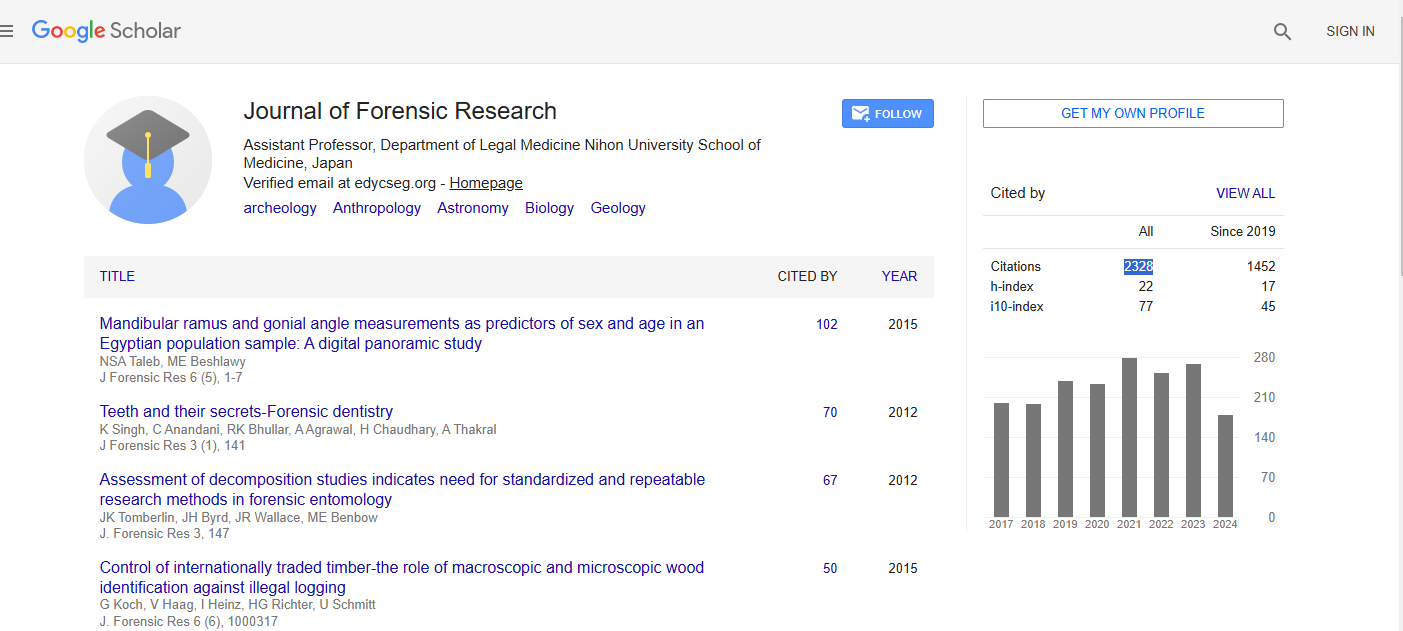
Journal of Forensic Research received 2328 citations as per Google Scholar report