Brief Report - (2025) Volume 16, Issue 2
Received: 02-Mar-2025, Manuscript No. jpm-26-179342;
Editor assigned: 04-Mar-2025, Pre QC No. P-179342;
Reviewed: 18-Mar-2025, QC No. Q-179342;
Revised: 24-Mar-2025, Manuscript No. R-179342;
Published:
31-Mar-2025
, DOI: 10.37421/2090-0902.2025.16.522
Citation: Kovács, Lina. ”Methods for Solving Nonlinear Partial Differential Equations.” J Phys Math 16 (2025):522.
Copyright: © 2025 Kovács L. This is an open-access article distributed under the terms of the Creative Commons Attribution License, which permits unrestricted use, distribution and reproduction in any medium, provided the original author and source are credited.
The field of nonlinear partial differential equations (PDEs) is fundamental to understanding complex phenomena across various scientific disciplines. These equations, due to their inherent nonlinearity, often defy straightforward analytical solutions, necessitating the development and application of sophisticated mathematical techniques. This introduction surveys recent advancements and established methodologies for tackling these challenging equations, highlighting their importance in physics and related areas. The Adomian decomposition method (ADM), variational iteration method (VIM), and homotopy perturbation method (HPM) have emerged as powerful analytical tools. These techniques provide systematic ways to obtain exact and approximate solutions for a wide range of nonlinear PDEs. Their application spans diverse areas, from fluid dynamics to quantum mechanics, underscoring their broad utility in theoretical and applied physics [1].
In plasma physics, the complexity of nonlinear PDEs necessitates specialized approaches. The unified solver method offers a novel framework for efficiently handling these equations, providing a general approach to analytical solutions. This method emphasizes its capability to integrate various analytical techniques, presenting a potent instrument for theoretical physicists working with plasma systems [2].
For phenomena exhibiting memory and hereditary properties, such as those modeled by fractional differential equations, the fractional variational iteration method (FVIM) has proven invaluable. This method is particularly adept at solving nonlinear fractional partial differential equations, offering accurate solutions with reduced computational demands compared to traditional numerical approaches [3].
Burgers-type equations, which frequently appear in fluid dynamics and other areas of physics, present unique challenges due to their nonlinearity. A novel spectral collocation method, utilizing Chebyshev polynomials and a collocation strategy, transforms these PDEs into systems of algebraic equations, enabling efficient and accurate solutions for benchmark problems [4].
Understanding the fundamental symmetries of nonlinear PDEs is crucial for simplifying them and uncovering conserved quantities. Lie symmetry analysis provides a powerful framework for this purpose. This method allows for the derivation of conserved quantities and the reduction of PDE order, potentially leading to exact solutions and deeper insights into the physical systems they describe [5].
Further refinements to established methods, such as the Adomian decomposition method, continue to enhance their effectiveness. The introduction of an auxiliary function approach (ADM-AF) aims to accelerate the convergence of decomposition series and improve the accuracy of approximate solutions, as demonstrated in applications within fluid dynamics and heat transfer [6].
The quest for exact solutions to nonlinear PDEs remains a significant area of research. The extended tanh-expansion method is a notable technique for finding exact traveling wave solutions for certain classes of these equations. This method has been successfully applied to equations relevant in nonlinear optics, revealing various solitary and snoidal wave solutions [7].
In solid mechanics, problems involving nonlinear elastic and plastic deformations often require robust numerical or analytical methods. A meshless local Petrov-Galerkin (MLPG) method offers flexibility in handling complex geometries and boundary conditions without the need for mesh generation, proving effective for these nonlinear PDE challenges [8].
Beyond specific techniques, comparative studies are vital for guiding the selection of appropriate solution methods. Research comparing different analytical and numerical methods, such as the finite difference method, ADM, and HPM, for nonlinear diffusion equations provides valuable insights into their relative accuracy, efficiency, and stability, aiding researchers in choosing the most suitable approach for specific physical problems [10].
The realm of nonlinear partial differential equations (PDEs) necessitates a diverse arsenal of analytical and numerical techniques due to their inherent complexity and the wide array of physical phenomena they represent. This section details various methodologies employed to solve these equations, highlighting their specific applications and advantages. For general nonlinear PDEs encountered in physics, including those in fluid dynamics and quantum mechanics, the Adomian decomposition method (ADM), variational iteration method (VIM), and homotopy perturbation method (HPM) offer systematic approaches to finding exact and approximate solutions. These methods are valued for their theoretical underpinnings and practical applicability, providing insights into their strengths and limitations [1].
In the specific context of plasma physics, the unified solver method has been developed to efficiently tackle nonlinear PDEs. This approach provides a general framework for obtaining analytical solutions and integrates various analytical techniques, serving as a powerful tool for theoretical physicists engaged in plasma research [2].
When dealing with fractional nonlinear PDEs, which are crucial for modeling systems with memory effects, the fractional variational iteration method (FVIM) emerges as a key technique. Its efficacy is demonstrated through case studies in fractional diffusion and wave propagation, showing its ability to yield accurate solutions with fewer computational resources compared to traditional numerical methods [3].
Nonlinear Burgers-type equations, prevalent in fluid dynamics, are effectively addressed by novel spectral collocation methods. These methods, often employing Chebyshev polynomials and a collocation strategy, transform the PDEs into systems of algebraic equations that can be solved efficiently, yielding high accuracy for benchmark problems [4].
A deeper understanding of nonlinear PDEs in theoretical physics can be achieved through Lie symmetry analysis. This powerful methodology allows for the derivation of conserved quantities and the reduction of the PDE's order, paving the way for the discovery of exact solutions and an exploration of their underlying symmetries [5].
Enhancements to existing methods, such as the Adomian decomposition method, continue to be explored. The integration of an auxiliary function approach (ADM-AF) aims to accelerate the convergence of the decomposition series and improve the accuracy of approximate solutions, as illustrated in applications related to fluid dynamics and heat transfer [6].
The pursuit of exact solutions for nonlinear PDEs is often achieved through specialized techniques like the extended tanh-expansion method. This approach is particularly effective for generating a variety of traveling wave solutions, including solitary and snoidal waves, and has been applied to equations relevant in nonlinear optics [7].
For complex problems in solid mechanics, such as nonlinear elastic and plastic deformations, meshless methods offer significant advantages. The meshless local Petrov-Galerkin (MLPG) method provides flexibility in handling intricate geometries and boundary conditions without the need for traditional mesh generation, proving its utility in solving these nonlinear PDE challenges [8].
Finally, a comprehensive understanding of the performance of different solution techniques is gained through comparative studies. Research that contrasts analytical and numerical methods, including the finite difference method, ADM, and HPM, for nonlinear diffusion equations provides crucial guidance on selecting the most appropriate method based on accuracy, efficiency, and stability requirements for specific physical problems [10].
This collection of research explores diverse analytical and numerical methods for solving nonlinear partial differential equations (PDEs). Key techniques highlighted include the Adomian decomposition method, variational iteration method, homotopy perturbation method, unified solver method, fractional variational iteration method, spectral collocation methods, Lie symmetry analysis, and meshless local Petrov-Galerkin methods. These approaches are applied to various physical domains such as fluid dynamics, plasma physics, quantum mechanics, solid mechanics, and nonlinear optics. The research emphasizes the development of methods for finding exact and approximate solutions, improving computational efficiency, and handling complex equation structures and phenomena like fractional derivatives and traveling waves. Comparative studies are also presented to guide the selection of appropriate methods for specific problems. The overarching goal is to provide robust tools for understanding and modeling complex physical systems governed by nonlinear PDEs.
None
None
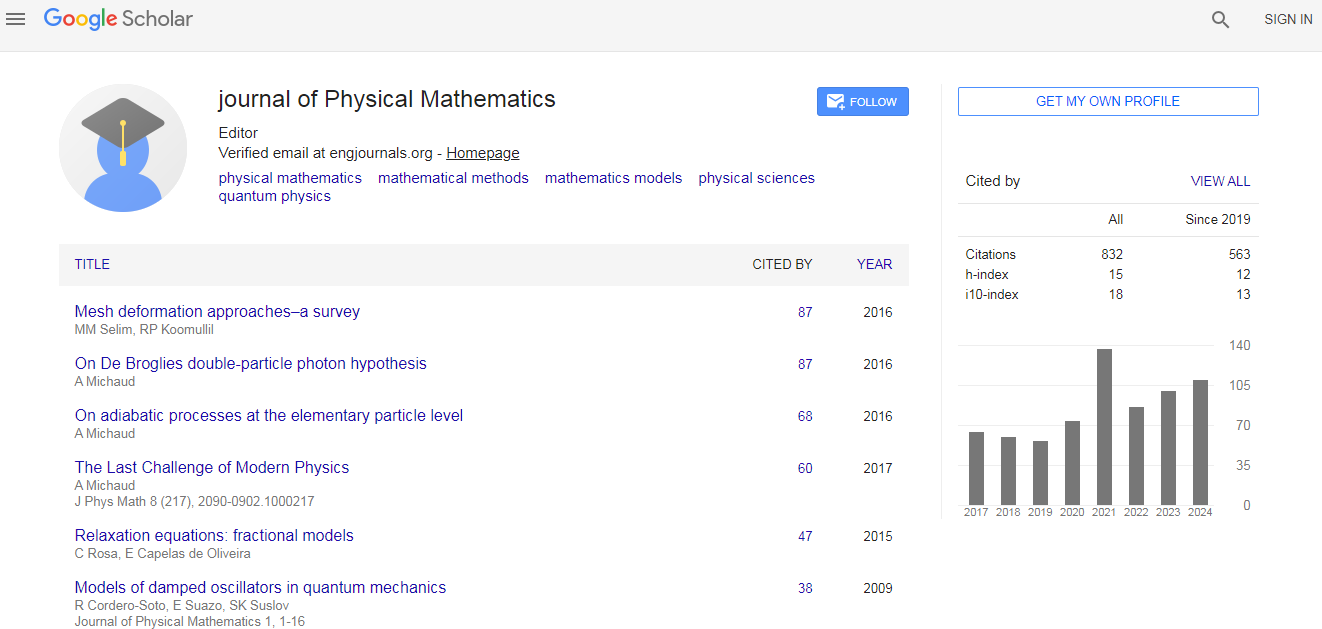
Physical Mathematics received 686 citations as per Google Scholar report