Commentary - (2025) Volume 15, Issue 4
Received: 01-Dec-2025, Manuscript No. jpdbd-25-174991;
Editor assigned: 03-Dec-2025, Pre QC No. P-174991;
Reviewed: 17-Dec-2025, QC No. Q-174991;
Revised: 22-Dec-2025, Manuscript No. R-174991;
Published:
29-Dec-2025
, DOI: 10.37421/2153-0769.2025.15.438
Citation: Lombardi, Matteo. ”Metabolomics: Transforming Disease Insights and Care.” Metabolomics 15 (2025):438.
Copyright: © 2025 L. Matteo This is an open-access article distributed under the terms of the Creative Commons Attribution License, which permits unrestricted use, distribution and reproduction in any medium, provided the original author and source are credited.
Clinical metabolomics holds real promise for better cancer care, especially for catching the disease early and tailoring treatments. By looking at specific metabolic changes, we can identify markers that tell us about cancer risk, progression, and how someone might respond to therapy. It's about moving toward more precise, individualized approaches in oncology[1].
When it comes to cardiovascular disease, metabolomics offers a crucial pathway for understanding underlying mechanisms and developing new strategies. We're talking about identifying novel biomarkers for risk assessment, disease diagnosis, and monitoring treatment effectiveness. The goal here is translating these metabolic insights into tangible clinical benefits for patients[2].
Metabolomics is making significant inroads in neurological and neuropsychiatric diseases. By analyzing changes in metabolites, researchers are uncovering potential biomarkers for conditions like Alzheimer's, Parkinson's, and depression. This work aims to improve early diagnosis, track disease progression, and even open doors for new therapeutic targets[3].
Understanding chronic kidney disease at a metabolic level is vital, and targeted metabolomics is proving to be a powerful tool. It allows for the identification of specific metabolic pathways disrupted in the disease, which could lead to better diagnostic markers, insights into disease progression, and ultimately, more effective treatment strategies to slow or halt kidney damage[4].
Metabolomics is transforming our understanding of diabetes, offering fresh insights into its complex pathology and progression. Recent work highlights how metabolic profiling can pinpoint early disease indicators, predict complications, and help customize dietary and pharmacological interventions. It's about getting ahead of the curve in managing this widespread condition[5].
When dealing with infectious diseases, metabolomics offers unique insights into the host-pathogen interaction and how infections impact a person's metabolism. This approach helps us discover biomarkers for early diagnosis, predict disease severity, and even track resistance to antibiotics. It's an essential tool for developing better diagnostic and treatment strategies against infections[6].
Clinical metabolomics is reshaping drug discovery and development. It helps us identify biomarkers that predict drug efficacy and toxicity, leading to more targeted therapies. Furthermore, metabolomics aids in drug repurposing, finding new uses for existing medications by understanding their metabolic impact. This really streamlines the path from bench to bedside[7].
Bringing metabolomics and systems biology together is a powerful step towards precision medicine. This combined approach allows for a comprehensive understanding of an individualâ??s unique metabolic profile, considering genetic and environmental factors. What this really means is tailoring medical treatments and preventive strategies to each person, moving beyond a one-size-fits-all model[8].
The gut microbiome plays a massive role in health and disease, and metabolomics is key to understanding its interactions with the host. By analyzing microbial metabolites, we can uncover how gut bacteria influence human metabolism, immunity, and even neurological functions. These insights are critical for developing interventions that target the microbiome for therapeutic benefit[9].
Biomarker discovery is a cornerstone of clinical medicine, and metabolomics is proving essential in this endeavor. While there are analytical hurdles to clear, the capacity to identify unique metabolic signatures holds immense potential for diagnosing diseases earlier, predicting outcomes, and monitoring therapeutic responses. It's about finding those subtle indicators that make a big difference[10].
Metabolomics, the study of small molecule metabolites, plays a pivotal role in advancing precision medicine. By integrating with systems biology, it provides a comprehensive understanding of an individual's unique metabolic profile, taking into account genetic and environmental factors. This means we can tailor medical treatments and preventive strategies to each person, moving beyond a one-size-fits-all model [C008]. Beyond this, biomarker discovery is a foundational aspect of clinical medicine, and metabolomics is proving to be an essential tool in this endeavor. Despite some analytical challenges, its ability to identify unique metabolic signatures offers immense potential for earlier disease diagnosis, outcome prediction, and monitoring therapeutic responses. What this really means is finding those subtle indicators that make a big difference in patient care [C010].
Here's the thing: clinical metabolomics holds significant promise for improving cancer care. It's especially useful for early disease detection and for personalizing treatments. By pinpointing specific metabolic changes, we can identify markers related to cancer risk, how the disease progresses, and how a person might react to therapy. This pushes us towards more precise, individualized approaches in oncology [C001]. Similarly, in cardiovascular disease, metabolomics offers a crucial way to understand underlying mechanisms and develop new strategies. This includes identifying novel biomarkers for risk assessment, diagnosing conditions, and tracking how well treatments work. The ultimate goal is to translate these metabolic insights into real clinical benefits for patients [C002].
Metabolomics is making considerable progress in understanding neurological and neuropsychiatric diseases. Researchers are using it to analyze changes in metabolites, uncovering potential biomarkers for conditions like Alzheimer's, Parkinson's, and depression. This work aims to improve early diagnosis, track disease progression, and even open doors for new therapeutic targets [C003]. For chronic kidney disease, understanding the condition at a metabolic level is vital. Targeted metabolomics helps identify specific metabolic pathways that are disrupted, which can lead to better diagnostic markers, insights into progression, and ultimately, more effective strategies to slow or stop kidney damage [C004]. It is also transforming our understanding of diabetes, providing fresh insights into its complex pathology. Metabolic profiling can pinpoint early disease indicators, predict complications, and help customize dietary and pharmacological interventions. It's about getting ahead of the curve in managing this widespread condition [C005].
When we look at infectious diseases, metabolomics offers unique insights into the host-pathogen interaction and how infections impact a person's metabolism. This approach helps us discover biomarkers for early diagnosis, predict disease severity, and even track resistance to antibiotics. It's an essential tool for developing better diagnostic and treatment strategies against infections [C006]. Clinical metabolomics also plays a key role in reshaping drug discovery and development. It helps identify biomarkers that predict how effective or toxic a drug might be, leading to more targeted therapies. Plus, metabolomics aids in drug repurposing, finding new uses for existing medications by understanding their metabolic impact. This really streamlines the path from bench to bedside [C007].
Here's another big area: the gut microbiome. It has a massive role in health and disease, and metabolomics is key to understanding its interactions with the host. By analyzing microbial metabolites, we can uncover how gut bacteria influence human metabolism, immunity, and even neurological functions. These insights are critical for developing interventions that target the microbiome for therapeutic benefit [C009].
Metabolomics is profoundly changing how we approach various diseases and medical fields. It offers real promise for better cancer care, helping with early detection and tailoring treatments by identifying specific metabolic changes that indicate risk and progression. This moves us towards more precise, individualized approaches in oncology. For cardiovascular disease, metabolomics provides a crucial pathway for understanding underlying mechanisms, developing new strategies, and pinpointing novel biomarkers for risk assessment and monitoring treatment effectiveness. The goal here is translating these metabolic insights into tangible clinical benefits for patients. In neurological and neuropsychiatric diseases, analyzing metabolite changes helps uncover potential biomarkers for conditions like Alzheimer's, Parkinson's, and depression, improving early diagnosis and tracking progression, which could open doors for new therapies. Understanding chronic kidney disease at a metabolic level is vital, with targeted metabolomics identifying disrupted pathways, leading to better diagnostic markers and treatment strategies. Metabolomics also transforms our understanding of diabetes, offering fresh insights into its complex pathology. Metabolic profiling can pinpoint early disease indicators, predict complications, and help customize interventions. For infectious diseases, it gives unique insights into host-pathogen interactions, helping discover biomarkers for early diagnosis, predicting severity, and tracking antibiotic resistance. This is essential for better diagnostic and treatment strategies. Clinical metabolomics reshapes drug discovery and development by identifying biomarkers for drug efficacy and toxicity, leading to more targeted therapies and aiding in drug repurposing. Combining metabolomics with systems biology is a powerful step towards precision medicine, allowing a comprehensive understanding of an individualâ??s unique metabolic profile for tailored treatments. The gut microbiome's massive role in health and disease is better understood through metabolomics, analyzing microbial metabolites to uncover their influence on human metabolism and immunity. Finally, biomarker discovery is a cornerstone of clinical medicine, and metabolomics is essential, despite analytical hurdles, for identifying unique metabolic signatures to diagnose diseases earlier and monitor therapeutic responses.
None
None
Xiaoming S, Ming-Liang Z, Fanqing M. "Metabolomics for early detection and precision medicine in cancer".Signal Transduct Target Ther 7 (2022):110.
Indexed at, Google Scholar, Crossref
Peter JM, Jennifer JS, Adam MH. "Metabolomics in cardiovascular disease: A translational roadmap".Nat Rev Cardiol 19 (2022):367-381.
Indexed at, Google Scholar, Crossref
Michael WM, Yan L, Zhiying W. "Clinical metabolomics in neurological and neuropsychiatric diseases".Neurobiol Dis 177 (2023):105990.
Indexed at, Google Scholar, Crossref
Ruijie H, Min W, Shichun L. "Targeted metabolomics of chronic kidney disease".Metabolites 12 (2022):111.
Indexed at, Google Scholar, Crossref
Haojie Z, Qianqian L, Hongliang L. "Metabolomics in diabetes: Recent advances and future perspectives".Front Pharmacol 14 (2023):1152945.
Indexed at, Google Scholar, Crossref
Guanyong M, Yu Z, Xuzhuang Y. "Metabolomics in infectious diseases: An update".Expert Rev Proteomics 19 (2022):497-511.
Indexed at, Google Scholar, Crossref
Jin-Yong W, Guang-Liang H, Ying-Zi M. "Clinical metabolomics for drug discovery and development: From biomarker discovery to drug repurposing".Chin J Nat Med 18 (2020):161-171.
Indexed at, Google Scholar, Crossref
Xiaotao Z, Wenjun C, Fengxue Z. "Metabolomics and Systems Biology for Precision Medicine".Molecules 29 (2024):651.
Indexed at, Google Scholar, Crossref
Qian Z, Yanhua L, Xiaojun X. "Metabolomics-driven insights into host-gut microbiome interactions in human health and disease".Gut Microbes 13 (2022):2110214.
Indexed at, Google Scholar, Crossref
Yiming D, Xiaotian H, Guohua Z. "Metabolomics in biomarker discovery: from analytical challenges to clinical applications".J Pharm Anal 12 (2022):541-552.
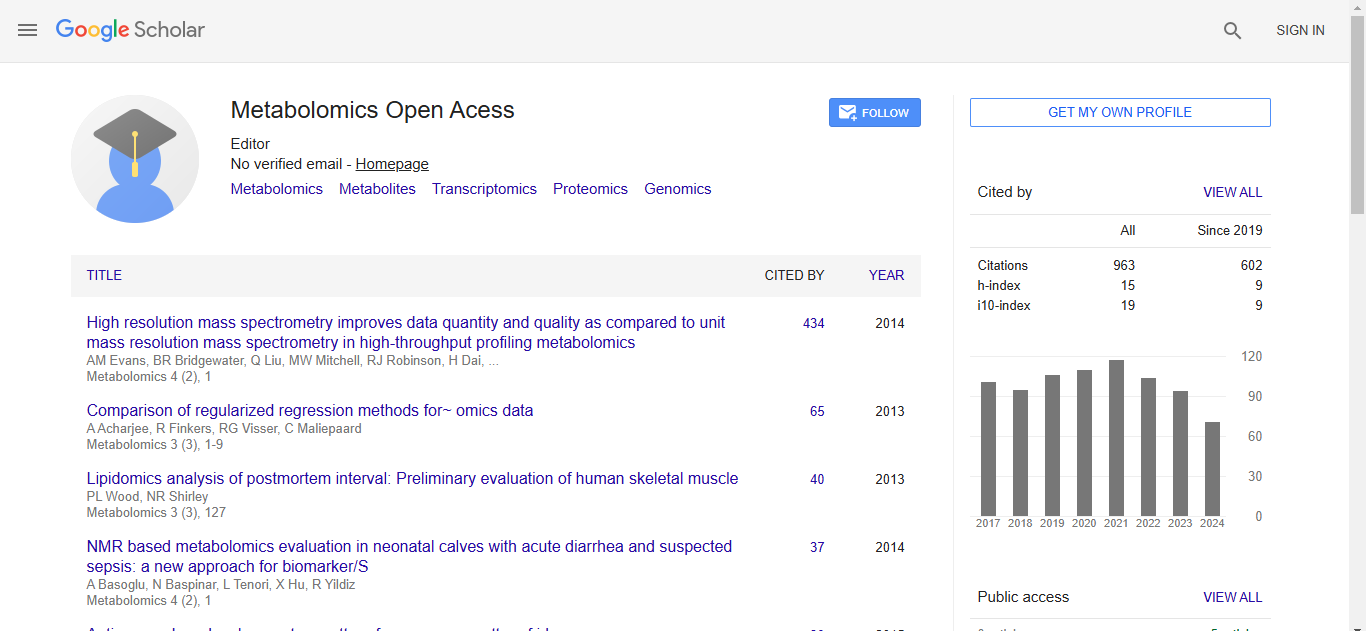
Metabolomics:Open Access received 895 citations as per Google Scholar report