Brief Report - (2025) Volume 15, Issue 3
Received: 01-Sep-2025, Manuscript No. jpdbd-25-174974;
Editor assigned: 03-Sep-2025, Pre QC No. P-174974;
Reviewed: 17-Sep-2025, QC No. Q-174974;
Revised: 22-Sep-2025, Manuscript No. R-174974;
Published:
29-Sep-2025
, DOI: 10.37421/2153-0769.2025.15.423
Citation: Hendricks, Sophia. ”Metabolite Profiling: Revolutionizing Science and Medicine.” Metabolomics 15 (2025):423.
Copyright: © 2025 Hendricks S. This is an open-access article distributed under the terms of the Creative Commons Attribution License, which permits unrestricted use, distribution and reproduction in any medium, provided the original author and source are credited.
Metabolite profiling serves as a powerful and indispensable tool for advancing precision cancer therapy. The core idea involves identifying distinct metabolic changes occurring within cancer cells. These specific metabolic signatures can then directly inform and guide the development of targeted drugs, allowing for the personalization of treatment strategies that promise more effective patient outcomes and improved therapeutic efficacy [1].
Beyond oncology, metabolite profiling has shown remarkable potential in neurodegenerative diseases. Research demonstrates its capability to distinguish between challenging conditions like Alzheimer's Disease and Frontotemporal Dementia. This is achieved by revealing unique metabolic signatures characteristic of each condition. Such insights open new avenues for earlier, more accurate diagnoses and a deeper understanding of the underlying disease mechanisms [2].
In the realm of plant science, metabolite profiling plays a crucial role in enhancing plant resilience against various abiotic stresses, such as drought or salinity. This approach involves meticulously identifying key metabolic pathways that are activated or altered during stress responses. Armed with this knowledge, scientists can develop innovative strategies to significantly improve crop survival rates and overall productivity, especially in challenging environmental conditions [3].
Understanding microbial interactions within the complex Gut Microbiota is another area where metabolite profiling excels. This methodology offers crucial insights into how different microbes communicate with each other and, critically, how they influence host health. These findings are vital, providing potential targets for developing novel therapeutic interventions aimed at modulating gut health for broader benefits [4].
The pharmaceutical industry benefits significantly from metabolite profiling in both drug discovery and development. This comprehensive review highlights its role in analyzing metabolic changes induced by potential drug candidates. Such analysis helps identify viable drug targets, accurately assess drug efficacy, and understand potential side effects much earlier in the pipeline, thereby streamlining the entire development process and reducing attrition [5].
Metabolite profiling is also revolutionizing our comprehension of Cardiovascular Disease, with a particular emphasis on conditions like atherosclerosis. Investigations using this technique demonstrate that specific metabolic signatures can act as valuable early indicators for heart-related conditions. Moreover, these unique metabolic profiles present promising therapeutic targets for intervention, offering new hope for prevention and treatment strategies [6].
A significant impact of metabolite profiling lies in its contribution to Biomarker Discovery for Precision Medicine. By meticulously uncovering unique metabolic fingerprints associated with specific diseases, this methodology actively paves the way for more accurate diagnostic tools. It also enables the development of highly personalized treatment strategies, tailoring medical care to individual patient needs for optimal outcomes [7].
Further expanding on microbial insights, metabolite profiling adeptly explores the intricate interactions between the Gut Microbiota and its host. Deciphering these complex metabolic dialogues is fundamental for truly understanding the multifaceted role of the gut microbiome. This research is crucial not only for maintaining host health but also for comprehending its contributions to disease development across various systems [8].
In the field of Environmental Toxicology, metabolite profiling proves to be an indispensable and vital tool. This comprehensive review underscores how it effectively helps in identifying exposure to environmental contaminants. Equally important, it aids in unraveling their toxic mechanisms, providing knowledge that is absolutely crucial for safeguarding public health and conducting accurate ecological risk assessments [9].
Finally, recent advancements in metabolite profiling for Clinical Diagnostics offer a current and promising perspective. This article emphasizes how continuous improvements in analytical techniques, coupled with sophisticated computational methods, are driving the integration of metabolomics into routine clinical practice. The goal is to enhance disease detection, improve prognosis, and ultimately refine patient management in healthcare settings [10].
Metabolite profiling has emerged as a versatile and indispensable analytical approach, providing profound insights into complex biological systems. It is particularly pivotal in advancing precision cancer therapy, where identifying specific metabolic changes in cancer cells can guide targeted drug development and personalize treatment strategies for more effective patient outcomes [1]. This methodology also has a significant impact on biomarker discovery for precision medicine, uncovering unique metabolic fingerprints associated with various diseases. These discoveries pave the way for more accurate diagnostics and tailored therapeutic interventions, enhancing patient care [7]. Moreover, recent advancements in analytical techniques and sophisticated computational methods are actively driving the integration of metabolomics into routine clinical practice, promising improved disease detection, prognosis, and overall patient management [10].
Beyond cancer, metabolite profiling offers critical insights into other challenging human health conditions. For instance, in neurodegenerative diseases, research demonstrates its capability to distinguish between Alzheimer's Disease and Frontotemporal Dementia. It achieves this by revealing unique metabolic signatures for each condition, suggesting new avenues for early diagnosis and a deeper understanding of disease mechanisms [2]. Similarly, the technique is revolutionizing our comprehension of Cardiovascular Disease, with a particular emphasis on atherosclerosis. Studies show how specific metabolic signatures can serve as valuable early indicators and promising therapeutic targets for heart-related conditions, offering new avenues for prevention and treatment [6].
In the pharmaceutical sector, metabolite profiling plays a crucial and significant role throughout the drug discovery and development pipeline. This comprehensive approach helps analyze metabolic changes induced by potential drug candidates, which is vital for multiple stages. It assists in identifying viable drug targets, accurately assessing drug efficacy, and understanding potential side effects much earlier in the development process. This streamlining capability significantly reduces attrition and accelerates the journey from drug concept to market [5].
The complex interplay within microbial ecosystems, particularly the Gut Microbiota, is another area where metabolite profiling excels. This method provides crucial insights into how different microbes communicate with each other and, critically, how they influence host health. These findings are instrumental in identifying potential targets for novel therapeutic interventions aimed at modulating the gut environment for broader health benefits [4]. Further, this work meticulously explores the intricate metabolic dialogues occurring between the Gut Microbiota and the host. Understanding these interactions is fundamental for deciphering the gut microbiome's multifaceted role in both maintaining host health and contributing to various disease developments [8].
Metabolite profiling extends its valuable utility to address environmental and agricultural challenges. In plant science, it is instrumental in enhancing plant resilience against abiotic stressors like drought or salinity. By identifying key metabolic pathways involved in stress responses, researchers can develop effective strategies to significantly improve crop survival rates and overall productivity, safeguarding global food security [3]. Moreover, in the critical field of environmental toxicology, this technique proves to be an indispensable tool. A comprehensive review highlights its effectiveness in identifying exposure to environmental contaminants and elucidating their toxic mechanisms, providing knowledge that is absolutely crucial for public health protection and conducting accurate ecological risk assessment [9].
Metabolite profiling is a versatile and powerful analytical approach with widespread applications across biomedical and environmental sciences. It plays a critical role in advancing precision cancer therapy by identifying specific metabolic changes in cancer cells to guide targeted drug development and personalize patient care. In neurodegenerative diseases, this technique can distinguish conditions like Alzheimer's Disease and Frontotemporal Dementia through unique metabolic signatures, providing avenues for early diagnosis. Beyond human health, metabolite profiling is essential for enhancing plant resilience against abiotic stress, identifying key metabolic pathways to improve crop survival. It also offers crucial insights into microbial interactions within the Gut Microbiota, explaining how microbes communicate and influence host health, presenting potential targets for therapeutic interventions. In the pharmaceutical sector, it streamlines drug discovery and development by analyzing metabolic changes to identify drug targets, assess efficacy, and predict side effects early. It is revolutionizing the understanding of Cardiovascular Disease, particularly atherosclerosis, by highlighting specific metabolic signatures as early indicators and therapeutic targets. This method is instrumental in biomarker discovery for precision medicine, uncovering unique metabolic fingerprints for accurate diagnostics and personalized treatment strategies. Furthermore, it reveals the intricate metabolic dialogues between Gut Microbiota and the host, crucial for understanding health and disease. In environmental toxicology, it serves as a vital tool for identifying contaminant exposure and elucidating toxic mechanisms, bolstering public health and ecological risk assessment. Recent advancements in analytical and computational methods are driving the integration of metabolite profiling into routine clinical diagnostics, promising improved disease detection and prognosis.
None
None
Ming-Liang K, Chia-Chi C, Chih-Yang W. "Metabolite Profiling for Precision Cancer Therapy".Int J Mol Sci 24 (2023):12592.
Indexed at, Google Scholar, Crossref
Marwa E, Sara MA, Reem MA. "Metabolite Profiling Reveals Distinct Metabolic Signatures in Alzheimer's Disease and Frontotemporal Dementia".Metabolites 12 (2022):812.
Indexed at, Google Scholar, Crossref
Muhammad N, Iftikhar A, Abdul W. "Metabolite Profiling for Enhancing Plant Resilience to Abiotic Stress: A Review".Molecules 29 (2024):614.
Indexed at, Google Scholar, Crossref
Kai-Wen C, Po-Ju F, Yu-Tang T. "Metabolite Profiling of Microbial Interactions in Gut Microbiota".Int J Mol Sci 24 (2023):3285.
Indexed at, Google Scholar, Crossref
Michael JM, Michael AS, Matthew PF. "Metabolite Profiling in Drug Discovery and Development".Ann Rev Anal Chem 14 (2021):173-194.
Indexed at, Google Scholar, Crossref
Yu-Hao H, Ching-Yi L, Chih-Yu C. "Metabolite Profiling in Cardiovascular Disease: A Focus on Atherosclerosis".Int J Mol Sci 21 (2020):6210.
Indexed at, Google Scholar, Crossref
Yi-Wen L, Yu-Kai L, Meng-Ru S. "Metabolite Profiling for Biomarker Discovery in Precision Medicine".Int J Mol Sci 24 (2023):4707.
Indexed at, Google Scholar, Crossref
Jing-Fu L, Po-Jen C, Chih-Lung L. "Metabolite Profiling of Gut Microbiota-Host Interactions: Implications for Health and Disease".Int J Mol Sci 23 (2022):4677.
Indexed at, Google Scholar, Crossref
Kai-Chun T, Sheng-Han T, Chien-Ting C. "Metabolite Profiling in Environmental Toxicology: A Comprehensive Review".Int J Mol Sci 22 (2021):5988.
Indexed at, Google Scholar, Crossref
Mei-Ling C, Yu-Chi L, Chih-Hung C. "Advances in Metabolite Profiling for Clinical Diagnostics: A 2024 Perspective".Metabolites 14 (2024):117.
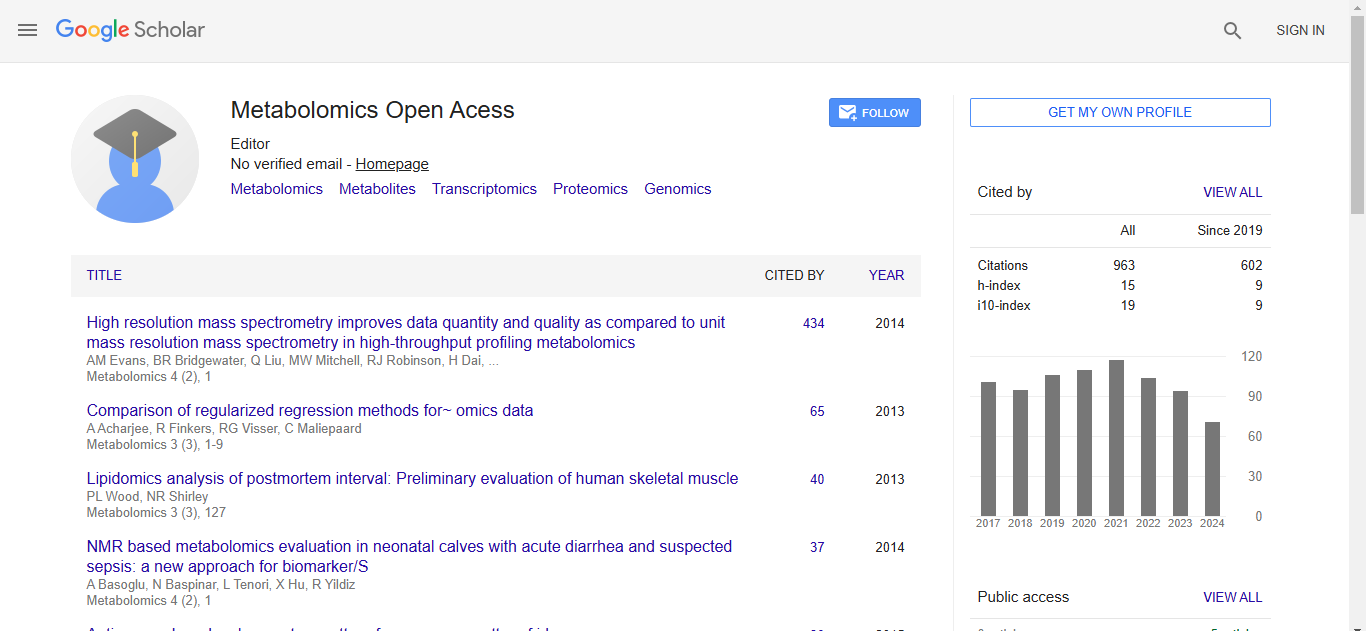
Metabolomics:Open Access received 895 citations as per Google Scholar report