Perspective - (2025) Volume 16, Issue 4
Received: 01-Jul-2025, Manuscript No. jpm-26-179436;
Editor assigned: 03-Jul-2025, Pre QC No. P-179436;
Reviewed: 17-Jul-2025, QC No. Q-179436;
Revised: 22-Jul-2025, Manuscript No. R-179436;
Published:
29-Jul-2025
, DOI: 10.37421/2090-0902.2025.16.546
Citation: Wei, Chen. ”Mathematics and Computation: Unlocking Cosmic Mysteries.” J Phys Math 16 (2025):546.
Copyright: © 2025 Wei C. This is an open-access article distributed under the terms of the Creative Commons Attribution License, which permits unrestricted use, distribution and reproduction in any medium, provided the original author and source are credited.
The study of the universe's fundamental nature and evolution has been profoundly shaped by the application of advanced mathematical and computational techniques. Early explorations into cosmic phenomena relied on foundational principles, but the complexity of observed phenomena necessitated the development of sophisticated theoretical frameworks. Differential geometry and tensor calculus have emerged as indispensable tools for modeling the intricate spacetime dynamics described by Einstein's field equations, particularly within the realm of cosmological models. These mathematical structures are crucial for comprehending phenomena such as cosmic inflation, the formation of large-scale structures, and the enigmatic nature of dark energy and dark matter. They provide the rigorous language needed to describe the curvature of spacetime and its interaction with matter and energy [1].
Spectral methods and Fourier analysis offer powerful computational approaches for solving fundamental equations governing the universe's evolution. Specifically, their application to the Boltzmann equation is vital for simulating the early universe and precisely predicting the anisotropies in the cosmic microwave background. This enables direct comparisons with observational data, pushing the boundaries of our understanding [2].
Probabilistic methods, including stochastic calculus and Fokker-Planck equations, have proven effective in modeling the diffusion and growth of structures within the universe. These techniques are particularly insightful when examining the non-linear processes that govern the formation of dark matter halos and the hierarchical assembly of cosmic structures [3].
Group theory and symmetry principles play a pivotal role in uncovering the fundamental laws of physics that underpin astrophysics and cosmology. The exploration of gauge symmetries in particle physics and symmetries inherent in general relativity highlights their utility in simplifying complex theoretical frameworks and revealing underlying universal principles [4].
Advanced numerical methods, such as finite element and finite difference techniques, are essential for tackling complex fluid dynamics problems in astrophysics. These computational approaches allow for detailed simulations of highly non-linear phenomena, including the behavior of accretion disks and the explosive dynamics of supernovae [5].
Information theory provides a unique lens through which to analyze cosmological data and refine theoretical models. Concepts like entropy and mutual information are employed to quantify uncertainty and extract meaningful insights from noisy observational datasets, thereby improving the precision of our cosmological parameters [6].
Lie algebras and differential equations are instrumental in studying the symmetries and conserved quantities within relativistic astrophysics. Their application to black hole physics and gravitational waves illuminates the behavior of extreme gravitational environments and offers deep insights into the fundamental structure of spacetime [7].
Graph theory and network analysis offer a novel perspective on the large-scale structure of the universe. By treating galaxies and dark matter halos as nodes in a vast cosmic web, researchers can explore the connectivity, evolution, and emergent properties of these structures [8].
Finally, mathematical formalisms like perturbation theory and statistical mechanics provide a rigorous foundation for describing the early universe. These methods are crucial for understanding the generation of primordial fluctuations that ultimately seeded the cosmic structures we observe today, offering a detailed account of the universe's initial conditions [9].
The scientific literature demonstrates a consistent and growing reliance on sophisticated mathematical and computational methodologies to unravel the complexities of the cosmos. This trend is evident across various subfields of astrophysics and cosmology, where theoretical models are increasingly intertwined with empirical observations through advanced analytical tools. In the domain of cosmological modeling, differential geometry and tensor calculus form the bedrock for understanding spacetime dynamics as dictated by Einstein's field equations. These mathematical frameworks are not merely descriptive but are essential for formulating predictive theories about phenomena such as cosmic inflation, the formation and evolution of large-scale structures, and the properties of elusive components like dark energy and dark matter. The ability to precisely define curvature and geodesic paths is paramount to constructing accurate cosmological scenarios [1].
For simulating the highly dynamic conditions of the early universe and the subtle fluctuations imprinted on the cosmic microwave background, spectral methods and Fourier analysis have become indispensable. Their application to the Boltzmann equation allows for high-precision computations, enabling stringent tests of cosmological models against observational data. This computational power is key to validating theoretical predictions [2].
The growth and evolution of cosmic structures, particularly dark matter halos, are phenomena characterized by complex, non-linear interactions. Stochastic calculus and Fokker-Planck equations provide the probabilistic framework necessary to model these processes effectively, offering insights into the statistical behavior of structure formation over cosmic timescales [3].
Symmetries and fundamental laws are deeply interconnected in physics. The application of group theory and the principles of symmetry in areas like gauge theories and general relativity helps to unify disparate physical phenomena and simplify complex theoretical descriptions. This approach is crucial for developing a coherent understanding of the universe's fundamental constituents and forces [4].
Astrophysical fluid dynamics presents significant computational challenges due to its inherently non-linear nature. Advanced numerical methods, including finite element and finite difference techniques, are vital for simulating phenomena such as accretion disks and supernova explosions. These methods allow researchers to explore regimes that are inaccessible through analytical means alone [5].
Information theory offers a powerful set of tools for extracting meaningful information from complex and often noisy observational data. By applying concepts such as entropy and mutual information, cosmologists can quantify uncertainty, analyze the statistical properties of large datasets, and place tighter constraints on cosmological parameters and theoretical models [6].
Relativistic astrophysics, particularly the study of black holes and gravitational waves, benefits immensely from the application of Lie algebras and differential equations. These mathematical structures are used to analyze the symmetries and conserved quantities inherent in these extreme environments, providing deep insights into the behavior of gravity and matter under extreme conditions [7].
The large-scale structure of the universe, often referred to as the cosmic web, can be effectively studied using graph theory and network analysis. This approach conceptualizes the universe as a network of interconnected nodes (galaxies and dark matter halos), allowing for the investigation of its topological properties and evolutionary pathways [8].
Understanding the very beginnings of the universe requires rigorous mathematical formalisms. Perturbation theory and statistical mechanics are employed to describe the state of the early universe and the origin of primordial fluctuations. These methods provide the necessary mathematical rigor to study the initial conditions that shaped the cosmos [9].
Moreover, the exploration of modified gravity theories often necessitates advanced mathematical frameworks beyond standard general relativity. Geometric measure theory and topology are employed to investigate the structure of spacetime in these alternative theories, seeking explanations for observed cosmological phenomena and potential resolutions to theoretical puzzles [10].
This collection of research highlights the critical role of advanced mathematical and computational techniques in modern cosmology and astrophysics. Studies explore the application of differential geometry and tensor calculus for modeling spacetime dynamics, spectral methods for simulating the early universe and cosmic microwave background anisotropies, and stochastic calculus for understanding cosmic structure formation. The use of group theory and symmetry principles aids in comprehending fundamental physical laws, while numerical methods like finite element and finite difference are vital for astrophysical fluid dynamics. Information theory is employed for data analysis, Lie algebras and differential equations for relativistic astrophysics, and graph theory for studying the large-scale cosmic web. Mathematical formalisms for the early universe and geometric measure theory for modified gravity are also discussed, collectively demonstrating the indispensable nature of these tools in advancing our understanding of the universe.
None
None
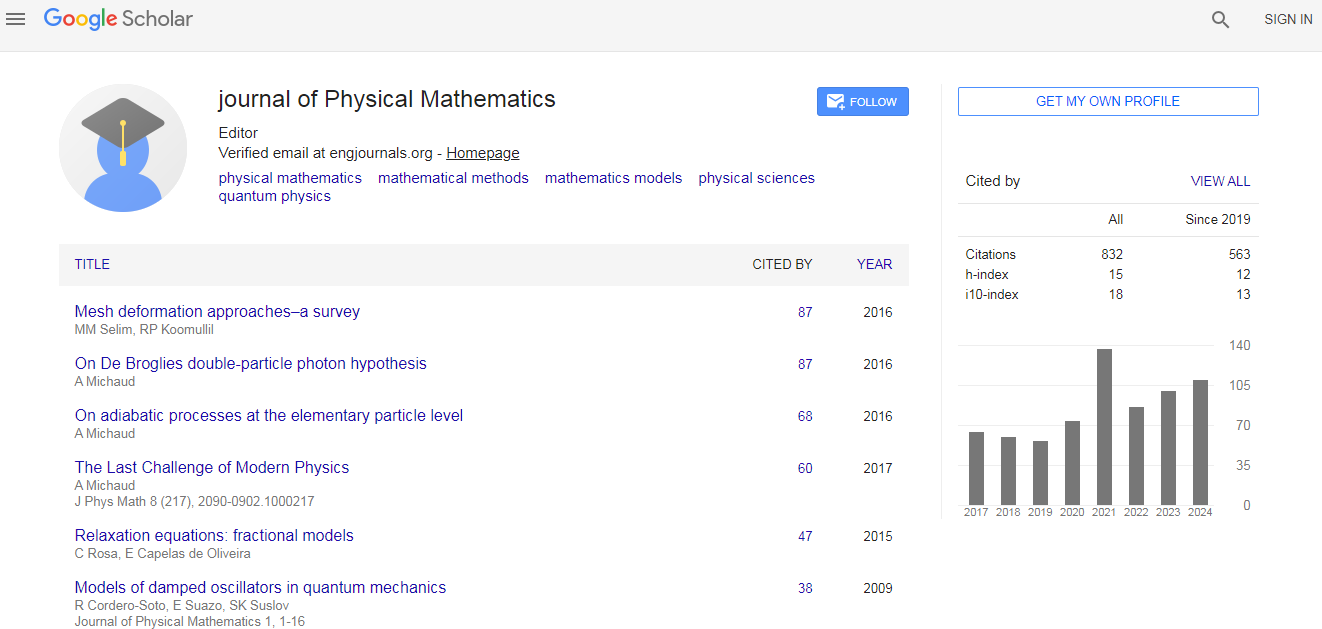
Physical Mathematics received 686 citations as per Google Scholar report