Opinion - (2025) Volume 16, Issue 4
Received: 01-Aug-2025, Manuscript No. jbmbs-26-183397;
Editor assigned: 04-Aug-2025, Pre QC No. P-183397;
Reviewed: 18-Aug-2025, QC No. Q-183397;
Revised: 22-Aug-2025, Manuscript No. R-183397;
Published:
29-Aug-2025
, DOI: 10.37421/2155-6180.2025.16.284
Citation: Nakamura, Yuki. ”Machine Learning for Disease Risk Prediction: Advancements.” J Biom Biosta 16 (2025):284.
Copyright: © 2025 Nakamura Y. This is an open-access article distributed under the terms of the Creative Commons Attribution License, which permits unrestricted use, distribution and reproduction in any medium, provided the original author and source are credited.
The burgeoning field of disease risk prediction leverages advanced computational techniques to forecast an individual's likelihood of developing specific health conditions. Statistical learning, a cornerstone of modern data analysis, offers powerful tools for identifying intricate patterns within vast datasets that may elude traditional epidemiological methods. These methods are increasingly vital for proactive healthcare, enabling earlier interventions and more personalized treatment strategies. Machine learning algorithms, such as random forests and support vector machines, have demonstrated significant efficacy in disease risk prediction. They excel at uncovering complex, non-linear relationships between various risk factors and disease outcomes, providing a more nuanced understanding of disease etiology than simpler models. The ability of these algorithms to process large volumes of data makes them particularly well-suited for the complexities of biological and health-related information. Deep learning architectures, including convolutional neural networks (CNNs) and recurrent neural networks (RNNs), represent a significant advancement in analyzing high-dimensional biological data. These models can automatically learn hierarchical representations from raw data, such as genomic sequences and medical images, which are often crucial for accurate disease prediction and diagnosis. Their capacity to discern subtle features can lead to improved diagnostic accuracy and risk stratification. Ensemble methods, which combine predictions from multiple individual models, offer enhanced accuracy and robustness in disease risk prediction. Techniques like gradient boosting and random forests, when used in an ensemble, can reduce overfitting and improve the generalization performance of predictive models. This approach is particularly valuable for building reliable risk scores that can be applied across diverse patient populations and disease types. Bayesian statistical methods provide a robust framework for disease risk prediction by inherently incorporating prior knowledge and quantifying the uncertainty associated with predictions. This is especially beneficial in scenarios with limited data or when a clear understanding of the confidence in a risk assessment is required. Bayesian networks and hierarchical models can offer deeper insights into disease mechanisms and risk factor interactions. Survival analysis techniques are fundamental to statistical learning in biostatistics, specifically for predicting the time until a disease onset or recurrence. Methods like Cox proportional hazards models are instrumental in analyzing time-to-event data, a common occurrence in clinical studies. Their application is critical for prognostic modeling and evaluating the impact of interventions on disease progression. Interpretable machine learning models are gaining traction in disease risk prediction due to the critical need for clinical adoption and trust. Techniques such as SHAP and LIME help to demystify the decision-making process of complex algorithms, allowing healthcare professionals to understand why a particular risk prediction was made. This transparency is essential for ethical implementation and for identifying potential biases. Graphical models, including Bayesian networks, are adept at representing and inferring complex probabilistic relationships between various factors contributing to disease risk. These models offer a visual and intuitive way to understand the interplay of genetic predispositions, environmental exposures, and lifestyle choices, leading to more informed risk assessments and targeted preventive strategies. Addressing the challenge of imbalanced datasets is a significant hurdle in disease risk prediction, particularly for rare diseases or events. Specialized techniques such as resampling, cost-sensitive learning, and anomaly detection are employed to ensure that predictive models are not biased against underrepresented classes. This is crucial for identifying individuals at risk of less common but potentially severe conditions. Feature engineering and selection play a pivotal role in enhancing the performance and interpretability of disease risk prediction models. By carefully crafting and selecting relevant features from diverse data sources, such as electronic health records and omics data, researchers can significantly improve the accuracy of risk stratification and provide more actionable insights for clinical decision-making. [1]
The application of statistical learning methods for predicting disease risk involves a systematic approach to analyzing complex biological and clinical data. This includes the use of sophisticated machine learning algorithms, such as random forests and support vector machines, which are capable of identifying subtle patterns and interactions within large datasets. These algorithms are instrumental in forecasting an individual's susceptibility to specific diseases by learning from historical data and known risk factors. A critical aspect of this process is the rigorous selection of relevant features and the thorough validation of predictive models to ensure their accuracy and reliability, ultimately contributing to enhanced early intervention strategies and the personalization of healthcare interventions. [1] Deep learning architectures, specifically convolutional neural networks (CNNs) and recurrent neural networks (RNNs), are being increasingly employed for disease risk assessment. Their strength lies in their ability to process high-dimensional data, such as genomic sequences and medical images, and to automatically learn intricate representations that traditional statistical methods might overlook. The implementation of these advanced models necessitates careful data preprocessing, a focus on model interpretability, and a thorough consideration of the ethical implications associated with their use in clinical decision-making processes. [2] Ensemble methods, by integrating the predictive power of multiple individual models, offer a robust approach to improving the accuracy and reliability of disease risk prediction. Techniques like gradient boosting and random forests, when applied collectively, can mitigate the weaknesses of single models, leading to more stable and trustworthy risk scores. This strategy is particularly effective in capturing complex interactions among various risk factors and demonstrates broad applicability across a wide spectrum of diseases, enhancing their utility in clinical settings. [3] Bayesian statistical methods provide a valuable framework for disease risk prediction, particularly due to their capacity to seamlessly integrate prior knowledge and quantify the uncertainty inherent in predictions. This feature is exceptionally advantageous when working with limited datasets or when a precise estimation of confidence in a risk assessment is required. Bayesian networks and hierarchical models, in particular, can illuminate disease etiology and the influence of risk factors with greater nuance, offering a more comprehensive understanding. [4] Survival analysis techniques, a foundational component of statistical learning in biostatistics, are essential for predicting the time until disease onset or recurrence. Methods such as Cox proportional hazards models and accelerated failure time models are adept at analyzing time-to-event data, which often includes censored observations. Their application is crucial for developing accurate prognostic models and for rigorously evaluating the efficacy of interventions aimed at delaying disease progression, providing critical insights into patient outcomes. [5] Interpretable machine learning models are crucial for the practical adoption of AI in disease risk prediction. Algorithms that can explain their predictions, such as those employing SHAP (SHapley Additive exPlanations) and LIME (Local Interpretable Model-agnostic Explanations), are vital. These methods allow for the understanding of individual feature contributions to a prediction, fostering trust and enabling clinicians to validate the AI's rationale, which is indispensable for ethical integration into clinical practice. [6] Graphical models, exemplified by Bayesian networks, are powerful tools for characterizing the intricate dependencies among genetic, environmental, and lifestyle factors that influence disease risk. These models offer a visual representation of probabilistic relationships, thereby enhancing the comprehension of disease pathways and facilitating more precise and targeted risk predictions. Their ability to map complex interactions makes them invaluable for understanding multifactorial diseases. [7] The challenge of imbalanced datasets is frequently encountered in disease risk prediction, particularly when dealing with rare diseases or outcomes. Various techniques, including resampling methods, cost-sensitive learning, and anomaly detection, are employed to develop models that perform effectively even with skewed data distributions. This ensures that the models are sensitive enough to identify individuals at risk, even if their condition is infrequent, preventing potential oversights in patient care. [8] Feature engineering and selection are indispensable components of statistical learning for disease risk prediction. The strategic construction and selection of features, drawing from diverse data sources like electronic health records and omics data, can dramatically boost model performance and interpretability. This process is key to achieving more accurate risk stratification and providing clinicians with clearer, actionable information. [9] Transfer learning and federated learning offer innovative solutions for disease risk prediction, especially in data-scarce or privacy-sensitive environments. Transfer learning enables the adaptation of models trained on extensive datasets for specific disease prediction tasks, while federated learning allows for model training across distributed data sources without compromising patient confidentiality. These methods are crucial for expanding the reach and applicability of predictive modeling. [10]
This collection of research highlights advancements in disease risk prediction through various statistical learning and machine learning techniques. Methods discussed include traditional statistical learning, deep learning, ensemble methods, Bayesian approaches, survival analysis, and interpretable AI. The papers address key challenges such as feature selection, data imbalance, and model interpretability, emphasizing the importance of these techniques for improving early intervention, personalized healthcare, and clinical decision-making. The goal is to enhance the accuracy, robustness, and trustworthiness of predictive models in healthcare.
None
None
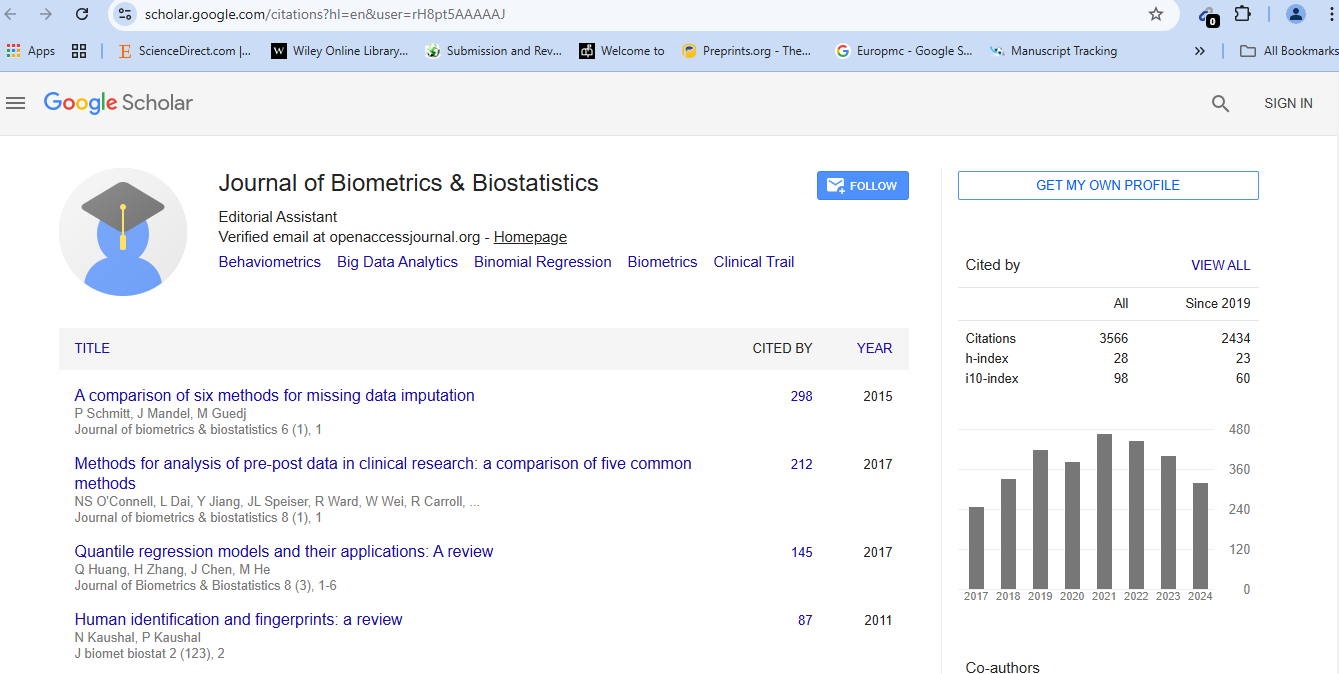
Journal of Biometrics & Biostatistics received 3496 citations as per Google Scholar report