Brief Report - (2025) Volume 16, Issue 5
Received: 01-Oct-2025, Manuscript No. jbsbe-26-183315;
Editor assigned: 03-Oct-2025, Pre QC No. P-183315;
Reviewed: 17-Oct-2025, QC No. Q-183315;
Revised: 22-Oct-2025, Manuscript No. R-183315;
Published:
29-Oct-2025
, DOI: 10.37421/2165-6210.2025.16.521
Citation: Ng, Rebecca. ”IoMT: Revolutionizing Healthcare With Biosensor Integration.” J Biosens Bioelectron 16 (2025):521.
Copyright: © 2025 Ng R. This is an open-access article distributed under the terms of the Creative Commons Attribution License, which permits unrestricted use, distribution and reproduction in any medium, provided the original author and source are credited.
The integration of biosensors with the Internet of Medical Things (IoMT) represents a paradigm shift in healthcare, enabling continuous, remote patient monitoring and paving the way for early disease detection and personalized treatment strategies. This synergy holds immense potential to revolutionize healthcare delivery by improving patient outcomes and operational efficiency [1].
The development of novel biosensor platforms is crucial for real-time detection of critical biomarkers. For instance, electrochemical biosensors are being integrated into IoMT frameworks to continuously stream data for cardiovascular disease management, allowing for timely interventions and personalized care due to their high sensitivity and low power consumption, making them suitable for wearable applications [2].
Remote patient management systems are also being advanced through IoMT integration. A notable example is the development of systems for real-time remote monitoring of blood glucose levels, addressing challenges in signal integrity, power management, and data security for reliable diabetes management [3].
The application of IoMT-integrated biosensors extends to personalized cancer therapy. These biosensors can monitor drug efficacy and patient response in real-time, facilitating dynamic adjustments to treatment regimens and addressing ethical considerations in personalized medicine [4].
However, the widespread adoption of IoMT-enabled biosensors necessitates a strong focus on security and privacy. Vulnerabilities in data transmission, storage, and access must be addressed with robust encryption and authentication mechanisms to safeguard sensitive patient information and ensure trust through standardized protocols [5].
In the realm of infectious diseases, electrochemical biosensors are proving invaluable within the IoMT context. Their rapid and sensitive detection capabilities enable swift diagnosis and containment of outbreaks, with IoMT ensuring timely dissemination of results to relevant authorities [6].
For wearable and implantable IoMT-enabled biosensors, effective power management is a critical consideration. Strategies including energy harvesting, low-power sensor designs, and efficient communication protocols are essential to ensure extended operational life and balance performance with miniaturization [7].
Neurological disorders are also benefiting from biosensor integration with IoMT. Continuous data from wearable biosensors offer valuable insights into disease progression and treatment response, aiding in proactive management and improving patient quality of life, despite challenges in signal interpretation and data integration [8].
Microfluidic-based biosensors are emerging as key components for point-of-care diagnostics, particularly when integrated with IoMT for remote data access. Their advantages in reducing sample volume and reaction time, coupled with IoMT connectivity, allow for rapid reporting of results, as demonstrated in the detection of inflammatory markers [9].
Furthermore, wearable impedance biosensors connected to IoMT platforms are enabling non-invasive monitoring of physiological parameters. These systems facilitate remote healthcare by providing cloud-based data analysis and visualization, highlighting the potential for early detection of health anomalies [10].
The critical role of integrating biosensors with the Internet of Medical Things (IoMT) for advancing healthcare is underscored by the capability for continuous, remote patient monitoring. This integration facilitates early disease detection, enables personalized treatment plans, and ultimately leads to improved patient outcomes, marking a significant evolution in healthcare delivery [1].
Innovative electrochemical biosensor platforms are being developed for the real-time detection of specific biomarkers. When integrated into an IoMT framework, these sensors allow for continuous data streaming to cloud-based analytics, which is vital for managing cardiovascular diseases through timely interventions and personalized patient care, thanks to their high sensitivity, selectivity, and low power requirements for wearable applications [2].
IoMT systems are also enhancing remote diabetes management through the integration of biosensors. The development of a robust system architecture for reliable blood glucose monitoring and alerts involves careful consideration of hardware components, communication protocols, and data processing, while also addressing signal integrity, power management, and data security challenges in real-world deployments [3].
The potential of IoMT-integrated biosensors extends to the field of oncology, specifically for personalized cancer therapy. These biosensors can provide real-time monitoring of drug efficacy and patient response, allowing for dynamic adjustments to treatment strategies and necessitating careful consideration of ethical implications within personalized medicine [4].
Addressing the security and privacy concerns inherent in IoMT-enabled biosensors is paramount. A comprehensive review highlights vulnerabilities in data transmission, storage, and access, advocating for strong encryption and authentication mechanisms to protect sensitive patient data and stressing the need for standardized security protocols for widespread adoption [5].
Within IoMT applications, electrochemical biosensors are demonstrating significant utility for the rapid detection of infectious disease markers. Their ability to provide fast and sensitive diagnostic results is crucial for swift identification and containment of outbreaks, with IoMT ensuring timely communication of findings to healthcare providers and public health agencies [6].
For IoMT-enabled biosensors, particularly those designed for wearable and implantable use, effective power management is a key challenge. Research explores various strategies, including energy harvesting techniques, optimized low-power sensor designs, and efficient communication protocols, to maximize operational longevity and balance device performance with miniaturization [7].
Continuous monitoring of neurological disorders is being facilitated by the integration of biosensors with IoMT. Wearable biosensors provide continuous data streams that offer crucial insights into disease progression and therapeutic responses, supporting proactive management and enhancing the quality of life for affected individuals, though challenges related to signal interpretation and data integration persist [8].
Microfluidic-based biosensors, when coupled with IoMT, are advancing point-of-care diagnostics. The integration facilitates remote data access, leveraging microfluidics for reduced sample volumes and faster reaction times, thus ensuring rapid reporting of results, particularly in applications like the detection of inflammatory markers [9].
Wearable impedance biosensors are being integrated with IoMT platforms for non-invasive health monitoring. These systems offer a comfortable and accurate means of tracking physiological parameters, with data analyzed via cloud infrastructure to identify health anomalies and enable remote healthcare interventions [10].
The integration of biosensors with the Internet of Medical Things (IoMT) is transforming healthcare by enabling continuous remote patient monitoring, early disease detection, and personalized treatments. Various biosensor technologies, including electrochemical and impedance-based sensors, are being developed for specific applications such as cardiovascular disease management, diabetes monitoring, cancer therapy, infectious disease detection, and neurological disorder tracking. The IoMT framework facilitates real-time data streaming, cloud-based analytics, and rapid reporting of results, leading to improved patient outcomes. However, challenges related to data security, privacy, and power management for wearable devices need to be addressed to ensure widespread adoption and the full realization of IoMT's potential in revolutionizing healthcare delivery.
None
None
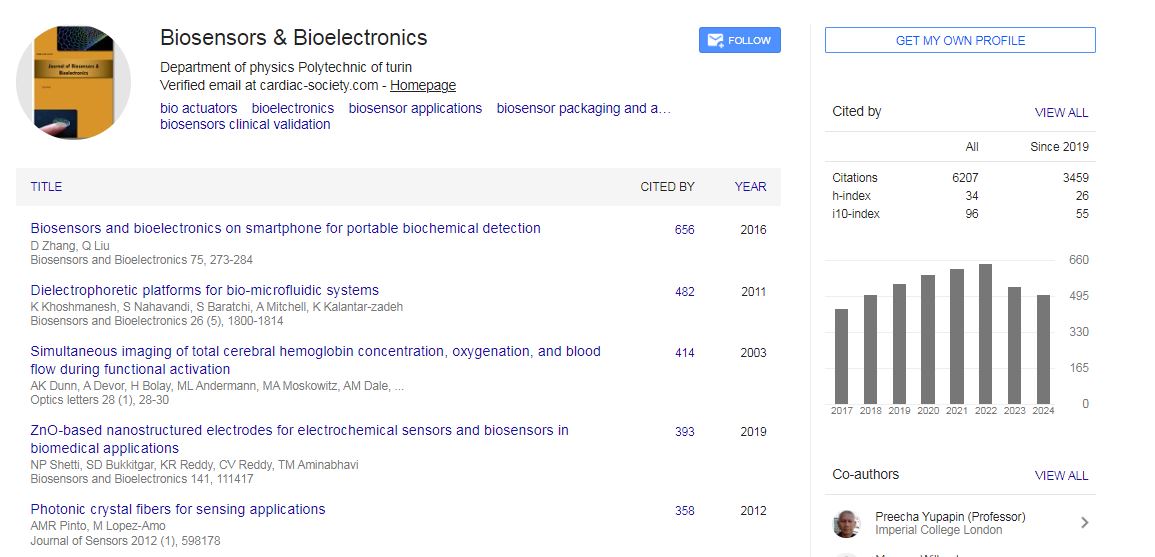
Biosensors & Bioelectronics received 6207 citations as per Google Scholar report