Short Communication - (2025) Volume 11, Issue 5
Received: 01-Oct-2025, Manuscript No. jctt-26-188431;
Editor assigned: 03-Oct-2025, Pre QC No. P-188431;
Reviewed: 17-Oct-2025, QC No. Q-188431;
Revised: 22-Oct-2025, Manuscript No. R-188431;
Published:
29-Oct-2025
, DOI: 10.37421/2471-9323.2024.10.349
Citation: Novak, Martina. ”Internal and External: A Holistic Skin and Hair Health.” J Cosmo Tricho 11 (2025):349.
Copyright: © 2025 Novak M. This is an open-access article distributed under the terms of the Creative Commons Attribution License, which permits unrestricted use, distribution and reproduction in any medium, provided the original author and source are credited.
The intricate relationship between internal health and external appearance is a growing area of scientific inquiry, with a particular focus on how various factors influence skin and hair vitality. This holistic approach to beauty is underpinned by an understanding of complex biochemical pathways and the identification of novel therapeutic targets for advancements in cosmetic and trichological applications. The interplay of nutrition, hormones, and the microbiome, for instance, has been shown to significantly impact the health and appearance of the skin and hair, suggesting that internal well-being is directly reflected externally [1].
The skin microbiome, a complex ecosystem of microorganisms residing on the skin's surface, plays a critical role in maintaining the skin's barrier function and influencing the aging process. Research has identified specific microbial strains and their metabolites that contribute to skin resilience and youthfulness, paving the way for potential probiotic and prebiotic strategies to enhance skin health through microbial modulation [2].
In the pursuit of anti-aging solutions, advanced peptide technologies have emerged as a significant area of research. These technologies focus on stimulating collagen synthesis and improving skin elasticity by utilizing novel peptide complexes. The development of targeted peptide delivery systems that enhance penetration and bioavailability is crucial for achieving visible anti-aging effects and restoring a youthful appearance to the skin [3].
Environmental factors pose significant threats to the health of hair follicles and the scalp. Investigating the impact of stressors such as UV radiation and air pollution on hair follicle stem cells is essential for understanding and mitigating hair loss. The development of protective ingredients and formulations that can combat oxidative damage and inflammation is key to promoting healthier hair growth [4].
The molecular basis of hair pigmentation and the phenomenon of graying are complex and involve intricate biochemical processes. Identifying the key enzymes and genetic factors responsible for hair color maintenance and premature graying provides valuable insights into potential interventions aimed at preserving hair color and addressing age-related changes in hair pigmentation [5].
Antioxidants play a vital role in protecting the skin from the damaging effects of photoaging and oxidative stress. A thorough review of various natural and synthetic antioxidants, their mechanisms of action, and their efficacy in cosmetic formulations is crucial for developing effective strategies to prevent skin aging induced by environmental factors [6].
Inflammation is increasingly recognized as a significant factor contributing to scalp health issues and hair growth disorders. Understanding the role of pro-inflammatory cytokines and exploring therapeutic strategies, including anti-inflammatory agents and lifestyle modifications, are essential for effectively managing conditions such as alopecia and promoting a healthy scalp environment [7].
Regenerative dermatology and trichology are being revolutionized by the application of growth factors and exosomes. These novel agents hold significant potential in stimulating cell proliferation, promoting wound healing, and facilitating hair regeneration, offering promising new avenues for treating various dermatological and hair-related conditions [8].
Sleep deprivation has a demonstrable impact on skin aging and barrier function, with underlying molecular mechanisms involving altered gene expression and reduced skin hydration. Recognizing sleep as a crucial factor in maintaining skin health underscores the importance of adequate rest for a youthful and resilient complexion [9].
Botanical extracts offer a rich source of compounds with therapeutic potential in hair care. Their antioxidant, anti-inflammatory, and hair growth-stimulating properties make them valuable ingredients for scientifically validated plant-derived formulations aimed at improving hair health and addressing common hair concerns [10].
The current scientific landscape is extensively exploring the intricate connection between internal physiological states and external aesthetic manifestations. A significant focus lies in elucidating how diverse elements, including dietary habits, hormonal fluctuations, and environmental exposures, collectively influence the vitality and appearance of both skin and hair. This holistic perspective on beauty is increasingly being informed by the identification of novel biochemical pathways and the development of innovative therapeutic targets, driving progress in cosmetic and trichological fields. The synergistic interplay between nutrition, hormonal balance, and the skin's microbiome is recognized as a fundamental determinant of overall skin and hair health, suggesting a profound bidirectional relationship where internal well-being is directly mirrored in external characteristics [1].
The complex community of microorganisms that inhabit the skin, known as the skin microbiome, plays an indispensable role in fortifying the skin's protective barrier and influencing the multifaceted process of aging. Emerging research has successfully pinpointed specific microbial strains and their associated metabolites that actively contribute to the skin's inherent resilience and youthful appearance. These findings hold significant promise for the development of targeted probiotic and prebiotic interventions, offering novel strategies to bolster and enhance overall skin health through the careful modulation of its microbial inhabitants [2].
Within the domain of anti-aging advancements, the exploration of sophisticated peptide technologies has emerged as a particularly promising avenue of investigation. These cutting-edge technologies are dedicated to optimizing the stimulation of collagen synthesis and the enhancement of skin elasticity through the strategic application of novel peptide complexes. The critical development of highly targeted peptide delivery systems, designed to significantly improve skin penetration and bioavailability, is paramount to achieving observable and impactful anti-aging outcomes and restoring a more youthful dermal presentation [3].
Environmental aggressors present a substantial and ongoing challenge to the health and integrity of hair follicles and the delicate scalp environment. Rigorous investigation into the specific effects of various environmental stressors, such as ultraviolet radiation and atmospheric pollutants, on hair follicle stem cells is indispensable for a comprehensive understanding of, and effective intervention against, hair loss. The creation of advanced protective ingredients and sophisticated formulations capable of neutralizing oxidative damage and mitigating inflammation is essential for the promotion of robust and healthy hair growth [4].
The underlying molecular mechanisms that govern hair pigmentation and the natural progression towards graying are intricate and multifaceted. The precise identification of the key enzymes and genetic determinants involved in the maintenance of hair color and the prevention of premature graying provides crucial insights. This knowledge is essential for the formulation of potential therapeutic interventions designed to preserve natural hair color and address the aesthetic concerns associated with age-related changes in hair pigmentation [5].
Antioxidants are widely recognized for their critical function in shielding the skin from the detrimental consequences of photoaging and pervasive oxidative stress. A comprehensive and systematic review of a diverse array of both natural and synthetic antioxidants, detailing their specific mechanisms of action and evaluating their demonstrated efficacy within cosmetic formulations, is imperative for the creation of effective preventive strategies against environmentally induced skin aging [6].
Inflammation is increasingly understood to be a pivotal factor contributing to a spectrum of scalp health concerns and various hair growth disorders. A thorough discussion of the role played by pro-inflammatory cytokines, coupled with the presentation of viable therapeutic strategies, including the judicious use of anti-inflammatory agents and the implementation of beneficial lifestyle modifications, is vital for the effective management of conditions such as alopecia and the overall improvement of scalp health [7].
The burgeoning fields of regenerative dermatology and trichology are experiencing a transformative influence from the application of advanced growth factors and exosomes. These innovative biological agents possess considerable potential to stimulate cellular proliferation, accelerate wound healing processes, and promote the regeneration of hair follicles. Their utilization represents a significant step forward in the development of novel therapeutic approaches for a range of dermatological and hair-related ailments [8].
The profound impact of insufficient sleep on the skin's aging process and the integrity of its barrier function is well-documented. Elucidating the intricate molecular pathways involved, including alterations in gene expression patterns and a reduction in skin hydration levels, unequivocally highlights the critical role of adequate sleep in maintaining optimal skin health and preserving a youthful complexion [9].
Botanical extracts represent a valuable and diverse resource for the development of hair care products, owing to their inherent antioxidant, anti-inflammatory, and hair growth-stimulating properties. A thorough review of scientifically validated plant-derived ingredients provides a solid foundation for their incorporation into effective cosmetic formulations aimed at enhancing overall hair health and addressing a variety of common hair concerns [10].
This collection of research explores the multifaceted aspects of skin and hair health, emphasizing the interplay between internal factors and external appearance. Key areas of investigation include the impact of nutrition, hormones, and the microbiome on skin and hair vitality, as well as the role of environmental stressors like UV radiation and pollution. The research also delves into advanced cosmetic technologies such as peptide complexes and regenerative agents like growth factors and exosomes for anti-aging and hair regeneration. Furthermore, it examines the mechanisms behind hair pigmentation and graying, the protective role of antioxidants, the influence of inflammation on scalp health, and the detrimental effects of sleep deprivation on skin aging. The potential of botanical extracts in hair care is also highlighted, underscoring a holistic approach to achieving healthy and youthful skin and hair.
None
None
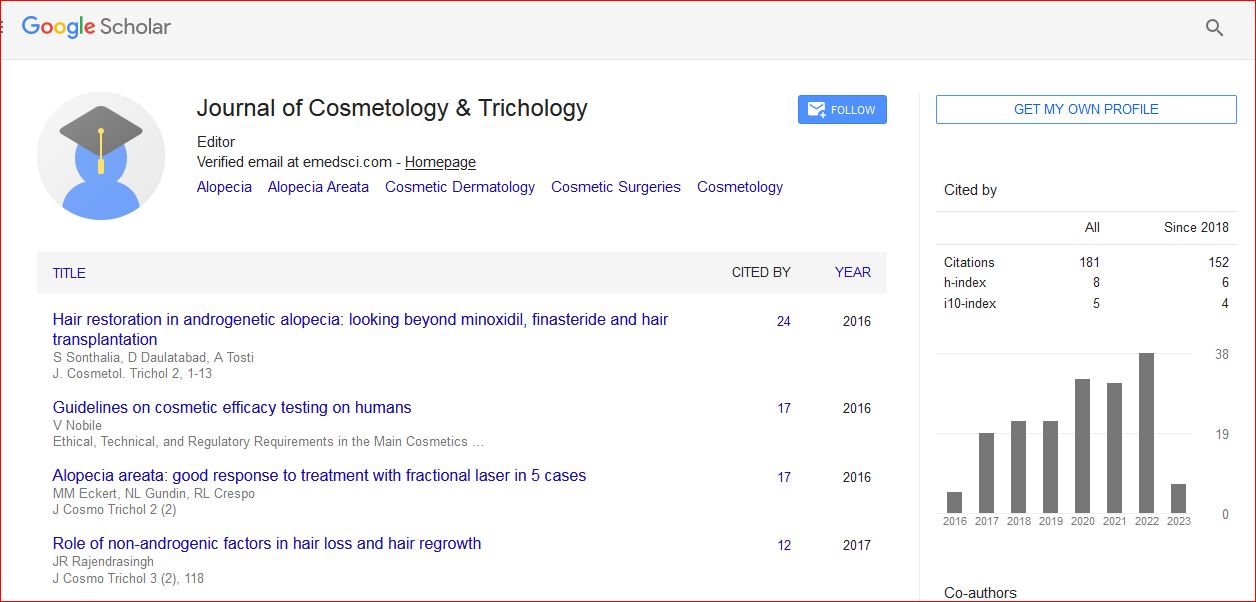
Journal of Cosmetology & Trichology received 180 citations as per Google Scholar report